Automation Capabilities

What Motionwell designs and builds in Singapore: filling machines, special purpose machines, palletizing, machine vision, lab automation, and compliance work.

Talk to an Engineer

Showing all 54 capabilities

Filling and packaging

Liquid filling is our deepest platform, split across several pages because the engineering diverges sharply by container size.

Material handling and robotics

Moving a part from where it is to where the next operation needs it. Which machine does it is settled by the shape of the layout, not by the brand of the arm.

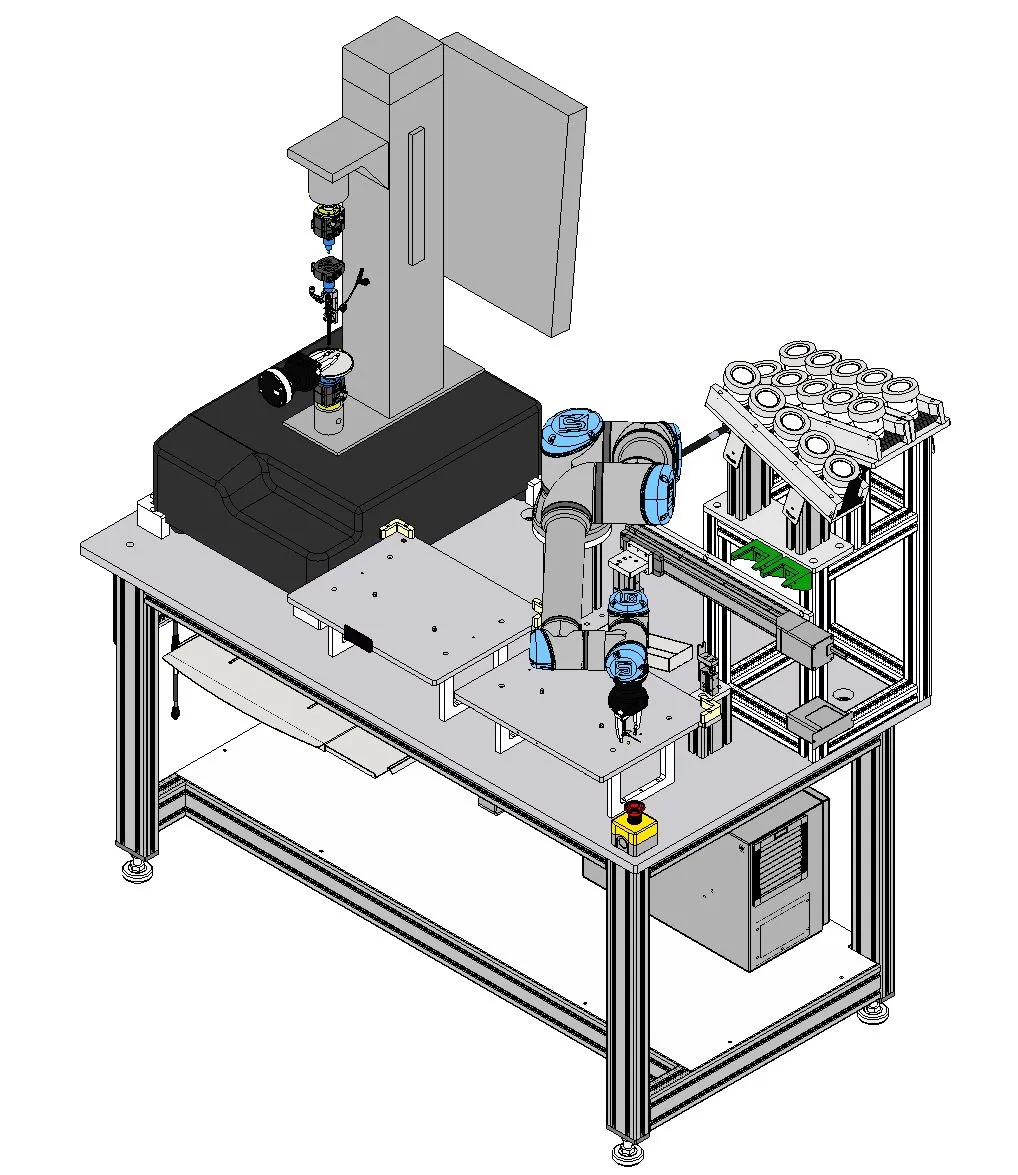
Autonomous mobile robot with a powered roller deck docked at a matching roller conveyor stand, lidar scanners at the vehicle corners and a charging contact plate set into the floor beside it AMR and AGV Integration AMR and AGV integration in Singapore: station handoff tolerance, traffic and deadlock rules, opportunity charging, WMS interfaces and fleet commissioning. Collaborative robot arm on an aluminium bench loading a small part into a bench-top test instrument with no fence around it, a teach pendant and emergency stop beside it, and an operator desk and stool immediately adjacent Cobot Applications Cobot integration in Singapore: the four collaborative modes, why tooling and workpiece set the force limit, and when a fenced industrial arm is the better buy. Two robot cells on one base for comparison: a collaborative arm working openly over a fixture table on the left, and a larger six-axis industrial arm inside a mesh fence with light curtains at the door on the right, both carrying similar vacuum tools Cobot vs Industrial Robot Cobot vs industrial robot compared on speed, payload, reach, duty cycle, guarding and whole-cell cost, including the cases where a cobot is the wrong buy. Robot end-of-arm tool on a stand: a tool plate with a quick-change coupling, an array of bellows vacuum cups, a two-finger pneumatic gripper, air tubing routed to a valve manifold, and a second interchangeable gripper on a stand alongside EOAT and Gripper Design End of arm tooling and custom gripper design in Singapore: gripper families, payload and inertia budgeting, vacuum leak paths, quick-change racks, validation. Two machine tending arrangements compared: on the left an overhead gantry beam spanning three CNC lathes in a row with a vertical Z column reaching into one, on the right a single six-axis robot on a pedestal with three machines arranged around it in an arc Gantry vs Six-Axis Gantry vs robot machine tending compared on layout geometry, orientation freedom, floor and overhead space, cost per served machine, and when a gantry is wrong. Linear gantry spanning three CNC lathes, two independent Z columns on the beam with one lowering a gripper into an open machine door while the other holds a part, and a tray of turned blanks on a stand below Machine Tending Machine tending automation built in Singapore: gantry versus arm versus cobot, door and chuck interfacing, part presentation, swarf, and unattended running. Fenced robot cell with a column-mounted arm on a linear axis carrying a multi-cup vacuum tool, an infeed conveyor of parts entering on the left, a fixture plate inside the cell and a control cabinet with HMI and stack light outside the fence Robot Integration Robot integration in Singapore: what an integrator delivers beyond the arm, how the robot brand gets decided, cell design, tooling, safety and commissioning. Automated palletizing system in Singapore placing a carton onto a pallet stack, with an infeed roller conveyor Palletizing Systems Automated palletizing and cobot palletizer systems built in Singapore: gripper choice, layer patterns, conveyor tie-in, safety. See when a cobot is wrong. Laboratory automation cell with a mobile robot carrying a collaborative arm, a sample tray rack and a tensile tester Laboratory Automation Laboratory automation for regulated QA labs: AMR sample transport, robotic instrument tending, scheduling, per-sample traceability. Four years, one lab.

Motion, transmission and structure

The axes and frames underneath everything above. These are the pages to read when the question is how a machine moves rather than what it does.

Assembly and part handling

Putting parts together and getting them presented to the station in the right orientation. Feeding is more often the bottleneck than the joining is.

Inspection and control

Putting a number or a verdict on every unit while the line runs, and keeping the record that proves it.

Storage, conveying and logistics

The transport layer between machines, and where product waits when the next station is not ready.

Control systems and engineering

The control system, the cabinet it lives in, and the software that has to be maintainable by someone who did not write it.

Retrofit and modernisation

Control system modernisation is our largest line of work this year. These pages are the decision and the method.

Equipment for specific industries

Machines whose design is driven by the environment they run in rather than by the process they perform.

Compliance and validation

The work that determines whether a finished machine can actually be used in a regulated plant.

Choosing, costing and running a project

If you are still working out what you need rather than which machine, start here.

Motionwell Automation is an automation company in Singapore that designs and builds production equipment to order. Everything below is a capability we have delivered, not a service line we are willing to try. The mechanical design, control system, programming, assembly and factory acceptance testing happen at our Woodlands Link facility, and the machines go out with the drawings, schematics, program documentation and training that let your team run them without calling us for every adjustment.

If you are comparing industrial automation companies in Singapore, the distinction that usually matters is whether the company builds machines or resells them. We build. That is why the pages below are organised by what the machine has to do rather than by which brand of robot sits inside it.

What have we actually delivered?

The specifications below are taken from equipment we have designed, built and shipped, not from a capability brochure. Where a figure is a range, it is the range across the units in that series rather than a best case.

Equipment we buildDelivered specification
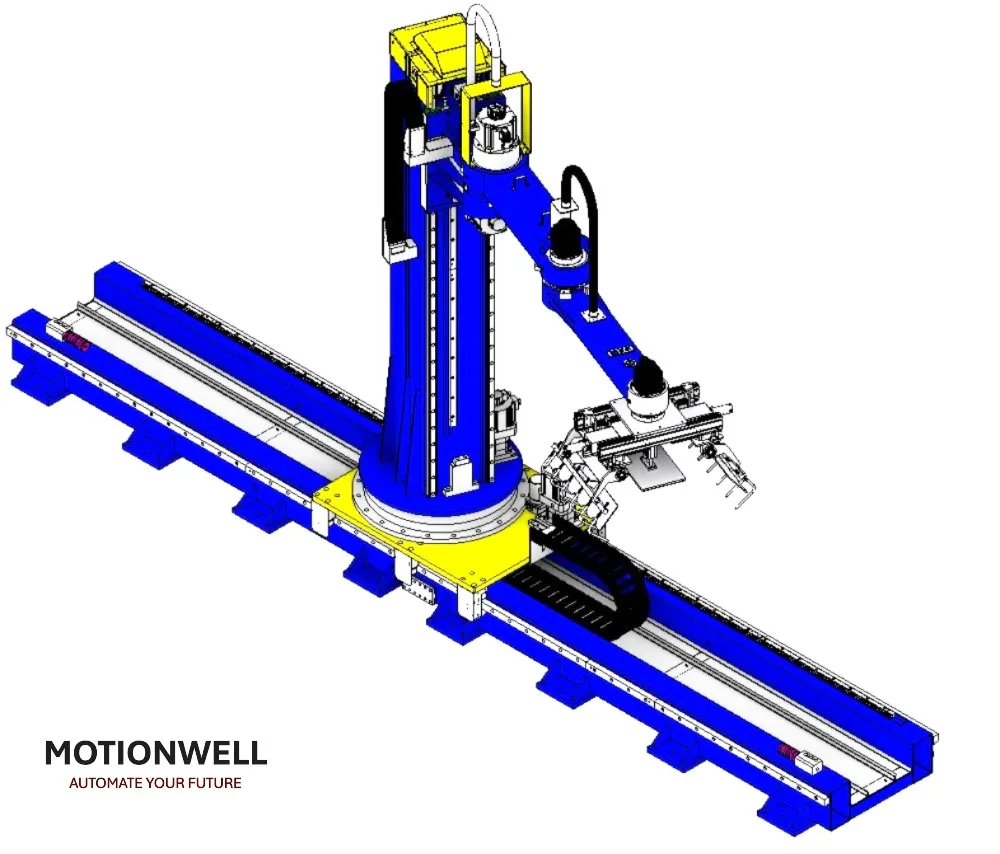
Robot 7th-axis linear track, low profile100 mm overall track height, ±0.05 mm repeat positioning, ground rack and pinion, carries ABB IRB-series six-axis arms
Heavy-duty robot trackPlatform load to 2,000 kg, rack-and-pinion drive, used to extend palletizing and machine-tending reach
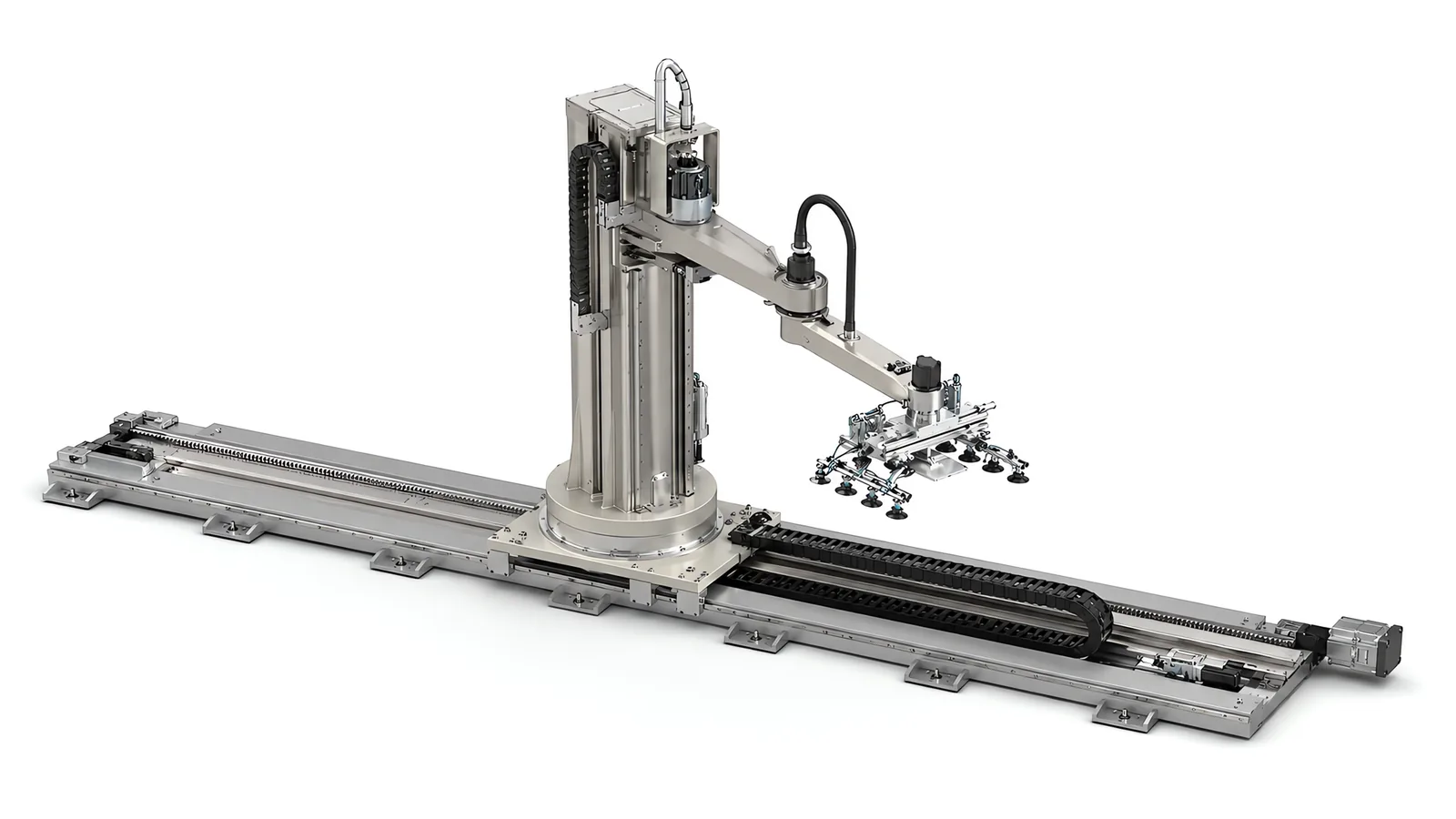
Column palletizing robot4 axes, 100-200 kg payload, ±0.1 mm repeatability, 1.5 m/s, 2-3 m working radius, ±180° base rotation
Linear gantry, aluminium frame3 axes, 5-20 kg payload, belt-driven, for light assembly and transfer
Linear gantry, steel single beam3 axes, 50-200 kg payload, X-axis stroke 10-30 m, one gantry serving 10+ CNC machines
Linear gantry, double beam200-1,000+ kg payload, spans beyond 20 m
SCARA vision-guided panel assemblyABB SCARA, ±0.01 mm repeat positioning, vacuum end effector, dome lighting, electric screwdriver station
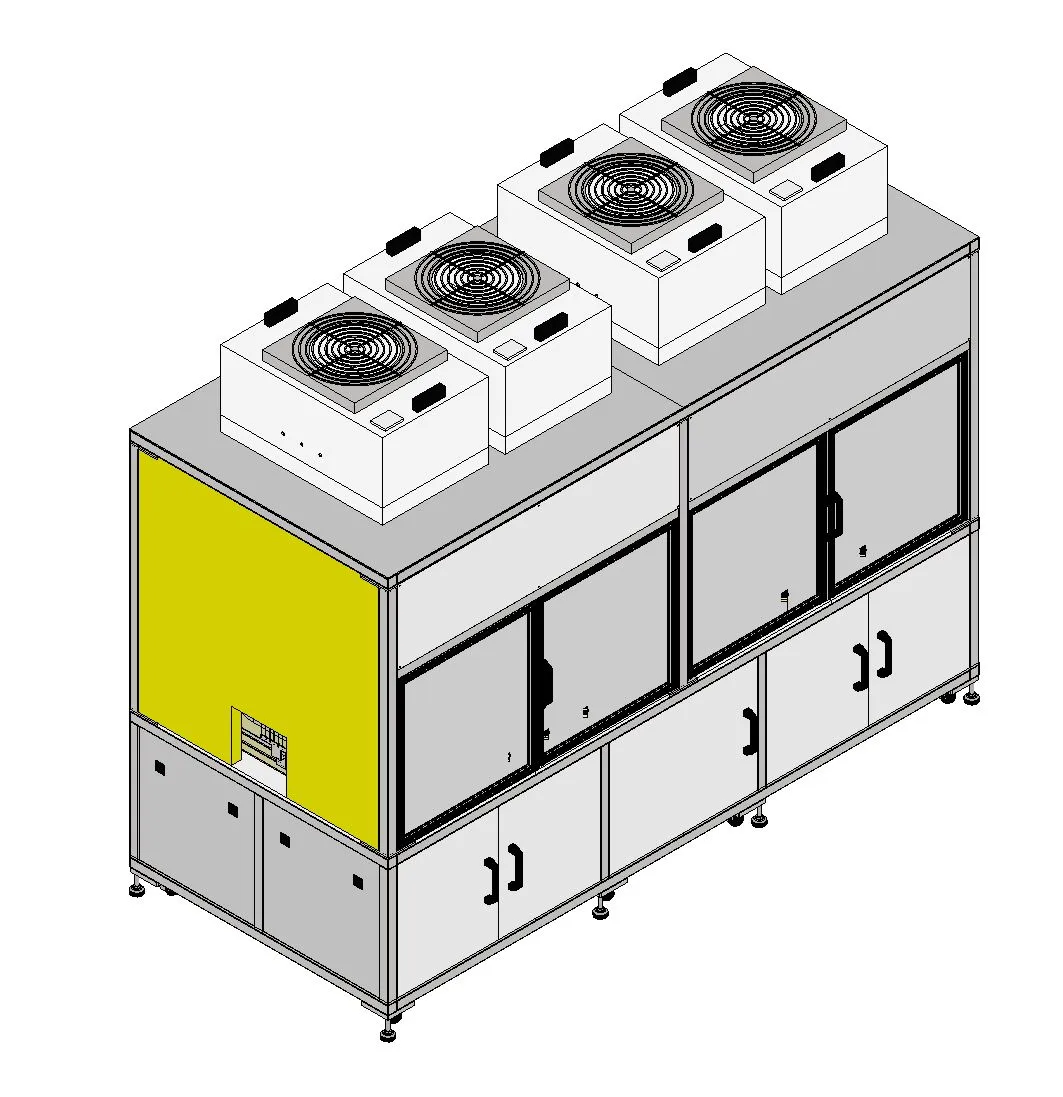
Cleanroom automated test equipment4-6 test stations, ±0.05 mm positioning, FFU filtration holding ISO Class 7/8, SPC-ready data export
5-axis CNC shot peening machineX/Y/Z/B/C simultaneous axes, 0.2-1.0 mm media, 0.3-0.6 MPa, 100-200% coverage, 2-5 minutes per turbine blade
Precision filling and sealing machine±1% volumetric accuracy, 0.5-0.7 MPa pneumatic supply, electropolished product-contact surfaces, dual infeed and outfeed turntables
Column palletizing robot on a heavy-duty rack-and-pinion linear track with a multi-cup vacuum end-of-arm tool
Column palletizing robot on a heavy-duty linear track. The 4-axis layout trades the reach flexibility of a six-axis arm for a lower cost per palletizing cycle, which is the right trade when the pattern is fixed and the duty is continuous.

Two of the entries above are our own products rather than one-off builds. The low-profile linear track exists because a conventional robot seventh axis eats 200-400 mm of vertical working height before the robot has done anything; ours is 100 mm, which keeps the arm’s usable envelope where the process needs it. The column palletizer exists for the same reason in a different dimension: a dedicated 4-axis palletizing kinematic costs meaningfully less than a six-axis arm doing the same fixed stacking pattern.

Which standards do we build to?

We do not write these documents and we do not certify against them. We design and document machines so that the people who do certify have something to work with. The editions below are the ones our current projects are designed against, each checked against the primary source named beside it.

StandardCurrent editionWhat it means for your machine
ISO 13849-1 — Safety of machinery, safety-related parts of control systems ISO 13849-1:2023 The 2023 edition is the version referenced by ISO 10218-1:2025 for robot control system safety functions. Designs still documented against the 2015 edition will need their PL calculations restated when the machine is re-assessed.Checked 1 Sep 2026 against ISO 10218-1:2025 normative references
ISO 10218-1 — Robotics, safety requirements, Part 1: industrial robots ISO 10218-1:2025 Published February 2025, the third edition and the first substantive revision since 2011. It adds robot classifications with matching functional safety requirements, safety-related cybersecurity requirements, and end-effector guidance. Most of ISO/TS 15066:2016 on collaborative operation moved into Part 2.Checked 1 Sep 2026 against ISO 10218-1:2025 (iso.org/standard/73933.html)
Regulation (EU) 2023/1230 — the EU Machinery Regulation (EU) 2023/1230 (changeover pending) Replaces Machinery Directive 2006/42/EC for machines placed on the EU market from 20 January 2027. There is no transitional period: 2006/42/EC applies up to 19 January 2027 and the Regulation applies from the next day, on the European Commission's wording 'on a mandatory basis as of 20 January 2027'. Before that date a manufacturer may declare conformity with the new Regulation voluntarily on the EU Declaration of Conformity, so a machine being built now can be documented against it early. It is also the first EU machinery law to put software integrity, updates and connected functions alongside mechanical safety, which changes what a machine builder has to document for a networked line.Checked 1 Sep 2026 against European Commission, Machinery page (single-market-economy.ec.europa.eu/sectors/mechanical-engineering/machinery_en); EU-OSHA legislation register
21 CFR Part 11 — FDA rule on electronic records and electronic signatures Current eCFR text; most recent amendment to the part dated 2 March 2023 It is the rule that decides what a PLC and HMI have to log and who is allowed to change a recipe. Part 11 applies to records a predicate rule already requires, so the first question on a machine is which records those are; everything about audit trails, time synchronisation, retention and signature binding follows from that answer rather than from the control platform.Checked 7 Sep 2026 against eCFR versioner API (ecfr.gov/api/versioner/v1/versions/title-21.json, part 11), latest section amendment_date 2023-03-02
ISA/IEC 62443 — security for industrial automation and control systems A series, not a single document; the ISA and IEC editions of each part are technically identical and released as concurrently as possible Maintained jointly by the ISA99 committee and IEC Technical Committee 65. It governs zone and conduit design the moment a machine gets a network port it did not have before, and it splits the requirements by role, so an asset owner, a system integrator and a component supplier are each answerable for a different part of the series.Checked 7 Sep 2026 against ISA, ISA/IEC 62443 Series of Standards page (isa.org/standards-and-publications/isa-standards/isa-iec-62443-series-of-standards)
ISPE GAMP 5 — a risk-based approach to compliant GxP computerised systems Second Edition, published July 2022 It sets the software category, and the category sets how much validation evidence a machine has to carry. The second edition adds the discussion of the FDA's Computer Software Assurance thinking and puts more weight on service providers, which matters when the control software on a machine is written by the machine builder rather than by the pharmaceutical company.Checked 7 Sep 2026 against ISPE, GAMP 5 Guide 2nd Edition publication page (ispe.org/publications/guidance-documents/gamp-5-guide-2nd-edition), stated publication date July 2022

Each edition above was checked against the primary source named in its row, on the date shown. Standards bodies revise on their own schedule, so confirm the edition that applies to your contract before it is signed.

Getting the edition wrong on a regulated line is expensive in a way that no other page on this site is, so this table is generated from a single register that is updated when a standard changes, rather than retyped page by page.

On the research side, Motionwell works with A*STAR’s Advanced Remanufacturing and Technology Centre, where the force-controlled robotic grinding and colour-vision paint-removal work in our aerospace pages was developed.

What is not on this list?

Work we have not delivered does not get a page. If you need a process we have not built before, we will tell you during concept review rather than after you have paid for a design. Two areas we routinely decline: production welding cells, and anything where the honest answer is that a catalogue machine from a distributor will serve you better and cheaper.

For the reasoning behind a custom build in the first place — when it beats modifying standard equipment, what drives cost, and how long it takes — start with the special purpose machine design guide.

Which industries do these capabilities serve?

The same engineering shows up differently depending on the regulatory environment and what a defect costs. The industries section covers eight of them: medical devices, electronics and semiconductor, pharmaceutical packaging, aerospace and precision, warehouse and intralogistics, QA laboratories, EV battery, and consumer products.

Next step: Tell us the process, the part, and the rate you need. We will tell you which of the above applies, and whether a standard machine would serve you better.

Frequently Asked Questions

What kind of automation company is Motionwell?

Motionwell is a machine builder and system integrator based in Singapore. We design and build production equipment to order rather than selling a catalogue: the mechanical design, control system, software and documentation for one machine or one line, built and tested at our Woodlands Link facility before it ships. We are not a distributor reselling someone else's machines, and we are not a consultancy that stops at a drawing.

Do you take on a single machine, or only whole lines?

Both. A large share of our work is one machine that fills a specific gap in an existing line, which is usually the cheapest place to start. Whole lines and turnkey cells are the other half. What we do not do is quote a line when a single station would solve the problem, and we will say so during concept review.

Which capability page should I start from?

Start from the process you need done rather than the equipment class. If you know the product and the container, the filling pages are the fastest route. If you know the process but not the machine, the special purpose machine design guide covers how a custom build is scoped, costed and commissioned. If the constraint is regulatory rather than mechanical, start from the compliance pages.

Not sure which of these your line needs?

Tell us the process, the part, and the rate. We will tell you which applies, and whether a standard machine would serve you better.