
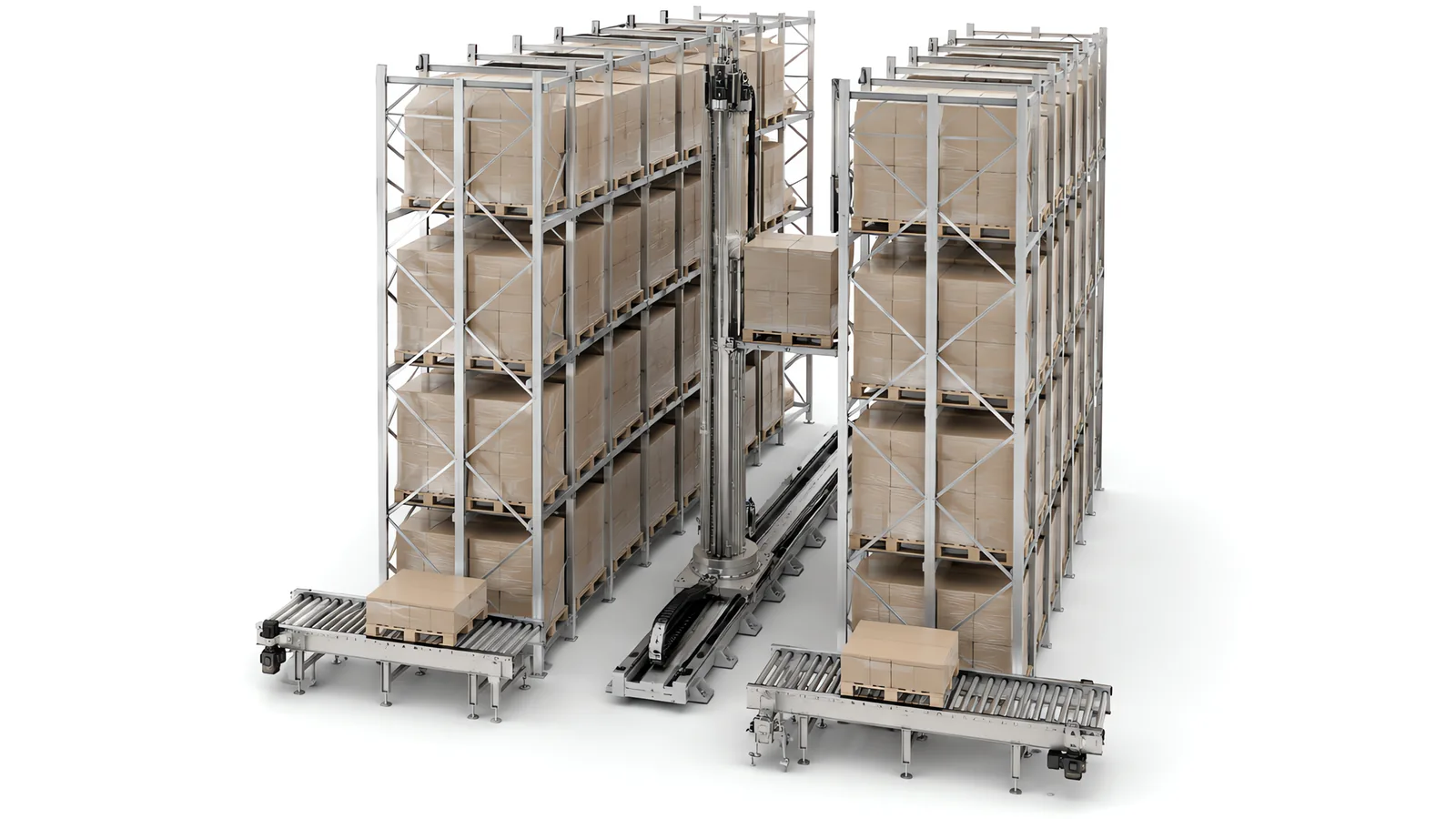
Motionwell Automation integrates ASRS and automated storage and retrieval systems in Singapore. This guide compares storage architectures by load type, building height, stock profile and sustained throughput, then explains the conveyors, controls and robot interfaces we build around the store.
Palletizing robots work to an ASRS retrieval sequence on medical consumables, so the cell takes its build order from the retrieval sequence. A storage and retrieval crane is sequenced by its own PLC and reports to a fleet management server over industrial Ethernet, with the interlocks held below that link: losing the server stops the crane. RFID-guided AGV pallet transfer runs between storage and the docks, charging automatically on the routes.
The warehouse management logic was written natively in the cell PLC. That is the right answer for one store, and the wrong one the moment a second building has to see the same stock. Machines are designed, assembled and tested at our Woodlands Link facility, and the company has delivered more than 150 special purpose machines since 2014 under ISO 9001:2015 and bizSAFE Level 3.
On the storage work delivered so far, the rack and the crane came from the storage vendor and the scope on our side was everything that touches them: the interface equipment, the controls, the stock-record interfaces, the safety scope and the recovery behaviour. The project where a vehicle fleet was put around an existing storage system is written up as an AGV fleet and storage integration case study, and the wider material-flow scope sits on the warehouse and intralogistics automation page.
What Is an ASRS Actually For?
An ASRS is selected for storage density, inventory control and the transactions it can sustain across a shift. Its value is measured across that complete duty, not just the travel time of one pallet.
Density is cubic. A crane works an aisle narrow enough that no truck could turn in it, and reaches a height no reach truck can service, so the same footprint holds considerably more than a wide-aisle layout does. Where floor area is the expensive thing, the only cheap direction is up, and the machine is what makes up usable.
Control is the half that gets undersold. Every deposit and every retrieval is a transaction the system records, so a location stops being a matter of somebody’s memory or a label that was meant to be updated. First-in-first-out becomes a rule the machine enforces, so no shift has to remember it, and stock accuracy stops depending on how busy the afternoon was.
A short, floor-level move may be quicker with a pallet truck. An automated store earns its place when it sustains the required moves across the full rack height and shift pattern while maintaining location records. Compare square metres used, stock accuracy and measured transactions per hour for the actual load mix.
Three numbers settle the shortlist before any of the detail below matters: how many distinct SKUs you hold, how many transactions per hour you need, and what the clear height is under the lowest thing already hanging in your building. Everything that follows is those three questions in more detail.
Which Storage Type Suits Your SKU Count, Rate and Building?
Five families, and they are not variants of one another. Each was designed around a different unit load and a different rate ceiling.
| System type | What it holds | What sets its throughput | Height it wants | Where it stops making sense |
|---|---|---|---|---|
| Unit load stacker crane | Full pallets, one machine per aisle | The machine, fixed per aisle | The full clear height of the building, which is the point of it | A low building, or a peak needing more transactions per aisle than one machine can pair |
| Mini load crane | Totes, trays and cartons | The machine plus the pick or feed station it serves | Tall relative to its footprint, below unit load height | Full pallets, and anything that has to arrive on one |
| Shuttle system | Totes or pallets, worked by vehicles on the levels | Vehicle count and the lifts at the aisle end, so rate is bought by vehicle | Level pitch decides more than total height | A store that needs capacity more than transactions |
| Vertical lift module | Trays of small parts in an enclosed cabinet | The person standing at the access window | A room’s height; it fits where a crane cannot go | Pallets, and any rate that outruns one operator |
| Carousel | Small parts brought to a fixed picking position | The picker, and how many units one picker works | Low, and it sits inside space you already have | Large SKU counts, and loads a person should not be lifting |
Two lines through that table decide most shortlists. The first is whether you store what arrives on a pallet: everything below the top row is a different unit load, and no amount of specification turns one into the other. The second is whether throughput is fixed or bought. A crane’s rate is a property of the machine and there is one of them per aisle. A shuttle system’s rate is a function of how many vehicles you put in it, which is a different financial shape for a business whose transactions grow faster than its stock.
The bottom two rows share a property the top three do not. A vertical lift module and a carousel are person-facing machines: their job is presentation, so the rate ceiling is the operator at the window and adding machines does not raise it. That makes them the right answer for a stockroom or a line-side buffer and the wrong answer for a dock.
Why Do Building Height and Floor Flatness Decide the System Before Any Vendor Does?
Because they are the two constraints no supplier can quote around, and both are cheap to measure and expensive to discover.
Your usable height is not the ridge. Subtract the lowest sprinkler head, duct, cable tray and light fitting anywhere along the run. Subtract the clearance your fire strategy demands above the top load. Subtract the machine’s own run-off above the top storage level. Divide what is left by the load height you genuinely store, pallet and overhang included, and that quotient is your number of levels. No brochure figure replaces it. Two secondary constraints follow immediately: rack and mast sections have to enter the building through a real door, and be erected inside it, which needs headroom of its own during installation.
The floor is the other one. A rail is fixed to the slab, the rack is fixed to both, and a mast turns a small error at the base into a large one at the top pick, because the error is amplified by the height it is carried through. Level and flatness are therefore survey deliverables, and they are set as one continuous run across the aisle. Measuring foot by foot hides exactly the error the crane will find. Underneath that sits a structural question people skip: a rack puts concentrated loads through a grid of baseplates into a slab that was designed for distributed load and forklift wheels. A floor that is fine for a reach truck is not automatically fine for a structure carrying the building’s stock through steel feet.
| Site input | What it decides | When it bites if nobody measures it |
|---|---|---|
| Clear height under the lowest service | Level count, and therefore whether the density case exists at all | On a concept drawing that assumed ridge height |
| Floor level and flatness along the aisle run | Whether the rail is shimmed, the slab is ground, or the design follows the floor | At installation, which is the worst time to find out |
| Slab capacity under a baseplate grid | Whether the floor takes the rack, or takes it after remediation | After the equipment order, as a construction variation |
| Door size and the access route in | Whether sections and mast can be delivered and erected at all | On the delivery date |
| Column grid inside the building | Where aisles can land, which sets aisle count and therefore rate | When the layout is finally drawn over the survey |
How Does the Store Join the Rest of the Plant?
The store is rarely the difficult part of the project. The two interfaces are, and they are where our scope lives.
On the way in, everything that enters an aisle has to sit inside the profile envelope the machine was designed for: height, overhang on all four sides, weight, a pallet in usable condition, film that is not trailing. The place to establish that is a profile and weight check on the entry conveyor, because the alternative is establishing it inside the aisle. A pallet stopped at the entry is a handling problem someone solves standing on the floor. The same pallet discovered by the rack is a recovery problem at height.
On the way out, retrieval hands to whatever moves goods next: a vehicle, a forklift, a pick station, or a robot cell. That last one is delivered work here: palletizing robots sequenced against the retrieval order, barcode verification confirming what went onto the pallet, and one heavy-duty linear track letting a single arm serve several palletizing stations. The cell-side detail is on our automated palletizing systems page and the verification loop on our code reading and traceability page. Where the next leg is a mobile robot, the docking tolerance and traffic questions belong to the vehicle project and are covered on our AMR and AGV integration page.
There is a rate-shape problem between the two ends that catches people out. A store transacts smoothly and a dock does not: a truck arrives as a block of pallets and leaves as one, while the machine does one paired trip at a time. Buffer conveyor length is the decision that determines whether the machine waits for the dock or the dock waits for the machine, and it is far cheaper to add at layout stage than to retrofit into a commissioned line.
| Interface | The mechanical question | The control question | Who normally owns it |
|---|---|---|---|
| Infeed conveyor and profile check | Squaring, gapping, weighing, and where a rejected pallet goes | Pass, fail, and the reject route | Motionwell |
| Store entry handshake | Height and speed match at the transfer point | Location assigned, pallet present, profile passed, machine ready, fault | Shared, and agreed in writing |
| Retrieval to outfeed | Transfer type, accumulation, and staging length | Order sequence, and confirmation the load actually left | Motionwell |
| Transfer to a vehicle or a truck | Matched deck height and speed, or fork access | Who calls, who confirms, and what happens on a timeout | Station ours, vehicle the fleet vendor’s |
| Stock record update | None | Which system writes, and when it is allowed to | Shared with whoever owns the record |
Every one of those rows is a place where two suppliers can each assume the other owned it, which is why the signal list belongs in the specification, and commissioning is too late to write it. How to write one that a vendor can be held to is on our page about writing an automation URS.
When retrieval serves a goods-to-person workstation, compare completed order lines with container presentations. Replenishment and picking may share storage or transport resources, so include both in the same peak-demand trial.
Why Is a Wrong Inventory Record Worse Than Open Shelves?
Because on a shelf there is something to look at. A wrong record on conventional racking is corrected by a person walking the aisle and using their eyes. In a dense rack the location is a row in a database and the load sits up a rack nobody can walk into, so stock the system has mislabelled is not misplaced, it is lost, and it stays lost until somebody empties the aisle to find it.
That is why the inventory model is the system you are actually buying. Four decisions carry it.
The first is one master record. Decide whether your ERP, a warehouse management system or the storage controller holds the authoritative version, and make everything else a copy that reads from it. Two masters is the classic failure, and it shows up as a slow drift that nobody can trace to the moment it started.
The second is one physical move, one record, confirmed. A deposit writes its record when a sensor says the location is occupied. A retrieval closes when the load is confirmed clear of the rack. Anything else is a record of what was meant to happen.
The third is identity verified at the door. Read the label at the entry station and compare it with what the system expects to store. That is a cheap read, and the entry is the cheapest point at which the physical and the digital can be reconciled, because nothing already stored has to be moved to do it.
The fourth is counting designed as a machine task. You cannot count a dense rack by walking it, so cycle counting becomes a sequence of retrieve, present, verify and return, and it consumes throughput you have already sold to production. Budget it in the rate calculation, before the first stock take finds it for you.
Exceptions are the fifth thing and they are what actually break databases: an unreadable label, a location the system believes is occupied and is not, a load that fails profile after it was already booked in, and a transaction interrupted halfway. Each needs a defined state and a route out of it that an operator can take at three in the morning. Undefined exception states are how a record drifts from the rack.
One boundary on our side of this. Storage logic written natively in a PLC suits a machine: it works at 70 sample positions across 7 racks with every state transition timestamped, and it stops being the right answer well below the size of a warehouse. Where you already run a validated system, the interface is the deliverable and the validated system stays as it is, and that division of work is set out on our PLC programming services page.
How Do You Work Out Throughput in Dual-Command Cycles?
You do not get it from a moves-per-hour figure on a datasheet, because that figure is quoted on the cycle you may not be able to run.
A single-command cycle carries one transaction: the machine goes out loaded and comes back empty, or goes out empty and comes back loaded. A dual-command cycle carries two: it takes a put-away out, deposits it, travels across to the retrieval location, picks up and returns loaded. The trip is a little longer than a single-command trip and much shorter than two of them, which is the whole of the arithmetic advantage.
So the real question is not how fast the machine travels. It is what fraction of your trips can be paired, and pairing needs a put-away waiting at the moment a retrieval falls due. A site that receives all morning and ships all afternoon pairs almost nothing, and will get close to single-command throughput from equipment quoted on dual-command figures. That mismatch is worth finding in a spreadsheet, while it is still cheap to fix.
Work it per aisle, at the peak hour, in this order.
- Time the four components separately: travel to the location, transfer in, travel between locations, transfer out. The transfer is a fixed cost per transaction regardless of trip length, and on a short aisle it can be the larger half of the cycle.
- Model the mean cycle over your own rack geometry, single command and dual command, never a corner-to-corner worst case that will never be typical.
- Split the peak hour into transactions that can be paired and transactions that cannot, using your own order profile.
- Add them up: paired trips counted twice, unpaired trips counted once, per aisle.
- Take availability off, then multiply by aisles, and compare the result with peak-hour demand. A daily total divided by hours hides the peak.
Two consequences follow that are easy to miss. On a short aisle the machine may never reach its rated speed at all, so a higher rated speed buys less than the specification implies and the transfer mechanism buys more. And capacity comes in whole aisles, because you cannot buy half a machine, so the storage capacity you need and the transaction rate you need almost never land on the same aisle count. Whichever is larger governs the design, and knowing which one governs tells you whether you are buying storage or buying transactions. The money that sits on top of those numbers is worked through in our warehouse automation ROI note.
What Has to Be Designed for the Day It Stops?
Recovery in a dense rack is slow. How slow is a design decision, and it is made months before the first fault.
Where a stranded load can be set down. A pallet half onto a fork at height has to go somewhere before anyone can work on anything, and if the design has no answer for that, the answer becomes a forklift, a scaffold and a long afternoon.
How the machine moves without its normal control. An inching or hand mode under a written safe procedure, a defined park position, and a means of lowering a load with the drive dead. Ask what each of those looks like on the specific machine, because the answers differ.
How one aisle is isolated while the rest keeps running. This is a control-system feature and it only exists if somebody specifies it. A system that has to stop entirely so somebody can enter one aisle has a very different availability number from one that does not.
What ships while the aisle is down. A picking face, or a small run of conventional racking holding the fast movers, is the cheapest contingency in the layout and it is usually the first thing removed to make a budget work.
Record integrity through the stop. A transaction interrupted mid-move must leave a state a person can resolve, with no inference drawn from the last successful message. In transit has to be a real state in the model, with a defined way out of it in both directions.
The commercial half of this is response time and spares: who attends, how quickly, and which parts sit on a shelf in Singapore and which sit on an aircraft. That belongs in the supplier comparison, and the questions to ask are in our note on choosing a system integrator.
What Do Fire Protection and Insurance Change in a Dense Rack?
They change enough to move the racking layout, which is why they belong in the concept, and why the wet services package at the end of a project is far too late to raise them.
Height and density change what the storage is, in fire terms. Storage height, commodity classification, aisle width and whether flue spaces stay clear all feed the strategy, and roof sprinklers alone may not be accepted for what the rack becomes once it is tall and tightly packed. Where in-rack protection is required it takes rack space, constrains where loads can sit and adds a service that has to be maintained somewhere people cannot easily reach. That is a change to the storage layout and to the level count as well as to a pipe schedule.
An unattended store also changes what detection is for. There is nobody inside to notice anything, and the machine will keep working while a problem develops, so detection and the automatic response are doing a job that a person does in a manned warehouse.
None of this is ours to determine. It is a building question answered with your own fire safety consultant and the authority having jurisdiction, and it has to be settled before the rack layout is fixed. After the steel is ordered it is somebody’s change order. Insurance sits alongside it and is often forgotten entirely: your property insurer holds a view on the storage arrangement, that view can be stricter than what is approved, and a requirement that surfaces after installation is paid for twice. Ask the insurer what they expect of a rack at the height you are proposing while the height is still a proposal.
How Is an Automated Store Maintained, and What Does Singapore Require?
Preventive work happens inside the aisle, and the aisle is the machine’s working envelope. Everything about maintenance follows from that single fact: access at height has to be designed in, the aisle has to be positively isolated while somebody is in it, and the control system has to keep the other aisles working while it is.
Wear is not distributed the way people expect. The transfer mechanism cycles once per transaction whether the trip was long or short, so it accumulates cycles faster than travel distance suggests and it is the item worth holding spares for. Rails, wheels, guidance and the energy supply along the aisle are the rest, and all of them are inspected from inside the machine.
The safety functions are the usual set with an unusual consequence if any of them is missing: aisle access interlocking, end of travel, anti-collision between machines sharing a run, load present and load overhang detection. Each is a safety function carrying a required performance level under ISO 13849-1, calculated and validated. Where a robot works the infeed or the outfeed, that robot and the integrated system fall under ISO 10218-1, and where the two safety cases meet is a line to draw at design stage.
Two Singapore points close this out. The Workplace Safety and Health Act requires dangerous parts of machinery to be securely fenced and places duties on the occupier as well as on anyone supplying machinery for use at work, so a fence line and an access procedure are not optional even though CE marking is not a local requirement. And machines incorporating lifting equipment must be examined and certified by an approved authorised examiner before use, with periodic re-examination after, which is a live question on equipment that lifts loads through the height of a building. We deliver the guarding scope that follows on the interface equipment we build, described on our machine safety and CE marking page.
When Is an Automated Store the Wrong Answer?
The stock does not need density. A short SKU list turning over quickly does not need to be stacked to the roof. Conventional racking with a better slotting discipline is faster to deploy, cheaper to own and far easier to change, and on a short list that turns over quickly it usually wins.
The constraint is picking. If your people spend the day walking to pick, the machine that fixes it is a goods-to-person arrangement, and the storage type then follows from the pick rate. Automating storage on its own does not shorten a pick walk.
The building is not yours for long enough. A rack is a structure sized to one building, and it does not relocate cheaply or fit the next unit by default. Where the lease is shorter than the payback, the arithmetic has to carry the cost of leaving, and it usually does not survive it.
The record is not trustworthy today. Storage automation inherits whatever record it is given, and then makes the error unreachable. Fix the record on the racking you already have first. It is the cheapest part of the project and it decides whether the expensive part works.
The load profile is still moving. A rack is designed around a load envelope, so a new pack format outside that envelope is a change to the racking, and the steel is what has to move. If your packaging is under review, settle it before the steel is sized.
The peak is short and the average is low. Capacity bought in whole aisles is bought for the whole year. A short daily peak is often met more cheaply with a buffer, a shift adjustment or people, and the store revisited when the average catches up.
Nothing on either side is ready to feed it. A store fed by a dock that cannot square a pallet, and emptied into a yard with no staging, is a fast machine between two slow ones. The interfaces are where the throughput actually lands.
What Should You Settle Before an ASRS Is Quoted?
Run these in order. The first that gives a hard answer usually settles the family, and where two disagree you have two problems.
- Are you short of space or short of transactions? This chooses the family before a vendor is called, and the two answers point at different machines.
- How many distinct SKUs, and how does movement spread across them? Fast and slow movers want different storage depth, and a single depth for both wastes one of them.
- What does the peak hour look like, counted in and out separately? Pairing lives in that split, and pairing is the throughput.
- What is the clear height under the lowest thing already hanging? Measured, with a photograph, never taken from the building drawing.
- What does the floor survey say? Level, flatness along the aisle run, and slab capacity under a baseplate grid.
- What is the load envelope, using the worst pallet you genuinely receive? The worst one you actually store, and never the one on the packaging specification.
- Where does the stock record live today, and how accurate is it? With a number from a recent count, because an impression will be wrong.
- What ships when one aisle is down? If there is no answer, that is the design item.
| Your situation | Start from | Why |
|---|---|---|
| Full pallets, tall building, space is the constraint | Unit load crane per aisle | Height is what you are buying, and the crane is what makes it reachable |
| Totes or cartons feeding assembly or a pick station | Mini load crane | The store’s job is presenting parts |
| Transactions growing faster than stock | Shuttle system | Rate is bought by vehicle |
| Small parts, low ceiling, one or two people at the window | Vertical lift module | It fits a room, and the person is the rate ceiling |
| High pick rate across a limited small-part range | Carousel | Presentation at a fixed position, with the picker as the ceiling |
| Short daily peak, low average | Buffer, shift pattern or people, and revisit later | Whole aisles are an expensive way to buy a short peak |
| Stock record is wrong today | Fix the record on the racking you have | The machine inherits the error and then hides it |
| Lease shorter than the payback | Conventional racking, reopened at renewal | The structure does not travel |
Where the answer comes out mixed, that is usually a sign the store has two populations in it, and the design question moves to where the boundary sits between them.
Standards Used in Machine Design and Validation
These references inform the design, testing and documentation described on this page. Each row links to its primary source and records the edition checked.
| Standard | Current edition | What it means for your machine |
|---|---|---|
| ISO 10218-1: Robotics, safety requirements, Part 1: industrial robots | ISO 10218-1:2025 | Published February 2025, the third edition and the first substantive revision since 2011. It adds robot classifications with matching functional safety requirements and safety-related cybersecurity requirements. Most of ISO/TS 15066:2016 on collaborative operation moved into Part 2.Checked 12 Sep 2026 against ISO 10218-1:2025 (iso.org/standard/73933.html) |
| ISO 13849-1: Safety of machinery, safety-related parts of control systems | ISO 13849-1:2023 | Provides the design method for safety-related control functions, including architecture, component reliability, diagnostic coverage and common-cause failure measures. The machine risk assessment establishes the required Performance Level; design calculations and validation provide the evidence for each function.Checked 1 Sep 2026 against ISO 10218-1:2025 normative references |
Frequently Asked Questions
Does Motionwell supply the racking and the stacker crane?
We integrate storage-vendor racking, cranes and shuttles with the equipment that feeds and receives them. Our scope includes infeed and outfeed conveyors, entry profile and weight checks, palletizing or depalletizing cells, control handshakes, stock-record interfaces and system safety. The quotation and signal list identify who supplies each item and who proves the complete transfer sequence.
Can an automated store be retrofitted into a building we already occupy?
Yes, and the constraints are usually programme constraints. Rack and mast arrive as sections that have to come through an existing door and be erected inside the building, which needs working headroom during installation as well as clearance afterwards. The floor has to be surveyed before anything is designed, and any remediation is construction work in a live building. The fire strategy for that space changes when the storage does, so it goes back for approval. The hardest question is operational: whether you can empty that part of the building for long enough, and what runs meanwhile. Sites that cannot answer it end up phasing the installation aisle by aisle.
Is a vertical lift module an ASRS?
Yes, at a different scale and for a different job. A VLM stores trays of small parts in an enclosed cabinet and extracts one to a window where a person works, so it automates presentation. Nothing moves across the building. It fits under a ceiling that would never take a crane, which is often why it is chosen, and it suits a stockroom, a spares store or a line-side buffer. Where it stops being the answer is pallets, loads a person should not handle at a window, and any rate that outruns one operator, because the operator at the window sets its ceiling, whatever the machine can do.