
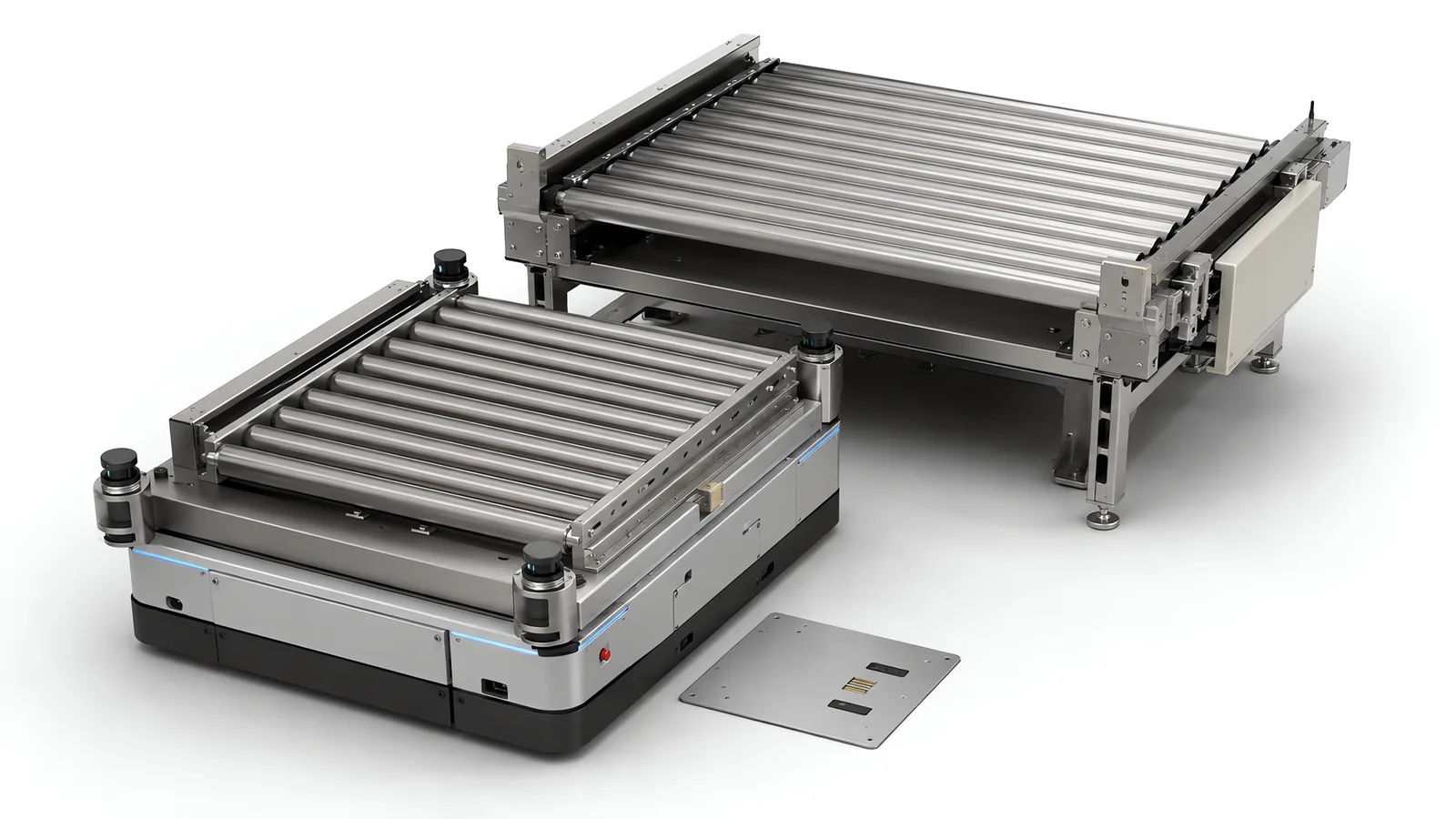
Motionwell Automation integrates AMR and AGV fleets in Singapore, covering vehicle selection, load handoff, traffic rules, charging and connections to warehouse or production systems. Route conditions and station interfaces determine the integration work alongside the vehicle’s payload, navigation and safety capabilities. We have been the authorised SIASUN AGV distributor for Southeast Asia since 2017 and also integrate free-navigating AMR platforms suited to the application.
Delivered work includes eight laser-guided vehicles rated at 1,500 kg each, transferring pallets into automated storage and using four charging stations on their routes. The AGV fleet and ASRS integration case study describes the fleet controls and conveyor handoffs. A separate QA laboratory programme uses an AMR-mounted collaborative arm and vision correction to place samples to plus or minus 0.5 mm. Station equipment is designed, assembled and tested at Woodlands Link.
If you are still choosing between the two vehicle types, that decision is worked through in our AMR versus AGV selection guide, and the wider material-flow scope sits on the warehouse and intralogistics automation page.
What Does Integrating a Mobile Robot Actually Cover?
Integration turns a vehicle’s navigation and carrying capabilities into a working material flow. It includes the places the vehicle stops, how the next mission is assigned, charging between jobs, interfaces to plant systems and any doors or lifts on the route. Vehicle selection and configuration are part of that scope.
That distinction is worth drawing on paper before anyone quotes, because it also settles who owns each piece.
| Part of the system | What it consists of | Who supplies it on our projects |
|---|---|---|
| The vehicle | Drive, navigation, on-board safety sensing, battery | Bought: an AGV under our own distributorship, or a free-navigating AMR from whichever platform suits the route |
| Handoff stations | The mating conveyor, rack slot, fixture or nest at each end of every move, and its sensing | Designed and built by us |
| Traffic design | Lanes, one-way rules, junction priority, blocked-lane handling, recovery procedure | Configured by us, on the fleet software |
| Charging | Charger type, count and placement against the route, and the trigger that sends a vehicle to one | Specified by us |
| Fleet manager interface | Mission in, status and load identity out, exception handling and operator override | Built by us, to your system |
| Route infrastructure | Floor condition, thresholds, ramps, doors, shutters, lifts, and the power to the chargers | Yours, with the interface scoped at survey |
| Storage racking and cranes | Racking, stacker cranes and their controls | Your storage vendor, and we integrate to it |
Read down the third column and the shape of the work is clear enough. One line is a purchase. The rest is design, and it is the reason two quotations for the same vehicle count can be a long way apart. The general form of this scope split, across fixed and mobile robots alike, is on our robot integration services page.
How Do You Hand a Load From a Vehicle Into a Fixture That Wants a Fraction of a Millimetre?
This is the hardest part of a mobile robot project, and it is often left to commissioning. A vehicle navigating by its own map parks within about plus or minus 50 mm. A rack slot, an instrument fixture or a machine nest wants a fraction of a millimetre. Nothing in the vehicle closes that gap, so something else has to.
Three mechanisms close it, and a fourth arrangement avoids needing to.
| Mechanism | What it corrects | What it costs | Where it fits |
|---|---|---|---|
| Physical docking feature | Vehicle pose, mechanically, by forcing the base into a known position at the station | Fitting and maintaining hardware at every station the fleet serves | Few stations, heavy loads, stable positions |
| Hand-eye vision on the arm | The real offset between expected and actual position, measured before the arm commits | A vision step in every cycle, and a dependency on fiducials staying clean | Many stations, positions that drift, light loads |
| Compliant tooling | Whatever residual misalignment is left at contact | Compliance is also lost stiffness, so it is bounded | The last few tenths, alongside one of the above |
| Removing the tolerance from the vehicle | The problem itself, by handing off at station speed | Every station now needs mating powered equipment | Pallet-scale flows between fixed points |
The laboratory programme combines base navigation, calibrated arm positioning and hand-eye vision. SLAM navigation takes the base to within plus or minus 50 mm of the station. The collaborative arm works in a calibrated coordinate frame with plus or minus 0.1 mm repeatability at the tool centre point. A wrist-mounted camera reads tray or fixture fiducials and sends X, Y and theta corrections to the arm controller, bringing placement to plus or minus 0.5 mm. This corrects docking variance and changes in the station position within the vision system’s working range. Failed checks trigger a bounded retry sequence and then an operator alert with the failure mode logged. The full build is in the QA lab automation case study, and fixed-station positioning is covered on our laboratory automation page.
The fourth row is a different move, and on pallet work it is usually the right one. Leave the vehicle’s accuracy alone and make the handoff insensitive to position instead: the warehouse fleet carries a chain conveyor deck on its top platform and transfers pallets sideways into a stationary chain conveyor, both driven at matched speed, with photoelectric sensors at each end confirming the pallet arrived. No fork tines, no mast, no lifting mechanism on any vehicle in the fleet, and the deck is rated at the same 1,500 kg per pallet as the storage side. The consequence has to be designed in up front: every station the fleet serves needs a mating powered conveyor at matched height, so there is no such thing as a free-standing drop point, and adding one later is a conveyor project. The gripper end of the same problem, where the load is a tray or a part, is covered on our end of arm tooling page.
For a powered deck interface, the pallet conveyor guide follows support and transfer confirmation from vehicle to fixed equipment. A goods-to-person picking system adds order and inventory coordination above the transport task; carrier movements and completed order lines should remain separate measures.
How Do You Keep a Fleet From Deadlocking in a Shared Aisle?
Traffic rules do it, written before the fleet arrives and tuned after it does. A single vehicle needs none of this. A fleet needs all of it, and the point at which it starts to matter arrives earlier than a two-vehicle pilot suggests.
On the delivered fleet, the fleet management server holds a live map of every vehicle position and every planned route. When two vehicles would converge at an intersection it assigns priority and issues hold and proceed commands, never letting the two on-board obstacle detectors negotiate it between themselves. Routes are recalculated against current traffic density, lanes blocked for maintenance and one-way restrictions, and missions are assigned to the nearest available vehicle by position, battery level and estimated travel time.
Deadlock is the specific failure this prevents, and it is worth naming precisely because it is not congestion. A junction, an aisle segment or a docking bay is a resource one vehicle occupies at a time. Deadlock is a cycle of those: each vehicle holds a segment another one needs and none can release. Two engineering answers exist. Prevent it, by making lanes one-way, by refusing entry to any segment a vehicle cannot leave, and by acquiring segments in a fixed order. Or detect it and reverse one vehicle out, which needs a vehicle that can reverse safely with a load on it and a rule for choosing which one yields. The prevention route is cheaper to validate and constrains the layout more.
Two site realities complicate this and both belong in the traffic design. First, the fleet does not control everything in the aisle. People, pallet trucks and forklifts move on their own rules, and staging stock in a lane is a habit no software prevents. Second, recovery decides whether operators trust the system. When a pallet is left in an aisle at two in the morning, somebody has to know within seconds what the fleet did, which vehicle is holding which mission, how the obstruction is cleared, and how the vehicle is returned to service without a supervisor. Those procedures belong in the design.
One more number is worth reading correctly. The traffic server on that fleet supports more than 20 vehicles without a software licence change, and eight were deployed. That is deliberate headroom: growth becomes a vehicle purchase. The real ceiling is the floor, because congestion at junctions and charging bays arrives long before the licence limit does.
Why Does Charging Strategy Change the Fleet Size Calculation?
Because it decides how many hours of the day a vehicle is available to move things, and fleet size follows from that far more than from the specification of the vehicle.
| Charging strategy | What the vehicle does | What the facility needs | Effect on fleet sizing |
|---|---|---|---|
| Dedicated charging window | Leaves service, charges to full, returns | One charger per few vehicles, and floor space to park them | Fleet must be sized for the moves plus the hours lost to charging |
| Opportunity charging | Tops up in natural gaps between missions, at contacts on the route | Chargers on high-traffic routes, and power to each one | Charging stops consuming vehicle hours and starts consuming route capacity |
| Battery swap | Exchanges a depleted pack for a charged one | A swap station, a charged battery inventory, and a person or mechanism to do it | Shortest downtime per vehicle, at the price of a second logistics problem |
The warehouse fleet uses the middle row. Four charging stations sit on high-traffic travel routes. When a vehicle drops below a configurable threshold, typically 30 percent state of charge, the fleet manager routes it to the nearest free station during a gap between transport missions. Spring-loaded contact plates on the vehicle meet the station’s pads, the charger delivers high-current DC, typically 30 to 50 A, and the vehicle disconnects at its target level, typically 80 percent, or earlier if a high-priority mission is assigned. Battery health data, meaning charge cycles, cell voltage balance and temperature history, is logged so packs are replaced on a schedule.
Where this changes the arithmetic is subtle and it is the reason the strategy belongs in the concept. Under a dedicated-charging model, availability per vehicle is reduced by the hours each one spends off the floor, so the fleet is sized for the transport demand plus that downtime, and a fleet running two shifts pays for it twice. Opportunity charging returns those hours, but it does not create capacity out of nothing: it converts a vehicle availability problem into a route design problem. Charger placement becomes part of the traffic design, the approach to each station becomes another position the vehicle must reach reliably, and a fleet running consistently near its throughput ceiling will find charging windows competing with transport missions. The test at concept stage is whether the duty profile has genuine gaps in it. If it does not, the extra vehicle you avoided buying comes back as a queue at a charger.
What Does the Fleet Manager Have to Exchange With Your WMS or MES?
It exchanges less than people expect in volume, and more than they expect in precision. A transport request that says move a pallet from A to B is not enough to run on.
A mission has to carry the source, the destination, the identity of what is being moved, a priority, and the condition under which the vehicle may release its load at the far end. What comes back matters as much: accepted, arrived, transfer complete, and failed with a reason that distinguishes a blocked route from a station that never confirmed. The failure worth designing against is not a vehicle that stops. It is a move that physically succeeded while the record says otherwise, because from that point every downstream decision is made against a wrong inventory position.
On the delivered warehouse fleet, transport requests arrive from the customer’s warehouse management system through its standard remote-call interfaces and are queued for assignment, so the fleet never becomes a second place where a move can be ordered. Every pallet is tracked from pickup to delivery, with the fleet server updating the inventory database at each handoff, so traceability exists without anyone scanning anything by hand, and RFID verification at the dock, the storage entry and the staging area confirms identity at each of those points. A web dashboard carries vehicle position, battery state, active missions, queue depth and throughput, and exception handling covers automatic rerouting with manual override from handheld terminals.
| Boundary | What crosses it | What breaks when nobody owns it |
|---|---|---|
| WMS or MES to fleet manager | Transport requests, priorities, cancellations, completion acknowledgements | Missions that cannot be cancelled cleanly, and stranded loads after a shift change |
| Fleet manager to vehicle | Route, hold and proceed, destination, charging instruction | Vehicles negotiating junctions between themselves |
| Vehicle to station equipment | Docked, transfer request, transfer complete, fault | A load pushed into a conveyor that was not ready, or a vehicle waiting on a station that never answers |
| Fleet system to operators | Positions, battery, queue depth, alarms, manual override | A fleet that works and an operations team that does not trust it |
| Fleet system to building services | Door or lift call, permission to enter, release | A route that works during commissioning and stops on the day the fire doors are tested |
Each of those boundaries needs a named owner on both sides of it, and the reason is organisational: an interface is where two suppliers can each assume the other owned it. Legacy plant equipment on the station side adds a third variable, and what to do when the machine on the other side of the handoff predates the network is on our legacy machine connectivity page.
What Changes in the Safety Case When the Floor Is Shared, and When the Arm Rides Along?
Start where every machine starts, with an ISO 12100 risk assessment, and note what is different about this one: the hazardous space is not a footprint on a drawing. It travels.
A vehicle brings its own conformity and its own on-board protective sensing from its manufacturer. What the integrator owns is the system around it: where vehicles are allowed to travel, how fast in each zone, what happens where routes cross doorways and pedestrian paths, and how a stopped vehicle is recovered. The QA laboratory shows the layered version of that, and it was a deliberate choice. Fencing the automated stations would have been simpler to justify in the assessment and would have cut the lab in two, so the design used on-board AMR scanning, defined traffic zones, and a cell-level assessment of the collaborative application including the gripper and sample geometry. Technicians work in the same room throughout.
Putting a manipulator on the vehicle changes the problem in a way that is easy to under-scope. The collaborative space moves with the base, so a single assessment at a nominal location does not cover the installation. Four consequences follow:
- The application has to hold at every station the vehicle can dock at. Tens of millimetres of docking variance shift the arm’s envelope relative to the bench and the people standing at it, so the clearances have to be checked where the vehicle actually parks.
- Travelling and reaching are different states, and the interlock between them is a safety function. The arm has to be stowed and its motion inhibited while the base moves, which means a rated function somebody has to specify, calculate and validate.
- The payload rides too. Contact limits are a property of the tool and the workpiece, so a sample rack, a tray edge or a gripper finger changes the assessment the same way it would on a fixed cell.
- Stopping is a compound problem. The base can stop for a person while the load on the arm keeps its momentum, so the stopping behaviour that has to be measured belongs to the pair, and never to either machine’s datasheet.
The applicable standards cover different parts of the installation. ISO 3691-4 addresses driverless industrial trucks, including AGVs and AMRs, and their operating zones. For a vehicle-mounted industrial manipulator, ISO 10218-1 covers the robot and ISO 10218-2 its application and integration. Safety-related control functions are designed and validated against the required performance levels under ISO 13849-1. The assessment joins these scopes at travel, docking and manipulation transitions. Our machine safety and CE marking page explains the resulting function register, protective measures and validation evidence.
What Actually Happens When a Fleet Is Commissioned?
Commissioning is mostly mapping and rules. The robots arrive working, and the schedule is consumed by everything they have to work with.
| Commissioning activity | What it produces | Who has to be in the room |
|---|---|---|
| Route survey | Aisle widths, floor condition, thresholds and ramps, charger power, door and lift interfaces | Facilities, and whoever knows what the building does at night |
| Map build and verification | The map the fleet navigates from, plus any absolute position references it needs | The integrator, on a floor in its normal state |
| Station-by-station docking proving | Docking repeatability at every handoff point, with real loads | Station owners, because a failure at a handoff is as likely to be the station as the vehicle |
| Traffic rule tuning | Lane directions, junction priority, hold points, speed by zone | Operations, since the rules constrain how people use the aisles |
| Recovery rehearsal | Written procedures for obstruction, fault and manual override, practised by the people who will use them | Shift supervisors and maintenance |
| Sustained acceptance run | Throughput held across a full duty profile, with the real mix and the charging behaviour in it | Everyone above |
Two of those rows are worth expanding, because both can be done in a way that proves nothing. Mapping on an empty floor produces a map that is wrong the moment production restarts, since a warehouse changes shape as stock moves. And an acceptance test that measures one vehicle doing one move measures nothing about a fleet. The run that means something is a sustained one at the real mix, long enough for vehicles to reach their charging threshold, with at least one deliberate obstruction in it to prove the recovery procedure.
The configuration and station logic we write ship with the system. Ownership of the map and the traffic rules has to be handed over explicitly, with a named person on your side and a documented way to add a station. A fleet is a system that gets edited, and a fleet nobody on site can edit becomes a fleet that stops being used after the third layout change.
When Is a Mobile Robot Fleet the Wrong Answer?
A short fixed link with a steady flow. Where material moves between two points that will not change, at a rate that justifies dedicated equipment, a conveyor is more deterministic, needs no traffic policy and has no battery. A fleet earns its keep on many-to-many flows.
The move count is low and irregular. Vehicles idle cheaply, but the stations, the interfaces and the safety scope cost the same whether the fleet runs ten moves a day or two hundred. Where the transport demand is genuinely small, the arithmetic rarely closes, and the inputs for testing that are set out in our warehouse automation ROI guide.
The route depends on something nobody controls. An aisle used for staging, a dock that fills with pallets at shift change, a door propped open for ventilation. These are operating habits, and a fleet does not change them; it just stops in front of them.
The floor is not ready. Slopes, gratings, expansion joints, dock plates and unlevel thresholds decide viability before any platform comparison starts, and they are cheaper to find on a site survey than during commissioning.
The destination tolerance cannot be relaxed and the station cannot be changed. If nothing at the receiving end can be modified, and no vision or compliance is permitted in the handoff, the answer is fixed automation, with the transport handled another way.
What Should You Settle Before a Fleet Is Quoted?
Seven items, in the order they change the design. The first three size the fleet; the last four are what separate two quotations for the same one.
- The station list: every place a load is picked up or set down, what equipment is there today, and at what height its transfer surface sits.
- Moves per hour by route, at peak, with the dwell at each end. Peak is what sizes a fleet; the average is what makes a business case look easy.
- The heaviest load and how it is carried: a pallet on a deck, a tote, a tray, a rack of samples. The carrying method decides the vehicle top module before anything else does.
- The tolerance the destination actually needs, and whether the station can be changed to meet it or the vehicle has to be made more accurate. Settle it before a layout exists, because it decides which of the four handoff arrangements you are buying.
- Which system raises a transport request today, what it knows when it raises one, and who is allowed to cancel or override it.
- Who else is in the aisles, with what equipment, at what hours, and where they stage things when they are busy.
- What the route crosses: doors, shutters, lifts, ramps and thresholds, with an owner named for each interface.
If you can answer four of the seven, that is a normal starting point and the rest is what a site survey produces. What we build against those answers is the station equipment, the traffic and charging design, the interfaces to your systems and the safety scope around them, integrated with whichever vehicle the first three answers point at.
Standards Used in Machine Design and Validation
These references inform the design, testing and documentation described on this page. Each row links to its primary source and records the edition checked.
| Standard | Current edition | What it means for your machine |
|---|---|---|
| ISO 10218-1: Robotics, safety requirements, Part 1: industrial robots | ISO 10218-1:2025 | Published February 2025, the third edition and the first substantive revision since 2011. It adds robot classifications with matching functional safety requirements and safety-related cybersecurity requirements. Most of ISO/TS 15066:2016 on collaborative operation moved into Part 2.Checked 12 Sep 2026 against ISO 10218-1:2025 (iso.org/standard/73933.html) |
| ISO 13849-1: Safety of machinery, safety-related parts of control systems | ISO 13849-1:2023 | Provides the design method for safety-related control functions, including architecture, component reliability, diagnostic coverage and common-cause failure measures. The machine risk assessment establishes the required Performance Level; design calculations and validation provide the evidence for each function.Checked 1 Sep 2026 against ISO 10218-1:2025 normative references |
Frequently Asked Questions
Do we have to cut our floor to run an AGV?
It depends on what the navigation is trusted to do on its own. On the delivered warehouse fleet, laser guidance was backed by RFID tags grouted into shallow recesses in the concrete at every intersection, docking position, charger approach and dock, because a warehouse changes silhouette as stock moves and wheel-encoder dead reckoning drifts between corrections. The tags sit below floor level so cleaning equipment and remaining forklift traffic cannot damage them. A free-navigating AMR needs none of that work, which is why floor access, curing time and shutdown windows belong in the comparison.
Do we need a WMS before we can run a fleet?
No, and the right answer depends on scale. The warehouse fleet takes its transport requests from the customer's existing warehouse management system through its standard remote-call interfaces, because the work orders already lived there and a second place to raise them would have to be reconciled with the first. The QA laboratory has no MES or WMS at all: the storage logic runs natively in the cell PLC across 70 positions in 7 racks, with a server dispatching missions over Ethernet/IP. The PLC-native route suits that scale and would not suit a site-wide system, and where a validated MES already exists the interface is the answer.
Can a mobile robot pass through a fire door or use a goods lift?
Only if something opens the door or calls the lift for it, and that interface is a scope item. A route that crosses a shutter, a fire door or a floor turns a transport project into a building-services one: the vehicle needs a call and release signal, the door or lift needs an interlock that is safe with an unattended vehicle in it, and the fire strategy for that opening has to survive the change. Establish who owns each of those at the site survey, because the answer decides whether the route is viable before any platform is compared.