
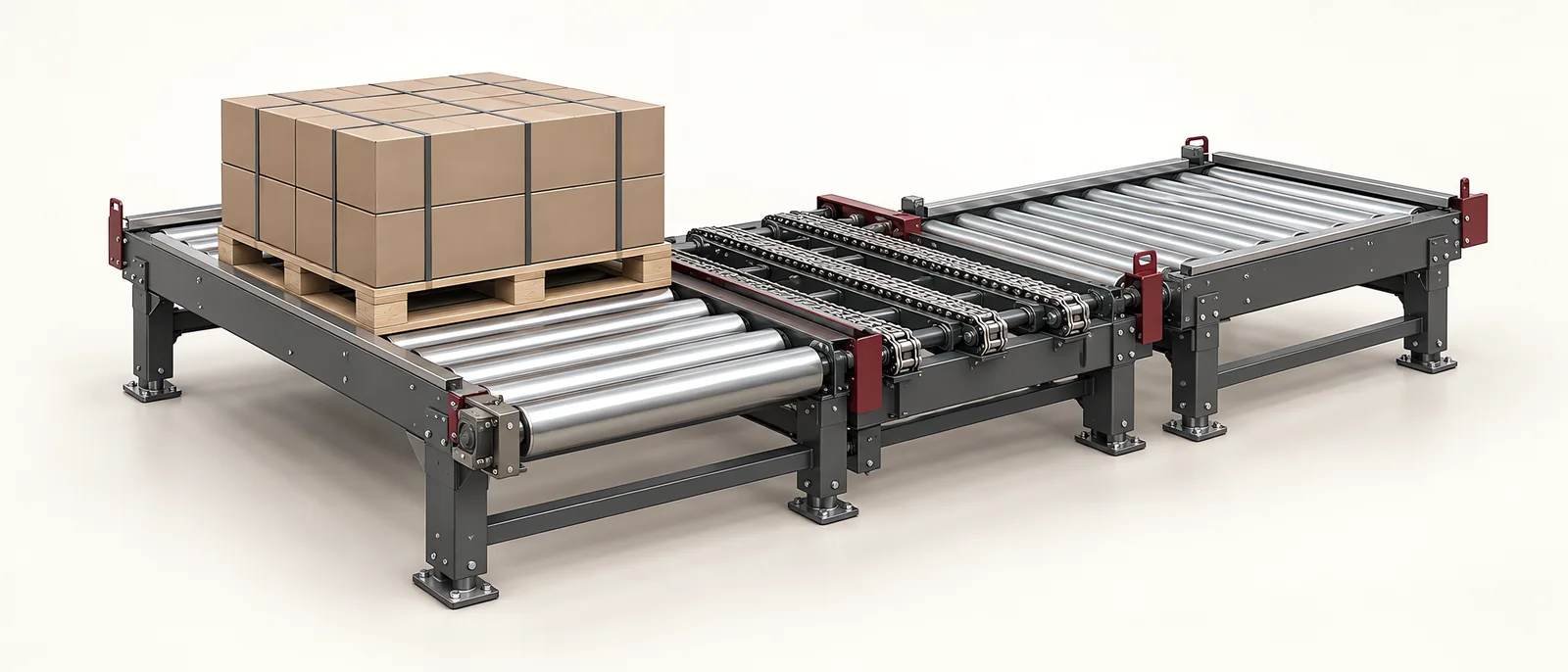
Conceptual equipment illustration.
A pallet conveyor must support the pallet base through every straight section, turn and transfer while controlling a much larger moving load than a typical carton conveyor. Specify the pallet construction and orientation together with the maximum loaded mass, centre of gravity and permitted condition of incoming pallets.
Two pallets with the same outside dimensions may have different bottom boards, runners or openings. Those differences determine whether rollers, chains and lifting transfer elements can support and move them correctly.
Start With the Pallet Base Drawing
Mark the surfaces that can carry load and the openings required for handling equipment. Include both loaded and empty pallets, because the empty pallet can behave differently during detection and transfer. Define how damaged, warped or protruding material is identified before entering the automatic route.
A conveyor integration design should show these interfaces in section views, not only in a plan view. Ask where the support moves as the pallet crosses from one module to another.
| Layout feature | Check before selecting the module |
|---|---|
| Straight roller section | Runner direction, roller pitch and distribution of the supported load |
| Chain section | Chain positions relative to the pallet’s carrying surfaces |
| Lift-and-transfer unit | Support in the raised and lowered positions and clearances during movement |
| Turntable | Swept envelope of the complete load and orientation after rotation |
| Vehicle docking position | Handover height, positioning tolerance and transfer permissions |
| End station | Stop position, access and how the pallet is removed |
Keep Turning and Side Transfer Distinct
A right-angle transfer moves the pallet onto another route. A turntable changes its orientation. The operations can appear similar on a layout, but the receiving conveyor may need the pallet runners facing a particular direction.
Interroll’s PM 9732 roller transfer is an example of a lift-table arrangement used for a 90-degree transport-direction change. Use the actual selected module’s sequence and load geometry when designing the interface.
Draw the pallet at the start, middle and end of the transfer. Check where its weight is supported in each position. This simple review can expose an unsupported runner or an interference hidden by a block diagram.
Define the Handover With an AGV or AMR
The vehicle and conveyor need to agree on more than arrival. A handover may require the vehicle to be positioned, the load deck to be ready, the receiving location to be clear and the transfer function to be enabled by both systems.
Write down which controller owns each decision. Define the evidence that a pallet has fully left one system and fully arrived on the other. If communication is interrupted mid-transfer, both sides need an agreed recovery procedure for the partly supported load.
These requirements should be reviewed with the AMR and AGV integration scope. A vehicle’s navigation accuracy alone does not establish a successful conveyor transfer.
Check the Load Leaving a Palletizing Cell
When the route starts at a palletizing system, include the completed load condition in the interface specification. Overhang, loose packaging and an unstable top layer can create problems after the pallet leaves the robot’s working position.
Set the conveyor acceleration and stopping behaviour against that load condition. Review detection of the pallet itself separately from detection of the goods above it. The sensor arrangement needs to distinguish an empty pallet, a complete load and an occupied station that is not ready to move.
Plan Access and Recovery Into the Route
Mark inspection points, pedestrian crossings and locations where a stopped pallet could block another process. Keep drive and sensor access practical without requiring the whole line to be dismantled.
During acceptance, test a full route with the permitted range of pallets. Include an occupied destination, failed arrival confirmation and a stopped vehicle interface. Verify that a restart does not issue two conflicting transfer commands or lose the identity of a pallet already in motion.
The broader warehouse and intralogistics plan should connect these recovery conditions to the storage and production processes they affect.
Planning pallet movement between machines or storage areas? Discuss the route with Motionwell. We can review the handling interfaces and control sequence around your pallet range.