
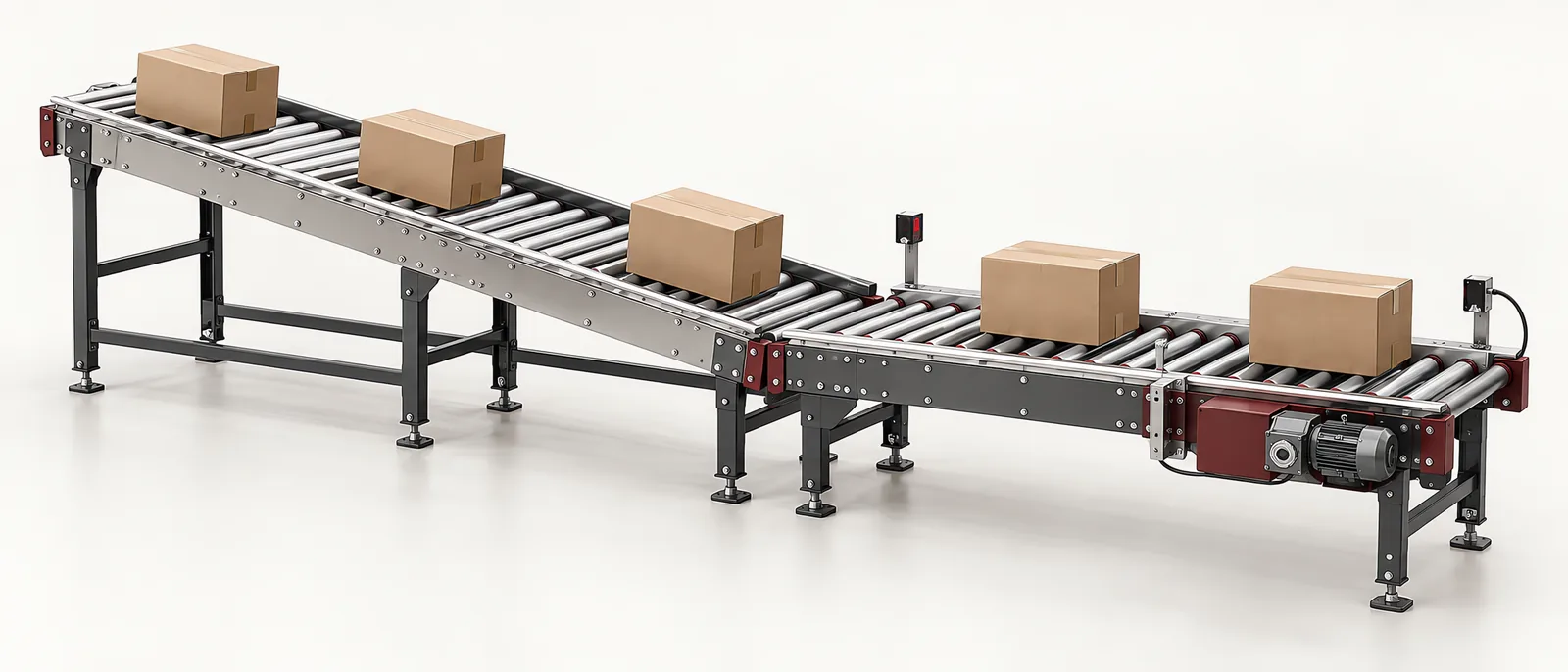
Conceptual equipment illustration.
A roller conveyor suits unit loads that can remain supported as they move from roller to roller. Start with the underside of the smallest and least rigid carton, tray or tote, then choose the roller spacing, drive arrangement and transfer details. Overall package size alone does not describe the support surface.
Gravity rollers are useful when an available slope or manual push can provide the movement. Powered rollers give the system an active means of moving loads and, with suitable controls, stopping and releasing them. Neither arrangement should be selected from a label such as light duty without checking the actual product range.
Inspect What Touches the Rollers
Place the shortest load, in its least favourable orientation, on the proposed carrying surface. Look for feet, ribs, recessed bases, loose flaps and surfaces that bend under load. A nominally long tote may contact only a small portion of the conveyor.
Record the minimum contact length in the direction of travel. Use that length to determine how many rollers support the load during movement and at transfers. Review roller capacity and deflection with the supplier for the selected diameter, shaft, bearing and installed length.
The Interroll conveyor roller catalogue distinguishes roller and transmission arrangements. Treat its model-specific dimensions as selection data for those products, not universal limits for roller conveyors.
If the product cannot maintain stable support, compare a belt or a dedicated pallet in the conveyor types guide.
Gravity and Powered Rollers Solve Different Control Problems
| Requirement | Gravity arrangement | Powered arrangement |
|---|---|---|
| Movement source | Slope or manual force | Drive torque through the selected transmission |
| Speed control | Requires suitable slope, braking or regulating equipment | Depends on drive and control configuration |
| Stop position | Usually needs a physical stop and a release method | Still needs suitable sensing and stopping behaviour |
| Accumulation | Load contact and stopping forces need deliberate treatment | Can use independently controlled zones when specified |
| Restart | Depends on the available driving force and load condition | Must provide enough starting capability for the actual load |
Specify the accumulation function alongside the drive. Zero-pressure operation requires zone detection and coordinated release, even when the selected conveyor already has motorised rollers.
Design the Handover as Carefully as the Straight Run
At a conveyor-to-machine transfer, compare elevations, gaps, support and surface speeds. Check the leading edge of the shortest product as it leaves one surface and reaches the next. A carton that moves perfectly along the straight run can still catch at a transition.
For a change of direction, establish whether the product turns with the route or maintains its original orientation. These are different requirements. Side guides, curves and transfer mechanisms must accommodate the chosen motion without damaging labels or unstable loads.
Bring those details into the conveyor design and integration scope. A layout should identify each transfer as a specific interface, not hide it between two equipment rectangles.
Specify the Queue and Release Behaviour
Describe what happens when the receiving machine stops. Will products touch, remain separated, or move to another route? State the required waiting capacity in products as well as conveyor length.
Use the receiving machine’s permission to define release. On a packing line, that may include case availability, machine-ready status and space at the infeed. The case packing and wrapping page covers the downstream equipment context; the conveyor should deliver the load in the condition that equipment can accept.
Run a Product Trial With the Difficult Loads
An acceptance trial should include the lightest empty container, the heaviest full load and the shortest contact surface. Test start, stop, accumulation, release and every transfer. Repeat with the product orientations the production process permits.
Record any required guide or speed changes between formats. If a changeover relies on an operator moving a guide, provide a reproducible setting and include it in the operating instructions. Avoid relying on an undocumented adjustment that only worked during the demonstration.
For a conveyor linking storage, picking and production, align these local decisions with the warehouse and intralogistics layout.
Planning a roller conveyor? Tell us what needs to move. We can discuss the carrying surface, transfers and controls for the route.