
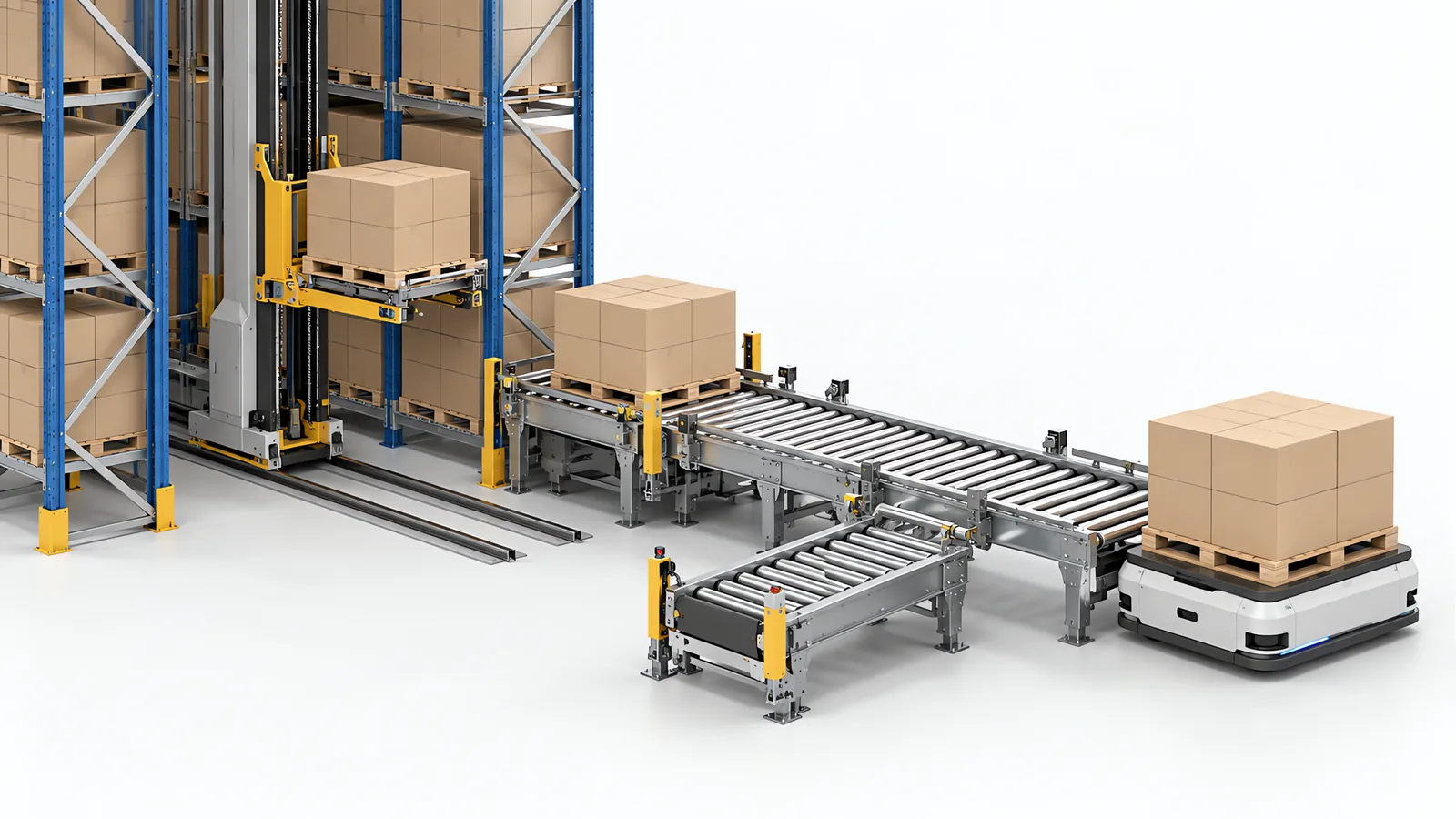
ASRS vs AGV is a choice between automating storage and automating transport. An ASRS puts loads into known rack positions and retrieves them; an AGV carries loads between stations. A warehouse can need both, with a transfer conveyor and control handshake connecting the two.
Motionwell integrates storage systems and mobile robot fleets in Singapore. Our delivered work includes a laser-guided pallet fleet serving an existing store, with conveyor-to-conveyor handovers, and palletizing sequenced against retrieval orders. Those interfaces are the focus of this guide.
For a phased project, reserve the store-face positions, load envelope and transfer capacity early. Fleet size can then grow with measured transport demand, provided the traffic routes and charging capacity support the additional vehicles. Price the transfer station, buffer and reject exit explicitly alongside the rack and fleet.
On storage projects the rack and the crane have come from the storage vendor and our scope has been the equipment that touches them, the controls, the safety scope at the interface and the recovery behaviour. On fleet projects our scope has been the vehicles, the station conveyors, the fleet software and the interface into whatever holds the stock record.
This page is about the join. The selection question inside the vehicle category, AGV or AMR, is a different decision and it is worked through in our AMR versus AGV guide.
What Does the First Phase Have to Reserve for the Second?
Storage and transport can both be phased when expansion space and interfaces are reserved. Their different task groups are set out in our note on the types of warehouse automation and on our ASRS and automated storage page. This page focuses on the transfer positions, capacity and controls a second phase will need.
When both systems are in scope, establish the load envelope, storage geometry and expansion space early. Size the first fleet against measured transport demand and check traffic and charging capacity for later vehicles. Changes to either side can require construction or controls work, depending on what the first phase reserved.
The second half of the point is that only the vehicle half of an extension is a purchase order. A new station for that vehicle to serve is a build, because the handover is conveyor to conveyor, and that design decision is set out in the AGV fleet and storage integration case study. Whether a second phase is an order or a rebuild depends entirely on what the first phase reserved, and the table below is the list worth arguing over while both vendors still want the first order.
| What the first phase leaves behind | Cost of reserving it on day one | Cost of discovering it at extension |
|---|---|---|
| A station naming and addressing scheme with gaps in it | An hour of agreement during design | Renumbering live stations, and a fleet map everyone has to relearn |
| One spare transfer position on the store face | A position on a layout drawing | Cutting into a commissioned store face, with the aisle down |
| Charging capacity and charger positions beyond the day-one fleet | Cable and a spare position | A charging window competing with transport missions at the peak hour |
| Traffic headroom in the segment every route crosses | A wider aisle on the drawing | Two fleets or two routes queueing politely where the throughput figure was sold |
| Reserved fields in the message set to the stock record holder | A line in the interface specification | A change request against a live warehouse management system |
| A record of the assessed layout and planned extension interfaces | A documented design review | A re-assessment nobody budgeted, found during commissioning |
Read the right-hand column as the real price of a phased plan. Phasing a fleet is normal and we recommend it. Phasing it without reserving anything is how the second phase pays for the first phase’s silence. The commercial half of the same move is to make each bidder price phase two now, as a named option with a stated validity. A price quoted while a supplier is still competing for the first order is not the price you get once you have no alternative left.
What Has to Line Up Before a Pallet Can Cross Between Them?
Compare three geometric and motion conditions, then agree drive control across the handover. Use both suppliers’ equipment data and measurements of the installed station.
Deck height, loaded. The AGV deck sags under a pallet and the station’s roller top does not. Both numbers have to be measured on the installed equipment with the load it will actually carry, and the tolerance between them has to be written down, not assumed to be generous.
Transfer speed. Both decks drive the pallet during a conveyor to conveyor handover, and two driven surfaces at different speeds scuff, skew or stall the load. The match is a commissioning parameter, so somebody has to own the number and be allowed to change it.
Stopping tolerance against catch geometry. This is the one that decides cost. The vehicle arrives within some lateral and angular error, and the station has to catch a pallet presented with that error. The two numbers are one budget, and the fixed side is nearly always the cheaper place to spend it. A lead-in, a wider entry or a centring guide is steel bought once on a fixed machine. Tolerance bought on the vehicle side is a sensor, a docking routine and a few seconds of approach on every trip for the life of the fleet. Docking tolerance as a fleet cost driver is covered on our AMR and AGV integration page.
Whose motor moves the pallet. Answer it in writing, because whoever drives the load owns the jam. A transfer where both decks run needs a single agreed start condition and a single agreed stop, not two controllers each believing they are in charge.
One more item crosses this boundary and it is a scope trap. A store-face profile and weight check needs a reject route. An AGV can report a load or mission fault, but a rejected pallet still needs a defined place for inspection and recovery. So the check belongs where a failed pallet can be pulled aside by somebody standing on the floor, upstream of anything a vehicle has to reach into. How that inbound check is built sits on our ASRS and automated storage page. The related constraint is that one pallet now has to satisfy two envelopes, the rack position and the vehicle deck, and the tighter of the two governs your packaging. A change of pack format is then a change to two machines and the conveyor between them.
| What has to match | Who holds the number | Cheaper side to buy tolerance on | What it costs if left to commissioning |
|---|---|---|---|
| Deck height under load | Vehicle supplier, measured loaded | Station, with an adjustable transfer deck | Shimming a vehicle fleet, or packing out a station one pallet at a time |
| Transfer speed of both decks | Shared, set at commissioning | Station drive, which is easier to re-rate | Skewed pallets arriving at a rack face that will refuse them |
| Lateral and angular stopping error | Vehicle supplier | Station, with lead-ins and a centring guide | Cycle time added to every trip, permanently |
| Pallet and load envelope | Buyer, from the worst pallet genuinely received | Neither, this one is settled before design | A rack envelope and a deck that disagree about the same pallet |
| Start and stop authority during transfer | Named in the specification | Not applicable, it is a decision | Two controllers, one jam and two suppliers pointing at each other |
How Much Conveyor Belongs Between the Store Face and the Vehicles?
This is the question an ASRS conveyor quotation answers by accident, and it deserves to be answered on purpose.
Why a buffer has to exist at all is argued on our ASRS and automated storage page, where the other side of the store is a loading dock. What changes when that side is an AGV fleet is where the sizing number comes from. A dock interrupts on a timetable you own and can read. A fleet interrupts inside a traffic design you have never seen, and the first answer to a request for those durations is an availability percentage, which is the one form of the number that cannot be turned into a length of conveyor.
Size it against interruptions. Three of them matter.
The longest interruption on the vehicle side you are willing to let reach the crane. A vehicle on a charger, a blocked lane, a mission sitting behind a higher priority job. The buffer is how long the store can keep working without a vehicle showing up.
The longest interruption on the store side you are willing to let reach the fleet. A recovery in the aisle, a cycle count run eating transactions, one aisle isolated so somebody can get into it. The buffer is how long the fleet has something to collect.
The arrival pattern in your own peak hour, counted in and out separately. A buffer sized on daily average demand is full at the peak and empty in the trough, which is the one result guaranteed to disappoint both vendors’ figures.
Then name which of the two failures you would rather have, in writing, because left unnamed each vendor answers it in their own favour. A full buffer stops the store: the crane holds a load it cannot deposit. An empty buffer idles the fleet: a vehicle waits at the face earning nothing. The two directions often want different lengths, which makes this a layout decision and not a control setting, and layout is settled before either machine is ordered.
Two details decide more than their size suggests. The reject exit needs a position of its own, outside the buffer count, or a failed pallet turns a handling problem into a blocked interface. Use independently controlled accumulation positions where pallets must stay separated and aligned at the rack face. The families and how zones and transfers are designed sit on our conveyor and material handling page and in our guide to conveyor system types.
Worth saying plainly, because this interface tends to travel as one line on somebody else’s quotation: a buffer and transfer unit is a machine. It has a bill of materials, a lead time, a panel, a safety case and an acceptance test of its own, and none of that appears when it is described as an interface. Put three questions to whoever is carrying it. How many suppliers sit behind this unit, and how many of those are a single source. What is the longest lead time inside it, and is that item ordered before or after the design review. And who runs its acceptance test, against what document. The supplier count is larger than buyers expect, and it decides how many chains you chase when one certificate is missing at handover.
| What the buffer absorbs | Which side it protects | Who can tell you the duration | Consequence of sizing it at zero |
|---|---|---|---|
| Vehicle charging and queueing | The store | Fleet supplier, from the traffic design | The crane stops because nobody came to collect |
| Crane recovery and aisle isolation | The fleet | Storage vendor, from the recovery procedure | Vehicles idle at the face through every fault |
| Cycle counting and housekeeping transactions | Both | Your own inventory team | Counting competes with shipping at the peak hour |
| Receiving and despatch arriving in blocks | Both | Your own peak hour data | Both machines meet their own figures and the pair still misses |
| A pallet that fails profile or weight | The interface itself | Storage vendor’s reject rules | One rejected pallet closes the handover |
What Happens When the Two Sides Disagree About a Pallet?
The happy path between an ASRS store face and an AGV deck is four signals, and both vendors will describe it. Ready, present, transfer started, transfer complete. A boundary level summary of what crosses each pairing in a warehouse is tabulated in our warehouse automation types note. What is usually missing is the other half: the states where the station and the vehicle hold incompatible beliefs about the same pallet, which is where commissioning time actually goes.
Four of them recur.
Both sides report a load present. A pallet straddling the gap blocks the station’s entry sensor and the vehicle’s deck sensor at once, so both are telling the truth and neither is complete. The interface logic must recognise an incomplete transfer and keep the vehicle docked. The agreed controller checks alignment, occupancy and transfer permissions before continuing.
Neither reports a load present, and the record says one exists. That is a pallet on the floor, a pallet still in the rack, or a dead sensor. All three need an operator route back in, because a retry against a missing pallet produces a second missing pallet.
The vehicle reports transfer complete while the station’s sensor stays blocked. Usually a wrap tail or an overhanging board. What must never follow is a vehicle departing on its own belief and a station holding a load it cannot index.
The link drops mid transfer. Stop transfer motion, retain the load securely and inhibit vehicle departure through the agreed fault response. Reconcile station occupancy, vehicle load state and the transaction before a controlled restart. Timeout values support fault detection; they do not by themselves authorise motion.
Three decisions cover all four states, and each is one line in a specification. Who arbitrates. Who may complete a transfer by hand, and what the system records when they do, including an operator identity so the stock record is corrected. And what happens on restart: the station re-reads its sensors, the vehicle re-confirms its deck, and the recorded transaction is reconciled before resuming or re-issuing a mission with duplicate-execution protection. All three belong on the interface page of the factory acceptance test, and how that test is built and witnessed is set out in our factory acceptance test checklist.
| State | What each side believes | What it usually is | Who should act, by prior agreement |
|---|---|---|---|
| Both report load present | Station: load at entry. Vehicle: load on deck | A pallet straddling the gap, or a short pallet | Keep the vehicle docked; the agreed controller verifies transfer conditions before controlled completion or recovery |
| Neither reports load present | Station: empty. Vehicle: empty. Record: a pallet exists | A pallet on the floor, a pallet never retrieved, or a failed sensor | Operator, on a defined route, with a recorded correction |
| Vehicle complete, station still blocked | Vehicle: done. Station: occupied | Wrap tail, overhanging board, or a slipped load | The vehicle stays put until the station clears or a person attends |
| Link lost mid transfer | Both: in progress | A network fault or a fleet server restart | Execute the agreed fault response: stop transfer motion, retain the load securely and inhibit vehicle departure. Reconcile occupancy on both sides before a controlled restart |
Which System Owns a Pallet That Has Left the Rack but Has Not Reached a Vehicle?
The interface specification should assign an owner to the pallet throughout the transfer, including its time on the buffer. That one system has to hold the authoritative record, and that in transit has to be a real state and not a silence between transactions, are both argued on our ASRS page. What a two vendor boundary adds is that neither controller wants that state, so somebody on your side has to hand it out deliberately.
Consider the sequence. The store completes a retrieval and closes its transaction, so the rack position is now empty and the storage controller has nothing further to say about that pallet. The fleet has not opened a transaction, because no vehicle is holding anything yet. For the seconds or minutes in between, a real pallet sits on a conveyor that belongs to neither controller, and whatever holds your stock record has to have a name for that condition.
Three rules keep the stock record true.
Name the owner of the in transit state, and give it a number. The owner is whichever system is still answering after both controllers have closed their transactions. The number is how long a pallet may be nowhere before somebody is told. Neither controller volunteers for this, and neither refuses it once it sits in a specification they signed.
Identity travels with the physical handover. Read or confirm at the station that the pallet on the deck is the pallet the mission named, and trust nothing that only the fleet server believes. Reading at every handoff point and writing into the operator’s warehouse management system is delivered work, described in the case study.
Cancellation after retrieval needs a route back. Orders get cancelled, trucks get rescheduled, and a retrieved pallet sometimes has to go back into the rack. Ask during design what happens when the original location has already been re-allocated, because the answer is either a rule or an afternoon of manual work.
One question to put to whoever owns your stock record before any vehicle is ordered, and it is a question about software: can your record hold a vehicle as a location? A fleet reassigns missions, so a pallet’s location is sometimes a moving object, and systems that can only store fixed locations will record that pallet as being where it is not. Which layer owns orders, which owns execution and which owns the record is set out in our note on what MES, ERP and SCADA each own.
Whose Risk Assessment Covers the Floor Between Them?
Coordinate the storage, vehicle and transfer-station assessments across the shared floor. Name who integrates and validates the boundary safety functions. Singapore’s WSH Act responsibilities apply to occupiers, employers and suppliers in their respective roles; the interface responsibility matrix should reflect those roles.
Three safety functions live at this boundary. Two of them are the generic pair for any powered station a vehicle docks against, each side holding the other still while a load crosses, and both are tabulated with their governing document in our types of warehouse automation note. The third is what this pairing adds: a buffer at a rack face is somewhere people reach into to straighten a pallet, so access to the transfer point while the station is live has to be detected or prevented, not discouraged by paint on the floor. All three carry a required performance level to determine and validate under ISO 13849-1:2023, and on a two vendor project the argument is about the owner, because an interlock split across two suppliers is one nobody has validated end to end.
Where a robot works the same face, and a palletizing cell sequenced against a retrieval order is a pairing we have delivered, the cell’s safeguarded space and the vehicle’s docking approach overlap on the same floor. That cell is assessed as a robot application under ISO 10218-2:2025, which is also where the collaborative operation requirements now live. The overlap is what has to be drawn: one document governs the cell, another governs the vehicle, and the square metres they share need a single owner who has looked at both.
Hardware is the straightforward part of this. Light curtains, safety controllers, safety relays, laser scanners and interlocks are catalogue items with published safety data, so the parts that enforce an interface are ordinary and available. The document is the work, and it has a version problem: an assessment written for the original routes does not describe the routes added later. Treat every extension as re-opening the assessment for the segments it touches, and settle who is paid to do that before the extension is ordered. The method for that assessment sits in our note on machine safety risk assessment.
When Is the Answer Neither an ASRS nor an AGV Fleet?
Apply a two machine test first. Take one away, and ask whether the other still pays for itself. If the fleet exists only to feed the store and the store exists only because the fleet needed somewhere to go, the pair is a loop, and the question to re-open is what the original complaint was.
The move is short and the stations are adjacent. A vehicle earns its keep on distance and on the number of routes it serves. Two stations in sight of each other with one flow between them is a conveyor spur, with no traffic rules, no charger, no map owner and no fleet server.
The pack format is not settled. Two envelopes and one pallet, as above. While the format is under review, neither purchase can be priced against anything.
Manual trucks are staying. A store face and a vehicle route sharing an aisle with forklifts is a traffic problem you will pay for twice, once in the safety case and again in the throughput that the traffic rules take back.
The constraint is the truck schedule. Where pallets wait because vehicles arrive at the dock in blocks, neither machine shortens the wait. Staging space and an appointment discipline do.
The move count will not fill one vehicle’s duty cycle. One vehicle is the minimum purchase, and it still needs traffic rules, a charger, a map with an owner and somebody who can recover it at night. Below a certain number of moves per shift, a pallet truck and a trained person is the cheaper system, and the move count is worth establishing before either proposal is drawn.
The middle answer is common and is not a failure of nerve: a store served by forklifts, or a fleet serving conventional racking. Both are real answers, and either one leaves the other available as a second phase with the interface already reserved. The payback arithmetic behind that sequencing is set out in our warehouse automation ROI note. The local version of the storage question, including what a Singapore building and its approvals do to the decision, is in our note on ASRS in Singapore.
What Belongs in the Shared Interface Specification?
Assign an owner for the AGV-ASRS interface specification. The storage supplier, fleet supplier and integrator contribute their signal definitions and operating limits; the approved document brings them together into one transfer and recovery sequence.
| Item in the specification | Who supplies the number | Why it belongs to you |
|---|---|---|
| Signal list at the boundary, with direction, meaning and physical form per point | Both suppliers, reconciled by you | Two lists that were never compared is the default state of a two vendor interface |
| Deck height and transfer speed, with tolerances | Vehicle supplier and station builder | Measured on equipment, not copied from a general arrangement drawing |
| Docking tolerance, split into the half each side holds | Shared | Buying it twice is waste, buying it nowhere is a commissioning stall |
| Buffer positions in each direction, plus a reject exit | You, from your peak hour | Each vendor sizes it to protect their own machine, not your throughput |
| The in transit state, its owner and its timer | Stock record holder | Neither controller wants a state it cannot close |
| Fault-detection timeouts, safe holding and restart permissions | Shared and validated as one transfer sequence | Timeouts detect a fault; verified load and station states govern the restart |
| Manual completion path and who may use it | You | It will be used at three in the morning whether or not it is written |
| Restart rules after any fault at the boundary | Shared | Resuming from an unverified state is how a record drifts |
| Test list at factory acceptance, repeated at site | You, agreed before either test | Only the buyer holds both contracts, so only the buyer can require the same list of each side |
| Extension clause: spare addresses, reserved fields, spare transfer position, charger capacity | You | Reserves the interfaces and capacity needed for the planned second phase |
The vehicle for all of that is a user requirement specification written before quotations are compared, and how to write one a vendor can be held to is on our page about writing an automation URS. Where the scope also crosses into panels, field wiring and site electrical work, the division of that scope is set out in our note on electrical system integrator scope. Our broader material flow work sits on the warehouse and intralogistics page.
Which Decision Are You Actually Making?
An ASRS and an AGV fleet are not competing answers to one question. The store decides where stock lives, in a purchase that arrives whole and stays, and the fleet decides who carries it, in a purchase that can be extended later if the first phase left room. Their combined output depends on the transfer capacity, shared signal definitions and a tracked in-transit state. Include that interface as a defined scope item when both systems appear in one budget.