
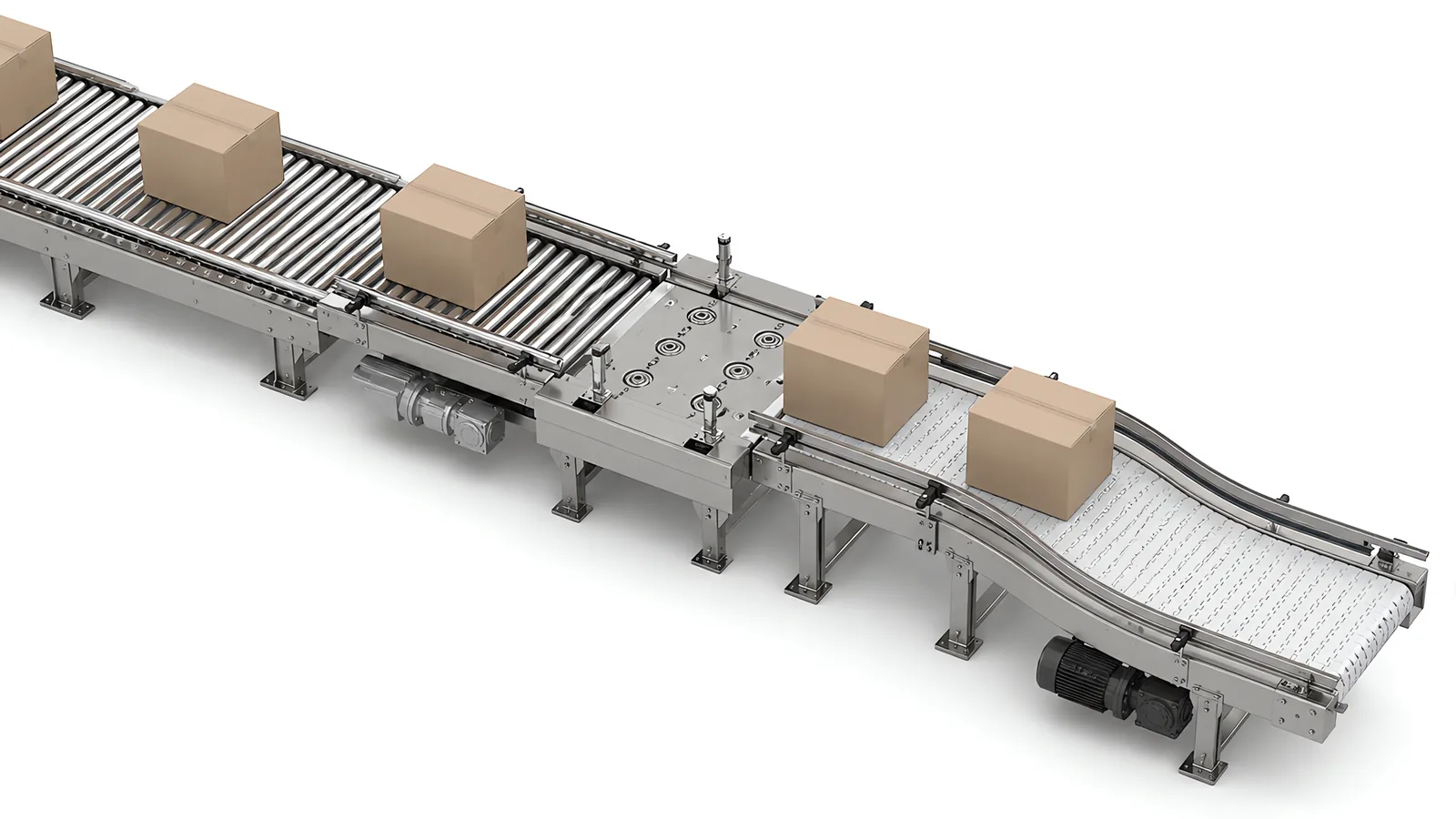
The main conveyor system types for unit loads are flat belt, modular belt, gravity roller, powered roller, motor-driven roller, chain and slat. Choose between them using the product base, load, smallest size, accumulation needs and operating environment. Transfers and controls then determine how the selected sections work as a line.
On a carton palletizing infeed, 24 V motor-driven roller zones run at 30 metres per minute. Occupancy sensing and release logic leave a gap between waiting cartons. On an EV battery disassembly line, a heavy-duty belt is rated for 500 kg per pallet position, and the load standing at one position sized the frame.
Motionwell also uses modular belt for suitable curved paths and closed-loop belt lines with positioned trays for cleanroom testing. In the latter, the tray carries a repeatable datum between stations. These applications show why the product and station interfaces belong in the type-selection decision.
Use the tables below to shortlist the carrying surface, then test the actual product through curves, stops and transfers. Speed, width, drive size and family are related decisions; changing one later can require new structure, handling trials and controls work.
How Many Types of Conveyor Are There, and What Does Each One Carry?
| Family | What it carries | Where it stops working |
|---|---|---|
| Flat belt | Almost anything that sits still: bags, loose product, small or irregular items, product with no rigid base | Sharp or hot product cuts or melts the belt; a single driven section stops together |
| Modular plastic belt | Bottles, trays and packs; radius versions for curves and flighted versions for inclines | Load, turn radius and drive must suit the selected belt; washdown access depends on construction |
| Gravity roller | Rigid flat-bottomed cases, moved by hand or by slope | Anything without a rigid base; no control over where product ends up |
| Powered roller | The same rigid cases under drive, at a controlled rate | Short product noses between rollers; light product does not drive reliably |
| Motor-driven roller (MDR) | The same again, but split into independently driven zones | Costs more per metre; the value is in the controls |
| Chain | Heavy unit loads, pallets, hot or oily product that would attack a belt | Not for small or light items; the chain itself is a maintenance item |
| Slat | Heavy or hot product needing a flat carrying surface | Heavy, noisy, and expensive per metre |
The first column is the one that decides. A conveyor question that starts with “how many metres” has skipped it.
What conveyor belts are made of
Seven families sit in the table above and two of them are belts. A flat belt is a fabric carcass under a polymer cover, and the cover is the part that gets specified: on the EV battery disassembly line the belt surfaces are carbon-fibre-loaded PVC with surface resistivity in the dissipative range under IEC 61340-5-1, because charge sitting on the carrying surface near an exposed terminal is the hazard being designed against. A modular belt is not a single surface at all. It is moulded plastic links pinned into a mat, which is why a damaged area comes out by hand instead of going to a splice press. Slats are steel or plastic carried on chain, and the chain itself is steel. Ask what the carrying surface has to survive, meaning the product, the debris that gets under it and the cleaning agent, and the material follows from that.
The three-roller rule
For any roller conveyor the working rule is that the product must always be supported by at least three rollers. That fixes the maximum roller pitch from the shortest product on the line, and the shortest product is frequently not the one people quote. A line specified around a 400 mm carton will not carry the 120 mm carton that arrives with a new SKU two years later, and the fix is either a new roller bed or a belt section spliced into the middle of the run.
How Do Belt, Modular Belt and Roller Differ in Practice?
The three families cover most of what a factory needs, and the differences that matter are not the ones in a catalogue.
| Flat belt | Modular plastic belt | Roller | |
|---|---|---|---|
| Product base | Continuous support; match grip and surface to the load | Match surface and module openings to the load | Sufficient supported contact across rollers and transfers |
| Curves | Purpose-designed curved belt section | Radius or side-flexing belt with matched turn radius and guides | Curved section with tapered rollers, or a transfer |
| Incline | Product grip and stability set the angle; cleats are an option | Select friction inserts or flights for the incline, with side guards where needed | Gravity descents need speed control; powered inclines depend on the module’s rating and product grip |
| Washdown | Match belt material, joint and take-up access to the cleaning method | Select flat-top or open-grid surfaces and hinge access for the cleaning task | Match rollers, seals and drive protection to the cleaning method |
| Repair | Splice or replace the whole belt | Replace individual modules by hand | Replace one roller |
| Accumulation | A moving belt can slide beneath held product, creating back pressure | Surface and accumulation design matter; roller-top options can reduce pressure | Zero-pressure operation needs zone sensing and release logic |
Modular describes the belt construction, not its turning ability. For a curve, match the belt’s minimum turn radius, width and guide arrangement to the layout; Intralox’s radius belt range includes designs specifically for turning. Accumulation also depends on the carrying surface: Dorner’s modular belt options include roller-top belts for reduced back pressure.
The repair row is the one that changes ownership cost. A flat belt fails as a unit and stops the line until it is spliced or swapped. A modular belt fails as a module, and a maintenance technician replaces the damaged section by hand in minutes without a splice press. On a line running two shifts, that difference outweighs the higher price per metre more often than the purchase decision reflects.
A drum motor encloses the drive inside the pulley, reducing external components around the wash path. Hygiene also depends on belt surface, joint and hinge access, seals, frame drainage and cleaning access. Select the belt and drive arrangement against the product and cleaning method: an open-grid modular belt provides drainage, while a flat-top design provides a more continuous carrying surface. The full hygiene argument sits on our conveyor and material handling page.
The detailed roller conveyor guide starts with the actual underside contact length and transfer support. Zero pressure accumulation is a controlled buffering function, not an automatic property of every powered roller line. For continuous unit-load movement between elevations, the spiral conveyor guide covers the product and transfer requirements.
When Does a Conveyor Need Driven Zones Instead of One Long Run?
A continuously driven belt can build back pressure when product is held at a downstream stop: belt friction keeps pushing against the held items. A powered roller run can do the same if its drive keeps transmitting force into the queue. Stopping the whole section and its upstream feed removes that continuing drive force. Select the accumulation mode against product damage limits, queue length and the required flow.
For zero-pressure accumulation, each zone needs enough length for its load and stopping distance. Occupancy sensors and downstream-clear logic hold upstream product until the next zone can receive it. This is the principle described in Interroll’s ZoneControl documentation. On Motionwell’s delivered carton palletizing infeed, a three-zone buffer uses 24 V motor-driven rollers and photoelectric occupancy sensors. The controller holds waiting cartons and releases them into clear zones with a gap between products.
Plan zoning before the layout is released. Adding zones later can require changes to the frame, drives, cabling, sensors and PLC I/O. A quotation should identify both the drive arrangement and the accumulation controls, because the label “MDR conveyor” alone does not specify how products stop and release.
| Question | Single driven run | Zero-pressure zones |
|---|---|---|
| When downstream stops | Stop the whole section, or accumulate with contact if continued drive is allowed | Hold each item until the next zone is clear |
| Adding buffer capacity later | Add usable conveyor length or redesign accumulation | Use spare zone capacity, or add zones and drives |
| Cost driver | Metres of frame | Zone count and I/O |
| When it is the right answer | Continuous transfer, or contact accumulation within product limits | Separate items during downstream pauses |
Which Types Handle a Change of Height?
Elevation change is where conveyor selection goes wrong most visibly, because the constraint is the product.
| Method | Typical angle | What it needs from the product |
|---|---|---|
| Plain belt incline | Up to roughly 15-20 degrees | Enough friction; nothing that slides or rolls |
| Cleated belt | Steeper, product-dependent | Product that sits between cleats without tipping |
| Modular belt with flights and side guards | Set by product stability and the selected belt configuration | Product that tolerates being carried in a pocket |
| Spiral | Continuous rise in a fixed footprint | Product stable on a curve while climbing |
| Vertical lift or elevator | 90 degrees | Product that can be indexed and released, and a cycle that tolerates the index |
| Servo lift axis | 90 degrees, positioned | Anything, but the axis becomes a machine with its own safety case |
The last row is the boundary between conveying and machine building. Once the vertical move has to stop at a position, a controlled axis is doing the work and the falling-load question replaces the friction question.
What Types Exist for Product a Belt Cannot Carry?
Some product rules out the main families entirely, and the specialist answers are worth knowing by name so they can be asked for.
- Chain conveyor, for pallets and heavy unit loads, or anything hot or oily. It is what an automated storage entry and exit runs on, and what an AGV hands a pallet to, as covered on the AGV and AMR integration page.
- Slat conveyor, a flat carrying surface built from steel or plastic slats on chain, for heavy product needing full support.
- Magnetic conveyor, holding ferrous parts to the belt, which lets the run climb steeply or run inverted.
- Vacuum conveyor, the same idea for non-ferrous sheet or film, holding light flat product against the belt.
- Overhead conveyor, with product hung from a track above head height, which is a floor-space answer.
- Screw and pneumatic conveyor, for bulk powder and granulate, which are not unit-load handling at all and belong to process engineering.
The last entry matters for scoping. A request for “a conveyor” from a plant that moves powder is a process question, and the two do not share a specification format.
A telescopic route serves loose cargo in vehicles, not complete pallet loads. telescopic boom conveyors specifies reach, cargo and the dock handover.
Moving a continuous chain stops its attached carriers together. overhead conveyor architecture distinguishes that synchronous route from independently stopped carriers.
How Do You Read a Conveyor Specification?
A conveyor quotation is easy to compare on the wrong numbers. These are the fields that decide whether two quotations describe the same machine.
| Field | What it actually tells you |
|---|---|
| Belt or roller width | Not the same as usable product width; guides and clearance take part of it |
| Speed | A maximum. Throughput is speed divided by pitch, and pitch is set by the product and the gap |
| Load rating | Per metre, per zone, or per pallet position. A 500 kg per pallet position rating and a 500 kg per metre rating are different machines |
| Drive location | Head, centre or drum. Decides the wash path, the guard count and whether a drive swap needs the section stripped |
| Zone count | The real cost driver on an MDR run, and invisible if the quote is priced per metre |
| Transfer type | Dead plate, nose-over or driven. Decides which product sizes survive the join |
| Controls scope | Whether the conveyor arrives with its own logic or expects your PLC to run it |
The last row is the one that produces disputes late. A conveyor supplied as hardware with a set of contacts is a different scope from a conveyor supplied as a controlled subsystem, and the difference does not appear in the mechanical description.
Carry that distinction into the budget. Our conveyor cost breakdown separates the transport hardware from controls, installation and the work needed at each transfer point.
Which Type Fits Which Kind of Line?
| Line | Usual answer | Why |
|---|---|---|
| Carton palletizing infeed | MDR with zero-pressure controls into a driven roller infeed | Cases must arrive squared and singulated, without pressure at the pick |
| Bottle or vial filling line | Modular belt or tabletop chain, with curve-capable sections where needed | Corners, wet environment, and product that must stay upright |
| Heavy pallet handling | Chain conveyor | Load and the need to hand off to a lift or a vehicle |
| Cleanroom test line | Closed-loop belt with tray positioning | Trays returning to the start; particulate control rules out open chain |
| Battery module line | Heavy-duty belt with accumulation zones between stations | Pallet-mounted modules at high mass, with buffers between disassembly steps |
| Bulk powder | Screw or pneumatic | Not unit-load handling |
What Does Each Type Ask of Maintenance?
The family decides who can fix the line and how long it is down, and that is settled at selection.
| Family | Failure that stops the line | Who can clear it | Line down for |
|---|---|---|---|
| Flat belt | Belt cut, tear or tracking off | Belt splicing skill and a press, or a supplier visit | Hours to a day, depending on splice method |
| Modular belt | Damaged modules | A technician with hand tools | Minutes, module by module |
| Powered roller | Failed roller or drive chain | A technician, if the section can be reached | Minutes for a roller, longer if the drive train is behind guarding |
| Motor-driven roller | Failed zone drum motor | A technician with safe access and a replacement module | Local replacement; the blocked route can also stop upstream flow |
| Chain | Chain wear, tension, lubrication | Scheduled work | Planned, if the schedule is kept |
Two things follow that are worth deciding before the order.
Can a drive be replaced without stripping the section? A drum motor comes out as one module. A motor, gearbox, coupling and chain does not, and on a line built tight against a wall the difference is measured in hours.
Does a failed zone block the material route? Independent drives help isolate a fault, but product still needs a working path through the conveyor. Continued production requires a designed bypass, alternate route or controlled manual transfer. Specify the required fault response and test it with the surrounding machines.
Lubrication is the quiet one. Chain needs it, and a chain conveyor over a product zone needs either a lubrication regime with a catch tray or a dry-running chain specification. Neither is expensive; discovering the requirement after the line is installed above an open product is.
How long does a belt last? Estimate life from operating hours, starts, load, temperature, ageing and the expected wear mechanisms. Sharp product, trapped abrasive debris, unsuitable cleaning chemistry and poor tracking can shorten it. Record inspection limits for the cover, splice and edges, and keep the replacement specification with the maintenance file. Early running inspections help establish a replacement interval for the actual duty.
Which Selection Decisions Are Expensive to Change Later?
Three decisions deserve attention before the layout is released.
The frame geometry. Belt height, width and support spacing are set by the family. A belt-to-roller change mid-life means new frame sections.
The product size window. Roller pitch fixes the shortest carriable item on a roller bed; belt width and side guides fix the widest on a belt. Both are decided at design and neither moves without hardware.
The regulatory position of the finished line. Determine whether the supplied conveyor is complete machinery, partly completed machinery or a component from its function and supply scope. For linked equipment, assess the resulting assembly and assign responsibility for the integrated safety functions and conformity work. The European Commission machinery guidance is the starting point for an EU-market project.
Assess the mechanical, electrical and conformity consequences together when modifying an existing line.
What Actually Decides the Selection?
Start with the heaviest and shortest products, their bases, the permitted contact between items and the cleaning environment. Combine those requirements with the floor route and required output to choose the family, transfers and buffer zones. For each curve and buffer, check the selected belt or roller design, turn radius, product spacing and release sequence together.
If you have a product list and a rate you are trying to hit, send them to an engineer and we will tell you which families the line needs, and where the transfers between them have to sit.