
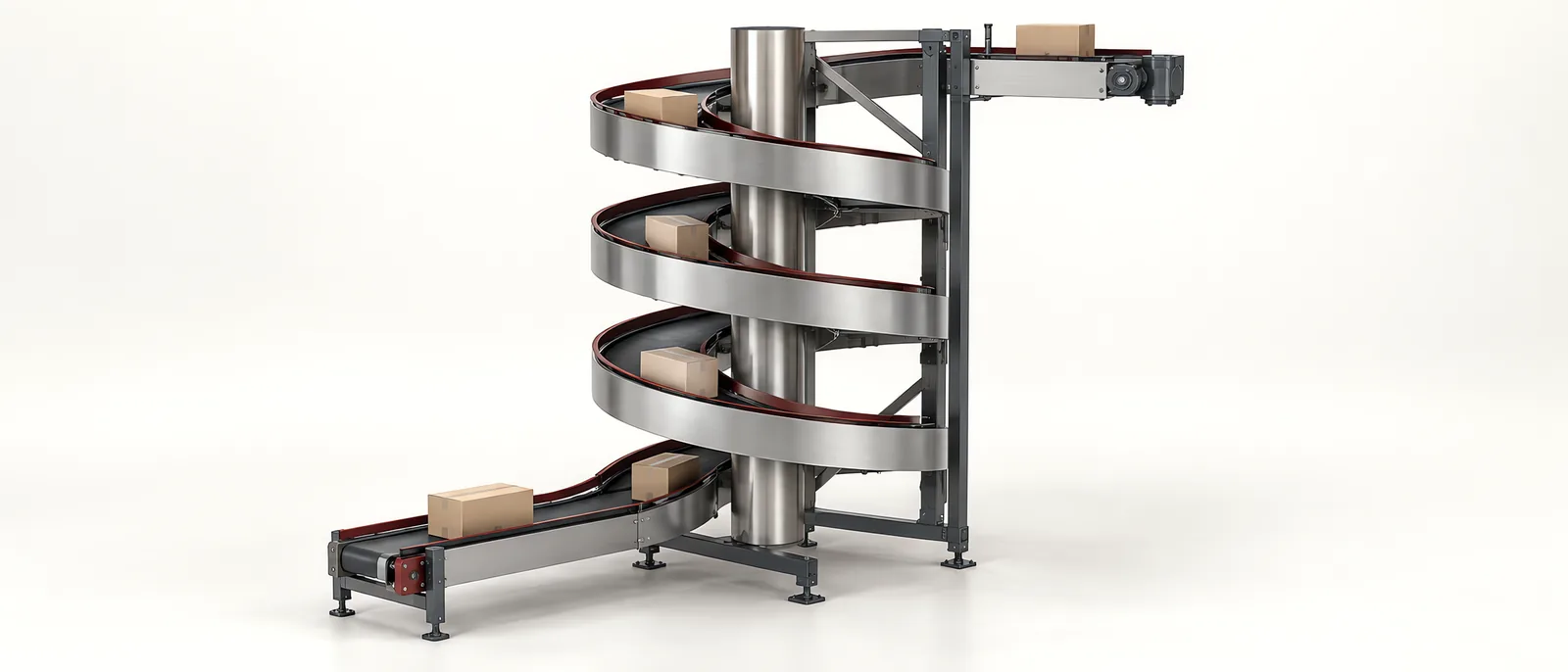
Conceptual equipment illustration.
A spiral conveyor moves packaged products between elevations along a continuous helical carrying path. It is useful where a long inclined conveyor would consume too much floor space and the process needs a steady flow of cartons, trays or totes.
The compact footprint is only part of the layout. Include the infeed and outfeed routes, total height, product clearances, maintenance access and space to recover a stopped load. This guide concerns unit-load spiral conveyors, not screw conveyors for loose bulk material.
Establish the Two Transfer Conditions
Start at the lower and upper interfaces. Record their elevations, directions, available straight lengths and required product orientation. Then draw the spiral between them. A compact tower is not a complete solution if either transfer forces an unstable turn immediately before a sensitive machine.
Ryson’s case spiral conveyor description identifies cartons, cases, trays and totes as unit loads for continuous vertical transport. Its guidance also distinguishes the conveyor’s total load capacity from the dimensions of an individual product. Both need checking when several products occupy the spiral together.
Use the conveyor types comparison to compare a spiral with an incline or lift before committing to the space allocation.
Review the Product on the Inclined Path
A product’s behaviour depends on its base, weight distribution, friction and packaging condition. Include the lightest empty pack as well as the heaviest full one. A tall container can be harder to handle than a heavier, lower carton.
Ask for trials at the proposed operating conditions, including starts and stops. Observe whether the product slides, rotates, touches guides or changes orientation at the transitions. Record any restrictions on product spacing and mixed-size operation.
| Specification item | What it changes |
|---|---|
| Smallest and largest product | Carrying width, guide arrangement and transfer geometry |
| Product height and stability | Clearance and acceptable motion on the inclined path |
| Weight of each load | Local carrying requirement |
| Maximum number of loads on the spiral | Total loading condition for the selected equipment |
| Flow direction | Transfer arrangement and controls for upward or downward movement |
| Stop and restart pattern | Product stability and coordination with the receiving process |
Do not assume that a machine suitable for carrying a product can also accumulate that product in contact with others. Define the intended buffering behaviour separately.
Include the Controls in the Equipment Scope
A spiral purchased as a mechanical conveyor may need integration with the facility control system. Ryson describes both standard supplied devices and optional controls on its product page. Confirm what the selected supplier actually provides and what the integrator must add.
The conveyor design scope should identify drive control, protective devices, product detection and the machine-to-machine signals. Give each signal a named owner and a defined effect on upstream release.
At the upper exit, a blocked receiving line can affect every product already on the spiral. Establish how the infeed is stopped, how much space remains and how products are released after the blockage clears. Check the actual stopping distance and occupancy conditions during commissioning.
Leave Space for Maintenance and Installation
Draw service access around the equipment, including the items that need routine inspection or replacement. Include access to upper-level sensors and transfer sections. An access platform, removable guard or maintenance opening takes space even when it is absent from a simplified sales drawing.
Plan the installation route into the building. Compare equipment dimensions and lifting arrangements with doors, floor openings and the available working area. Record the interface loads and building requirements for the appropriate design review.
For a packaging operation, coordinate these decisions through the packaging line integration plan. The spiral’s maintenance or recovery zone should not make another machine inaccessible.
Accept the Complete Vertical Route
Run the permitted product range through the actual lower transfer, spiral and upper transfer. Test a blocked outfeed, an interrupted upstream flow and a restart with products already on the machine. Confirm both product stability and the response of the surrounding conveyors.
When the route connects warehouse levels or production floors, place these tests within the warehouse and intralogistics system acceptance plan.
Considering a spiral conveyor? Tell us the elevations and products involved. We can discuss the route, interfaces and space needed for integration.