
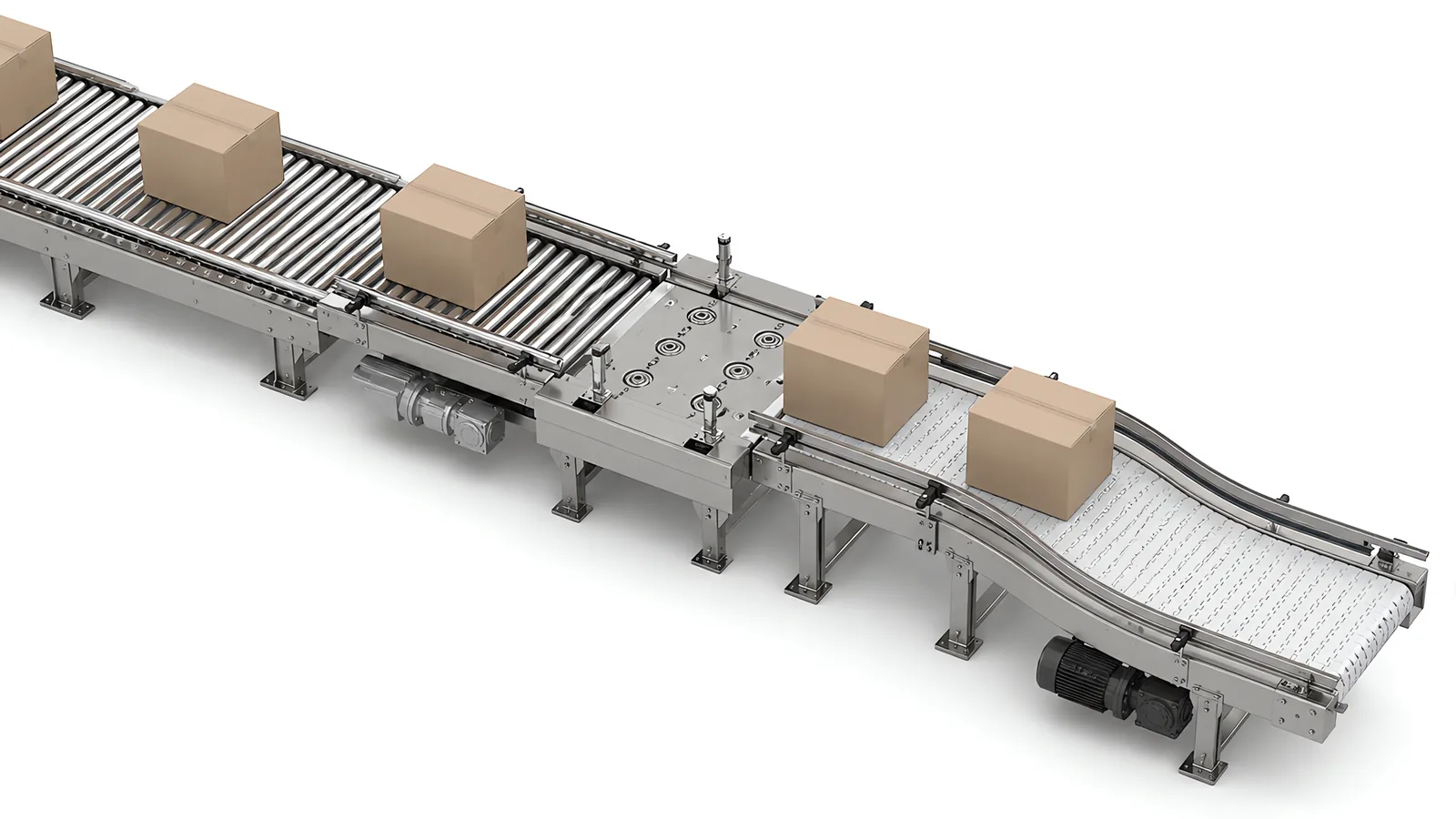
Motionwell Automation designs and builds conveyor and material handling systems in Singapore to connect production machines. We select the carrying surface, accumulation zones and transfer mechanisms around the product, then integrate the signals that control release, blockage and recovery.
Delivered systems include 24 V motor-driven roller accumulation on a carton palletizing cell, a heavy-duty conveyor rated for 500 kg per pallet position on an EV battery disassembly line, dual roller feeds for a multi-machine CNC gantry and a closed-loop tray conveyor inside cleanroom test equipment. Each solves a different transport problem: preventing case pressure, supporting a heavy load, keeping machines supplied or locating a unit accurately for testing.
Conveyor modules, drum motors, belting and cable carrier come in as catalogue items. What we design is the arrangement: which family carries which product, where the accumulation sits, how one section hands off to the next, what the controls do when a zone fills, and how the whole run meets the machines at either end.
This page is about the transport layer and stops where the machines start. Layer patterns, pallet handling and the fenced cell are on our automated palletizing systems page; grouping loose units into a case is on the case packing and wrapping page; storage, retrieval and vehicle-based movement are on the warehouse and intralogistics automation page. What follows runs in the order the decisions get made, from what picks the conveyor family through to when a conveyor is the wrong purchase.
Is the Conveyor Decided by the Product or by the Length?
It is decided by the product, and immediately after that by the accumulation strategy. Length decides drive sizing, structure and price. It does not decide the family, and an enquiry that opens with a number of metres has skipped the two questions that settle the design.
Four questions settle most of it, and all four are answerable from a sample and a photograph. How short and how stable is the worst item: a roller conveyor carries only what stays supported across enough rollers to sit level, so roller pitch follows the shortest product in the direction of travel. Can the item be pushed by the item behind it, which is the accumulation question in its rawest form. Does its position have to be known, or only its presence, because a product that must arrive at a defined place in a defined orientation belongs on something that holds it: a bottle sliding on a flat-top chain is not located, a bottle in a puck is. And what is on it and around it, since moisture, oil, dust, heat, static charge and cleaning chemistry each rule out families before anything else.
| Family | What it suits | What breaks it |
|---|---|---|
| Fabric belt on a slider bed | Small, light, short or unstable items, inclines, and any run needing a continuous surface with no gaps in it | Wet, hot or sharp product, a splice that traps residue, and accumulation of any kind |
| Modular plastic belt | Positive drive, curves without a separate transfer, product that must not stall; sections lift out for cleaning | Cost per metre, and it still accumulates under pressure unless the run is zoned |
| Gravity roller | Short manual moves, laybys and staging where a person pushes the load | Anything needing a rate, a gap or a controlled release |
| Belt- or chain-driven live roller | Powered transport of cases, totes and trays over long straight runs | Accumulation, because the run drives together and product presses on whatever stopped |
| Motor-driven roller zones | Independent zones, so a stopped item ahead is not pressure behind it, and release one item at a time | More control hardware per metre, plus the cabling and zone cards |
| Chain and slat | Heavy, hot, oily or awkward loads: pallets, drums, castings, pallet discharge into a wrapper | Product too small to sit across the slats, and the mass and noise of the format |
| Puck or carrier | Anything unstable, round, tall, or that must be held square under a station | One carrier set per product envelope, and a return path they have to travel |
The bottom two rows are argued about on price and decided on the product. Motor-driven roller zones cost more per metre than a driven run, which is the subject of the next section, and carriers cost more again, and are the answer that survives where a product has to be both located and buffered. That is why they turn up on filling and labelling lines.
For a broader comparison, the guide to conveyor system types covers elevation changes, specialist carrying methods and the maintenance work each construction needs. Use it to shortlist the transport family before specifying this line’s transfers and controls.
An overhead route needs the fixture, clearance and loaded turns checked together. overhead carrier requirements covers carrier motion, access and process stops.
Why Does Zero-Pressure Accumulation Exist?
Because product pressed against stopped product is being damaged, and is about to jam on release.
Picture the ordinary case: a run of driven rollers all turning together, a stop at the head of it, and a machine beyond that stop taking one item at a time. The rollers keep turning under everything behind the stop, so every item is driven into the item ahead of it and the force adds up down the queue. Cartons deform, labels scuff, thin-walled containers ovalise, tall items tip, and a soft pack crumples.
The second failure is the one that stops production. A queue held under pressure releases as a solid block, so nothing gaps, and the machine that wanted one item at a time gets a slug of them. It either jams or waits while somebody separates the slug by hand.
Zero-pressure accumulation removes both by dividing the run into zones, each with its own drive and its own occupancy sensor, and by letting a zone run only when the zone ahead of it is clear. Product stops with a gap in front of it and no load on it, and the queue releases one zone at a time. The delivered carton palletizing infeed is built that way: 24 V motor-driven roller zones with the drive inside the rollers, and a three-zone buffer in which every zone reads its own occupancy. That occupancy is read by a photoelectric sensor at each zone, because a timer reports only that a zone was told to run: it cannot separate a zone holding a case from a zone whose case never arrived, and a zone that releases into one still occupied is the jam the accumulation was bought to prevent. The whole build, including robot selection and the safety design around it, is in the palletizing robot case study.
How long the buffer needs to be is a design decision, and never whatever length was left over between two machines. A buffer does not remove a stop, it converts a stop into a slow-down, and how much of a stop it absorbs follows from how long the downstream machine typically stops and what the upstream one keeps producing meanwhile. Two delivered examples show the range: three zones ahead of a palletizer, and a three-position accumulation buffer between disassembly and sorting on the battery module line, put there so the two ends of the process need not share a cycle time.
Pressure is not always wrong, which is worth saying before anyone specifies zones down a whole plant. Rigid, unmarked product travelling a short distance into a blade stop accumulates against it perfectly well, and a driven run costs less to buy and to maintain. The rule is the product.
The zero pressure accumulation design guide covers zone length, release modes and restart occupancy. The carrying surface remains a separate decision: roller conveyor selection checks support under cartons or totes, and pallet conveyor design follows the pallet runners through each transfer.
Where the route changes elevation, compare a spiral conveyor against the available product stability and access space. At a packing-machine infeed, a case erector supplies light empty cases whose flap and seam geometry need checking at the transfer.
What Happens Where One Conveyor Meets the Next?
The product crosses a gap, and small or unstable items fall into it, tip over it or stall on it. This is the failure that turns up at commissioning on a line that looked complete on the layout drawing.
Every transfer between two sections has a physical gap, set by the diameter of the pulleys or rollers at each end plus the frame between them. A long rigid case bridges it and never notices. A short carton, a soft pouch, a small tray or a vial noses down and stalls, tips forward, or drops through. The ratio between the gap and the product footprint decides, so the item to test with is the smallest one in the range.
The fixes, roughly in order of cost:
Remove the transfer. One continuous run has no gap in it, which is one of the two reasons modular plastic belt earns its cost per metre where product needs positive transfer, and it is the least expensive answer whenever the layout allows a single length.
Shrink the gap. A nose bar or knife-edge end, or a small-diameter transfer roller between the two sections, closes the distance the product has to bridge.
Bridge it with a dead plate. The following item pushes the leading one across. It costs almost nothing and reintroduces exactly the pressure the accumulation design just removed, so it belongs where product is rigid and nowhere else.
Drive across it. A powered transfer roller or a short powered section running whenever product is present carries the item over.
Two other things change at a transfer and both are easy to miss on a drawing. A step in height between sections is an impact, which damages product and makes noise. And a speed change is a standard way to create or close a gap: a faster downstream section pulls items apart, a slower one closes them up. If your next machine needs gaps, this is usually where they get made.
Empty-pallet dispensing is a separate controlled handover. The empty-pallet supply guide connects stack replenishment, single-pallet release and receiving-conveyor checks.
Product spacing and movement connect detection to the correct reject action. metal detector conveyor tracking tests that path with the actual product and conveyor behaviour.
The extending section still needs coordinated fixed transfers. telescopic conveyor interfaces tests cargo presentation, occupied outfeed and direction/stop sequencing.
What Do Merges and Diverts Demand That a Straight Run Does Not?
They demand a decision per item, taken in time, and a place to make it.
A merge asks two streams to become one, so every item joining the main line needs a gap on it to enter. Three things have to exist: a gap-making mechanism upstream, a stop and release on the joining lane so an item waits for its gap, and a rule that owns priority. Alternate, main-line priority and fullest-lane priority are all defensible; the failure when nobody chose one is a lane that starves while the other jams.
A divert asks a single item to leave while the rest carry on, and the device follows the product.
| Divert device | Suits | Watch for |
|---|---|---|
| Pneumatic pusher | Small items at speed into a single destination, including quarantine and reject | Impact on the item, and whether the destination fills without anybody noticing |
| Pop-up wheel or roller section | Cases and totes at a right angle, without rotating them | Cycle time, since the item stops before it is driven away |
| Swing arm or gate | Splitting a stream between two lanes at speed | Timing at the transition, and product catching the gate edge |
| Robot pick-off | Items placed, or segregated into several destinations | Rate, and whether the decision data reaches the arm in time |
A delivered example sits at the top of that table: the palletizing infeed carries a reject lane with a pneumatic diverter for out-of-spec cartons flagged by an upstream checkweigher. Whatever the device, it needs a sensor proving the item actually left the line: a stuck pusher passes failed product downstream while the log records a rejection, which is worse than no rejection at all because it is a fault that hides itself.
Then the timing problem, which is where these stations are lost. The decision was made upstream at a camera, a reader or a checkweigher, and it has to travel with the item to a device several metres away. Two mechanisms do that reliably: a shift register clocked by a line encoder, or re-identifying the item at the divert. A timer works only while the line speed never changes, and the line changes speed every time an operator touches the infeed. The reading and reconciliation side of the same problem, including why an item gets counted twice at a merge or an accumulation table, is on our code reading and traceability page.
What Does a Curve Do to Product Orientation?
It rotates it, because the outside of a curve is longer than the inside.
The outer edge of a product going round a bend has further to travel than the inner edge. On a plain belt curve the product slews outward and rotates until it finds the outer guide rail, then rides along it. A tapered-roller curve compensates for part of that by turning the outer end of each roller faster, and a modular belt curve drives the belt itself around the bend, which is the second reason modular belt earns its price where product has to change direction, because the product keeps the orientation it entered with, and never finds the outer rail and riding it round the bend.
Three consequences follow, and together they are why a curve is never only a change of direction on a layout:
- A case entering square leaves skewed, so a station downstream wanting a repeatable pick position no longer has one. That is why the delivered palletizing infeed carries a carton squaring station with pneumatic side guides between the transport and the pick.
- Product rides the outer rail, which scuffs labels and printed panels. A curve after your labeller or coder is where marked packs come from.
- Tall or top-heavy items tip outward, and they tip at a lower speed than the straight run was sized for.
Two alternatives are worth pricing before accepting the rotation. A right-angle transfer lifts the item on a pop-up section and drives it away at ninety degrees, changing direction without turning: it costs cycle time and buys orientation. For a product that must not rotate or lean at all, the answer is not a better curve but a carrier that holds it.
What Changes on a Washdown or Hygienic Line?
The frame stops being structure and becomes part of the cleaning procedure.
The governing rule is that an open frame that drains beats a closed one that holds water, because a box-section leg with a sealed end keeps whatever gets into it. What lets an operator finish a clean in the time the schedule allows is a set of specific choices: sloped surfaces so water runs off, continuous welds instead of lap joints, no horizontal ledges under the product zone, and tool-free removal of anything that has to come off. The tray-fed filling and sealing machine we delivered for a medical and pharmaceutical customer runs a stainless steel frame with product-contact surfaces finished against the customer’s cleaning chemistry, and was designed to sit inside ISO Class 7/8 space; the cleanroom end of the same argument is on the cleanroom automation equipment page.
The belt choice follows. A fabric belt has a splice and a return path hard to see into and harder to reach, while a modular plastic belt lifts out in sections, which is why it appears on hygienic lines more often than its cost per metre alone would justify. The drive follows too: a drum motor puts the drive inside the pulley, so no external gearbox, coupling or chain guard stands in the wash path.
Be precise about the electrical scope, because this is where specifications quietly disagree with sanitation procedures. The enclosure rating is a specification line, and it is set from the cleaning routine. An IP65 enclosure covers dust ingress and low-pressure water jets, so hose-down and wipe-down between shifts is fine. IP65 is not a high-pressure or steam-cleaning rating. A procedure using caustic foam and a pressure rinse belongs on the specification before the frame is drawn, and it changes the guarding hardware too: a standard dry-environment interlock switch fails early on a washdown line and takes the line down with it. The wider washdown line context is on our pharmaceutical packaging automation page.
A different environment makes the same point from the other direction. On the EV battery disassembly line the belt surfaces are carbon-fibre-loaded PVC with surface resistivity in the dissipative range under IEC 61340-5-1, and grounding straps bond the conveyor frame to the facility ground bus every 3 m, so charge bleeds away continuously, and never discharges near an exposed terminal. Different hazard, same principle: the frame is part of the process.
What Makes a Conveyor Quiet, Maintainable and Safe to Stand Beside?
These three arrive together because they come from the same decisions, and they matter because a conveyor is one of the few machines somebody stands next to for a whole shift.
Quiet. Noise comes from impact and from clearance: product dropping at a transfer, slack in a chain, a bearing running dry, a roller with a flat worn on it, product rubbing a guide rail for metres at a time. Each of those is also a damage mechanism, so the choices that make a run quiet are the ones that make it gentle. No drops between sections, no product held against a rail longer than it must be, correct tension, and the right family for the product to begin with.
Maintainable. Five questions asked at design review decide what the run costs to own:
- Can a drive be replaced without stripping the section? A drum motor comes out as one module; a motor, gearbox, coupling and chain does not.
- Can a zone card or a sensor be swapped without anything being re-taught afterwards?
- Is the take-up reachable, and is the tension it was set to written down anywhere?
- Are sensors mounted where an indicator is visible from a standing position, and never where the bracket was easiest?
- Do the spares carry part numbers your storeman can order without calling us? Drum motors, belt modules, zone cards and photoelectric heads can each be specified as a catalogue item held in distributor stock, and the test to apply at design review is whether every one of them has a replacement path that does not run back through the builder. A part only the builder can source stops the line for as long as the builder takes to answer, which is the argument made in full on our local versus overseas machine builder page.
Safe to work beside. Conveyor hazards have one useful property: unlike a robot cell, they do not move. In-running nips where a belt meets a pulley, the drive and take-up, transfer points, and the pinch between a moving belt and a fixed guide all sit at known places and can be guarded once, at design. What has to be decided is access along the run, meaning a stop reachable from wherever a person can stand, and behaviour on stopping, since product rolling back on an incline is a hazard the risk assessment has to have seen. The required performance level of that stop chain comes from the risk assessment, and ISO 13849-1:2023 is the standard the reliability argument is made under. Singapore does not require CE marking, but the Workplace Safety and Health Act requires dangerous parts of machinery to be securely fenced and places duties on the occupier and on anyone supplying machinery for use at work. The physical scope that follows, meaning guard fencing, interlocked access doors, safety-rated stop circuits and LVD and CE testing, is on our machine safety and CE marking page.
One scope question belongs here. Adding a section to a working line is a modification, and the European Commission’s machinery guidance states that the Machinery Directive applies to products placed on the market for the first time or when existing machinery is modified to such an extent that it becomes de facto new machinery. Where the new conveyor changes what the line as a whole does, that decides who carries the conformity work, and it is cheaper settled in the scope discussion than after commissioning.
What Do We Need to Know About the Last Five Metres You Already Run?
A large share of this work is a retrofit into a line that already produces, so the specification governing the interface is yours. Cases arrive at whatever height and pitch the old conveyor runs at, and the new section has to match that before it does anything clever.
| What we ask for | What it decides | What happens without it |
|---|---|---|
| Height to the top of the carrying surface at the handover point | Whether the new section meets it, or a lift or decline is in scope | A transition discovered on site and paid for twice |
| Product pitch and orientation as it arrives | Whether a squaring, turning or gapping station is needed | The pick position is not repeatable and a turning station appears late |
| The shortest and least stable item | Roller pitch, belt family and transfer type | A run that carries most of the range and stalls on the rest |
| Sustained rate, and how long the downstream machine typically stops | Zone count, buffer length and drive sizing | A buffer sized for the case that stops the line |
| Make, model and vintage of the controller at that end, and who holds the program | Where the handshake lives and whether it can be extended | A second controller bolted alongside the first and owned by nobody |
| Which signals are exchanged, and who owns each | Whether the two ends agree on what ready, full and fault mean | The interface becomes the project, discovered during commissioning |
| Sanitation method, chemistry and frequency | Frame construction, belt family, enclosure rating and interlock hardware | A frame that cannot be cleaned in the window the schedule allows |
| Ceiling height, aisle width, forklift routes and pallet size | Whether the route can go overhead, and where a full pallet leaves | A layout that fits the drawing but not the building |
The last row carries more weight than it looks like it should, because a conveyor is the one machine on a plant that has to agree with the building along its whole length. On the controls side the scope is usually smaller than it looks. Control-system modernisation of legacy production machines is Motionwell’s largest current work line, replacing ageing PLCs, servo drives and VFDs on the platform a plant already supports, so tying a new section into old controls is routine work here. Where an existing PLC is too old to extend safely we say so and quote the replacement, and the options for that are on our machine retrofit and modernisation page.
Once those interfaces are defined, compare conveyor quotations on the same scope. Transfer mechanisms, machine handshakes and installation work should be visible in the budget, including who commissions the complete route.
When Is a Conveyor the Wrong Answer?
Four situations, and they are worth checking before a layout is drawn.
The route is not permanent. A conveyor is capital committed to one path, which is efficient on a route that runs every shift for years and wasted on one that moves next quarter. Where the relationship between areas changes, a vehicle carries the route in software. Our AGV deployments use RFID-based floor navigation and carry chain conveyor modules on top for automated pallet loading and unloading from stationary chain conveyors, and where routes change often enough that re-laying tags becomes the bottleneck, an AMR with SLAM navigation is the better tool, a trade worked through in the AMR versus AGV guide.
The distance is a symptom. A long run between two machines is sometimes a layout that should be shortened. Conveying makes a bad layout work, and then keeps paying for it.
The product cannot be conveyed at all. Anything with no stable base, anything that must not be touched on the face it would be carried on, and anything no standard carrier exists for moves on a machine instead. On our heavy-duty linear gantry cells the gantry does the transport between machines and dual roller conveyors handle only material coming in and going out. The truss manipulator installations work the same way, picking workpieces one by one from motorised roller conveyors, with a scissor lifter underneath raising the conveyor to present the next batch when the quantity runs low.
The rate and the distance are both small. Two operators and a trolley often beat a conveyor at low volumes over short distances, and that answer costs nothing to trial.
There is a fifth case worth naming for the sake of the comparison. Where a straight run at standard case sizes into a standard destination is genuinely all you need, a catalogue conveyor from a conveyor house covers it at a lower price. What a designed run is for is the case that has to accumulate without pressure, hand a product to a machine with a handshake behind it, survive a sanitation procedure, or fit a building nobody designed around it.
What Usually Goes Wrong, and Where Does the Fix Live?
A line already running tells you which of the decisions above went the wrong way, which is more useful than a specification.
| What you see on the line | What it usually is | Where the fix lives |
|---|---|---|
| Crushed cartons or scuffed labels at the head of a queue | Line pressure on a driven run accumulating against a stop | Zoned accumulation, or a shorter queue with a controlled release |
| The next machine gets a slug of product, then nothing | A queue releasing as a block because it contained no gaps | Zone-by-zone release, and a gap made at the discharge |
| Small items stall, tip or drop between two sections | A transfer gap larger than the smallest product’s footprint | A nose bar, a transfer roller, or one continuous belt through the run |
| The pick position is different on every case | Rotation through a curve, or a case arriving skewed | A squaring station before the pick |
| The robot waits, then rushes, then waits | Gaps in the upstream stream from rejects and stops | Buffer length sized as a design decision, covered on our robot integration services page |
| A reject is logged but bad product reaches the pallet | No sensor proving the item left the line | A confirmation sensor on the reject path |
Standards Used in Machine Design and Validation
These references inform the design, testing and documentation described on this page. Each row links to its primary source and records the edition checked.
| Standard | Current edition | What it means for your machine |
|---|---|---|
| ISO 13849-1: Safety of machinery, safety-related parts of control systems | ISO 13849-1:2023 | Provides the design method for safety-related control functions, including architecture, component reliability, diagnostic coverage and common-cause failure measures. The machine risk assessment establishes the required Performance Level; design calculations and validation provide the evidence for each function.Checked 1 Sep 2026 against ISO 10218-1:2025 normative references |
| Modified machinery as new machinery: Machinery Directive 2006/42/EC scope rule | Directive 2006/42/EC (applies until 19 January 2027) | For EU-market retrofits, review the proposed changes to function, performance and safety to establish whether the modified equipment is treated as new machinery. Record that assessment during scope definition and assign responsibility for the risk assessment, technical file and conformity documentation.Checked 1 Sep 2026 against European Commission, Machinery page (single-market-economy.ec.europa.eu/sectors/mechanical-engineering/machinery_en) |
Frequently Asked Questions
How fast should a conveyor run?
Fast enough to create the gap the next machine needs, which is usually a different number from your line rate. Speed and rate are separate: a run carrying its cases nose to tail and a run carrying the same number of cases with a clear gap between each are moving at very different speeds, and only the second can be picked, read or diverted item by item. The delivered powered roller infeed on our carton palletizing cell runs at 30 metres per minute for that reason, and the line never demanded it. Speed also has ceilings the rate cannot argue with: product stability through a curve, impact at a transfer, and stopping distance when something upstream faults.
Which signals have to be agreed between your conveyor and our machine?
At minimum four, each with a named owner on one side or the other: product ready at the handover point, buffer or accumulation full, downstream ready to receive, and fault. On the delivered palletizing line that set is case ready, accumulation full, pallet in position, pallet complete and fault. The list matters less than the ownership. Every interface is a place where two suppliers each assumed the other owned it, and the symptom shows up at commissioning as a line that runs normally until something abnormal happens, then stops with neither controller willing to restart it. Agree the signals, the electrical form they take and the owner of each in writing before either side builds anything.
Can a robot pick from a moving conveyor, or does the belt have to stop?
It can, provided four things are all present. The robot controller has to support conveyor tracking, there has to be an encoder on the conveyor drive, a vision or sensor trigger upstream has to tell the controller where each item sits as it enters the window, and the arm needs enough reach and speed to finish the pick inside that window. Miss any one of them and the answer is to index the conveyor and accept the stop, which is frequently cheaper than the tracking option and the commissioning time behind it. Tracking earns its place mainly where stopping the flow would back product up into a process that cannot be stopped.