
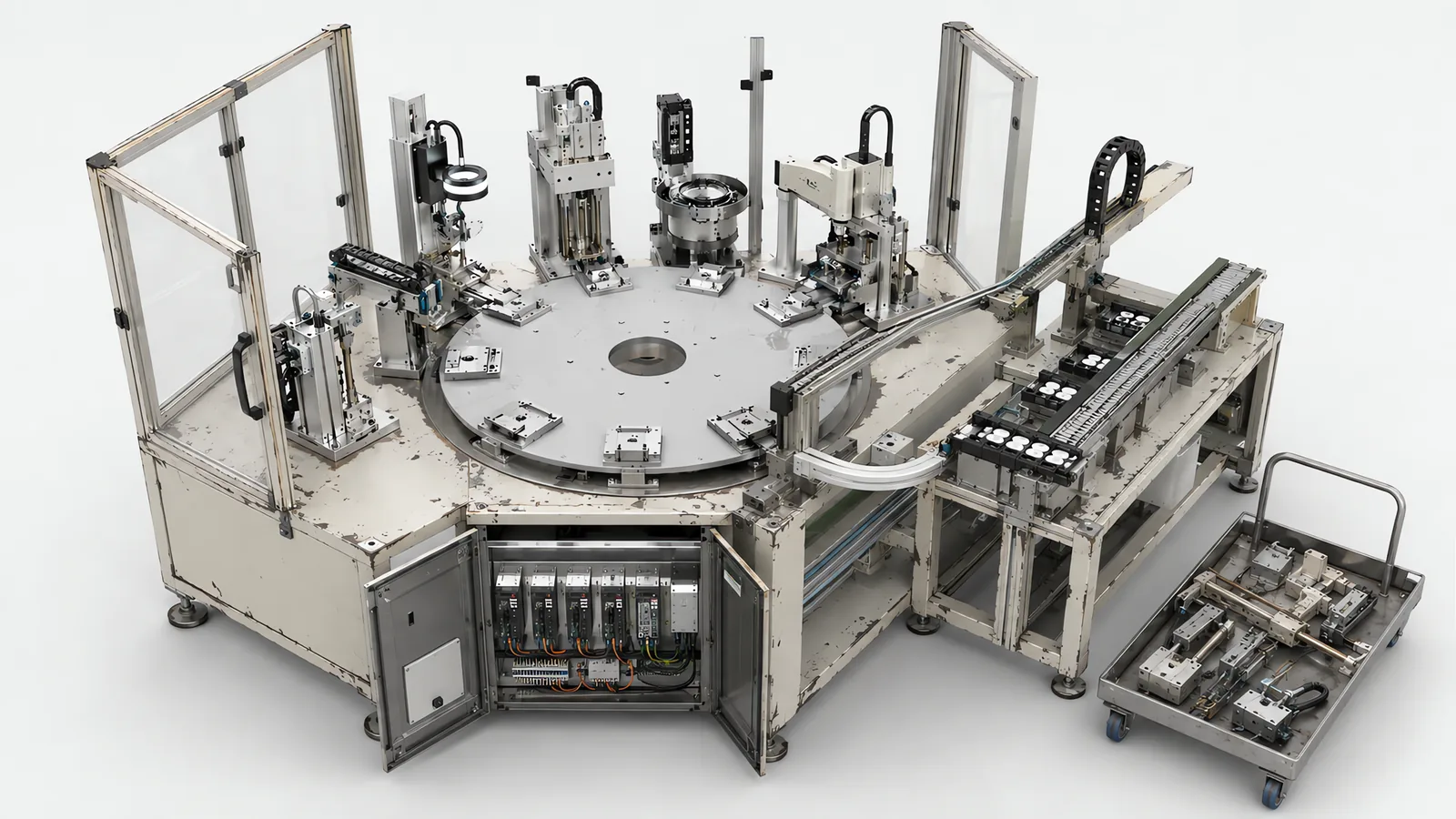
Motionwell Automation runs machine retrofit in Singapore as its largest line of work this year: replacing ageing PLCs, servo drives and VFDs on legacy production machines, normally onto whichever control platform the plant already programs and stocks spares for, because a machine rebuilt onto a platform nobody on site supports has bought a few years and traded one obsolescence date for another. The shape of equipment modernisation in Singapore is usually the same: the mechanics stay, the control system becomes current, and the machine keeps the process capability you have already paid for and proven. Machines are designed, assembled and tested at our Woodlands Link facility, and the company has delivered more than 150 special purpose machines since 2014 under ISO 9001:2015 and bizSAFE Level 3.
Retrofit work happens inside somebody else’s plant, on equipment that belongs to them, so this page is specific about the things that transfer between jobs: the obligation a modernisation creates, the survey that has to happen before a price can exist, and the point at which a machine has stopped being worth the work.
What a landing configuration looks like, since the machine itself stays anonymous. The first decision is where the I/O lives, and two delivered machines went opposite ways on it for defensible reasons. A seven-drive modernisation was rebuilt around one controller and a central I/O rack in a new enclosure, because the drives stood together at one end of the machine and the field wiring already ran back to a single panel: concentrating it keeps the device count down and puts every terminal in one place for fault finding, at the cost of a long loom and a panel that has to be opened before anything can be seen. A seven-axis indexer took the distributed route instead, with I/O mounted at the machine beside the axes it serves and the sensor layer brought onto the machine network at the point of use, because on a machine whose axes are spread around a dial the loom is the expensive part and a fault then reads out at the station where it happened. What that buys is paid for in more devices to address and in a network whose failure takes out a group of inputs.
Three choices inside those two configurations carry more weight than the controller badge. On the seven-drive machine each drive took its safety function on the drive itself, never behind a shared contactor, which makes the stop a monitored function that can be validated and logged instead of a contact assumed to have opened. Gearmotors were changed only where the mechanical ratio changed, because the mechanics are what the retrofit is paying to keep, and re-rating a drive around the existing gearbox is cheaper than re-rating the gearbox around a new drive. And the enclosure was replaced, which is the usual outcome once the heat load of current drives exceeds what the original panel was ventilated for. Both machines are ordinary outcomes for this kind of work. Neither is a recommendation for your machine until the survey says so.
The safety scope that follows sits on our machine safety and CE marking page. What a control change does to a validated machine is on the computer system validation page, and the motion side of the same job is in our guide to servo, stepper and pneumatic actuator selection.
Why Modernise a Machine, and What Forces the Retrofit Decision?
Four things, and they arrive independently. A machine can be mechanically excellent and still fail on any one of them, which is why the trigger matters more than the age of the machine.
Obsolete controls with no spares. The controller is out of vendor support, spares are scarce, and the firmware cannot be patched. The machine runs, and it runs on the condition that a particular card does not fail. Where a patch cannot be applied at all, which happens with obsolete equipment more often than vendors admit, the compensating measures are to tighten the network route, restrict the accounts and increase monitoring, and that decision has to be documented as a decision.
A safety standard the machine no longer meets. Guarding, interlocking and stop circuits designed to what was normal when the machine was built, on a plant that now specifies a required performance level per safety function and expects a validation record for each one.
A product change the machine cannot follow. This is the mechanical version of obsolescence. A machine built around mechanical cams and pneumatics gets a new product variant, and the cam is not adjustable, so the variant becomes a machining job. Replacing that cam with a servo and an electronic cam profile turns it into a recipe change, and that conversion is usually the whole business case, ahead of any speed gain.
Data the existing controls do not expose. A relay-logic machine may have no readable cycle tag or counter, so data collection needs an interface, added sensors or dry-contact signals. The legacy machine connectivity page compares those routes. When the requirement also includes user accounts, audit trails and controlled records, a controller or data-layer upgrade may be needed, as described on our 21 CFR Part 11 and electronic records page.
| What forces it | What it looks like on the floor | What deferring it costs |
|---|---|---|
| Obsolete controls | A controller out of vendor support, scarce spares, firmware that cannot be patched | The unplanned outage lasts as long as the hunt for a replacement card, not as long as the repair |
| Safety standard gap | Guarding and stop circuits designed to an older expectation, with no safety function register behind them | The gap surfaces during an audit or an incident, never at a time you chose |
| Product change | A cam, a stop or a change part that has to be re-machined for each new variant | Every variant becomes a workshop job, and the machine sets the product roadmap |
| Data gap | No cycle-active state, no readable count, no stop reason, no user account | Improvement work argues from opinion, and regulated records stay on paper |
Where two of them arrive together, the second one is what turns a repair into a project. A controller replacement is also the moment the alarm structure gets rebuilt, so tagging each alarm with a downtime reason costs almost nothing then, while doing it two years later means touching a program that is by then in service. The measurement side of that is set out in our guide to OEE and where the data comes from.
Adding vision or production data does not automatically mean replacing the machine controller. Use the Industrial PC vs PLC guide to divide sequencing, image processing and data storage, then define what happens if the connection between them fails.
What Has to Be Established Before a Price Can Exist?
A survey, on the machine, before anyone quotes. On legacy equipment the control system is often undocumented, and working out what the existing circuits do before replacing them is frequently the largest single item in a retrofit safety scope. That work has to happen whether or not it appears on a quotation, so the only question is whether it is priced or discovered.
Four things get established on the machine itself, and each of them can change the answer; the table below adds the two that follow from them.
What the machine currently does, as opposed to what the manual says it does. That means the full sequence, every operating mode including setup, cleaning, jog and manual recovery, the interlocks between stations, the recipes or format settings and where they live, and the undocumented behaviour that somebody added during a shutdown years ago and never wrote down. A retrofit reproduces all of this before it improves anything, and the parts nobody can describe are a common source of commissioning trouble.
What its safety functions are. Each guard door, each stop, each light curtain, each two-hand control, listed as functions, with what each one is protecting against. Some legacy machines have safety functions only in the sense that a circuit opens a contactor, with no record of what performance level that circuit was ever supposed to reach.
What the electrical drawings actually match. The gap between the schematic set and the machine decides more than people expect. Every modification made since commissioning either reached the drawings or did not, and the ones that did not are found by tracing wires. This is the part of the survey with no shortcut.
Which parts are still procurable. Controller, drives, HMI, safety devices, sensors, motors and the mechanical wear parts, each checked for vendor support status and lead time. Ask for the end-of-support date of the replacement platform in writing at the same time, because that is the number that sets your real patching horizon, and the number that turns into another project later.
| What the survey establishes | Why no price exists without it |
|---|---|
| Sequence, modes, interlocks and recipes | Sets the software scope, which is most of the engineering hours |
| Safety function list with what each protects against | Sets how many circuits, calculations and validation tests the job carries |
| Drawing-to-machine accuracy | Decides whether re-termination is a day or a week, and whether the window holds |
| Procurable parts and end-of-support dates | Decides whether the platform is a replacement or a temporary reprieve |
| Mechanical condition of what stays | Decides whether new controls are being fitted to a mechanism worth keeping |
| Where the conformity line sits for this scope | Decides whether the deliverable is a modified machine or a new one, covered below |
The survey has a second output that buyers value more than the quotation: a documented description of the machine as it exists today. On a regulated line that description is an IQ deliverable in its own right, since the design specification, I/O list, schematics and software inventory all have to describe the machine as it now stands.
CNC modernization needs axis feedback and auxiliary sequences inventoried together. CNC control retrofit scope defines retained interfaces and finished-workpiece acceptance.
Device collection needs a suitable master and upstream interface. IO-Link master data path defines port class, supply, process data and diagnostic access.
Sensor connectivity does not establish what is measured or exposed. IO-Link sensor data interpretation checks the physical variable, IODD, timing and replacement settings.
Industrial data integration needs a contract as well as a protocol label. OPC UA versus MQTT architecture explains their different functions and OPC UA PubSub over MQTT.
Industrial AI preparation starts with one observable decision and representative evidence. manufacturing AI data readiness connects acquisition, labels, independent testing and the operating action.
When Does a Modernisation Become New Machinery in the Legal Sense?
This is the reason scope has to be settled before hardware is ordered.
The European Commission states that the Machinery Directive applies to products placed on the EU market for the first time or when existing machinery is modified to such extent that it becomes de facto new machinery. For a retrofit that sentence is the decision that sets the cost. A modernisation which crosses that line puts the party doing it in the position of placing new machinery on the market, with the conformity work that follows, while one which stays below it does not. Where the line sits is a judgement made per project, and it has to be settled before the scope is fixed.
Two consequences follow, and neither is a paperwork detail.
The first is that scope decisions and legal position are the same decision. A drive replacement that keeps the machine’s function, its safety functions and its performance identical is a different proposition from one that adds an axis, raises the rate, changes what the machine makes or removes a guard because the new controls make it unnecessary. The technical arguments for the second group are often good ones. They are also the arguments that move the project across the line, so they get made in the kickoff meeting with the conformity question open, not in a change order six weeks later.
The second is that somebody owns the outcome, and it may not be the integrator. Where a customer assembles a supplied machine into their own line they may become the manufacturer of the assembly, with the supplied machine covered by a declaration of incorporation. A retrofit rearranges that question, because the party who modifies the machine and the party who operates it are frequently not the same. Write the answer into the contract.
We do the machine builder’s share of the work that follows: the risk assessment, the safety architecture, the validation and the technical file. Issuing certificates is a notified body’s role and it is not ours.
Which Machinery Law Will the Machine Be Judged Against?
A machine being modernised now will serve across a change of law, so the useful question is which text it will be judged against over its remaining life today.
Machinery Directive 2006/42/EC applies to the EU market up to 19 January 2027. Regulation (EU) 2023/1230 applies from the next day, on the European Commission’s wording on a mandatory basis as of 20 January 2027, with no transitional period between the two. Before that date a manufacturer may declare conformity with the new Regulation voluntarily on the EU Declaration of Conformity, which is the option worth discussing on any machine intended to run for years.
| Placing on the EU market | Which text applies | What it means for a machine modernised now |
|---|---|---|
| Up to 19 January 2027 | Machinery Directive 2006/42/EC | The de facto new machinery scope rule above is the Directive’s, and it is the rule in force while your project runs |
| From 20 January 2027 | Regulation (EU) 2023/1230, mandatory, no transitional period | A machine documented only to the Directive is not automatically re-documented; the file is what it is on the day it was compiled |
| Before 20 January 2027, by choice | (EU) 2023/1230, declared voluntarily on the EU Declaration of Conformity | Early conformity is permitted, so a modernisation can be documented against the text the machine will live under |
There is a reason this matters more on a retrofit than on a new build. Regulation (EU) 2023/1230 is the first EU machinery law to put software integrity, updates and connected functions alongside mechanical safety, and a control system modernisation is precisely the moment a machine acquires a network port it never had before. A newly networked legacy machine fails on day one with PLC, drives, HMI and cameras sharing one flat segment and a fresh route to a plant server bolted onto it. Partitioning that properly at design time is cheap; retrofitting an access policy onto a machine already running production is a negotiation, not an engineering task, and the zone and conduit reasoning is in our guide to IEC 62443 for industrial control systems.
Does Any of This Apply to a Machine Standing in Singapore?
Directly it does not, and practically it often does, so it is worth separating the two.
Singapore does not require CE marking. The Workplace Safety and Health Act requires dangerous parts of machinery to be securely fenced and places duties on the occupier and on anyone supplying machinery for use at work, and machines that incorporate lifting equipment must be examined and certified by an approved authorised examiner before use, with periodic re-examination after. Motionwell handles that certification as part of delivery, alongside LVD and CE testing.
The EU text still reaches machines that will never leave Singapore, by two routes. Most multinational manufacturers here specify CE conformity as an internal standard regardless of where the machine stands, so the group engineering standard imports the obligation whether or not the law does. And equipment moves: a machine modernised in Singapore may be transferred to a European site inside the same group, at which point the question of who placed it on the market gets asked about work done years earlier by somebody who is no longer in the building.
If neither route applies to you, say so early and the conformity scope comes out of the quotation. That is a legitimate outcome and it is cheaper. What is not legitimate is leaving the question unasked, because the cost of answering it late is the cost of doing the assessment twice.
What Happens to the Safety Case When the Controls Change?
The safety case is rebuilt. Three parts of it move together on a retrofit.
The calculations move first. ISO 13849-1:2023 is the current edition, and a design still documented against the 2015 edition will need its performance level calculations restated when the machine is re-assessed. On a legacy machine there is frequently nothing to restate, because no calculation was ever recorded, and the safety function register is written from the survey file.
The measurements move second, and this is the test that catches people. Stopping performance is measured on the built machine, not calculated from datasheets, and it is the most important measurement after a control system retrofit, because a new servo drive on old mechanics changes run-down time in ways no datasheet predicts. Scanner and light curtain distances then follow from ISO 13855, using the approach speed constant taken as 2,000 mm/s up to 500 mm and 1,600 mm/s beyond, plus that measured stopping performance. A guard position that was correct with the old drives is not automatically correct with the new ones, in either direction: sometimes the machine now stops faster and the distance could be reduced, and the only way to know is to measure.
The evidence moves third. Validation under ISO 13849-2 is by analysis and by testing, and on a retrofit the testing includes fault injection on the new dual-channel circuits, a reset device sited outside the hazard zone with a full view of it, and energy isolation verified by attempting a movement with the isolator locked off. What survives afterwards is the file: the risk assessment, the safety function register with required and achieved performance levels, the calculation record, circuit schematics, safety distance calculations, the validation report and the stopping time records.
Where the machine runs under GMP or a quality system, the same change triggers an impact assessment on the validation side, and whether historical data can carry the performance argument depends on whether the original validation package was retained. Sites that kept theirs requalify quickly, and that reasoning is set out on the computer system validation page.
Check the proposed network against the retained equipment before fixing the cutover plan. Our PROFINET vs EtherNet/IP comparison explains why device model, motion support and diagnostic access matter beyond having an Ethernet port.
If the change reaches the safety controller, the safety PLC selection guide connects the proposed architecture to the protective functions and validation scope. Include those checks in the shutdown plan alongside production recovery.
How Is the Work Staged Against a Shutdown Window?
The window is the constraint the whole project is designed around, so it gets designed first.
The principle is that the shutdown carries only what cannot be done anywhere else. Panels are built and wired off site. Software is written and exercised against simulated I/O so that the sequence, the alarms and the recipe handling are debugged before they meet the machine. Cable routes, mounting plates and any mechanical adaptation are made and trial-fitted in advance where the machine’s geometry allows it. Everything that survives that treatment is a strip-out and a re-termination.
| Stage | Where it happens | What makes it overrun |
|---|---|---|
| Survey and as-built capture | On your floor, machine running | Undocumented modifications, and the person who made them having left |
| Panel build and software against simulated I/O | Off site, machine still producing | Sequence detail that was never established, so the program is written twice |
| Isolation and strip-out | In the window | Wiring that does not match the drawings, and seized or worn mechanics found on removal |
| Mounting and re-termination | In the window | Cable lengths, gland positions and anything that had to be measured |
| Loop checks and dry run without product | In the window | I/O that was mapped from a list |
| Safety validation and stopping time measurement | In the window | A measured stopping distance that moves the guard positions |
| Product trial and handover | In the window, then production | Format and recipe cases nobody listed, found on the second product |
Two decisions make the difference between a window that holds and one that does not, and both are taken months earlier. The first is whether the old panel is kept intact as a fallback until the new one has run product. Keeping it costs space and a little money and buys a route back; discarding it saves both and commits you. Say which one you have chosen out loud, because a fallback that exists in nobody’s plan is not a fallback.
The second is how the machine is divided. Where a machine has separable stations, taking it in phases means several short windows, and each phase begins from a working machine. Where it does not divide, one window is what you get, and the survey is what shortens it. A single machine also rarely allows the parallel running a lab or a multi-station line can use, so the acceptance evidence has to be gathered inside the window.
A supervisory-platform upgrade must preserve required runtime history as well as configuration. SCADA upgrade evidence defines compatibility, restore and cutover tests.
What Has to Be True Before a Machine Is Worth Retrofitting at All?
Five conditions have to hold, and where one of them clearly does not, the money belongs on a different project.
The mechanics have to be worth keeping. New controls fitted to worn ways, tired bearings, a stretched drive train or a frame that has been repaired twice buy accuracy the mechanism cannot hold. A control system cannot compensate for backlash it cannot see. If the mechanical condition is the actual complaint, controls are the wrong purchase.
The process itself has to be right. A machine that does the wrong operation efficiently is not improved by doing it repeatably. Where the process needs to change, a retrofit locks in the old process and adds the cost of documenting it, and the reasoning for a purpose-built machine instead is in our special purpose machine design guide.
The machine has to outlive the product. If the product it makes is at the end of its life, or a facility move is planned, the capital is better spent elsewhere and we will say so during concept review.
The change has to stay on the side of the line you intended. Where the wanted scope clearly makes the machine into new machinery, price a new machine alongside the retrofit. Once the conformity work, the guarding, the controls and the documentation are all in the retrofit’s scope, the gap between the two options narrows, and the new machine arrives without the archaeology.
A catalogue machine must not already cover it. Where a proven standard machine covers your application at a lower price than anything we would build or rebuild, that is the recommendation you get. Production welding cells are the standing example: those go to the specialists who build nothing else.
There is a sixth case that is not about the machine at all. If no one at the plant can describe what the machine does, no drawings exist, the original builder is gone and nobody has run it in its intended mode for years, the retrofit is a reverse-engineering project with a machine attached. That is a legitimate thing to buy, and it should be bought knowingly, with the survey priced as its own piece of work ahead of any fixed-price quotation.
What Does the Retrofit Leave Behind Besides a Working Machine?
The documentation set, and it is the part that decides whether the machine is still maintainable in five years. On a legacy machine a small fault becomes a long outage when nothing describes the machine accurately, and a retrofit is the opportunity to fix that as a side effect of work you are doing anyway.
What ships with the modernised machine is the same pack our new builds carry: as-built drawings and schematics, the I/O list, program documentation and a program archive, the alarm list with each alarm mapped to a stop reason, calibration records, spare parts lists, operator training and maintenance procedures. On a regulated build that pack is referenced from the IQ and OQ protocols, so the quality team keeps one set of records.
Two additions are worth specifying explicitly because they are easy to leave out. A component list with firmware versions lets your team subscribe to supplier vulnerability notices, and the end-of-support date for the control platform is the number that sets your patching horizon. Neither costs anything at handover and both are awkward to reconstruct later.
Wiring needs traceable terminations and final as-built documents. control-panel wiring verification separates panel checks, field connections and verified I/O behaviour.
Controller maintenance needs a usable backup and model-specific retention procedure. PLC battery and recovery planning covers battery identity, retained values and post-maintenance checks.
Collected values need retained time, quality and operating context. industrial data historian tests tests buffering, replay and the distinction between samples and interpolated queries.
Which Route Fits the Machine in Front of You?
There are more routes than the two most people arrive with, and the ones between a data tap and a new machine are where a good deal of the value sits. Run these questions in order, and the first that gives a hard answer usually settles it.
- What is actually forcing the change: spares, safety, product or data? The driver decides the route more than the machine’s age does.
- Is the mechanism worth keeping? That is judged on physical condition and on the process capability the machine still holds.
- Does the controller support what you now need: named users, spare capacity, a network port, a firmware still under support?
- Do the drawings match the machine? Only a survey answers this, and the answer sets the risk in every schedule below.
- Does the wanted scope cross the conformity line? If it does, the conformity work is in the project either way, so price a new machine beside the retrofit.
- How long can the machine stop, and can it be taken in phases? This decides the staging, and the staging decides the cost.
- Which platform will your maintenance team stock and be trained on? A plant standard is worth more than a marginally better controller.
| Your situation | Route | Why |
|---|---|---|
| Machine sound, controller modern enough, you only need the numbers | Add sensing, or read tags from the existing PLC | Can preserve the control sequence; assess the effect on interfaces and records, then verify the changed functions |
| Machine sound, controller supported, records are the requirement | Keep the controller and add a data layer above it | Avoids touching a validated control program when the benefit does not justify it |
| Controller out of support, spares scarce, or new functions needed | Replace the PLC, drives, HMI and safety circuits | Mechanical capability is retained, and the data structure is designed in |
| Cam or mechanically set machine facing a new product variant | Replace the mechanical setting with a servo axis and an electronic cam profile | Turns a machining job into a recipe change |
| Mechanically worn, or the process itself has to change | New machine | Controls cannot hold accuracy the mechanism has lost |
| Scope clearly makes the machine into new machinery | Price both, with the conformity work in each | The gap narrows once the file, guarding and controls are counted on both sides |
Where the answer comes out mixed, that usually means the machine has more than one driver behind it, and the useful next move is to separate them: fix the one that is forcing the schedule, and put the rest into a phase that starts from a working machine.
The available PLC program source determines how much existing behaviour can be reviewed before shutdown. If the enclosure needs rebuilding around new hardware, the control panel design and build scope covers that work.
Network changes should follow the retained machine functions. EtherCAT vs PROFINET compares motion and I/O integration; PROFINET vs Modbus separates cyclic device control from defined register exchange. For a platform change, the Siemens vs Allen-Bradley comparison includes software, maintenance and migration work.
A data-only project needs a different acceptance plan. A machine monitoring system defines states, counts and timestamps, while industrial energy monitoring starts with a metered boundary and production context. Both can be evaluated without assuming that every machine needs a replacement controller.
For data-led maintenance, a machine condition monitoring system connects asset-health observations to inspection and maintenance actions. For cabinet changes, the control panel enclosure selection guide checks heat losses and access alongside the new component layout.
Standards Used in Machine Design and Validation
These references inform the design, testing and documentation described on this page. Each row links to its primary source and records the edition checked.
| Standard | Current edition | What it means for your machine |
|---|---|---|
| Modified machinery as new machinery: Machinery Directive 2006/42/EC scope rule | Directive 2006/42/EC (applies until 19 January 2027) | For EU-market retrofits, review the proposed changes to function, performance and safety to establish whether the modified equipment is treated as new machinery. Record that assessment during scope definition and assign responsibility for the risk assessment, technical file and conformity documentation.Checked 1 Sep 2026 against European Commission, Machinery page (single-market-economy.ec.europa.eu/sectors/mechanical-engineering/machinery_en) |
| Regulation (EU) 2023/1230: the EU Machinery Regulation | (EU) 2023/1230 (changeover pending) | Applies on a mandatory basis from 20 January 2027, replacing Machinery Directive 2006/42/EC. Project planning should align the intended EU market date with the conformity assessment and technical documentation, including relevant software integrity and connected-function requirements. The European Commission permits voluntary declarations against the Regulation before that date, while the Directive remains applicable.Checked 1 Sep 2026 against European Commission, Machinery page (single-market-economy.ec.europa.eu/sectors/mechanical-engineering/machinery_en); EU-OSHA legislation register |
| ISO 13849-1: Safety of machinery, safety-related parts of control systems | ISO 13849-1:2023 | Provides the design method for safety-related control functions, including architecture, component reliability, diagnostic coverage and common-cause failure measures. The machine risk assessment establishes the required Performance Level; design calculations and validation provide the evidence for each function.Checked 1 Sep 2026 against ISO 10218-1:2025 normative references |
Frequently Asked Questions
What is a machine retrofit, and what does it actually replace?
On the control system modernisation work that is our largest line this year, the mechanics stay and the controls become current: the PLC, the servo drives, the VFDs, the HMI, the safety circuits and the wiring between them, rebuilt onto a supported platform. Which platform it lands on follows your plant, because a controller your maintenance team cannot open, stock spares for or get local support on has swapped one obsolescence date for another. What comes with it, and is easy to leave out of a quotation, is the paperwork the machine will be run and audited from: as-built schematics, an I/O list, a program archive and an alarm structure that describes the machine as it now exists.
Does modernising a machine make us its manufacturer?
It can. The test is the European Commission's: machinery modified far enough to become de facto new machinery is being placed on the market anew, and whoever modified it carries the conformity work that follows. Because there is no published threshold for how far is far enough, this is a contract question before it is an engineering one. Name the party who carries it while the scope is still being written.
How long does the machine have to be down?
Less time than the project takes, if the work is staged for it. Panel build, wiring and as much of the software as can be exercised against simulated I/O happen away from your floor while the machine keeps producing, so the shutdown window carries only what cannot be done anywhere else: isolation, strip-out, mounting, re-termination, loop checks, a dry run without product, safety validation and a product trial. Two things extend a window more than the new equipment does, and both are what the survey exists to find first: drawings that do not match the machine, and mechanical condition that only becomes visible on strip-out.