
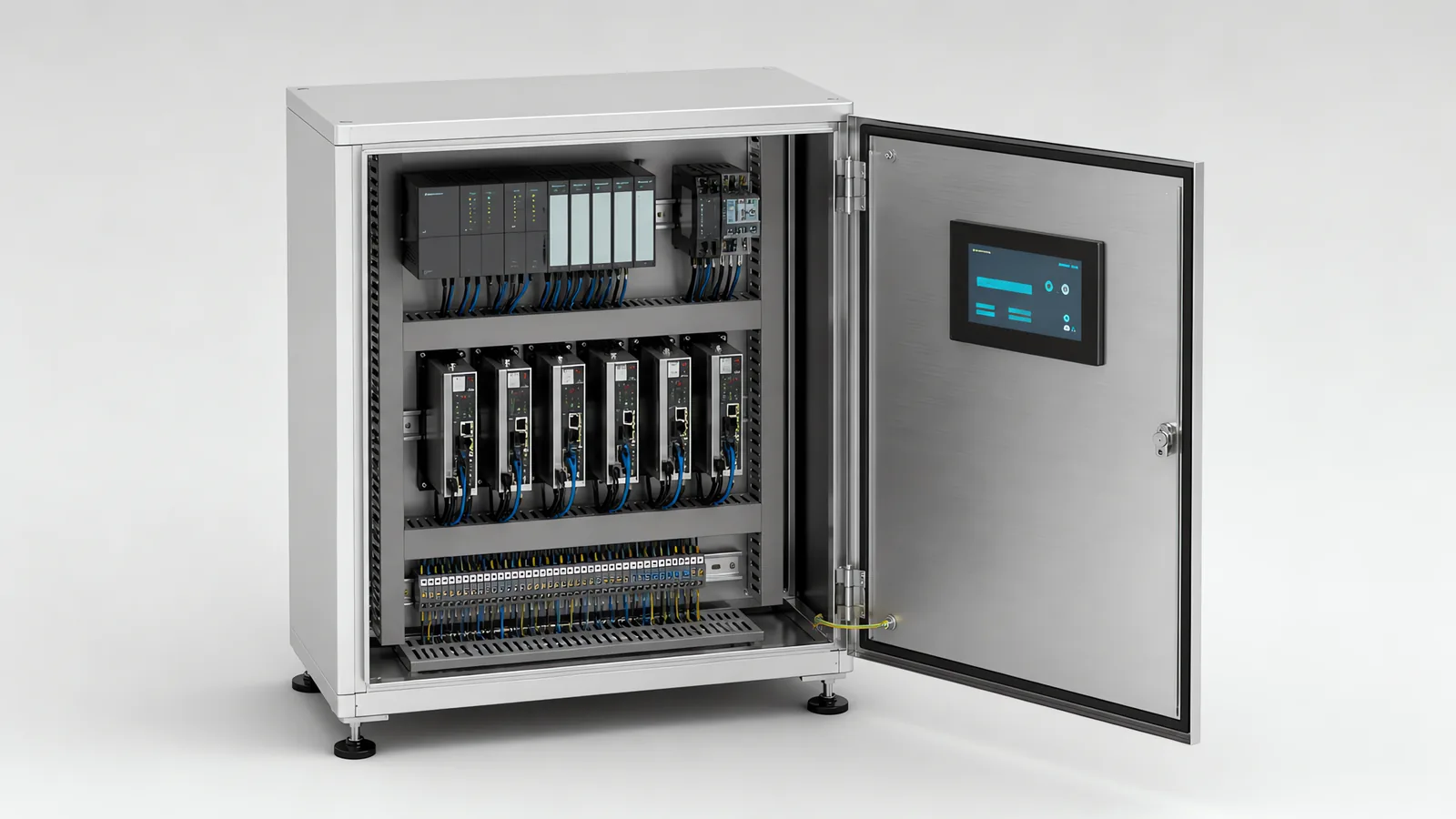
Computer system validation is documented evidence that a computerised system does what its specification says it does, does it repeatably, and keeps doing it in daily production. On a production machine that scope covers the PLC application code, the HMI, recipe management, inspection pass/fail decisions and any electronic record the machine creates. The evidence is built along a V-model: a user requirement specification and design documents on the way down, then Installation Qualification, Operational Qualification and Performance Qualification on the way back up, each one testing a specific document written earlier. Motionwell Automation delivers IQ/OQ/PQ documentation with the machines we build for regulated production, such as our tray-fed filling and sealing machine.
This page explains what validation means for one piece of equipment, which is a narrower job than validating an enterprise IT system: what each stage proves, what evidence satisfies it, where GAMP 5 software categories change the workload, and why the user requirement specification decides your schedule. If you already have a URS and a validation plan, send them to an engineer and we will scope the qualification effort against them.
What Does Computerised System Validation (CSV) Mean on a Production Machine?
Validation answers one regulator’s question: how do you know this machine does what you say it does? The answer is never “we tested it and it worked”. It is a signed, traceable record showing a written requirement became a design, got built, installed, challenged and proven.
On a special purpose machine the computerised system is rarely one thing. It is layered:
- PLC application code that runs the sequence, motion and interlocks
- HMI or SCADA project handling recipes, operator access and alarms
- Vision or measurement software making accept/reject decisions
- Data handling: batch records, audit trails, .csv file or database logging, label and code printing
- Networked equipment such as code readers, printers, drives and safety controllers
Each layer needs its own treatment. A safety relay configured from a supplier catalogue is a small job. A vision recipe written to inspect your specific part is not.
In pharmaceutical quality documents the abbreviation CSV means computer system validation, and that is the sense it carries everywhere on this page. The same three letters name a comma-separated data file, so one machine specification can hold both meanings at once: a CSV protocol that qualifies the audit trail behind a .csv batch export. When a URS, a supplier questionnaire or an inspection observation says CSV, read it as the validation activity unless the sentence is about file formats.
For computer system validation in pharma the expectations come from EU GMP Annex 11 and the equivalent PIC/S guidance, with 21 CFR Part 11 governing electronic records and signatures for FDA-regulated products. Singapore’s HSA is a PIC/S member, so a line built here for a local site and a line built for export are usually held to the same specification set. Record-level controls (unique user accounts, an audit trail you cannot switch off, e-signature meaning) are covered in more detail on our 21 CFR Part 11 compliance page.
How Does the V-Model Connect Specifications to Tests?
The V-model exists so that no test is orphaned and no requirement is untested. Every document on the left side has a matching qualification stage on the right. If you cannot name which document a test proves, the test does not belong in the protocol.
| Specification (left leg) | What it defines | Verified by (right leg) |
|---|---|---|
| User Requirement Specification (URS) | What the user needs: throughput, accuracy, product formats, regulatory scope, data and record requirements | Performance Qualification (PQ) |
| Functional Specification (FS) | What the machine does to meet the URS: sequences, alarms, interlocks, access levels, recipe behaviour | Operational Qualification (OQ) |
| Design Specification (DS): hardware, software, configuration | How it is built: component selection, I/O list, panel layout, software architecture, parameter settings | Installation Qualification (IQ) |
| Module design and code | Individual routines, function blocks, inspection scripts | Code review and module testing |
Read the table bottom-up and the project sequence falls out of it: design review before build, IQ before OQ, OQ before PQ. Skipping ahead does not save time. It moves the failure later, where it costs more.
What Is the Difference Between IQ, OQ and PQ?
IQ OQ PQ validation runs in a fixed order, and each stage asks a different question and fails in a different way.
| Stage | What it answers | What a failure looks like |
|---|---|---|
| IQ | Is the machine on your floor the machine the design documents describe, installed and connected the way they specify? | The equipment and the paperwork disagree: a component substituted during build and never recorded, a schematic not updated after the panel was rewired, a calibration certificate that lapsed before handover |
| OQ | Does every function behave correctly at the ends of its declared range, with fault conditions forced? | Behaviour that holds at the nominal setting and breaks at the limit: dosing accurate at the middle volume and out of tolerance at the smallest, or an interlock that lets the cycle continue when the guard opens mid-move |
| PQ | Does the process stay inside its acceptance criteria across batches, shifts and operators, running real product to your own SOPs? | Results that pass on the first batch and drift by the third, or a changeover that works only when the builder’s engineer performs it |
What Is an IQ OQ PQ Validation Protocol?
A protocol is the written test document for one qualification stage, approved before anyone executes it. Each one states its purpose and scope, lists the specifications and drawings it verifies, and then sets out numbered test steps, each with the expected result and the acceptance criterion that decides a pass. The engineer executing the protocol writes the actual result beside the expected one, attaches the raw evidence such as printouts, screen captures and measurement records, and initials and dates every step. Anything that misses its criterion is raised as a deviation, and the stage cannot be approved until that deviation has been investigated and closed with a documented disposition. The stage ends with a summary report and the approval signatures the validation plan calls for, normally engineering plus the quality unit that owns the system.
The approval comes first because a test written after the result is known proves nothing. On our projects the protocols are written against the functional and design specifications, and your quality unit approves them before anyone runs a step.
Installation Qualification
IQ is a matching exercise against the design documents. Typical evidence on a machine built for a GMP site:
- As-built mechanical drawings, electrical schematics and pneumatic layouts
- Component verification against the BOM: model and serial numbers of drives, dosing valves, sensors, code readers and printers
- Material certificates for product-contact parts, plus surface finish records where the URS specifies a finish
- Calibration certificates traceable to national standards for every critical instrument
- Software and firmware versions recorded for the PLC, HMI, drives and vision system, with a checksum or program archive
- Utilities verified as connected and within specification: power, compressed air quality, extraction, environmental conditions
- Manuals, spare parts list, safety documentation including interlock and guard verification
IQ is the stage most often treated as paperwork. It is the stage that saves you two years later, when a drive fails and nobody can prove which firmware version was qualified.
Operational Qualification
OQ challenges the functional specification with scripted tests, at the limits and not at the comfortable middle. On a filling line that means dosing at the bottom and top of the declared range, well past the nominal volume. Typical OQ content:
- Functional test of every sequence step and every alarm, including the deliberate creation of fault conditions
- Safety function verification: guard door interlocks, light curtains, emergency stop categories, restart behaviour
- Access control by user level, and confirmation that an operator cannot change a validated parameter
- Audit trail generation, content and review, including that entries cannot be altered or deleted
- Recipe creation, approval, loading and change control
- Power-loss and recovery testing: pull the supply mid-cycle and prove the machine restarts in a defined, safe state without corrupting the record
- Backup and restore of the program and the data
- Rejection logic: force a fault part and prove it is detected, diverted and logged
Performance Qualification
PQ moves from function to process. Real product, production operators, approved SOPs, and enough runs to show the result is not a lucky one. On our tray-fed filling and sealing machine, PQ evidence centres on dose volume held within its declared tolerance across trays, batches and shifts, with each dosing head calibrated individually, plus changeover performed by the customer’s own staff following their procedure. The build is described in the filling and sealing machine case study, and the equipment on the custom filling machines page.
What Is GAMP 5 Validation, and What Does It Ask of Machine Software?
GAMP stands for Good Automated Manufacturing Practice. GAMP 5 is the ISPE guide that sets out a risk-based approach to validating computerised systems in regulated manufacturing, and it is industry guidance. GAMP 5 validation therefore describes a method: the IQ, OQ and PQ effort is scaled by software category and by risk, so the layers that carry product quality and record integrity are tested hardest.
GAMP 5 sorts software by how much of it was written for you, because that is what decides how much you must test. Category 2 was retired in GAMP 5; what remains is the following.
| GAMP category | What it covers | On a production machine |
|---|---|---|
| Category 1: Infrastructure | Operating systems, database engines, runtime firmware, programming environments | Windows on the HMI PC, PLC firmware, SQL engine behind the data log |
| Category 3: Non-configured | Products used as installed, default settings only | A code reader running a stock read job, a temperature controller left at defaults |
| Category 4: Configured | Commercial packages configured for your process without new code | SCADA/HMI project, MES or LIMS interface, configured vision toolset, drive parameter sets |
| Category 5: Custom | Software written for one application and running nowhere else | PLC application code, motion profiles, custom recipe logic, bespoke inspection scripts, custom reporting |
A single machine can occupy several rows at once. On a filling machine, infrastructure software, configured HMI functions and a custom dosing sequence require different assurance activities. Assess each component by its intended use, configuration and custom development. For Category 5 code, design review, code review and tests traced to the functional specification provide evidence for the bespoke behaviour. Assessed supplier development records, reviewed reusable components and existing test evidence can support that work; additional testing addresses application-specific risks and gaps in the available evidence.
The consequence is a risk-based split of effort. Functions affecting product quality, patient safety or record integrity get scripted, evidenced testing. Functions affecting only convenience get lighter, unscripted assurance. That principle sits at the centre of GAMP 5 Second Edition and the FDA’s computer software assurance thinking, and it separates a validation package that protects you from one that merely weighs a lot.
How Does a Traceability Matrix Prove Coverage?
The requirements traceability matrix is one table that makes the whole package auditable. Each row starts at a requirement and ends at a signed result.
| Column | Content |
|---|---|
| Requirement ID | URS-014 |
| Requirement | Dose volume held within the tolerance declared in the URS, across the declared fill range |
| Risk classification | Critical: direct product quality impact |
| Specification reference | FS-3.2 dosing control, DS-7 dosing valve and actuator selection |
| Test reference | OQ-11 volume challenge at range limits, PQ-04 batch performance |
| Result and deviation | Pass / deviation number, disposition, approval |
An auditor reads that table first. Gaps show immediately: a requirement with no test, a test with no requirement, a deviation with no closure. Build the matrix when you write the URS and it maintains itself. Build it at the end and you will spend a week reverse-engineering what you tested.
What Delays Validation More Than Anything Else?
A user requirement specification written too late, or written too vaguely, delays validation more than anything else. Nothing else comes close.
Late means after detail engineering has started. By then components have been selected, the panel is laid out and the code structure is fixed. A requirement that arrives at that point (a second product format, a serialization requirement, an audit trail on a parameter nobody flagged as critical) is not a document change. It is a redesign, and it moves the FAT date.
Vague means untestable. “The machine shall be easy to clean” cannot be qualified. “Product-contact parts shall be removable without tools and cleanable per the customer’s SOP within a defined changeover window” can. Every URS line should survive one question: what test would prove this, and what result would fail it? If there is no answer, the line will become a deviation during OQ.
Three habits that keep the schedule intact:
- Write the URS before concept approval, and freeze it before detail engineering. The phase gates are described in our guide to special purpose machine design.
- Classify each requirement by risk while writing it, so the test effort is decided early.
- Agree the acceptance criteria and the sampling plan with your quality unit before the protocol is drafted, not while the machine is running.
Is Equipment Qualification the Same as Computer System Validation?
They overlap but they answer different questions. Equipment qualification asks whether the machine (mechanics, utilities, materials, process capability) is fit for its intended use. Computer system validation asks whether the software and the records it produces are correct, controlled and attributable. On a modern machine the two are executed as one set of protocols, because you cannot test a dosing function without testing the code that commands it.
The practical arrangement on our projects: engineering commissioning happens first and generates test data, then qualification uses that data where it was collected under controlled, documented conditions. That approach follows the intent of ISPE Baseline Guide Vol. 5 and ASTM E2500, and it is what keeps a validated build from taking twice as long as an unvalidated one. Cleanroom equipment adds environmental qualification to the same structure (fan filter unit performance, recovery, particle counts) as on the cleanroom automated test equipment we have delivered.
Does a Retrofit or Control Upgrade Trigger Revalidation?
Control-system modernisation is the validation question that comes up repeatedly on legacy equipment: an obsolete PLC, ageing servo drives or a dead HMI on a machine that has run validated for a decade. Retrofits are now Motionwell’s largest project family. The replacement control platform is chosen from what your site can already program, spare and support, because a validated machine running on a platform nobody on site maintains has swapped an obsolescence problem for a competence problem, and the second one does not surface until the first breakdown. Each one starts the same way.
First, an impact assessment: which functions does the change touch, and which functions share data, interlocks or records with them. Second, a documentation update, the design specification, I/O list, schematics and software inventory must describe the machine as it now exists, which is the IQ deliverable. Third, a test scope agreed with the quality unit: full OQ on changed functions, regression testing on connected functions, and a PQ run long enough to show the process still holds.
The mechanical process usually did not change, so the PQ argument rests on comparability with historical data: possible only if the original validation package was retained. Sites that kept theirs requalify quickly. Sites that did not are effectively validating a new machine.
What Does Motionwell Deliver with a Validated Machine?
We are a machine builder and system integrator: you own the validation, and your QA approves it. What we deliver into it:
- URS review, with requirements challenged for testability before design starts
- Functional and design specifications written to be traceable, with a requirements traceability matrix maintained from the URS forward
- Software inventory and GAMP categorisation per layer, with supplier documentation for configured components
- IQ and OQ protocols and execution support, including FAT at our Woodlands Link facility and SAT on your site
- PQ protocol support and execution alongside your quality team
- Safety documentation: interlock and guard verification, LVD/CE test records, and MOM lifting certification where applicable
- As-built drawings, schematics, program archives, calibration records, operator training and maintenance procedures
Record-generating systems get the same treatment. Our electronic device history record system, built for a medical device manufacturer, is a Category 5 application validated for user access, audit trail and record integrity. The same structure applies across medical device production and pharmaceutical packaging lines, where serialization data is part of the validated record set.
Standards Used in Machine Design and Validation
These references inform the design, testing and documentation described on this page. Each row links to its primary source and records the edition checked.
| Standard | Current edition | What it means for your machine |
|---|---|---|
| ISPE GAMP 5: a risk-based approach to compliant GxP computerised systems | Second Edition, published July 2022 | Guides the lifecycle assurance of GxP computerised systems. Intended use, process risk, patient safety, product quality and data integrity shape the verification effort; software category and supplier assessment help plan the supporting evidence.Checked 7 Sep 2026 against ISPE, GAMP 5 Guide 2nd Edition publication page (ispe.org/publications/guidance-documents/gamp-5-guide-2nd-edition), stated publication date July 2022 |
| 21 CFR Part 11: FDA rule on electronic records and electronic signatures | Current eCFR text; most recent amendment to the part dated 2 March 2023 | Applies to electronic records maintained under FDA predicate rules and to the electronic signatures within its scope. Identify those records during machine specification, then design access control, audit trails, retention, accurate copies and signature binding around their intended use.Checked 7 Sep 2026 against eCFR versioner API (ecfr.gov/api/versioner/v1/versions/title-21.json, part 11), latest section amendment_date 2023-03-02 |
Frequently Asked Questions
What is computer system validation?
Computer system validation is documented evidence that a computerised system does what its specification says, does it consistently, and keeps doing it through its operating life. On a production machine that means the PLC application code, the HMI, recipe handling, inspection decisions and electronic records. The evidence is produced against written specifications through installation, operational and performance qualification, and it is reviewed and approved by the quality unit that owns the system.
What is the difference between IQ, OQ and PQ?
IQ proves the machine that arrived is the machine that was specified and that it is installed correctly: serial numbers, drawings, software versions, calibration certificates, utilities. OQ challenges every function across its operating range with test scripts, including alarms, interlocks, access levels, recovery from power loss and audit trail behaviour. PQ runs the machine with real product, real operators and real procedures to show the process holds over time.
Is PLC machine software GAMP 5 Category 4 or Category 5?
Usually both, in different layers. A configured HMI, SCADA or vision package used as the supplier designed it is Category 4. PLC application code, motion sequences, custom recipe logic and bespoke inspection scripts written for one machine are Category 5, because no other installation runs that code. Category 5 needs design review, code review and functional testing against the specification, so it carries the heaviest share of the effort.