
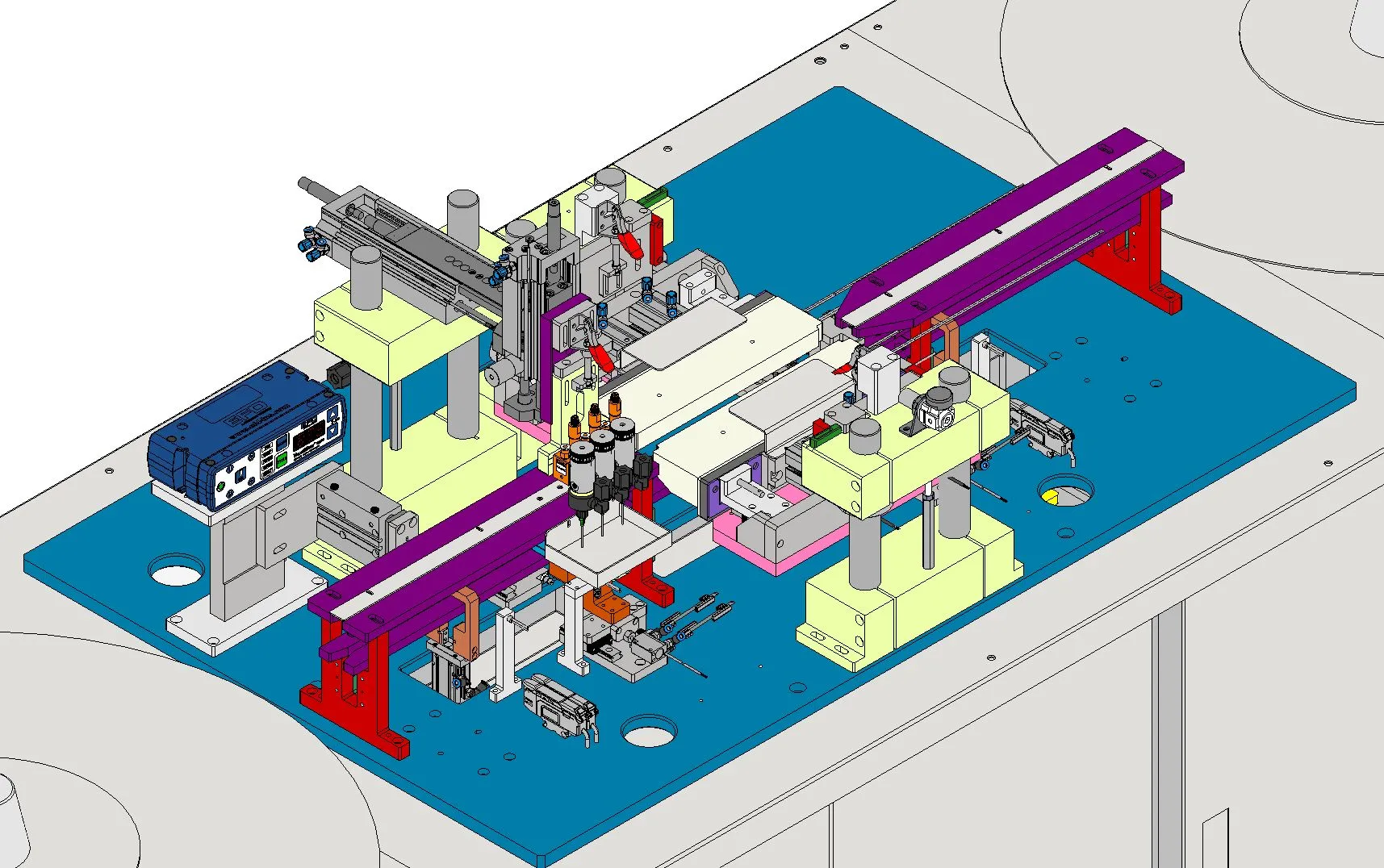
Motionwell Automation designs and builds filling machines in Singapore for pharmaceutical and medical device production. The capability rests on a delivered filling and sealing machine: a tray-fed platform with triple-head dosing through diaphragm valves, built for a customer’s GMP cleanroom, and a separate vial capping and uncapping unit delivered as its own project. Every machine is designed, assembled, and tested at our Woodlands Link facility before delivery, with machined parts made to our drawings by local machine shops.
Our custom liquid filling equipment combines dosing, container handling, closure and inspection around your product. Select the metering method first, then size the line for the required fill tolerance, container range, cleaning procedure and sustained output.
Which Type of Filling Machine Does Your Product Need?
Filling machines are classified by how they meter the dose. Four families cover almost everything a Singapore plant fills, and the product decides which one applies before any other requirement does.
| Dosing method | How it meters | Suits | Where it struggles |
|---|---|---|---|
| Piston / volumetric | A cylinder draws a fixed volume and pushes it out | Thin to medium liquids, creams, pastes, 1 mL to 5 L | Products that entrain air, or where density shifts batch to batch |
| Gravimetric (net weight) | A load cell under the container measures what actually went in | Anything sold by weight, viscous or particulate products, bulk containers | Slower per cycle than volumetric; needs a stable weighing platform |
| Flow meter | Magnetic, mass or Coriolis meter counts the dose in line | Clean fluids at higher speed, no product contact with a pump chamber | Magnetic meters need a conductive liquid, so most solvents and oils are out |
| Time and pressure | Product flows under constant pressure for a set time | Very low viscosity, low value, high speed | Accuracy drifts with temperature and head pressure |
Our delivered filling and sealing machine doses through diaphragm dispensing valves and meters volumetrically or gravimetrically depending on the product; that page works through when each is the right call. For bulk containers the choice usually flips to net weight, and the reasoning is set out on our drum and pail filling page.
The product questions that decide the machine. Viscosity at filling temperature. Whether it foams when it moves. Whether it carries particulates, fibres or fill-through solids. Whether it is flammable, which pulls in hazardous area classification. Whether it is corrosive enough to rule out standard elastomers. A supplier who quotes before asking these five is quoting a catalogue machine and hoping.
What Goes into the Filling and Sealing Machine Motionwell Delivered?
The machine was built for a medical and pharmaceutical customer and runs in their GMP cleanroom. It is a tray-fed platform: containers arrive in machined trays, and the same tray carries them through dosing, sealing and inspection to the outfeed. Reading it in order of travel explains most of the design decisions.
Infeed and Outfeed
The infeed tray station supplies empty containers and the outfeed station collects finished ones. Their capacity and reload sequence determine how replenishment affects output. Specify the available buffer and demonstrate tray exchange during a sustained-rate trial; separate infeed and outfeed positions alone do not establish uninterrupted feeding. The trays are designed around the container and machined to our drawings, so a new container geometry may require a new tray set. The filling line changeover guide separates format changes from routine replenishment.
Container Handling
Pneumatic cylinders, slides and grippers lift containers out of the tray and locate them under the dosing heads and then under the sealing tooling. Pneumatic handling suits this job because every move is a fixed stroke between two stops, so the repeatability comes from the mechanics and the machine carries fewer drives to maintain in a cleanroom.
Dosing
Three dosing heads work in parallel through diaphragm dispensing valves, so three containers fill on every cycle. In a diaphragm valve the diaphragm sits between the pneumatic actuator and the product, so nothing on the air side touches the fluid, and the diaphragm is the wear part that gets replaced on a maintenance schedule. Each head meters volumetrically or by weight depending on the product, and the dose range and the tolerance band are set against your product and container at design review, not carried over as a catalogue rating. Vacuum suck-back at the end of each shot stops the product stringing between the nozzle and the container.
Sensing
Container presence at each station is confirmed by fibre optic sensing, never inferred from the handling sequence having had time to finish, because a valve that opens over an empty nest puts a dose on the tray. In a cleanroom that costs a cleaning procedure and a batch record entry, not one lost container. Fibre optics were chosen over a self-contained photoelectric head for a reason specific to this machine: the part at the station is a pair of glass fibres with no electronics and no heat in the wetted zone, so the surface an operator wipes down stays simple and the amplifier sits where it can be adjusted without reaching into the container track.
Fill-Level Inspection
A vision station reads the fill level in the container immediately after dosing, and a container outside the fill window is flagged there, before any closure is committed to it. The station sits between dosing and sealing for that reason alone.
Sealing
The closing station is fitted to the closure: heat seal, press seal, or screw cap. Heat sealing runs under closed-loop temperature control with the thermocouple reading the sealing tooling, because the temperature that decides the seal is the one at the surface touching the film, and a heater sitting at setpoint while the tooling is still climbing produces a seal that looks finished and opens in transit. Temperature, dwell and closing force are set together as one recipe, since they trade against each other and moving one alone rarely fixes a failing seal.
Materials and Environment
The frame and product-contact surfaces are stainless steel, with the steel grade and the surface finish selected against the cleaning chemistry the product and the room require, and the enclosure rating specified so the exterior stands up to the sanitation method in use. The design is compatible with ISO Class 7 and Class 8 rooms. Control is PLC and HMI, with a three-colour stack light, guarded doors and emergency stop.
Downstream of the filler, our vial capping and uncapping unit was delivered as a separate project for the same class of container, and closure options and torque control are covered in full on our capping and sealing systems page. The full build is documented in our filling and sealing machine case study, and the broader production context on the pharmaceutical and packaging industry page.
What Changes on a Tray-fed Line Versus a Bottle Line?
A conveyor bottle line and a tray-fed machine solve different handling problems, and picking the wrong one is expensive to correct after the frame is drawn.
A conveyor line suits containers that stand up on their own and arrive in bulk: bottles with a flat base and enough mass to survive a starwheel. The container is located by the conveyor guides and the starwheel pockets, and speed comes from the fact that the container never stops moving. The price is that every format change touches the guides, the starwheels and the timing screw, and that a small, light or narrow-based container falls over.
A tray-fed machine locates the container in a pocket for its whole journey. Vials, tubes and other small containers that would tip on a conveyor sit upright in the tray, the tray indexes under each station, and the pick-and-place only has to lift and set. That is why our delivered machine is tray-fed: the containers are small, and a tray keeps them upright and located from infeed to outfeed with few moving parts in the cleanroom. The tray is also the change part. A different container needs a different tray set, machined to suit, so a format change is a tray swap. How changeover time is engineered, and why it decides actual daily output, is set out under changeover design on a filling line.
Throughput on a machine of this type is quoted as a range, because it depends on the fill volume and the closure. A small volume with a screw cap sits at one end; a larger volume with a heat seal that needs dwell time sits at the other. The dual-tray feed is what makes the quoted number achievable in a shift, because a machine that stops for every tray swap never sees its rated speed.
What Specifications Does the Filling and Sealing Machine Hold?
| Parameter | Filling and sealing machine |
|---|---|
| Filling range | Dose range set per product and container, three heads in parallel |
| Accuracy | Tolerance band fixed at design review, volumetric or gravimetric |
| Throughput | Set by fill volume and closure time, continuous dual-tray feed |
| Dosing hardware | Diaphragm dispensing valves, vacuum suck-back |
| Sealing | Heat seal, press seal, screw cap |
| Materials | Stainless steel frame and contact surfaces, grade and finish set by cleaning chemistry |
| Environment | Designed for ISO Class 7/8 cleanrooms |
| Changeover | Container format carried in machined tray sets |
| Verification | Vision fill-level check |
| Control | PLC and HMI |
| Footprint | Single-bay frame, dimensions confirmed at layout review |
The machine is built in Singapore as a complete filling and sealing system: tray infeed, container handling, dosing, sealing, verification, reject handling and the control cabinet are engineered together, because the specifications above only hold when each station feeds the next at a steady rate.
What Does the Product Itself Change About the Machine?
The product changes more than the container does. Two lines filling the same 30 mL container at the same rate can need a different dosing head and different steel, purely because of what is going into it.
Viscosity sets the dosing technology first. Thin aqueous products run on almost any dosing head. As viscosity climbs into gels and pastes the head needs a larger flow path and a slower profile to avoid cavitation at the inlet, and the fill time per cycle goes up whether or not the rated speed does. On our triple-head machine the dose range per head is a design-review decision, and where the product sits on the viscosity scale decides how many heads are needed to hold a given rate, beyond how fast each head can move.
Foaming decides the nozzle and the fill path. A product that foams gets a diving nozzle that starts at the bottom of the container and withdraws as the level rises, so the stream never falls through air. That single decision changes the machine: the nozzle needs a vertical axis, the container has to be located precisely enough for the nozzle to enter it, and the cycle gains the dive and retract time. Specifying a diving nozzle after the frame is drawn is an expensive correction.
Particulates and suspended solids rule out anything with a tight clearance. Seals and check valves are where solids collect, and a product with fibres or beads usually moves to a lobe or peristaltic head with a straight flow path and no small gaps to bridge. Peristaltic also keeps the product inside a tube, which matters when the fluid path has to be single-use or replaced between campaigns.
Chemistry sets the material list. Whether contact surfaces run in 304 or 316 stainless follows from the cleaning chemistry, chlorides above all, and the surface finish follows from how the machine is cleaned. Solvents, acids and chlorides each change which elastomer is acceptable for seals, gaskets and the valve diaphragm, and the wrong elastomer fails as swelling and particle shed, so it shows up in product quality before it shows up in maintenance.
Stringing and drip are the last one, and the one that gets discovered at factory acceptance. A product that strings needs suck-back on the valve, a cut-off geometry at the nozzle tip, or both, tuned against the actual product. Send a sample. A specification sheet does not tell us whether a fluid strings.
Powder behaviour can change the relationship between dose volume and mass. powder filling process trials covers bulk density, hopper level and final quantity checks.
Should You Buy a Semi-automatic Filling Machine or a Custom Automatic Line?
Not every operation needs a custom line, and buying one early ties up capital that the volume has not yet earned. A semi-automatic liquid filling machine of the tabletop or pneumatic type, bought from a local distributor, costs a fraction of a custom line and works fine when volumes are low, the product format never changes, and an operator loads each container by hand.
The economics flip under any of these conditions: sustained throughput beyond what hand loading keeps up with, GMP or HSA validation requirements, multiple container formats on one line, or a quality system that demands inline verification with automatic rejection. At that point a custom automatic machine stops being an upgrade and becomes the cheaper option per unit filled, because rework, giveaway from overfilling, and manual QC labour all scale with volume.
The threshold is worth working out before the enquiry, not after. Count your fills per shift, the hours an operator spends loading and checking them, and the units you scrap or overfill in a month. If that arithmetic does not clear the cost of a custom line, a distributor machine is the right purchase, and a concept review will tell you which side of the line you are on.
What Does a Complete Filling Line Include Besides the Filler?
An enquiry for filling machines and equipment in Singapore is usually an enquiry about a line. The filler is one station in a chain, and the stations around it decide whether the filler ever reaches its rated speed.
A typical line, in order of travel:
- Container infeed: unscrambler, rotary table, tray station or conveyor buffer. This is what decides whether rated speed is ever reached, because a filler that waits for containers runs at the infeed’s rate.
- Container cleaning: air rinse, water rinse or ionised air blow-off, where the product or the standard requires it.
- Filling station: the dosing heads, the nozzles, and the no-container-no-fill interlocks.
- Closing: capping, sealing, crimping or induction sealing, with torque control and closure presence checks.
- Verification and rejection: checkweigher, fill-level vision, cap and seal inspection, with a pneumatic pusher diverting failures to a quarantine bin.
- Coding and labelling: batch, expiry, and where the market requires it, a serialised 2D code with a verification camera immediately downstream.
- Collation and end of line: accumulation table, case packing, and palletizing.
Motionwell scopes the whole chain even when the order is only the filler, because the interfaces are where projects go wrong: conveyor heights that do not match, handshakes that were assumed, and a control architecture that cannot see the station upstream.
For foil-lined closures, induction sealing joins packaging compatibility and cap application with the heating window. A downstream checkweigher needs suitable spacing and a defined treatment of packaging-weight variation before its result can be used to assess contents.
Bulk empty bottles need a defined upright and rotational presentation. bottle unscrambler outfeed covers usable outfeed, accumulation and format-change trials.
How Is Every Fill Verified Before the Container Leaves the Line?
Every container on our filling and sealing machine is verified, and the checks are placed where a fault can still be caught cheaply. Fibre optic sensors confirm a container is present before a valve opens, which removes two faults that waste product on any filler: a shot fired into an empty pocket, and a double fill into a container that failed to index. After dosing, a vision station reads the fill level in the container, so a short or over-filled unit is flagged before a closure is applied to it. A container flagged at the fill-level check is identified before the tray leaves the machine.
The order matters. A fill-level check placed after sealing finds the same fault but has already spent a closure and a sealing cycle on it, and on a heat-sealed container it cannot be reworked. Placing the check between dosing and sealing costs one more station and saves the rework.
How the camera systems are specified, lit, and calibrated is covered in our guide to vision inspection systems.
Which Other Container Formats Can Be Filled?
The delivered machine runs vials and similar small containers carried in trays. For cans, pails, drums and other bulk containers, see our drum and pail filling systems, where the dosing method, nozzle design and container handling are a different engineering problem from small-container lines. For bottles, jars and preformed bags, Motionwell engineers filling systems to order from the same building blocks: volumetric or gravimetric dosing, stainless construction, inline verification, and PLC control. These are custom special purpose machine projects, scoped and quoted from your container and product samples. Our custom machine design process explains how that works, from concept through commissioning.
Flexible packaging needs an open pouch and clean seal area as well as a dose. pouch filling and sealing compares handling architecture and interrupted-pack states.
Packaging tubes need the right tail-sealing process for their construction. tube filling and closure separates orientation, dose and closure verification.
What Drives the Cost and Lead Time of a Filling Machine in Singapore?
The filling line quotation is built from the dosing duty, format range, handling, inspection and documentation requirements. The following items explain why two machines with similar layouts can require different investment.
| Cost driver | Why it moves the number |
|---|---|
| Number of filling heads | Heads scale throughput almost linearly, and each head carries its own valve, nozzle and calibration |
| Container format count | Every additional format adds change parts, and format changeover design costs more than format count suggests |
| Accuracy target | A tighter tolerance band changes the dosing technology |
| Validation scope | IQ/OQ/PQ with protocol authoring is a documentation project sitting alongside the build |
| Cleanroom compatibility | Surface finish, material certificates and construction practice all change |
| Serialization | Printer, camera, reject and the data layer behind them are a subsystem |
Lead time runs 16 to 24 weeks from concept approval to factory acceptance testing for a standard build, and 24 to 32 weeks where cleanroom compatibility or full GMP validation applies. Design, fabrication, assembly and testing all happen at our Woodlands Link facility, which is the reason a Singapore buyer can attend the factory acceptance test without flying to it.
Why local matters more on a filling line than on most equipment. Fillers are the station that gets adjusted: a new viscosity, a different closure, a container the marketing team changed without telling production. Those adjustments happen in hours when the builder is in the same industrial estate and in weeks when the builder is overseas.
What Documentation Ships with a GMP Filling Machine?
GMP projects ship with full IQ/OQ/PQ documentation packages. Factory acceptance testing happens at our Singapore facility before shipment, followed by site acceptance testing at your cleanroom, with validation protocols following ISPE Baseline Guide Vol. 5. Batch records support 21 CFR Part 11 compliance. Every delivery includes mechanical drawings, electrical schematics, PLC program documentation, operator training, maintenance schedules, and spare parts lists, so your team maintains the machine without calling us for every adjustment.
Standards Used in Machine Design and Validation
These references inform the design, testing and documentation described on this page. Each row links to its primary source and records the edition checked.
| Standard | Current edition | What it means for your machine |
|---|---|---|
| 21 CFR Part 11: FDA rule on electronic records and electronic signatures | Current eCFR text; most recent amendment to the part dated 2 March 2023 | Applies to electronic records maintained under FDA predicate rules and to the electronic signatures within its scope. Identify those records during machine specification, then design access control, audit trails, retention, accurate copies and signature binding around their intended use.Checked 7 Sep 2026 against eCFR versioner API (ecfr.gov/api/versioner/v1/versions/title-21.json, part 11), latest section amendment_date 2023-03-02 |
| ISO 14644-1: Cleanrooms and associated controlled environments, Part 1: classification of air cleanliness by particle concentration | ISO 14644-1:2015 (second edition; reviewed and confirmed 2021, remains current) | Classifies cleanroom air by airborne particle concentration at specified particle sizes, sampling locations and occupancy states. Machine design supports the target environment through suitable materials, contained particle sources, cleaning access and airflow; equipment suitability is addressed separately in ISO 14644-14.Checked 9 Sep 2026 against ISO catalogue page iso.org/standard/53394.html (edition 2, confirmed 2021) |
Frequently Asked Questions
How much does a filling machine cost in Singapore?
It depends on what the line has to do. Cost is driven by the number of filling stations, throughput target, GMP validation scope, serialization requirements, and the level of inline verification. A standard semi-automatic filler from a distributor sits at the low end; a custom multi-station GMP line with full documentation is a different class of investment. Motionwell provides a detailed quotation after concept design review.
What filling accuracy can a custom filling machine achieve?
Accuracy is a specification line: it is set by the product, the container and the dose size, and it is fixed before the dosing method is chosen. Our delivered filling and sealing machine doses through three diaphragm dispensing valves in parallel, metered volumetrically or by weight depending on the product. Every container is checked: a vision station reads the fill level after dosing so a short or double fill is flagged before sealing. A tighter tolerance band is a change of dosing technology, so state the accuracy target and send a product sample, because a product that foams or strings can consume more of the tolerance than the valve does.
Does Motionwell build GMP-compliant filling machines?
Yes. Our filling and sealing machine was delivered to a medical and pharmaceutical customer and runs inside their GMP cleanroom; the design is compatible with ISO Class 7 and Class 8 environments. The frame and product-contact surfaces are stainless steel, with the grade and the surface finish specified against your cleaning chemistry, and enclosure ratings specified against the sanitation method used in the room. GMP deliveries include IQ/OQ/PQ protocols, factory acceptance testing at our Singapore facility ahead of site acceptance testing in your cleanroom, and batch records supporting 21 CFR Part 11. Serialization, when the market requires it, is scoped as a separate subsystem with its own printer, camera and reject station.