
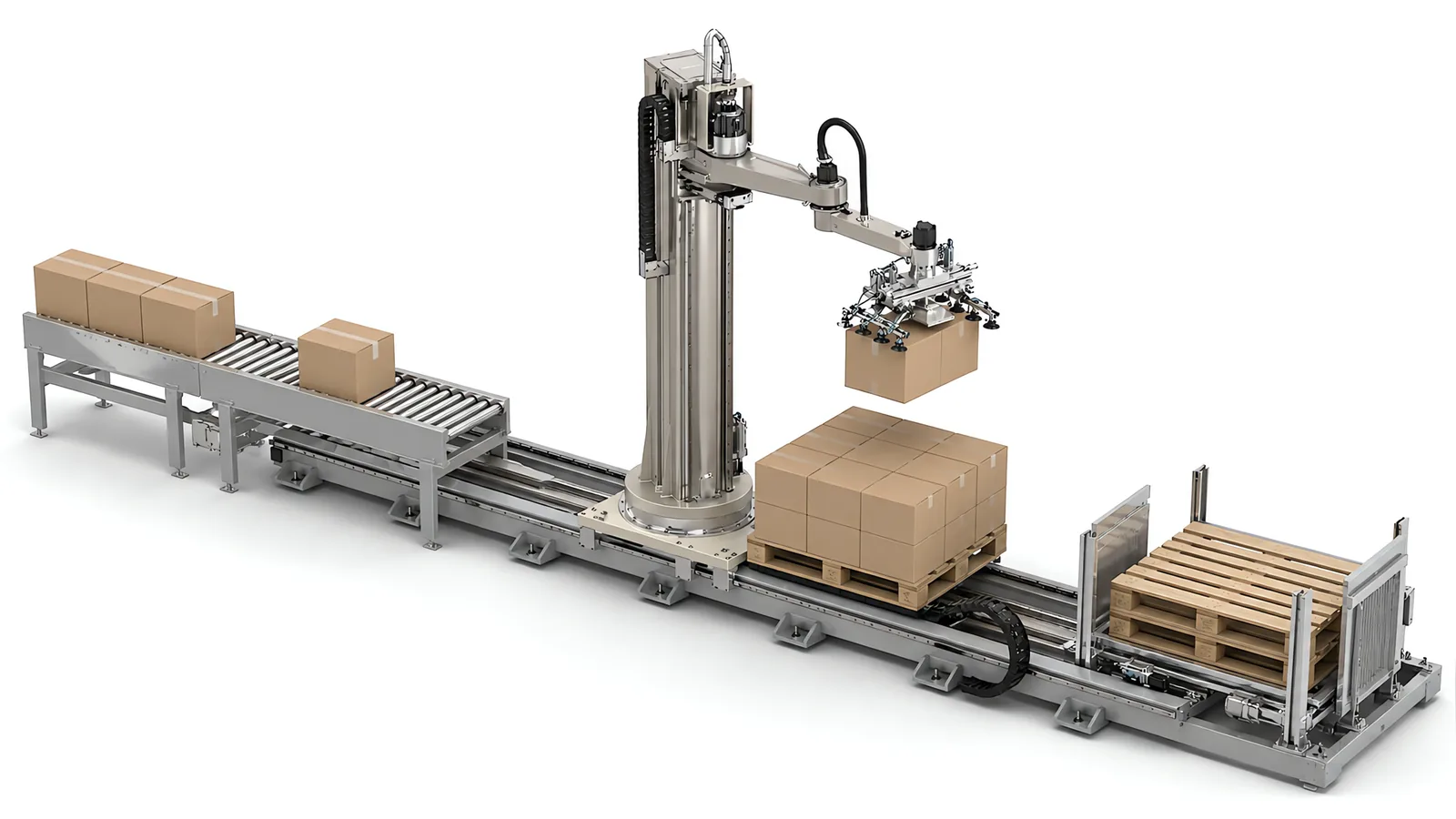
Motionwell Automation designs, builds and integrates automated palletizing systems in Singapore, from single-arm cobot palletizers sitting beside an existing line to fully guarded industrial robot cells with accumulation infeed and pallet handling. The short answer most people arrive looking for: a cobot palletizer is the right choice when your case rate is in the low single digits per minute, your heaviest case plus the gripper fits inside the arm’s rated payload, and fencing an industrial cell would cost you an aisle you cannot spare. Above that, a fenced industrial robot is cheaper per case and far less frustrating to own.
In sequence, a palletizer takes finished cases off the end of the production line, accumulates and squares them so every case reaches the pick point in the same position, lifts them with a gripper onto a pallet in a set layer pattern, and repeats layer by layer until the pallet is full and ready to leave the cell. A robotic palletizer is that job built around a robot arm: the arm, a gripper matched to your case format, the infeed that presents the case, the pallet handling, and the controls and guarding that tie all of it to the line you already run.
The same trade away from the pallet, stated in general terms, is on our cobot vs industrial robot page.
What Types of Palletizing Systems Are There?
Four families, and what separates them is what actually carries the load to the pallet.
| Family | How the load reaches the pallet | Where it fits | What you give up |
|---|---|---|---|
| Conventional layer palletizer | Cases are turned and pushed into a complete layer at a forming station, then the whole layer is transferred down onto the stack | One case size, one pattern, high sustained rate, little or no changeover | Flexibility. A new case size is a mechanical setting |
| Robotic arm | A robot picks one case, several cases or a full layer and places each pick | Cartons in the mid-rate band, several SKUs, patterns stored as recipes | Rate per pick, which has to be bought back with a bigger gripper |
| Gantry or truss | A beam carried on columns travels overhead, and a Z column lowers the load onto the pallet | Long runs, several pallet positions under one machine, floor kept clear beneath | Orientation, since three linear axes place a case the way the gripper took it |
| Collaborative arm | The same pick and place, run at speeds low enough to work beside people | Low single-digit case rates where fencing an aisle is not possible | Rate, permanently, because the speed cap is the technology |
The conventional layer machine has no robot in it. Cases are grouped into a layer once, and the placing motion then happens once per layer, which is why the format survives on single-SKU lines running hard. Rate comes from layer size. What it costs you is changeover: a different case size means moving guides and stops, which is the opposite of the recipe call described further down this page. Our own delivered palletizing work is robotic, which is worth knowing when you read a recommendation from us.
Robotic splits again, into four axes and six. The column platform we build is a four-axis machine: base rotation carrying the load between the infeed and the pallet positions either side of it, a purely vertical lift column, a horizontal arm, and wrist rotation for case orientation. Stroke, reach and payload are sized to the case list and the full stack height, and placement tolerance is specified against what the corrugated case itself holds, never tighter than that. Where a line needs a higher sustained rate than one column platform holds on single-case picks, we specify a dedicated palletizing arm, because that class is built around the pallet duty: the wrist does nothing but keep the case level and turn it, the structure is stiffer for having given up the other two wrist axes, and the maker publishes a cycle rate at rated payload, and never a peak speed with nothing on the flange. Read that published rate as the figure to compare between arms, and ask which pick-and-place cycle it was measured on, because a test cycle that lifts less than your own stack height flatters every arm on the shortlist equally. The sixth axis gets bought for what the wrist does: bags, labels on more than one face, and cases dropped into a constrained space.
Gantry earns its place on distance. A beam supported at its ends carries the payload into the columns and into the floor, so the load it can hold does not fall away as the travel gets longer, and the area underneath stays clear. That suits a long row of pallet positions or a route that has to cross an aisle. The structure, the payload classes and the guarding of an overhead envelope are on our linear gantry and truss robot page. Two things settle whether it fits a pallet job: the columns have to land somewhere on your floor, and three linear axes hand over each case in the orientation it was picked in, so a pattern that rotates cases needs a rotary axis added at the Z column.
When Is a Cobot Palletizer Better Than a Full Industrial Cell?
Both do the same job. They fail in different places, and the failure points are predictable.
| Selection factor | Cobot palletizer | Industrial robot cell |
|---|---|---|
| Case rate | Low single digits per minute | Sustained double-digit rates |
| Payload | Rated payload of the arm, minus the gripper | Heavy cases, multi-case grabs, full-layer picks |
| Pallet height | Usually needs a lift column or 7th axis to top out a full pallet | Reach and vertical stroke sized for full stack height from the start |
| Guarding | Possibly none, decided by risk assessment | Fence, interlocked doors, scanners or light curtains |
| Floor space | Fits into an existing line without a cell footprint | Needs cell area plus safe operator and forklift access |
| Redeployment | Move to another line and re-teach in a shift | Fixed installation |
| Duty cycle | Check continuous-duty rating, thermal load and the planned motion cycle | Check the same factors at the required payload and sustained rate |
How to Work Out Your Real Payload Budget
This is where most cobot palletizing projects go wrong before anyone touches CAD. Rated payload is measured at the tool flange, and your gripper hangs off that flange. A carton vacuum head with its manifold, ejectors and frame is not light, and whatever it weighs comes straight out of the budget left for the case.
Then subtract more. Rated payload assumes the load sits close to the flange. A vacuum plate holding a 400 mm carton pushes the centre of mass well out, and the resulting moment is what limits the arm. Every collaborative arm publishes a payload-versus-centre-of-gravity chart. Read it before you pick one.
Do the arithmetic in this order: heaviest case in your SKU list, plus gripper mass, checked against the payload curve at your real tool centre of gravity and your real reach. If the heaviest SKU only just fits, it does not fit. Case weights drift, and someone will add a heavier SKU next year.
How Do Rate and Stack Height Affect Cobot Selection?
For a power-and-force-limited application, the risk assessment considers the robot, gripper, load and possible contact points together. Speed and motion settings are selected and validated for that application. Compare the resulting cycle with a guarded industrial cell at the required payload, including access for pallet exchange.
Check the arm’s reach to the lowest and highest case positions in every layer. A pedestal, vertical lift column or additional linear axis can extend the usable workspace, and each changes the footprint and cycle. Motionwell has designed and delivered low-profile robot linear tracks for other robot applications. For palletizing, compare the complete cobot arrangement with a 4-axis industrial palletizer using the same stack height and output target.
For three-shift production, we compare the complete cycle at operating payload, the manufacturer’s continuous-duty rating and the pallet-change sequence. Multi-case picks or an industrial palletizing arm can increase capacity where a single-case collaborative cycle would leave insufficient headroom.
Are We a Robotic Palletizer Manufacturer or an Integrator?
Motionwell designs and builds the palletizing cell around a selected robot arm: gripper, frame and pedestal, infeed and squaring, pallet handling, safeguarding, controls and pattern software. We integrate robot, camera and drive components from the manufacturers supported by your plant.
Which make of arm goes into a cell is decided by what your plant already runs, and never by what a builder would prefer to sell. The reason is the cost that arrives after commissioning: a second brand on the floor duplicates the spares shelf, the programming software and the training your maintenance team has already paid for, and that duplication outlives whatever the arm saved on the quotation. We also build cells around an arm a customer has bought already, which is a different commitment from recommending one, because reach, payload and controller are fixed before the design starts and the rest of the cell has to absorb whatever they do not cover.
The delivered end-of-line reference is our palletizing robot case study, covering robot selection, infeed accumulation, pattern programming and the safety design of a fenced cell.
How Do Palletizing Patterns Actually Get Programmed?
A palletizing pattern is two things stacked together: the layer pattern, which is how cases arrange within one layer, and the stack recipe, which is how layers repeat, rotate and interleave up the pallet.
Column, Interlock and Pinwheel Patterns
Three families cover almost everything.
Column stacking puts every case directly above the one below. It is the strongest pattern in pure compression, because case corners carry the load, and it is the weakest against toppling because nothing ties the layers together. Use it when you stretch wrap well and the pallet does not get handled much.
Interlocked patterns rotate alternate layers so cases bridge the seams below them. You lose some compression strength, since case walls no longer line up corner to corner, and you gain a lot of stability in transit. This is the default for most distribution.
Pinwheel patterns rotate cases around a central void. They suit case footprints that do not tile cleanly onto the pallet, and they interlock naturally between layers. The central void is not wasted space so much as the price of a footprint that does not divide evenly.
Two things constrain all three: overhang and underhang. Cases hanging over the pallet edge lose support and crush; cases sitting well inside it waste cube and let the stack lean. The pattern has to be built against the real pallet, which in Singapore is commonly 1200 x 1000 mm, sometimes 1200 x 800 mm EUR, and sometimes the 1100 x 1100 mm format used around the region.
Changeover Between SKUs
Patterns are stored as recipes. A pattern editor generates placement coordinates from case dimensions and pallet size; the operator picks a recipe on the HMI, or the line PLC picks it from a barcode scan or an MES download. Nothing mechanical moves. That is the first thing to check on any quotation: ask how a new SKU gets added, by whom, and whether it needs the integrator on site.
Reach and clearance get verified in offline simulation before the cell is built, because a pattern that cannot be reached at layer eight is a mechanical problem.
Which Gripper Suits Cartons, Bags and Trays?
The gripper decides more of the outcome than the arm does, and it is the one part nobody can buy off a shelf for a mixed line.
Cartons and Sealed Cases
Vacuum is the default. A foam or suction-cup plate on the top face, fed by vacuum generators and valve manifolds carried on the tool, picks a sealed carton cleanly and lets you take two or three cases at once when the layer allows. It fails on poor top-flap glue, on wet or dusty surfaces, and on anything out of a washdown zone. Where the top face is unreliable we add pneumatic side clamps, so the case is held mechanically and vacuum only assists. Where the vacuum itself comes from is a duty-cycle and compressed-air decision: ejectors at the tool are cheap to fit and expensive to run continuously, and a central pump is the other way round.
Bags and Sacks
Vacuum on a woven or perforated sack is a bad bet. Bags want clamshell or fork-and-clamp tools that get underneath, support the full length, and lay the bag down under control so the fill settles flat. They also need a flattening step upstream: a bag arriving with a hump builds a pallet that leans by layer six.
Trays, Totes and Bare Product
Mechanical grippers, and this is the one part of the tool where a catalogue unit usually beats a machined one: the jaws and seals are wear items, a catalogue gripper publishes a cycle life and has a distributor holding the seal kit, and a gripper we machine instead puts that spare on our lead time. Open-top trays give vacuum nothing to hold, so the tool grips the tray rim or tote flange. Bare product onto a slip sheet needs a tool designed against the product itself, a custom machine design job.
For mixed-format lines there are two workable options: one combination tool that compromises on every format, or a quick-change interface with a small tool rack. Which one wins depends on changeover frequency. Four format changes a shift argues for the combination tool; weekly changes argue for the rack.
How Does a Palletizer Tie Into Conveyors You Already Own?
Most end of line palletizing projects are retrofits. The palletizer has to accept whatever the existing line hands it, which means three separate integration problems.
Mechanical. Cases arrive at whatever height and pitch the old conveyor runs at, and the transport layer itself is covered on our conveyor and material handling page. The new infeed has to match that height, then square and gap cases so the robot picks from a repeatable position. We build infeed sections around drum-motor driven roller zones for zero-pressure accumulation, and modular plastic belt where a case needs positive transfer or has to turn a corner, because a roller curve has to drive the outer end of each roller faster to keep the case square and a belt carries the case around the bend. Case position is confirmed by a sensor at the pick point: a timer reports the gap the program expected, and a robot that picks at an expected position crushes the case that slipped.
Electrical and control. The palletizer needs a handshake with the upstream line: case ready, accumulation full, pallet in position, pallet complete and fault. Motionwell’s largest current work line is control-system modernisation of legacy production machines, replacing ageing PLCs, servo drives and VFDs on the platform a plant maintains. For a new palletizer, we review the program documentation, spare I/O, memory, software access and safety interfaces. The survey defines the upstream changes and whether the project should extend the existing controller, add a coordinated cell controller or include a migration.
Downstream. A full pallet has to leave: either a manual forklift pull with the light curtain muted for the pallet opening, or automated discharge onto a chain conveyor feeding a stretch wrapper. Code verification happens at the infeed, before the case is stacked, because a bad code found after the pallet is wrapped costs the unwrap, the restack, and a decision about whether every other case on that pallet can be trusted. Wider material-flow context sits on the warehouse and intralogistics automation page.
Check the completed load as it leaves the cell: pallet conveyor design includes runner support, transfer orientation and load stability. At the picking tool, vacuum gripper selection tests carton porosity, sealing area and the handling motion together.
A palletizer needs one correctly presented empty pallet. empty-pallet dispensing defines stack separation and the request/transfer sequence before pallet loading.
What Safety Standards Apply to a Palletizing Cell?
Start from ISO 12100 risk assessment. The assessment decides the design. Industrial robot cells are then covered by ISO 10218-1 for the robot and ISO 10218-2 for the integrated system, with each safety function rated for performance level under ISO 13849-1. Collaborative applications add ISO/TS 15066.
One point gets missed often enough to state plainly: a collaborative robot is not the same thing as a collaborative application. A force-limited arm says nothing about the gripper, the case, or the pallet. Palletizing carries hazards that power-and-force limiting does not address at all, a case dropped from the top layer, a vacuum failure over an operator’s foot, a stack toppling into an aisle. Those get handled with fixed guarding under the pallet zone, safety laser scanners covering the approach, or speed-and-separation monitoring. Our guide to collaborative robot safety standards works through that assessment.
Motionwell delivers the physical scope that follows: guard fencing and interlocked access doors, safety laser scanners, safety-rated stop circuits, LVD and CE testing, and MOM lifting certification where the machine includes lifting equipment. The company holds ISO 9001:2015 and bizSAFE Level 3, and machines are assembled and tested at our Woodlands Link facility before they ship.
How Much Does a Robotic Palletizer Cost?
A quotation here starts from your case list. Until we have dimensions, weights and formats for the SKUs you actually run, there is no number to give you, only a range wide enough to be useless. What we can tell you is what moves it.
| Cost driver | Why it moves the number |
|---|---|
| Case rate | Sets the robot class, and decides whether guarding is optional or mandatory |
| SKU and format count | More patterns, more gripper compromise, possibly a tool changer |
| Case condition | Sealed cartons are cheap to grip; sacks, open-top trays and shrink bundles are not |
| Stack height and reach | Lift column or 7th axis where the arm cannot reach the top layer |
| Guarding strategy | Fence, doors and scanners versus a collaborative application with a clean risk assessment |
| Conveyor scope | Tying into existing accumulation versus building new infeed and squaring |
| Pallet handling | Manual pallet swap versus dispenser, discharge conveyor and stretch wrapper |
| Controls integration | Dry contacts versus recipe download from MES or ERP |
| Site constraints | Ceiling height, floor flatness, forklift traffic, power availability |
Publicly listed packages are useful anchors: a distributor’s standard cobot palletizer bundle (arm, lift column, pedestal, one gripper) sits far below a fully guarded industrial cell with accumulation infeed, pallet dispenser and wrapper. Neither figure tells you what your line costs. The gripper and the infeed get custom-designed, and they vary most between two plants running what looks like the same product.
Where Does End-of-Line Palletizing Fit in the Rest of the Line?
Palletizing is the last station, so it inherits every problem upstream. Cases that arrive skewed, under-filled, badly sealed or mislabelled all surface as palletizer faults, and the palletizer gets blamed for them. So when we scope an end-of-line cell we look at the two stations before it as well, which is why the same team also builds filling and sealing machines and case packing equipment.
If pallet loads are strapped after stacking, define the frame and restraint positions separately. pallet-load strapping covers tension, package trials and coordinated release.
Standards Used in Machine Design and Validation
These references inform the design, testing and documentation described on this page. Each row links to its primary source and records the edition checked.
| Standard | Current edition | What it means for your machine |
|---|---|---|
| ISO 10218-1: Robotics, safety requirements, Part 1: industrial robots | ISO 10218-1:2025 | Published February 2025, the third edition and the first substantive revision since 2011. It adds robot classifications with matching functional safety requirements and safety-related cybersecurity requirements. Most of ISO/TS 15066:2016 on collaborative operation moved into Part 2.Checked 12 Sep 2026 against ISO 10218-1:2025 (iso.org/standard/73933.html) |
| ISO 13849-1: Safety of machinery, safety-related parts of control systems | ISO 13849-1:2023 | Provides the design method for safety-related control functions, including architecture, component reliability, diagnostic coverage and common-cause failure measures. The machine risk assessment establishes the required Performance Level; design calculations and validation provide the evidence for each function.Checked 1 Sep 2026 against ISO 10218-1:2025 normative references |
Frequently Asked Questions
When should I choose a cobot palletizer over an industrial robot cell?
Compare the required case rate, total tool-and-product load, stack height and safeguarding layout. A cobot can suit compact, lower-rate stations with frequent operator access. Industrial palletizing arms offer useful options for high-rate, heavy or multi-case picks. Check both choices against the manufacturer's duty limits and the complete application cycle, including pallet exchange.
How fast can an automated palletizing system run?
Rate is set by three things: pick cycle time, how many cases the gripper takes per pick, and how long the infeed takes to present a squared case. A collaborative arm running as a power-and-force-limited application is speed-limited by ISO/TS 15066 contact limits, so it lands well below a fenced industrial palletizer running at full programmed speed. Full-layer and multi-case grippers raise throughput more than raising arm speed does.
How much does a robotic palletizer cost?
Case rate, SKU count, and case condition drive most of it. After that: pallet stack height, whether the cell needs fencing or qualifies as a collaborative application, how much new conveyor is in scope, whether pallet dispensing and stretch wrapping are automated, and how deeply the system must talk to your existing PLC or MES. Motionwell quotes after a layout review.