
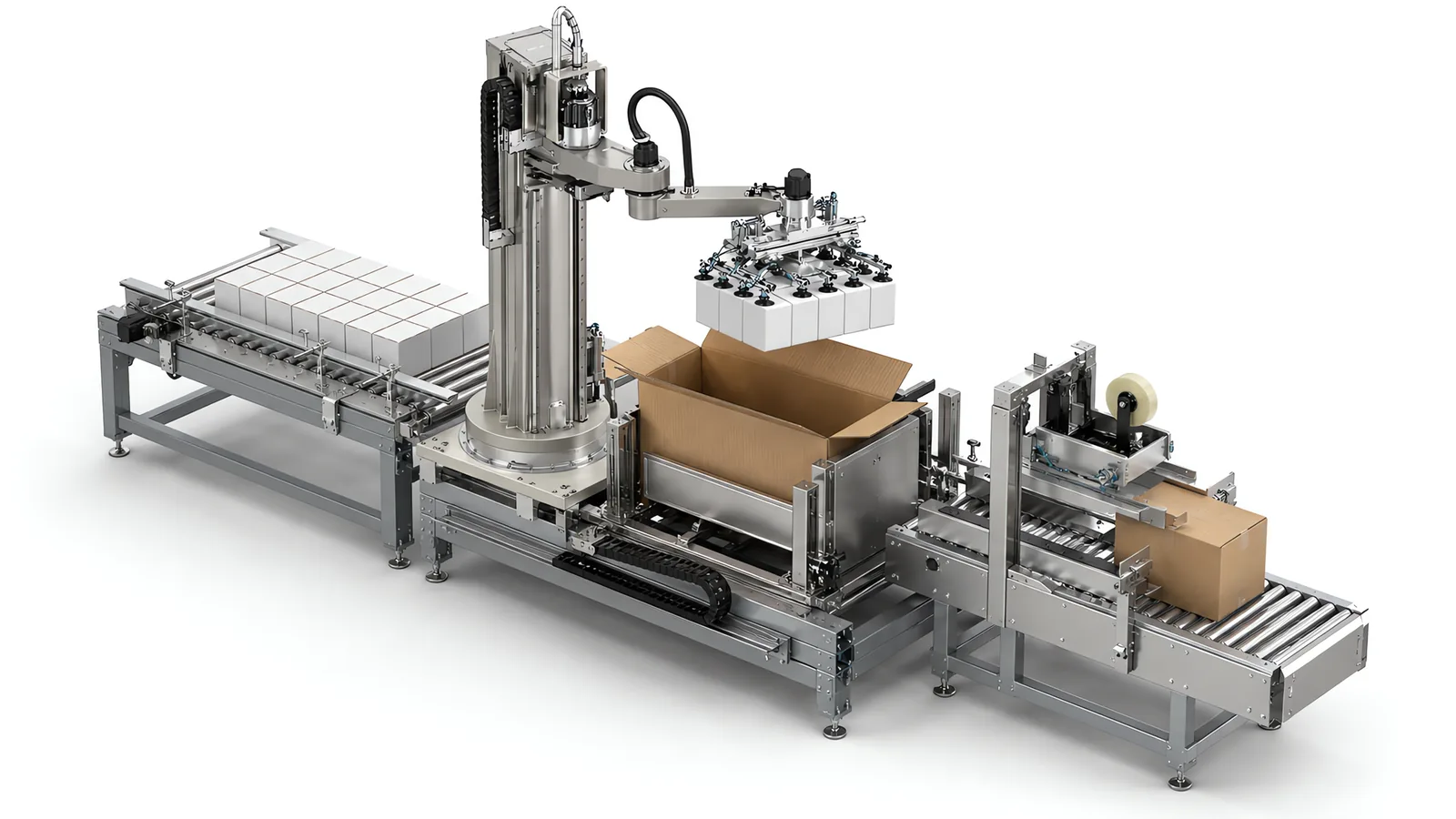
Motionwell Automation designs and builds case packing and wrapping equipment in Singapore for the last stations of a production line: collation and grouping, case or bundle forming, loading, sealing, coding and the handoff to palletizing. The delivered reference for this work is a wrapping and packaging machine whose collation section has run several group formats on the same hardware (two-row grouping, four pieces per row, and six pieces per wrapping cycle) using independent X and Y pitch adjustment so the group geometry is selected from a recipe, with vision-guided labelling on the finished pack. Machines are designed, assembled and tested at our 20 Woodlands Link facility, and Motionwell has delivered over 150 special purpose machines since 2014 under ISO 9001:2015 and bizSAFE Level 3.
What we build is the part that has to be designed against your product: the collation, the grouping pitch, the loading motion, the tooling and the control system that ties the stations together. Shrink tunnels, wraparound case packers and stretch wrappers are settled products made in quantity, so those get specified and integrated into the line. The same split applies to can seamers and pallet conveyors, set out on the drum and pail filling page.
The downstream half of the same line sits on our automated palletizing systems page, and the high-mix version of this problem, where SKU count is the enemy, is covered under FMCG and co-packing automation.
What Is the Station Order on an End of Line Packaging System?
End of line packaging in Singapore is usually sold as one machine and delivered as five. The sequence below is how Motionwell scopes it, and it is the order the product physically travels.
- Collation and grouping. A single-file stream of units becomes a rectangular group at the correct pitch. Lane dividers, back-pressure control, indexing flights or a robot pick pattern all live here.
- Case erecting or bundle forming. A flat blank is opened into a square case and its bottom flaps are sealed, or the film is wrapped and formed around the group with no case at all.
- Loading or wrapping. The group enters the case by side push, by gravity drop or by robot pick, or the film closes around it and is sealed and shrunk.
- Sealing. Hot melt adhesive or tape on the top flaps, or a film seal and shrink tunnel on a wrapped bundle.
- Coding and verification. Batch, date and where required a serialised 2D code, printed and then read back.
- Palletizing and pallet wrapping. The case joins a layer pattern, the pallet is stretch wrapped, and it leaves.
On the packaging lines we have built, that chain runs as carton erecting and forming, automated product loading, carton sealing with hot melt or tape, labelling with vision verification, then shrink wrapping cartons into shelf-ready or transit packs before a column palletizing robot stacks them onto pallets to the layer pattern. The full line context is on the pharmaceutical packaging automation page.
The reason we insist on scoping the whole chain even when the order is one station: every interface in that list is a place where two suppliers each assumed the other one owned the handshake.
Which Case Loading Method Suits Your Product?
Three families cover almost every case packer you will be quoted. They fail in different places, and the product decides which failure you can live with.
| Loading method | How product enters the case | Suits | Where it struggles |
|---|---|---|---|
| Side-load (horizontal push) | Case is erected on its side, the collated group is pushed in horizontally, then the case is uprighted | Rigid units, bottles, cans, cartons packed in a tight matrix; high case rates | Tall unstable units that tip during the push; groups needing partitions inserted first |
| Drop-load (top-load by gravity) | Case sits upright under the collation deck, the deck opens and the group falls in | Bags, pouches, light sachets, anything tolerant of a short drop | Fragile or heavy units; drop height and case depth limit what survives; slower reset between cycles |
| Pick-and-place (robotic) | A robot picks the group with vacuum or a mechanical tool and places it into the case | High-mix lines, mixed SKUs, gentle placement, changing patterns | Cost per cycle at high rates; every product format needs tooling thought; open-top and porous surfaces defeat vacuum |
| Wraparound | A flat blank is folded around the collated group and glued | Retail-ready packs, tight fits, board savings | Blank quality intolerance; a change in group size is a change in blank |
Robotic loading is where most of our own work in this area sits, because it is the family that suits a Singapore plant running many SKUs at moderate rates. Where several arms share one packaging line, they are sequenced against line rate, because reach and speed on packaging duty are set by carton and case geometry, and an arm tuned to its own best cycle only waits longer for the group. Case position is confirmed by sensing, because a timer reports what the program hoped for: a case arriving late or skewed still gets loaded, and the group lands on the conveyor and never in the case. Vacuum generation is sized from the duty cycle, since a tool that holds the group on a test bench can still drop it when every station on the line draws air in the same instant.
One design rule worth stating before it costs you money: a group is only as good as the worst unit in it. A pick tool that holds twenty-three of twenty-four bottles is not a working tool.
Retail packs may need their own cartoner before outer-case packing. retail cartoning selection defines the product/leaflet and closure checks for that operation.
When Do You Use Shrink Film and When Do You Use Stretch Film?
An enquiry for a shrink wrapping machine in Singapore often turns out to be an enquiry for a pallet wrapper. These two get confused in specifications more than any other pair on this page, and they are not substitutes.
| Shrink film | Stretch film | |
|---|---|---|
| How it holds | Heated in a tunnel so it contracts tightly onto the pack | Pulled under tension and held by its own cling, no heat |
| Where it belongs | Multipacks, trays of bottles, shelf-ready bundles, transit bundles of cartons | Around a loaded pallet, binding the stack to the deck |
| Machine | Sealer plus shrink tunnel, with a heat and dwell recipe per film | Turntable, rotary arm or ring wrapper with film carriage |
| Consumable behaviour | Gauge and formulation change the shrink profile; a film substitution is a re-validation | Pre-stretch ratio and wrap pattern decide film use more than film brand does |
| Energy and space | Tunnel draws real power and needs extraction and clearance | Little power, but needs floor area and pallet access |
| Common failure | Burn-through, dog ears, seals opening on cooling, tunnel scorching a label | Loose top layers, film breaks at the corners, a stack that arrives leaning |
| Changeover cost | Heat and dwell per format, plus sealer tooling | Wrap recipe per pallet pattern, usually software only |
Two practical notes. First, heat and product do not always coexist: chocolate, some cosmetics, certain medical devices and anything with a heat-sensitive adhesive label rule out a tunnel before any other requirement. Second, a code printed on a panel that later ends up under a shrink band or a case flap is unreadable, and it is a mistake that survives right up to the first production run. Walk the pack through every downstream station with a marker pen on the intended code position before anyone orders equipment.
A narrow strap restrains the pack differently from surrounding film. strapping versus wrapping covers package damage, joining and consumable trials for the selected operation.
Heat shrinking is different from stretch wrapping. shrink tunnel process trials covers film, product exposure and the interface with the upstream film closure.
What Does a Carton Erector Actually Decide?
A carton erector takes a flat blank from a magazine, opens it square, folds the bottom flaps and seals them with hot melt or tape, then presents the open case to the loading station. It looks like the simplest machine on the line. It is the one that determines whether the line runs on Monday morning.
Three things decide that.
Blank quality. Board grade, scoring depth, moisture and glue-lap accuracy set how reliably a blank opens square. Singapore humidity is a real variable here. Cases stored on a hot loading bay overnight behave differently from cases fed straight from a conditioned store. If your erector jams intermittently and nobody can reproduce it, look at where the blanks were sitting before you look at the machine.
Squareness. A case that leaves the erector even slightly out of square accepts a side-load push badly and jams the loading station. The fault gets logged against the packer.
Magazine capacity and reload. The erector will happily outrun its own magazine. Magazine depth in minutes at your case rate is a specification worth writing down, because it decides how often an operator has to walk to that machine, and that walk is how a one-operator line becomes a two-operator line.
Sealing on the top flaps then follows the case: hot melt gives a stronger, faster and tamper-evident closure with a glue system to maintain, and tape is cheaper to own and easier to open. Neither is universally right.
The case erector selection guide turns these blank and closure questions into a format-change trial. Its discharge also needs a suitable roller conveyor transfer where rollers are used. If the packer stops temporarily, zero pressure accumulation can preserve case separation when the zones and release logic are designed for that load.
How Is Collation Pitch Worked Out Before Anyone Draws the Machine?
Pitch is the centre-to-centre distance between units in the group, and it is the number that constrains the whole station: tooling width, lane spacing, robot pick geometry, case internal dimensions and how much clearance the group needs to enter the case without scuffing.
Start with the unit footprint at its widest production tolerance. Add the spacing needed by the loading motion, including room for tool fingers or cups, and calculate the complete group’s outside dimensions. Compare that envelope with the case’s minimum usable internal dimensions, leaving clearance for insertion and case distortion. If starting from external case dimensions, first subtract the wall thickness to obtain the internal dimensions; do not subtract it again from an internal measurement. Prove the fit with production cartons and the least favourable product combination.
Then repeat it for every SKU on the line. This is what decides whether a multi-format machine actually runs every format. Our delivered wrapping and packaging machine handles it with independent X and Y pitch adjustment, so the group geometry changes on recipe selection instead of by shimming a guide rail. The same approach runs on our cobot unloading station for a consumer goods distribution centre, where X and Y axis pitch adjustment on stepper motors is what lets one end-of-arm tool cover several product sizes and packaging formats without a mechanical changeover, alongside a 5-magnet electromagnet quick-change tool that switches between gripper and vacuum modes on its own.
The question to ask any supplier is not whether the machine handles multiple formats. It is who changes the pitch, with what, and how long the line is stopped while they do it.
Why Is the Bottleneck Usually Collation, Not the Packing Machine?
Because the two stations do not run at the same rate, and only one of them is quoted in the units you were thinking in.
A case packer indexes once per case. A collator has to handle every single unit going into that case, at full line speed, and deliver them as one intact group. So the packer’s workload is your case rate, while the collator’s workload is your unit rate, a factor of twelve, twenty-four or forty-eight higher, depending on the pack.
Run the arithmetic on a real line. Our tray-fed filling and sealing machine doses through three heads in parallel, and the rate it sustains is set by the container and the fill volume. Divide whatever that rate turns out to be by the count per case and you have the packer’s index rate, which on a container line lands at a few indexes a minute and which no case packer finds difficult. The engineering problem is not the packer at all. It is converting a single-file stream of units into squared, gapped groups without tipping anything, without a gap propagating into a short group, and without the accumulation table growing until it needs its own floor plan. A faster filler upstream changes the numbers.
Four things go wrong at collation, in rough order of frequency.
Gaps in the stream. Any upstream reject, missed fill or momentary stop leaves a hole in the group. The collator either waits for it to fill, which stalls the line, or releases a short case, which is worse. This is why zero-pressure accumulation with motor-driven roller zones exists, and why the buffer length between the filler and the collator is a design decision.
Product instability. Tall, light or top-heavy units tip during lane division or on the transfer plate. Nothing downstream recovers from a tipped unit.
Pitch mismatch. The stream arrives at the conveyor’s natural spacing, and the group needs a different one; accumulation and transfer are covered on our conveyor and material handling page. Something has to change the pitch, and that something is the mechanism most often underspecified.
Reset time. The collator has to clear the deck and reset before the next group builds. That reset is dead time inside your cycle, and it is rarely in the rated speed on the quotation.
The diagnostic that settles it: before anyone quotes you a faster case packer, count how many units per minute actually reach the accumulation table and how many of them arrive in a usable group. If the second number is well below the first, a faster packer buys you nothing.
Where Do Coding, Labelling and Verification Belong on a Case Packing Line?
The code goes on after the last operation that could damage, smear or hide it, and it gets read back before the pack goes anywhere it cannot be retrieved from. Motionwell designs the coder and the reader into the line, and the reader is lit and lensed per substrate, because the same code on kraft board, on a white label and on shrink film is three different optical problems on one machine. The placement rule that settles most arguments: give the coder a settled surface and a known face. A code printed on a flap that moves while the ink is still wet reads at the station and fails at the warehouse.
On the case itself, label inspection should grade barcode readability against ISO/IEC 15416, and never report a bare pass or fail. A grade sliding from B toward C across a shift is a maintenance ticket you can raise before you make a single reject; a pass or fail flag tells you nothing until the day it fails. A rejected pallet at a retailer’s receiving dock costs far more than the camera that would have caught it. How these stations get lit, lensed and calibrated is set out on our machine vision inspection page.
Weight is the check that catches what the cameras cannot see. A case with a missing unit reads correctly on every code, grades well on every label and is still short, and the only station that finds it before the customer does is a checkweigher on the outfeed. Those two checks belong together on a case outfeed: a vision station ahead of the checkweigher and the checkweigher behind it, so count and content are verified by two independent physical principles, and whatever defeats the camera still has to beat the scale. Scopes like that also carry work nobody draws, such as rotating the mounting direction of an existing motor so a new frame clears it. Items of that kind belong on a real integration scope and never appear on a layout drawing.
Two rules make a checkweigher worth its cost. Set the reject limits from the actual filled-unit distribution, not from the nominal case weight, because a limit computed from nominal will either pass short cases or reject good ones as soon as the upstream process drifts normally. And give the reject a place to go: a diverter, a lane and a bin that an operator empties on a defined routine, with a counter. A reject mechanism with nowhere to put the case stops the line, and a line that stops for a reject gets the reject switched off.
Where every saleable unit carries a serial, the case packer becomes part of the traceability system. Aggregation binds each unit serial to its case, and the case to the pallet, so a warehouse scans one label. Two patterns work well: read every unit before it enters the case and close the case only when the expected count is confirmed, which suits robotic packing because the pick sequence is already deterministic; or read the assembled stack from above before flap closing, which is faster but constrains the collation pattern to keep every code facing up. Designing for aggregation up front is far cheaper than adding it later, and the detail is on our pharmaceutical serialization page.
What Do We Build Ourselves and What Do We Buy In?
Being specific about this is more useful to you than a capability claim.
| Scope | Position |
|---|---|
| Collation, grouping and pitch mechanisms | We design and build these, including multi-row and multi-piece group formats with recipe-driven X and Y pitch |
| Robotic case loading and pick tooling | We design and build; robots are bought and integrated, tooling is ours |
| Wrapping and packaging machines with vision labelling | Delivered, and the reference project for this page |
| Carton erecting, case sealing, shrink tunnels, stretch wrappers | We integrate proven standard machines |
| Conveying, accumulation and line handshakes | We design, build and program |
| Coding, code verification and reject handling | We design and integrate; the coder and reader are bought in and specified per substrate, and the tracking and reject logic behind them is ours |
| Control system, HMI, recipes and line data | We design and program on the platform your plant already maintains, so a recipe change does not need us on site |
| Guarding, interlocks and the safety design | We design, build and test, including LVD and CE testing |
How Does Case Packing Hand Off to Palletizing?
It hands off badly whenever nobody owns the interface. A palletizer inherits every problem upstream of it: cases that arrive skewed, under-filled, badly sealed or mislabelled all surface as palletizer faults, and the palletizer gets blamed for them.
Three things have to be agreed in writing before either machine is built. Conveyor height and case orientation at the transfer point, since a case that arrives on the wrong face forces a turning station nobody budgeted for. The handshake signals (case ready, accumulation full, pallet in position, pallet complete, fault) and which controller owns each one. And the point at which code verification happens, which must be before the case is stacked, because finding a misprinted code after the pallet is wrapped is expensive.
Pattern design then belongs to the palletizer, and the case dimensions you chose at the packing stage decide whether a clean pattern exists at all. A case footprint that does not tile onto a 1200 x 1000 mm pallet, the common Singapore size, wastes cube on every pallet you ship for the life of the product. Layer patterns, gripper choice and the guarding scope are covered on the automated palletizing systems page, with a delivered example in the robotic carton palletizing case study.
What Safety Scope Applies to an End of Line Packaging Cell?
Start from an ISO 12100 risk assessment, and let the assessment drive the design. Case packing lines carry a specific mix of hazards: trap points at the erector and flap folders, a hot melt system that burns, a shrink tunnel that is both a heat and an extraction question, and a robot cell where the danger is often the case. Where a robot is involved, ISO 10218-1 covers the robot and ISO 10218-2 the integrated system, with each safety function rated for performance level under ISO 13849-1.
Motionwell delivers the physical scope that follows: guard fencing and interlocked access doors, safety laser scanners, safety-rated stop circuits, LVD and CE testing, and MOM lifting certification where the machine includes lifting equipment. On washdown lines the interlock switches themselves have to be washdown rated, because a standard dry-environment switch fails early and takes the line down with it. The design method is set out on our machine safety and CE marking page.
What Drives Cost and Lead Time on a Case Packing Line in Singapore?
Two quotations for what looks like the same case packing machine in Singapore can differ by a wide margin, and the difference is decided before any hardware is ordered. These are the decisions that move the number.
| Cost driver | Why it moves the number |
|---|---|
| Units per minute upstream | Sets the collation design, which is the expensive half of the station |
| Units per case and case count per minute | Decides loading family, tooling and whether one packer is enough |
| SKU and pack format count | Every format is a pitch, a tooling set and a recipe; format count costs more than it looks |
| Product stability | Tall, light or fragile units add guiding, gentle transfer and slower cycles |
| Case style | Regular slotted case, wraparound blank, tray-and-hood and shelf-ready packs are different machines |
| Shrink or stretch scope | A tunnel adds power, extraction and clearance; a pallet wrapper adds floor area |
| Coding and serialization | Printer, camera, reject device and the data layer behind them are a subsystem |
| Interface to existing line | Tying into an existing conveyor and PLC versus building new infeed and controls |
| Site constraints | Ceiling height, floor area, forklift traffic, power and extraction availability |
Lead time runs 16 to 24 weeks from concept approval to factory acceptance testing on a standard build, and 24 to 32 weeks where cleanroom compatibility or full GMP validation applies. Design, fabrication, assembly and testing all happen at Woodlands Link, which is why a Singapore buyer can attend the factory acceptance test without flying to it. That matters more at end of line than anywhere else on a plant, because packing stations get adjusted constantly, a new pack size, a board grade change, a promotional multipack that marketing committed to before anyone asked production. Those adjustments happen in hours when the builder is in the same industrial estate.
How a custom build is scoped, costed and commissioned in general is covered in our special purpose machine design guide.
Frequently Asked Questions
Does Motionwell build case packing machines in Singapore?
Yes, as custom collation and case packing equipment, with no catalogue packaging range behind it. Our delivered reference is a wrapping and packaging machine that has run several group formats on the same hardware, including two-row grouping, four pieces per row and six pieces per wrapping cycle, with independent X and Y pitch adjustment and vision-guided labelling. Shrink tunnels and stretch wrappers are settled products made in quantity, so those are specified and integrated into the line, and the split is settled at concept review.
What is the difference between shrink wrapping and stretch wrapping?
Shrink film is heated so it contracts onto the pack, and stretch film is pulled taut and held by its own cling with no heat at all. Shrink belongs on primary and secondary packs: multipacks, trays of bottles, shelf-ready bundles. Stretch belongs at the pallet, where the film binds a whole stack to the deck. They are different machines, different consumables and different energy profiles, so the choice is decided by what you are holding together.
Why is my end of line packaging slower than the case packer is rated for?
Almost always because collation is setting the pace. A packer indexes one case per cycle, but the collator has to accumulate every unit in that case at full line speed, square them, hold the pitch and release the group intact. Gaps, doubles, skew or a missing unit stall the group and the packer waits. Before buying a faster packer, count how many units per minute reach the accumulation table and how many of them arrive in a usable group.