
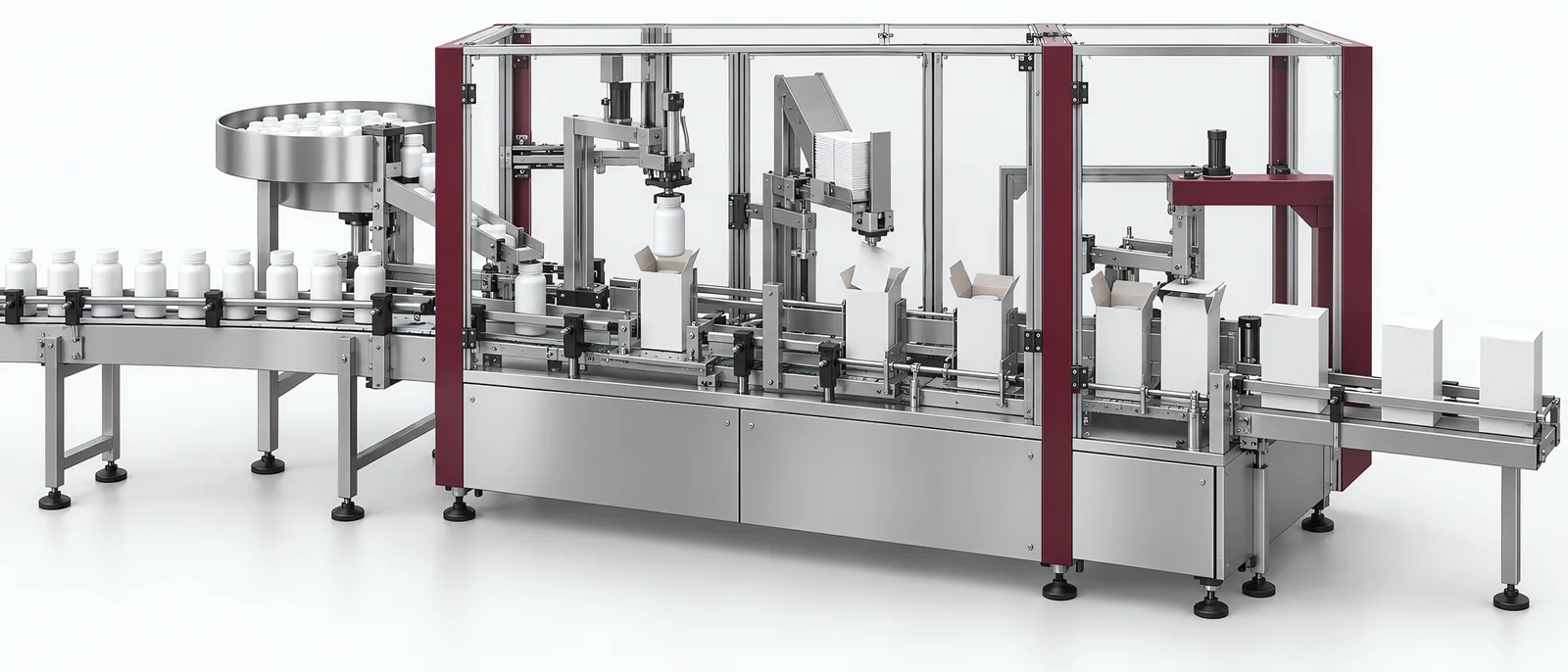
Conceptual equipment illustration.
An automatic cartoner opens a folded retail carton, loads the product and closes the pack. It is a different machine from a case erector or case packer handling shipping cartons. Choose the loading method around the product, its carton and any leaflet or accessory that must be inside.
For a pharmaceutical and packaging line, define those pack contents before comparing machine output ratings.
Match the Loading Direction to the Pack
Side-loading and top-loading arrangements have different product-presentation needs. An unstable bottle, a wrapped device and a stacked group of components do not all travel into a carton in the same way.
IMA-PG’s cartoning range includes continuous and intermittent machines, with tuck or hot-melt closure and optional leaflet/code equipment on selected models. These are configuration choices; “automatic cartoner” does not establish that all of them are included.
During a product trial, watch the loading motion as well as the closed carton. The pack should not conceal a crushed leaflet or a product caught beneath a closing flap.
Define Missing-Component Detection
Write a component-presence sequence for the actual pack:
- Confirm a carton has opened correctly before loading.
- Confirm the product and required leaflet/accessory are available.
- Prevent or reject the incomplete pack according to the agreed sequence.
- Confirm the rejected carton leaves the accepted-product flow.
A sensor showing a leaflet in the feed path does not necessarily prove it reached the final pack. Establish what each check observes and whether the pack remains identifiable after the check.
The same distinction applies to printed codes. Reading the correct code on an incoming carton and inspecting the code on the completed pack are different positions in the process.
Trial the Carton Variation and Changeover
Include cartons from the intended supplier and production variation, not only hand-selected samples. Test opening, loading and closure at the proposed operating rate. Record the glue/tuck configuration and the part settings needed for each format.
A changeover trial should include restoring the recipe, physical guides and verification checks. Run deliberately incorrect pack combinations to establish how the machine responds. Do not accept a recipe name as proof that every mechanical change was made.
For the next stage, a case erector creates the shipping case and case packing and wrapping handles the outer pack. Keep their counts and stop conditions coordinated through the packaging-line interfaces.
Contact Motionwell about the cartoning task to discuss the product flow and checks around the selected equipment.