
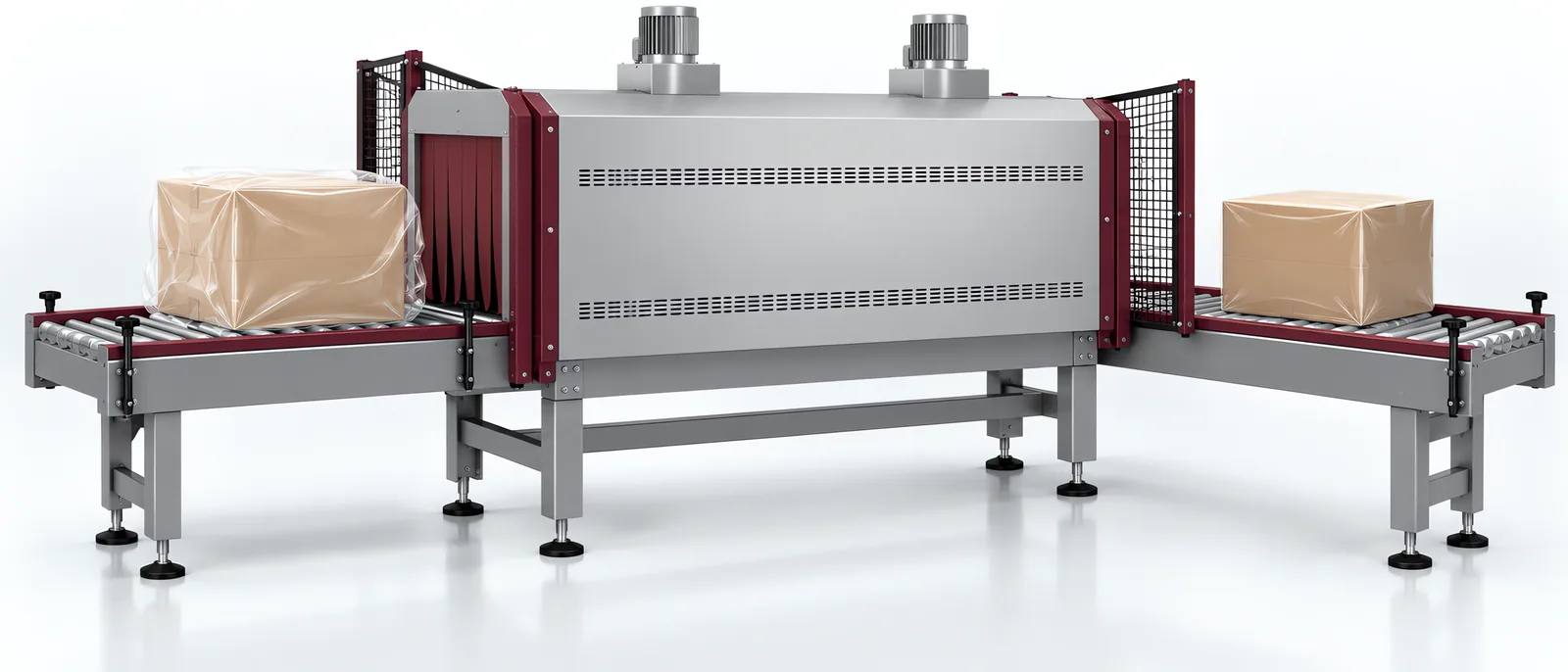
Conceptual equipment illustration.
A heat shrink tunnel machine applies controlled heat around a film-wrapped product while a conveyor carries it through the chamber. Select the tunnel from the film’s process window, package geometry and the product’s tolerance for thermal exposure. A neat outer film finish does not prove the product inside remained acceptable.
For packaging automation, distinguish the tunnel from the upstream operation that forms and seals the film around the pack.
Heat, Airflow and Time Act Together
Sealed Air’s Shanklin tunnel overview describes heat and airflow with controlled temperature and conveyor operation. The particular machine configuration determines how those variables can be adjusted.
Do not choose a set temperature in isolation. A different belt speed changes exposure time, and an uneven pack can shield some film areas from the airflow. Trial the actual film thickness, seals and product orientation together.
For an illustrative geometric check, assume the effective heated travel is 1.2 m and conveyor speed is 0.1 m/s. Nominal travel time through that length is 12 seconds. This is not the film or product temperature history; it only establishes the transport interval for a trial.
Inspect Two Different Outcomes
Keep packaging appearance and product condition separate in the acceptance record.
| Inspection | What to observe |
|---|---|
| Film and seals | Loose corners, holes, distorted seams and trapped air |
| Package presentation | Movement, tipping or contact with the tunnel entrance |
| Product | The temperature-sensitive characteristic specified for that product |
| Outfeed handling | Film contact, cooling space and conveyor transfer |
A tunnel does not replace a verified upstream seal. Confirm which defects originate at film formation or closure before adjusting tunnel heat to hide them.
The case-packing and wrapping page distinguishes shrink and stretch processes. Establish which operation is actually needed.
Include Stops in the Trial
Product flow is not always continuous. Test the planned response when the downstream conveyor stops and packs remain in or near the heated zone. Verify the selected machine’s documented heater, blower and conveyor sequence; different designs manage residual heat differently.
Agree how interrupted packs are identified and checked before returning to accepted flow. The packaging-line control scope should include that recovery path, not only the normal ready/running signals.
When comparing total conveyor-system costs, include entrance/outfeed handling and the space needed around this thermal process. A tunnel quoted without its transfer equipment is not the same scope as a working station.
Contact Motionwell about the wrapping line to discuss the pack and the transfers around the tunnel.