
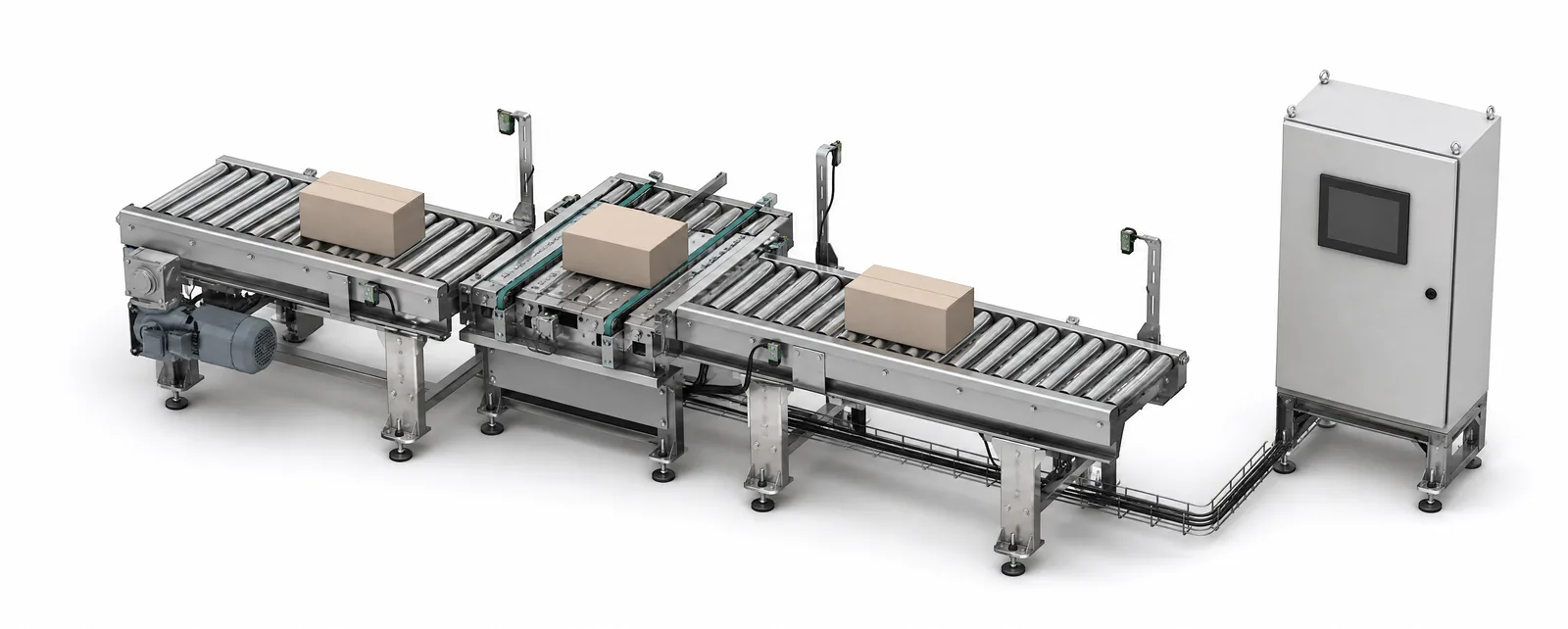
Conceptual equipment illustration.
Conveyor system cost includes the carrying equipment, transfers, controls and work needed to connect the line to your production process. A price per metre becomes useful once those other items have their own agreed scope. Start with the complete installed system, then compare the conveyor sections within it.
For a factory or warehouse in Singapore, the practical budgeting question is: what must be working when the installation team leaves? Moving a carton along a straight section is one requirement. Releasing it to a packaging machine, holding the queue during a stop and restarting without a jam add different equipment and engineering tasks.
Put Both Quotations on the Same Layout
Mark each conveyor section and every handover point on one drawing. Give both bidders the same product range, required output and connection points. A supplier can then identify its scope against the drawing, including the parts it expects another contractor to provide.
Choose the carrying method first using our comparison of conveyor types. Roller, belt and chain arrangements have different load and transfer requirements. Dorner’s industrial conveyor overview also separates product handling, controls and integration functions when describing a complete system.
Use this worksheet to reconcile quotations. Give each row an equipment reference and an included price or named supplier.
| Budget item | What to identify | Question for each bidder |
|---|---|---|
| Conveyor sections | Length, width, carrying surface, supports and load | Are both offers built for the same smallest and heaviest products? |
| Drives and zones | Motors, gearboxes or driven rollers, and independent control zones | What can stop or restart separately? |
| Transfers and handling | Curves, lifts, stops, diverts and small-product transfers | Who supplies each handover mechanism? |
| Sensors and controls | Detection, PLC or zone logic, cabinet, HMI and field wiring | Does the price include the operating sequence? |
| Machine interfaces | Signals, software changes and tests with adjacent machines | Who modifies the existing controller? |
| Installation | Delivery access, assembly, cabling and site commissioning | Which shutdown and access conditions were priced? |
| Acceptance and support | Product trials, training, documentation and initial spares | What evidence demonstrates that the line is ready for use? |
The conveyor design and integration page explains how those mechanical and control choices fit together. Keep project management, building work and utilities on the same budget sheet even when they come from separate suppliers.
Why Two Equal-Length Conveyors Can Have Different Costs
Consider two proposed runs of the same length. The first moves stable cartons between manual workstations. The second feeds a machine that pauses between batches and accepts one carton at a time. Both drawings may show a straight conveyor, but the second specification also needs a defined queue, controlled release and a response to the receiving machine’s status.
A useful comparison names those differences individually. Ask how many products the buffer holds, how the controller detects them and what happens when the downstream machine stops. Add a test with the shortest carton and the least stable load. This reveals the equipment behind the price without requiring either bidder to imitate the other’s design.
For multi-machine projects, include the work described under packaging line integration: product condition at transfer, release signals and coordinated recovery. Buying these interfaces as part of the planned scope makes the installation budget more complete.
A Small Buffer Calculation You Can Reuse
Suppose a line delivers 15 cartons per minute and you want the buffer to absorb a 20-second downstream pause. These are example planning inputs:
Waiting capacity = 15 × 20 ÷ 60 = 5 cartons.
If each carton needs 0.6 metres of allocated conveyor pitch, the queue occupies 5 × 0.6 = 3 metres. Add the transfer sections, detection arrangement and operating margin to obtain the physical layout. Use the actual carton dimensions and stop pattern when calculating your own requirement.
This also gives bidders a shared test: stop the receiving machine for the agreed interval while the upstream flow continues. Check how many cartons are held and how the queue clears after restart. The arrival rate, available space and recovery rate belong together in the specification.
Keep Installation Cost Visible
For an existing line, photograph the handover heights, nearby control cabinets, cable routes and access along the proposed run. Record when the area is available and whether equipment must pass through a lift, doorway or occupied aisle. These details let the installation scope reflect the building that is actually there.
Separate work that can be completed before shutdown from work requiring production to stop. Cabinet preparation and offline software checks may be possible earlier; the physical connection and joint machine trials need a coordinated window. Ask for an installation sequence with responsibilities and the production restart test attached.
For a route connecting storage and production, check the wider warehouse and intralogistics plan before fixing the conveyor layout. The project budget should support the material flow you want to achieve.
Compare Running Costs Against the Same Duty
Keep purchase cost and operating cost in separate columns. Compare operating hours, loaded and idle periods, energy use, cleaning work, planned maintenance and the spares needed to recover a failed section. Use the same evaluation period and duty profile for both proposals.
A lower initial price can be a good choice when the scope and operating needs match. The worksheet helps establish that match before you decide. It also makes a later scope change visible: a new divert or additional accumulation zone becomes a defined addition to the agreed layout.
Planning a conveyor project? Tell us what you need to move and where it needs to go. A layout or short line video can help us discuss the conveyor sections, interfaces and installation scope with you.