
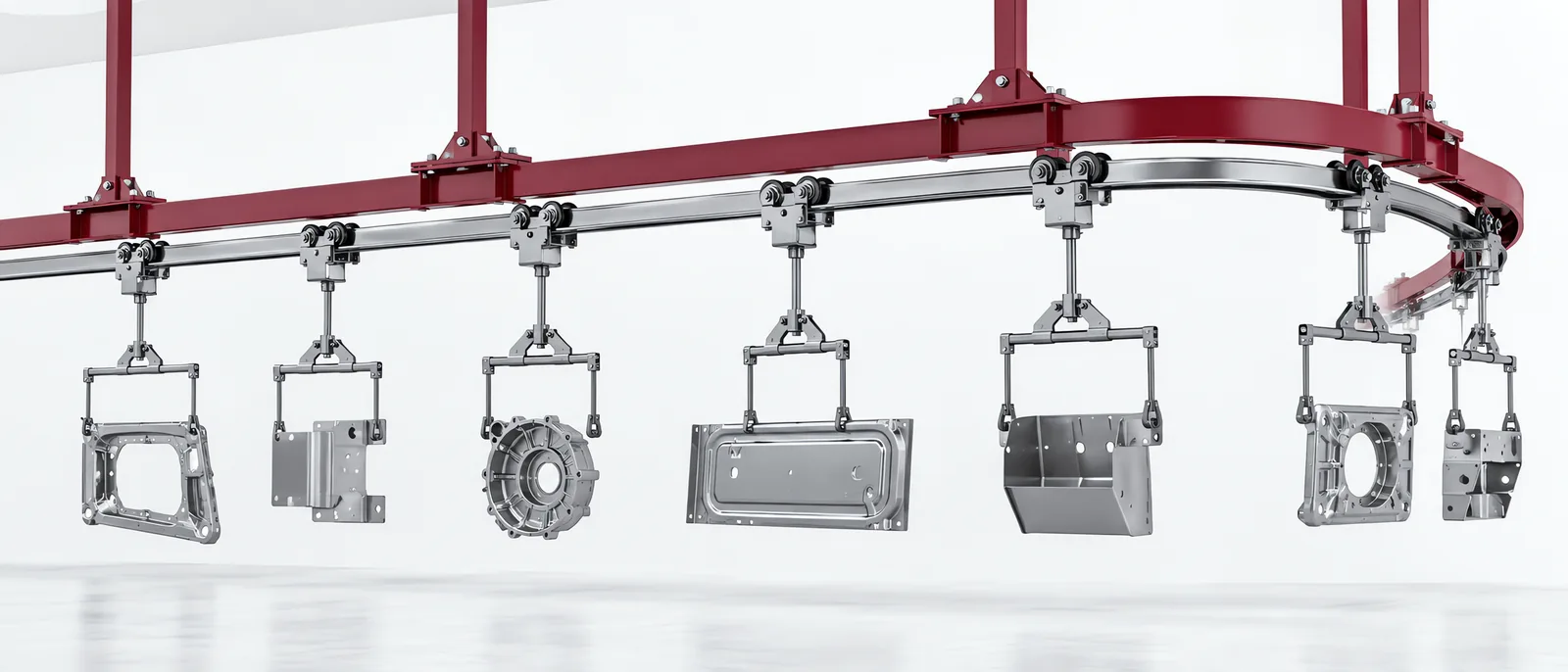
Conceptual equipment illustration.
An overhead conveyor system carries workpieces on suspended carriers along a track. Choose the carrier and route from the component’s support needs and process sequence. Moving a load above the floor does not, on its own, establish usable access or independent accumulation at every station.
The equipment can form part of warehouse and internal material flow, or connect production operations through a planned route.
Decide Which Carriers Must Stop Independently
PACLINE’s overhead-conveyor introduction describes a continuous chain circuit with drive, take-up and track curves. In a synchronous arrangement, the loads move together because they are attached to the same continuous chain.
If some carriers must wait while others continue, specify an architecture that provides that function. Do not assume a basic continuous chain can offer independent workstation stops just by adding software.
Compare the proposed arrangement with the conveyor-types guide. The control capability follows the selected mechanical architecture.
The Carrier Is Part of the Machine
List load mass, centre of gravity, permitted movement and attachment points. A carrier needs to support the component through horizontal and vertical curves as well as straight travel.
Check swinging, rotation and clearance with the load installed. Empty-carrier clearance is not a loaded-route trial. Fixtures used in a wet, hot or dusty process also need materials and maintenance appropriate to that environment.
For parts that must be removed at a workstation, define how the carrier becomes accessible and how the system confirms a completed load/unload action. Do not let an empty carrier proceed into an operation that assumes a part is present.
Route the Complete Working Envelope
Prepare a layout including carrier spacing and the load envelope through turns. Include maintenance access to drives and take-up arrangements. A floor-space comparison that ignores support structures and service access can be misleading.
At interfaces with other equipment, coordinate the material-handling sequence. A blocked destination needs a defined response before carriers reach it.
Trial loading, process stops, unloaded return and restart with the intended carrier pattern. Keep the number and distribution of loaded carriers in the test record; that operating load matters to the selected drive and route.
Compare the Full Installed Scope
The conveyor-system cost guide separates equipment from supports, controls and installation. For overhead equipment, identify who supplies the supporting structure and verifies the interface to the building or process equipment.
Contact Motionwell about the suspended-load route to discuss the carrier, stops and transfers needed for the task.