
When production slows down, the root cause is often hiding in material flow: parts waiting in the wrong place, operators searching for stock, or bottlenecks between storage and production stations. We build warehouse automation that eliminates these gaps.
How those categories differ, and which problem each one solves, is set out in the five types of warehouse automation. Our delivered systems include palletizing robots integrated with ASRS storage for medical consumables, RFID-guided AGV pallet transfer with automatic charging, and dual Z-axis gantry systems servicing 10+ CNC machines in parallel, the approach set out on our machine tending automation page. We have been the authorized SIASUN AGV distributor for Southeast Asia since 2017 and integrate AMRs for flexible-routing applications. Our AMR vs AGV comparison guide compares route changes, traffic and transfer requirements.
For fixed routes between warehouse stations, the budget needs to include transfers and controls as well as conveyor length. Our guide to conveyor system cost and quotation scope shows how to compare complete installations.
Choosing the Fixed Conveyor Routes
For cartons and totes, roller conveyor selection begins with the underside support and transfer gaps. A pallet conveyor instead needs the pallet runners, load stability and vehicle handover checked throughout the route.
A spiral conveyor can carry suitable unit loads between elevations, with space retained for both transfers and maintenance. Between machines on the same route, zero pressure accumulation controls the waiting queue through product detection and coordinated release.
Empty-pallet supply needs verified singulation before transfer. pallet dispenser requirements covers actual stack geometry, double release and occupied-outfeed states.
Loose-load handling at a dock needs a route that fits both bay and vehicle. telescopic conveyor dock selection covers reach, cargo trials and downstream capacity.
Suspended carriers need a loaded envelope and the right stopping architecture. overhead conveyor routing distinguishes synchronous chain movement from independent accumulation requirements.
What Warehouse Automation Has Motionwell Delivered in Singapore?
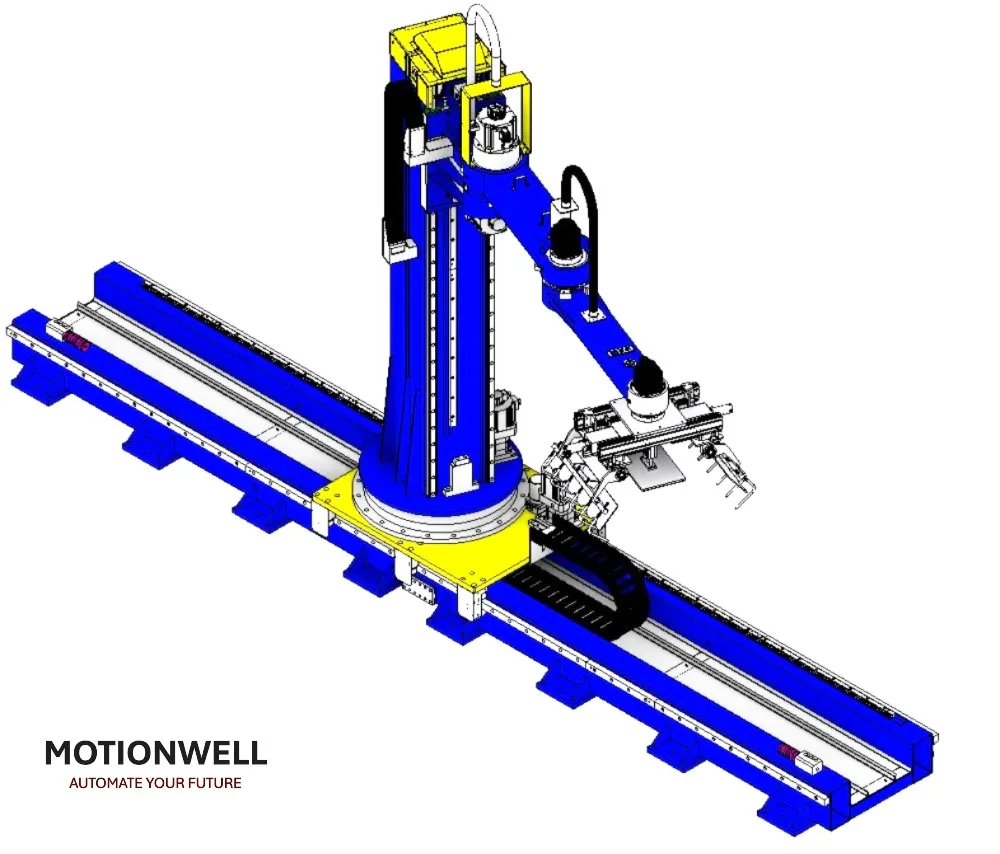
Motionwell Automation builds AGV, AMR and ASRS warehouse automation in Singapore, and has been the authorized SIASUN AGV distributor for Southeast Asia since 2017. The storage side is set out on our ASRS and automated storage page and the mobile side on AMR and AGV integration. Delivered work includes palletizing robots integrated with ASRS stacker-crane storage for medical consumables under WMS barcode verification, a 4-axis column palletizing system on a heavy-duty rack-and-pinion linear track serving more than one pallet station, RFID-guided AGV pallet transfer with automatic charging stations, and dual Z-axis gantry robots servicing more than 10 CNC machines in parallel. Where routes change often enough that re-laying floor tags becomes the bottleneck, we integrate AMRs instead, which trades a deterministic cycle time for a layout nobody has to keep still, and adds traffic management and docking accuracy to the scope in exchange. Moving material is rarely the whole project, so our capability pages set out what we take on either side of it, including palletizing and the safety work for a floor shared with people and forklifts.
- Palletizing robots integrated with ASRS stacker-crane storage for medical consumables, with WMS barcode verification at the palletizing station
- AGV pallet transfer with RFID floor navigation, chain conveyor transfer modules, and automatic charging stations
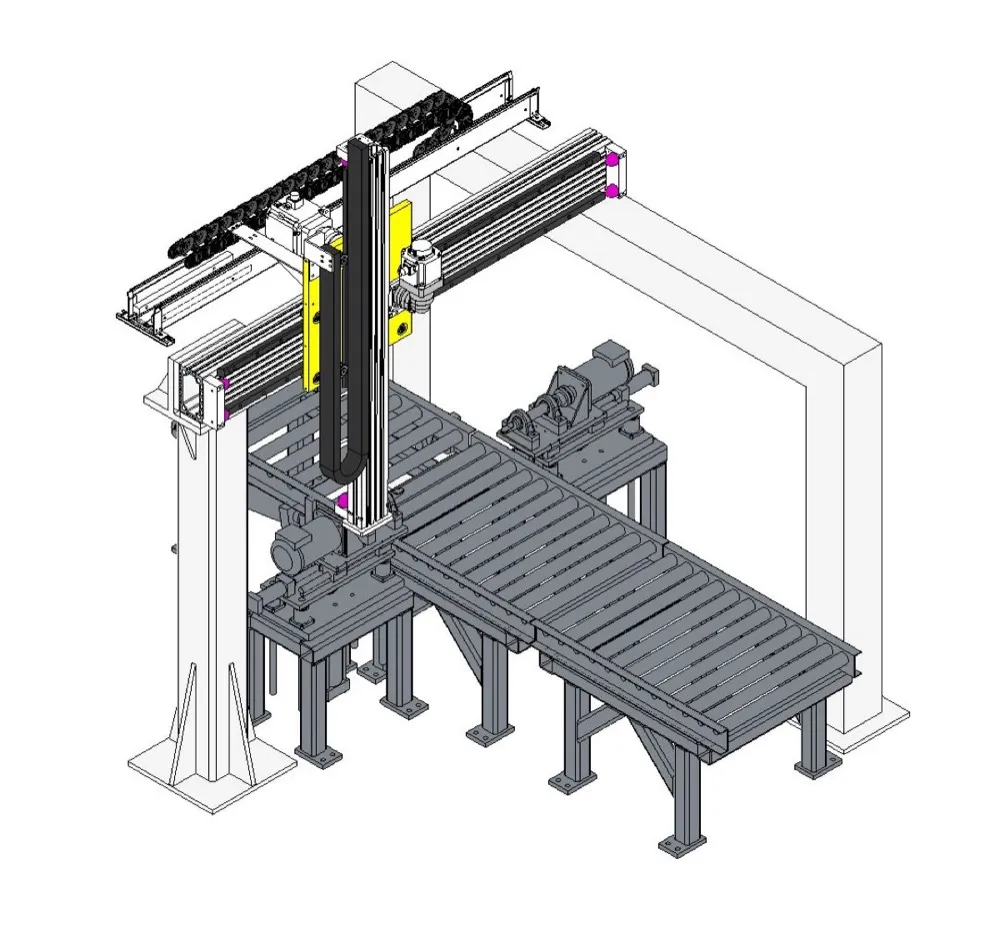
- Linear gantry robots in aluminium extrusion, welded single-beam and double-beam builds, with dual Z-axis for parallel CNC machine tending across 10+ stations
- Column palletizing robots (4-axis, counterbalanced vertical lift column) on heavy-duty linear tracks with rack and pinion drive
- Throughput and cycle time matching between storage, transport, and production to eliminate buffer waste
- Inventory visibility at the point of use with WMS integration, barcode/RFID verification, and replenishment triggers
- Layout optimization for real walking paths, forklift routes, and safety zones and scanner coverage in mixed traffic environments
- Scalability: adding vehicles, stations, or storage capacity without redesigning the entire system
- Payback arithmetic before commitment, the inputs are set out in our warehouse automation ROI guide
- SIASUN AGV systems (authorized Southeast Asia distributor since 2017) and AMR integration, selected against route changes, load, docking accuracy and traffic conditions
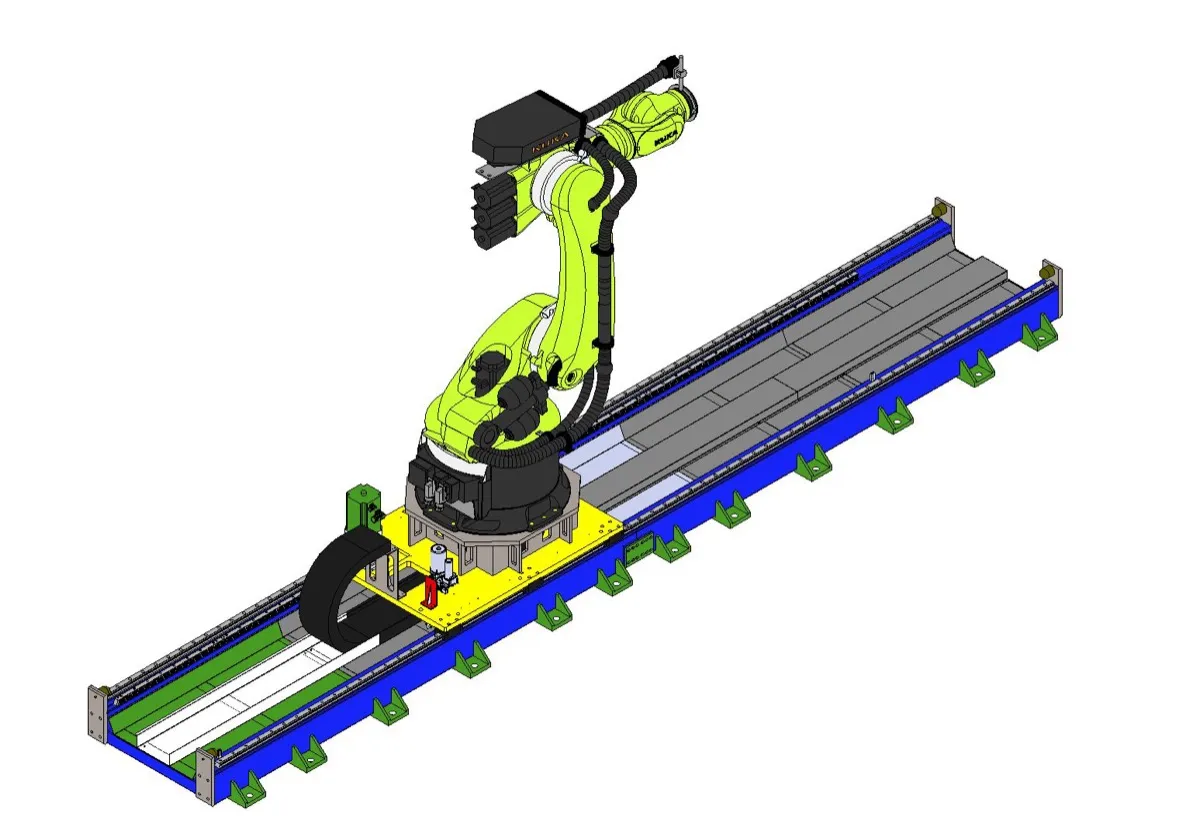
- Palletizing robot programming, robot integration and EOAT design on the arm platform your plant already supports, with the track, the gripper and the safety circuit designed around it
- Gantry systems: compact 3-axis aluminium extrusion frames through welded single-beam to dual-beam bridge builds, with servo or VFD drive
- WMS data exchange, barcode/RFID verification, bin location management, and replenishment trigger logic
Featured: Column Palletizing Robot with Heavy-Duty Linear Track
Motionwell designed and built a 4-axis column palletizing robot system with heavy-duty linear tracks for high-payload warehouse palletizing. The counterbalanced column takes the load vertically and the rack and pinion track carries the robot between stations, so one robot serves several palletizing positions instead of one robot per pallet.
- Robot: 4-axis column palletizing robot with counterbalanced vertical lift column
- Track: Heavy-duty linear track with rack and pinion drive, extended stroke
- Rate: set by case weight, layer pattern and cases taken per pick
- Integration: Robot programming, WMS barcode verification, multi-station serving
Full build detail is in the palletizing robot case study.
When Is a Truss Manipulator Better Than an Articulated Robot?
Motionwell designs and builds dual rail truss manipulators for high-speed, heavy-load material transfer between conveyor stations. These manipulators use rack and pinion mechanisms driven through a common pivot shaft, with V-shape roller guides for dusty and harsh environments.
A truss manipulator can carry several picking units on one beam, with the gripper sequence matched to the conveyor presentation and receiving stations. Stroke, travel and motion profile are sized against workpiece mass and station spacing. A lift beneath the roller conveyor presents the next batch at the required pickup height. The timing plan states which picks run together and which are sequenced individually.
This type of manipulator is designed for applications where articulated robots cannot reach the required travel distance or payload, and where gantry overhead access is preferred over floor-mounted robots.
How Do AGV Fleets Navigate and Recharge Themselves?
Motionwell’s AGV fleet deployments use RFID-based floor navigation for deterministic path following, the vehicle goes where the tags say, every time, which is what you want on a route that never changes. AGVs carry chain conveyor modules on top for automated pallet loading and unloading from stationary chain conveyors. Fleet management software coordinates vehicle routing, pallet assignment, and wrapping station scheduling. When battery level drops below threshold, a vehicle takes itself to a contact charging station and rejoins the fleet, so the schedule absorbs charging instead of stopping for it. Where routes change often enough that re-laying tags becomes the bottleneck, an AMR with SLAM navigation is the better tool; the AMR vs AGV guide covers that trade-off in detail.
What Handles Wafer Transfer Between Cleanroom Stations?
For semiconductor and electronics logistics, wafer handling automation coordinates substrate tooling, carrier interfaces and process-tool handshakes. Servo motion, ESD-safe handling and airflow are designed around the substrate and the installation’s cleanroom requirements. Recovery and particle-verification procedures are part of the equipment specification.