
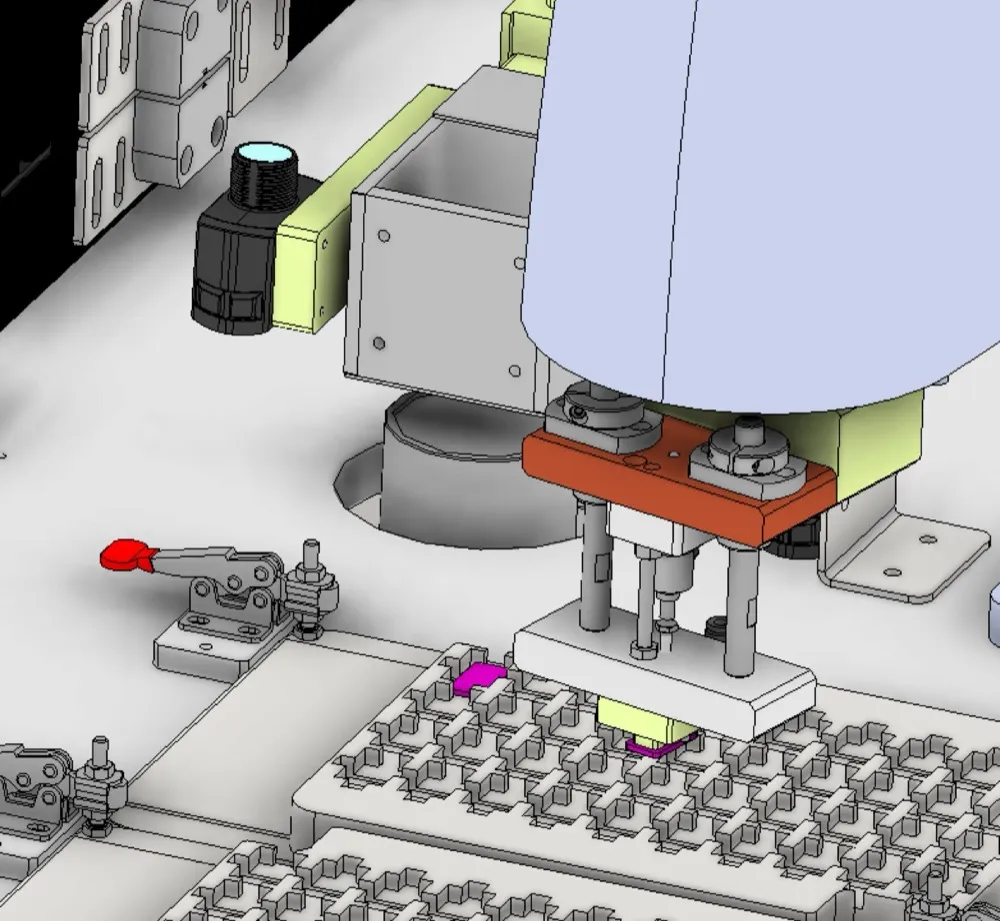
Motionwell builds consumer products automation in Singapore for mixed-SKU unloading, assembly and end-of-line packaging. For FMCG manufacturers and co-packers, the task is to maintain reliable handling as cartons, pack counts and product variants change. Delivered work includes cobot unloading with quick-change gripper and vacuum tooling, alongside vision-guided SCARA panel assembly.
HMI recipes coordinate the pick pattern, tooling and vision verification. Format parts are designed around the SKU range, with clear settings and storage at the station to make changeovers repeatable.
Who Builds Turnkey Assembly Automation for High-Mix Consumer Product Lines?
Motionwell integrates product handling, assembly checks, case packing and palletizing around the line’s SKU schedule. A useful starting point is the smallest and largest pack, the changeovers per shift, and the time currently spent adjusting guides or tools. The same questions drive changeover design on a filling line. Our automation capabilities page shows the equipment types that can be combined into a staged build.
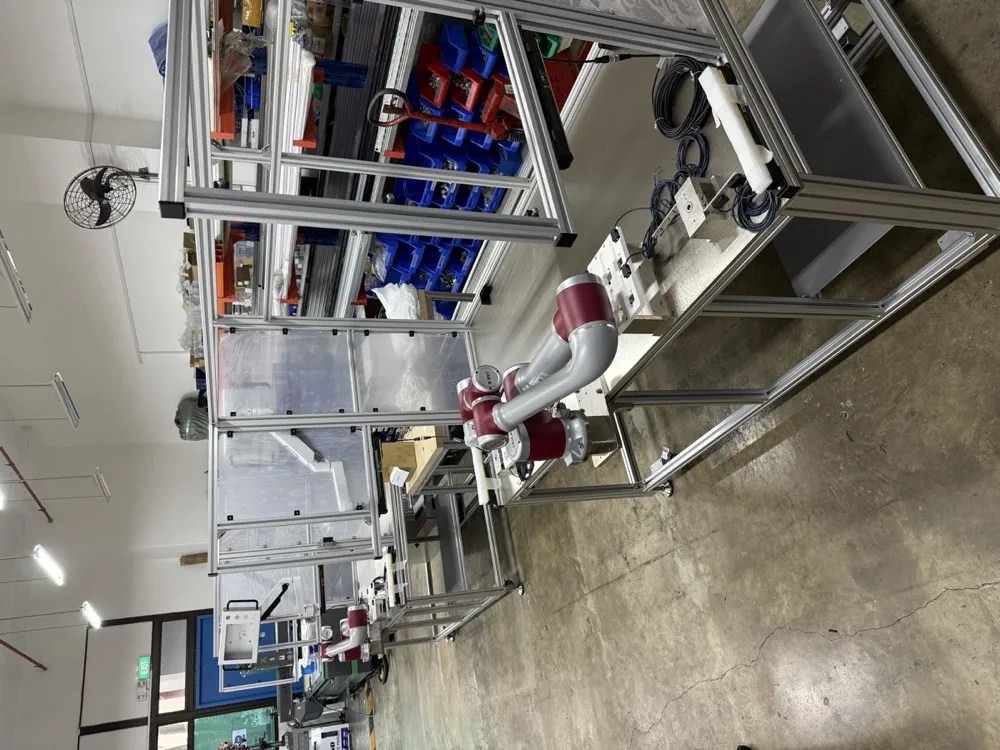
- Cobot unloading stations with auto-adjusting pitch for different package sizes, handling mixed SKUs including beverages, snacks, and household products
- Electromagnet quick-change EOAT with 5-magnet array, pneumatic gripper mode, and vacuum suction mode for automatic tool switching
- End-of-line packaging automation: wrapping, vision-guided labeling, case packing, and palletizing cell integration
- SCARA robotic assembly for home appliance panels, consumer electronics, and wearable device components with vision-guided alignment
- Changeover time and operator simplicity: recipe-driven mode switching via HMI with no mechanical adjustment needed
- SKU variant management with vision verification of colour, label, barcode, and pack content at line speed
- Cost-effective automation that starts semi-auto and scales to full automation as volume grows
- Handling that survives varied packaging materials: carton, plastic, shrink-wrap, bottles, and pouches
- Collaborative robot cells with gripper, vacuum and electromagnet tooling, including customer-supplied arms; tooling, fixtures and operating limits are assessed together for the application
- OPC-UA and Ethernet/IP communication for line integration and production data exchange
- Vision-based variant verification and label inspection with multi-recipe programming
- Modular fixture design for fast SKU changeover without mechanical rework or special tools, guarded to collaborative robot safety standards
Featured: Cobot Unloading Station with Quick-Change EOAT
Motionwell designed a cobot-based unloading station for a consumer goods distribution centre handling mixed SKUs including consumer beverage products, snacks, and detergent. The system features a 5-magnet electromagnet quick-change EOAT that automatically switches between gripper and vacuum modes depending on the package type, with auto-adjusting pitch for different carton sizes. It sits on the boundary between production and warehouse intralogistics, which is where most decanting and re-packing work actually happens.
- Robot: Collaborative robot with custom multi-mode EOAT
- EOAT modes: 5-magnet electromagnet array, pneumatic gripper, vacuum suction
- SKUs: Mixed consumer products (beverages, snacks, household goods)
- Switching: Automatic mode selection based on product type, no manual changeover
What Does Automation Look Like on an FMCG or Co-Packing Line?
Changeover is part of the production cycle. A co-packing specification should include the time to clear the previous SKU, load the next recipe, change format parts and approve the first good pack. Modular fixtures and colour-coded parts keep those steps easy to follow. The recipe then selects the pack count, pick pattern and inspection criteria for the new job.
Case packing brings carton size, collation pattern and flap-sealing settings together. Recipe-selected pick patterns and a tool-change rack let the robot select the appropriate tooling; adjustable guides carry marked settings for each format. Downstream, robotic palletizing uses the same product identity to select the stack pattern and pallet label.
The other recurring FMCG problem is variant control: two products in near-identical packaging, one promotional sleeve, and a picker who has been on shift for nine hours. Vision checks colour, label artwork, barcode, and pack count at line speed, the approach is set out in our machine vision inspection guide. Catching the mix-up on the line costs seconds. Catching it at a retailer’s receiving dock costs a rejected delivery and a chargeback.
How Does the Modular Unloading Station Work?
A carton box enters the modular unloading station via a carton box conveyor. A barcode scanner reads the carton ID label. Tote bins enter via tote bin conveyors and their tote IDs are also scanned. The carton is securely clamped at the work zone.
Based on the carton ID information, the robot arm equipped with a customized End-of-Arm Tool (EOAT) automatically reconfigures to the correct tool set from a tool change rack. The tool reconfiguration is predefined in the Host PLC. The robot unloads SKUs from the carton box into tote bins. Once unloading completes, the carton ID updates with process code and the emptied carton conveys out of the station. Every filled tote bin updates with SKU information and conveys out.
The X and Y axis pitch adjustment runs stepper motors sized for the pick spacing each product needs. That is what lets one EOAT cover several product sizes and packaging formats without a mechanical changeover.
How Do Stations Talk to Each Other on a Mixed-SKU Line?
The unloading station runs its own PLC and exchanges data with neighbouring stations over OPC-UA. Ready, occupied and transfer-complete signals coordinate each handoff. Buffers provide room for a station to continue during a short downstream stop, while the line controller holds further transfers when the buffer is full. Barcode tracking links each carton and tote to its station events and timestamps.
That same event data is what makes OEE measurement mean anything on a high-mix line. Without per-SKU changeover timestamps, availability losses get filed as “setup” and nobody ever finds out which product family is quietly eating the week. Lines that share the room with regulated production carry the added constraint that the changeover includes a clean as well as a format swap.
For bulk containers, pails, drums and jerrycans of detergent, lubricant or coating, see drum and pail filling systems, which covers net-weight dosing and heavy-container handling.