
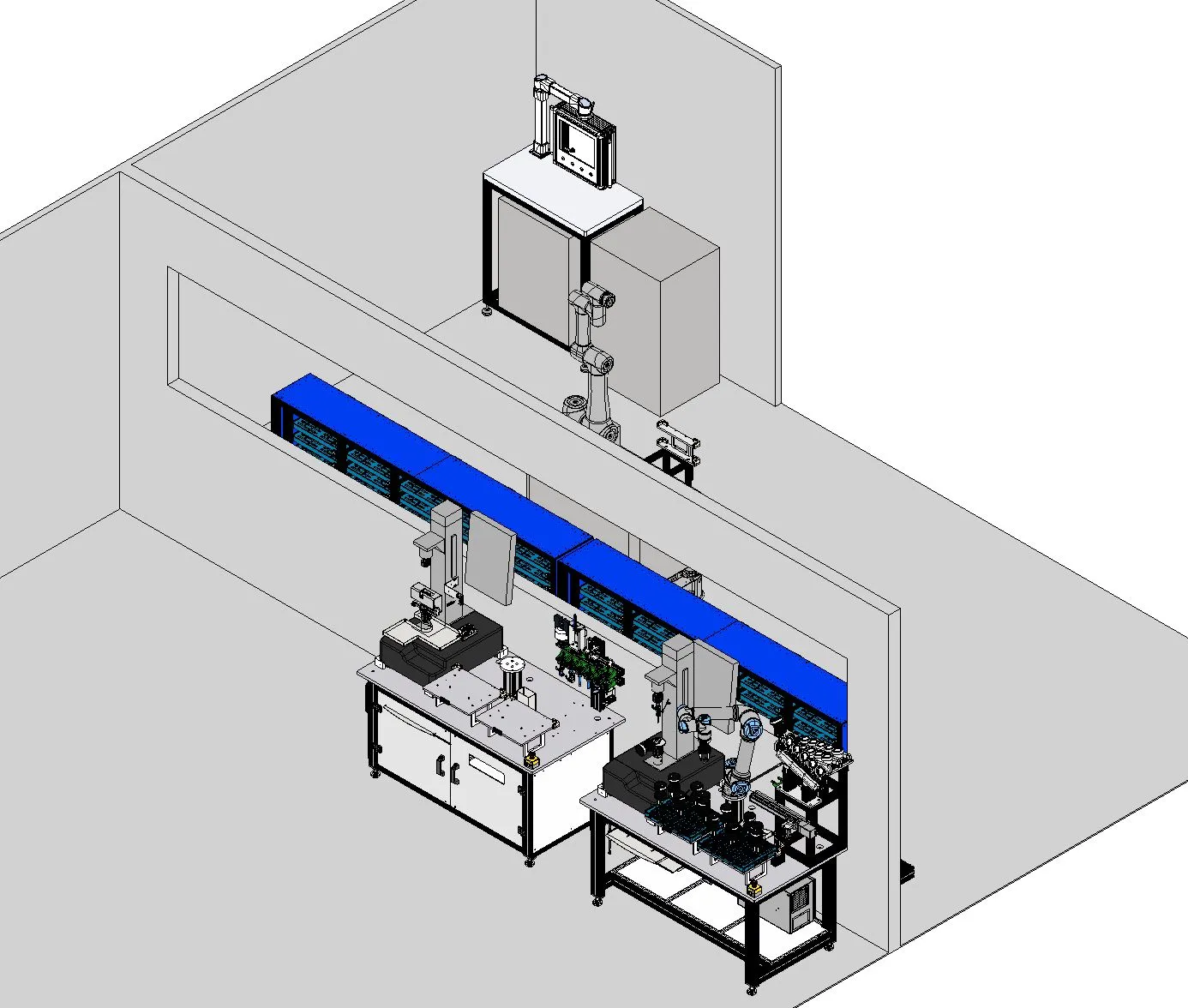
Motionwell’s flagship laboratory project delivers a working QA laboratory automation system in a manufacturer’s own test lab. An autonomous mobile robot carrying a collaborative arm moves samples between a 70-position PLC-native storage rack and the lab’s universal testing machines, covering tensile, compression and flex testing with traceability from sample pickup through to filed result.
The customer has placed repeat orders for four consecutive years. For a lab evaluating a similar system, the main decisions are instrument access, specimen handling and result traceability. The laboratory automation capability page explains the transport, instrument-tending and scheduling options behind those decisions.
What Does Motionwell’s QA Lab Automation System Actually Do?
The system takes a queued specimen from storage, loads the selected universal testing machine, starts the assigned method and files the result against the sample ID. Vision compensates for the mobile base’s docking offset before the cobot picks or places a specimen. The PLC tracks each sample through the workflow and exposes a recovery state when a test or transfer fails. Transport, controls and inspection can also be commissioned in stages using the equipment in our automation capability list.
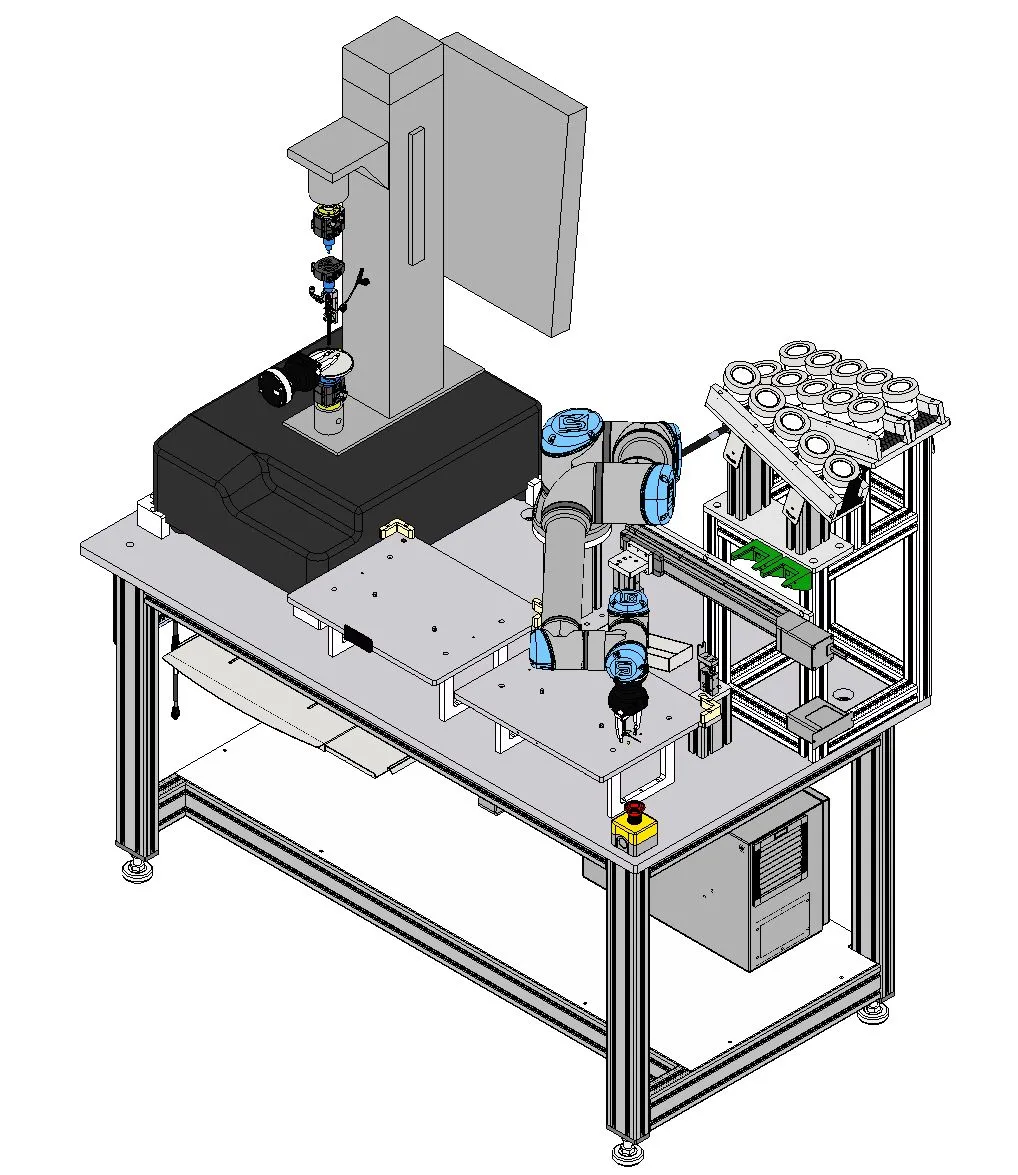
- AMR + cobot compound mobile robot for autonomous sample transport between storage and testing stations with vision-compensated docking
- Multi-station universal testing machine integration with auto zero reset, speed setting, start trigger, and bidirectional PLC communication via Ethernet/IP
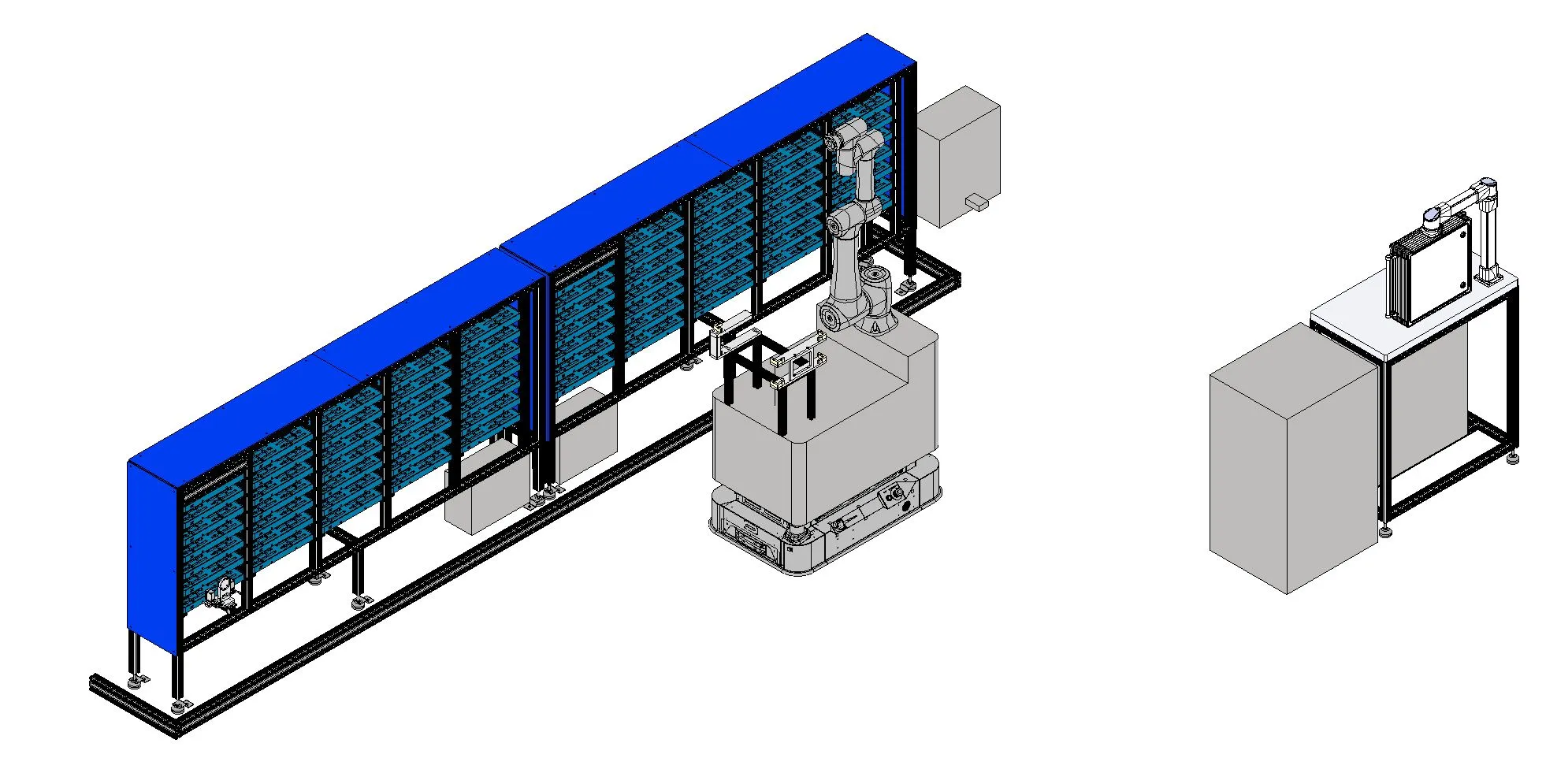
- 70-position sample rack storage (7 rows x 10 columns) with PLC-native lightweight WMS scheduling, slot tracking, and priority queue management
- Automatic test result naming, network file upload, and complete audit trail with sample state tracking (queued, in-test, completed, failed)
- Compound precision: AMR docking accuracy + cobot reach + hand-eye vision compensation for reliable sample handoff every cycle
- Data integrity with explicit sample states, controlled timestamps, and file naming rules that pass audit review
- Safe collaborative operation with station-level safeguarding for mixed human-robot QA environments
- Recovery logic: verified retries, operator prompt sequences, and safe-hold states that maintain traceability when things go wrong
- AMR fleet management with mission dispatch via REST API and automatic charging coordination
- Collaborative robot arm with custom EOAT, gripper I/O control, and hand-eye vision calibration for sample pickup
- PLC-native orchestration with OPC-UA, Ethernet/IP and PROFINET multi-protocol communication
- Universal testing machine communication, test parameter setting, and result file management
Which Labs Is This Built For?
This architecture suits mechanical QA labs running repetitive destructive or mechanical tests on physically handled specimens. The sample, test method and result file remain linked to the manufacturing batch or lot.
That describes the incoming and in-process test labs attached to medical device manufacturing, the release testing behind pharmaceutical packaging lines, and materials and coupon testing in aerospace and precision machining. What these labs share is not the test method. It is the shape of the working day: a queue that builds up during the shift, instruments that sit idle overnight, and a technician spending part of every day carrying trays and renaming files.
Inside the QA Lab Programme: What Was Delivered?
Featured: Automated QA Lab with AMR-Cobot Compound Robot
This is Motionwell's reference QA lab automation delivery. An autonomous mobile robot carries a collaborative arm as one compound mobile unit, navigating between a 70-position sample storage system and multiple testing stations. The PLC-native WMS manages sample queuing, test scheduling and result filing with audit trail support. The customer has re-ordered for four consecutive years. Build detail is in the QA lab automation case study.
- Programme: four consecutive years of repeat orders
- Robot: AMR plus collaborative robot arm as a compound mobile unit
- Storage: 70-position rack (7 x 10) with PLC-native WMS
- Testing: Multi-station universal testing machine integration (tensile, compression, flex)
- Control: PLC-native scheduling, OPC-UA / Ethernet/IP / PROFINET
- Traceability: Automatic file naming, network upload, complete audit trail
How Reliable Is the Sample Handoff, Cycle After Cycle?
This is the question that decides whether a lab can leave the system running unattended, and it is the one customers ask first. A mobile robot does not park in exactly the same spot twice, so precision has to be recovered at the point of pickup and never assumed from navigation.
Three layers stack to make the handoff repeatable. SLAM-based localization brings the mobile base to the docking station, correcting continuously against known landmarks. The cobot arm then reaches the target using its joint encoders, with hand-eye calibration mapping camera coordinates onto the tool frame so residual docking offset is already accounted for. Finally, a wrist camera measures the actual sample position immediately before gripping and applies a pixel-to-world correction.
Because the last correction is measured, pickup accuracy does not decay as the AMR accumulates navigation drift over a long shift. The machine vision inspection page covers how that calibration and correction is built, and AMR vs AGV explains why a free-navigating robot is chosen over a fixed-path one in a lab that gets rearranged.
What Changes for the Lab Technician?
Three things, and none of them is the robot.
Samples wait in assigned rack locations between tests. The scheduler selects an available instrument compatible with the required method, and the AMR carries the tray to that station.
The scheduler can continue dispatching queued tests after the staffed shift. Overnight capacity is planned against test duration, specimen availability and the recovery actions that require an operator.
Files stop being named by hand. Sample ID, test type, timestamp and operator ID are concatenated by rule and uploaded to network storage the moment a test finishes. Nobody types a filename, so nobody mistypes one.
The technician’s day shifts toward setting up methods, reviewing out-of-specification results and handling the low-volume tests that were never worth automating. How that split is decided, which methods are worth end-to-end automation and which are better left manual, is worked through on the laboratory automation capability page.
Will the Records Survive an Audit?
Sample state is tracked explicitly: queued, in-transit, at-station, in-test, completed, failed. Every transition carries a timestamp and is logged to the server database, so the question “where was this sample at 02:40” has an answer.
For a lab operating under GxP, that log is only half the requirement. Audit trails, access control and electronic signatures on the equipment layer are covered on the electronic device history record page, and the qualification route for the system itself, IQ, OQ, PQ and the traceability matrix behind them, is set out under computer system validation.
Safety matters here too, because a lab is a shared space. A mobile robot and a collaborative arm operating around technicians need a risk assessment before the layout is fixed; cobot safety standards covers what that assessment has to establish, and machine safety and compliance covers the safeguarding, interlocks and certification that follow.
What Do We Need from You to Scope Your Lab?
Four inputs get a realistic proposal back:
- Sample volume per day and per test method, plus how much of it arrives in bursts
- Which instruments you already own, their make and model, and whether they expose a control interface
- A lab layout with floor space, door widths and where the samples currently wait
- Your IT rules for network storage, server access and who is allowed to write result files
The instrument control interface is the item that most often changes the answer, so it is worth checking before anything else. A lab that cannot pause testing during installation is a normal starting condition, the laboratory automation capability page explains how the build is phased around a running lab.