
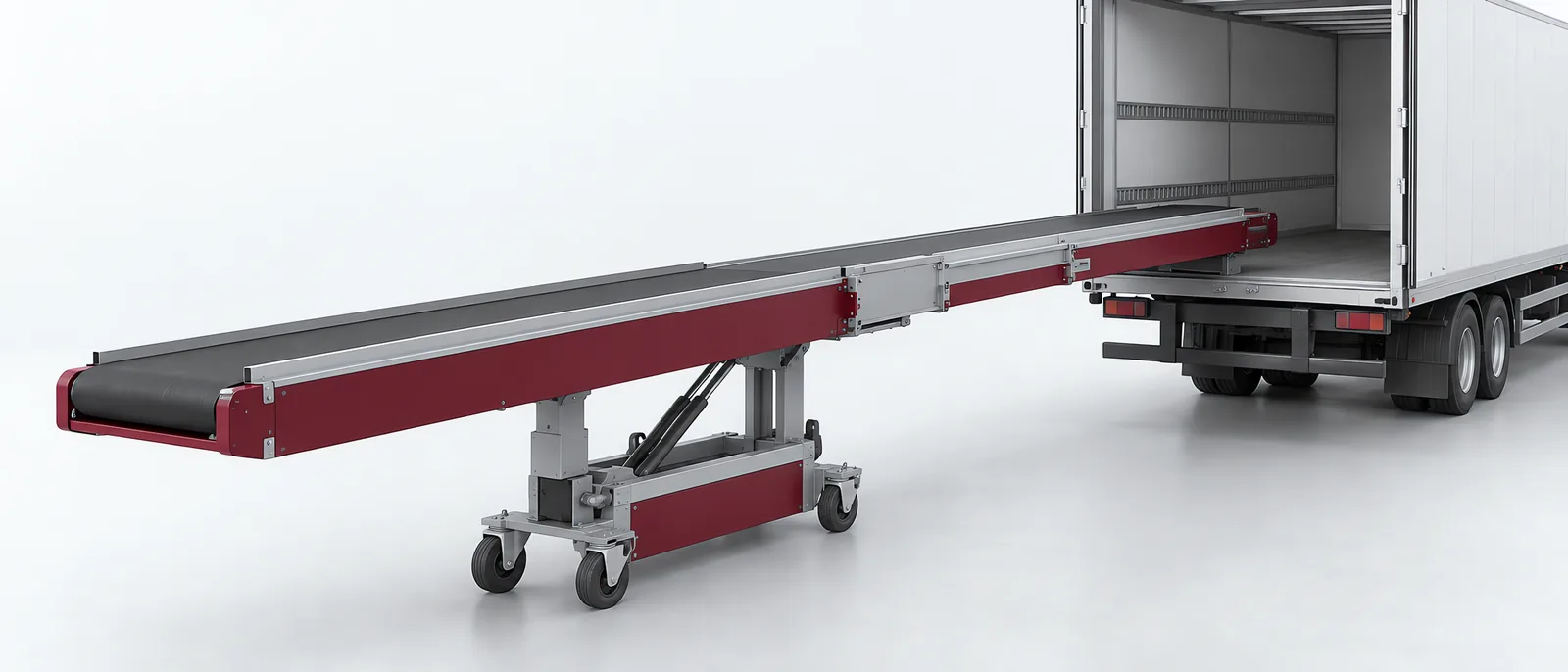
Conceptual equipment illustration.
A telescopic boom conveyor extends into a vehicle or container to bring loose parcels closer to the loading or unloading position. Choose its reach and working height from the actual dock and vehicle geometry, then test the intended cargo. It is not a substitute for a pallet-handling system carrying complete loaded pallets.
For warehouse and intralogistics automation, define the loose-load flow before selecting the conveyor.
Fit the Dock and Vehicle Together
Measure the installed base position, dock leveller, vehicle entrance and available extended path. Check both the stored and working envelopes. A machine that fits the bay when retracted may obstruct another operation when extended.
Caljan’s Performer documentation shows telescopic equipment with configurable direction and optional front-end features. Confirm the exact proposed configuration; operator platforms, variable fronts and reverse operation are not automatically present on every telescopic conveyor.
Use the largest and smallest intended packages to trial the belt and transfer. Polybags, cartons and irregular loose items can behave differently at the same transition.
Specify the Human and Machine Interfaces
Identify where the operator works and how controls are reached through the working range. Include visibility and access around the boom and dock. Extension movement and belt movement are separate actions, so specify their permissions and stopping behaviour separately.
The receiving conveyor and material-handling system must accept the stream generated at the vehicle. A telescopic conveyor cannot maintain unloading flow when its outfeed has no available capacity.
Test upstream/downstream occupied states, a stopped belt with cargo present and the coordinated restart. A reverse-capable configuration also needs a defined direction-change sequence.
Use the Actual Cargo for Throughput Trials
Measure sustained handling with the mix of packages the operation expects, including items that need manual repositioning. Keep those conditions with the result. A belt-speed figure is not parcels per hour, and a rated distributed load is not automatically the allowable point load of a heavy item.
Compare the selected arrangement with the conveyor-types guide, especially where the dock transfers onto rollers or another belt. Test the transition for the permitted package dimensions.
The conveyor-cost guide helps separate the extending machine from fixed transfers, electrical work and the dock interface. Compare that complete scope across quotations.
Discuss the loading-bay task with Motionwell to plan the cargo route and controls around the telescopic section.