
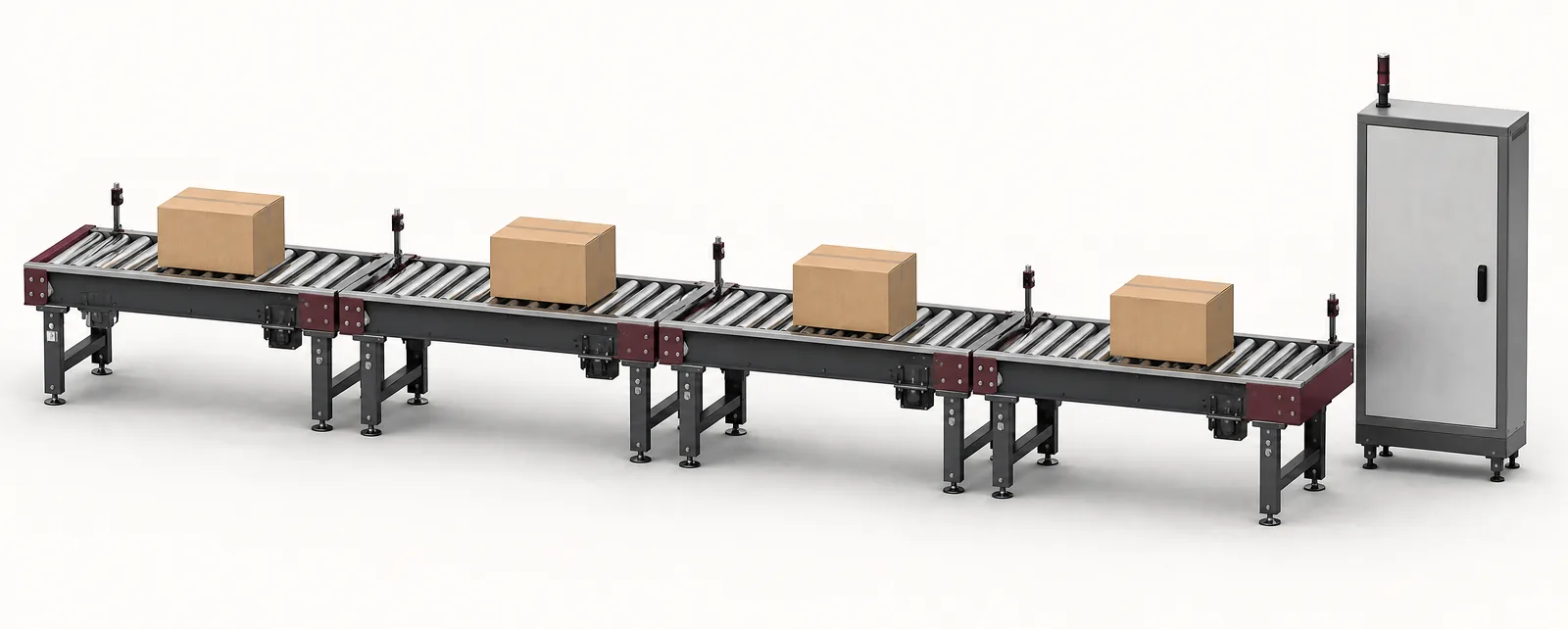
Conceptual equipment illustration.
A zero pressure accumulation conveyor holds products in controlled positions without allowing the waiting queue to push against adjacent products. It does this through a coordinated combination of zones, detection and release logic. Motorised rollers alone do not establish the function.
For cartons or totes, specify the product range and required buffer capacity first. Then design zones that can detect, stop and release those products with the required separation.
What a Zone Must Know
A basic zone needs to know whether it contains a product and whether the next position can accept it. In Interroll’s ZPA operating explanation, an occupied downstream zone causes the upstream zone to hold its package, maintaining separation.
That principle needs to be translated into the actual sensor positions and stopping behaviour of your conveyor. A product can extend beyond a detection point, and a drive can continue moving briefly after a stop command. Check the longest load against both conditions.
The conveyor integration page explains the larger mechanical and control scope. The conveyor types guide separates this operating function from the carrying surface on which it is implemented.
Design the Zone Around the Product Range
Record minimum and maximum product length, load mass, underside condition and permitted orientation. A short carton must be detected reliably; a long one must not occupy an adjacent zone in a way the controller fails to recognise.
If the selected control platform supports linked zones for long products, specify how the product length is identified and how those zones are reserved and released. Do not assume this feature exists on every zone controller.
| State or condition | Expected behaviour to define |
|---|---|
| Empty zone, upstream product available | Accept only when the local path is available |
| Product present, downstream unavailable | Hold the product within the allocated stopping position |
| Downstream ready | Release according to the chosen spacing and handover mode |
| Product does not reach the expected sensor | Raise a transfer fault and control upstream release |
| Sensor remains occupied unexpectedly | Prevent an unchecked feed into the affected position |
| Restart after interruption | Re-establish occupancy before issuing movement commands |
Map these states to the functions and fault handling available on the selected controller.
Choose the Release Mode Deliberately
A line feeding one machine cycle at a time may need individual product release. Another operation may accept a train of products with controlled spacing. Interroll’s ZoneControl manual describes zone coordination and release modes for that controller family; use current documentation for the installed equipment when defining the sequence.
At the final zone, the receiving machine becomes part of the decision. Its ready signal may mean that the machine is healthy, but not necessarily that there is room for another carton. Define a specific permission-to-transfer condition and a completion confirmation.
For a case packing or wrapping machine, include the required carton orientation and separation at entry. The buffer should preserve both while waiting.
Calculate Capacity in Products, Then Check the Layout
For an illustrative buffer, suppose each of six zones is allocated to one carton. The nominal waiting capacity is six cartons. If a transfer sequence requires one position to remain available, the usable waiting capacity under that sequence is smaller. State which capacity the proposal quotes.
Compare the arrival and departure patterns as well as average rates. A buffer can absorb a temporary stop, but it cannot indefinitely compensate for a receiving process that runs more slowly than the sustained incoming flow.
Link this local buffer decision to the warehouse and intralogistics layout so that a queue does not simply move congestion to an earlier station.
Test the Failure Cases With the Actual Packages
During acceptance, interrupt the receiving machine, obstruct an agreed sensor under controlled test conditions and stop a product during a transfer. Check the physical separation and the recorded fault. Repeat with the shortest and longest permitted loads.
After recovery, confirm that no product is lost from the occupancy model and no two releases compete for the same destination. A successful empty-conveyor demonstration cannot establish these behaviours.
Need a controlled buffer between machines? Discuss the flow with Motionwell. We can review the zone layout, release conditions and upstream interfaces.