
Why Replace Manual End-of-line Stacking?
Motionwell Automation integrated automated palletizing robot systems for manufacturers in Singapore, replacing manual end-of-line pallet stacking with robotic automation. The systems use articulated arms and 4-axis column palletizers, selected on payload, reach and duty cycle, because the end-of-line station handles every case the line makes and a platform sized against the average case is the one that stalls on the heaviest.
Manual palletizing is the station where a line’s output meets a person’s endurance. Stack quality drifts across a shift, and a pallet that leans has to be re-squared before it can be wrapped or racked. Automating the last station also removes the lifting exposure that drives most end-of-line injury claims. The financial case is usually built the way we set it out in how to model warehouse automation ROI, where labour hours are the visible input and rework and damaged loads are often the larger term. This work belongs to our broader palletizing systems capability, and the cell-building side of it to robot integration services.
How Is the Cell Designed?
Robot Selection
Motionwell selects palletizing robots based on application payload, reach, and cycle time requirements:
- 4-axis articulated arm: the higher-rate option for standard cartons. Four axes cover pick, lift, place and case orientation, and leaving out the wrist axes is what allows the arm to be geared for sustained rate. It is specified when case rate is the binding constraint, and not when a heavier case is.
- Higher-payload platform: for multi-case grabs, full-layer picks, or individual cases above 30kg, the cell moves to a heavier palletizing platform. That selection is driven by case weight and layer pattern.
- The robot controller keeps motion and its own safety functions; the cell PLC owns sequence, infeed and pallet handling, and the two exchange state over industrial Ethernet. Splitting it there means a layer pattern change is a robot program edit and a conveyor change is a PLC edit, so neither job waits on the other discipline.
Custom vacuum and mechanical gripper designs are engineered for each application. The default is a vacuum area pad, because it releases fast, marks nothing and covers a new case footprint by re-zoning the pad instead of by a mechanical change. Pneumatic side clamps are added where vacuum has nothing to hold: open-top cases, wet or dusty board, and loads whose top face lifts away from the contents. Clamps cost cycle time and have to be re-taught per case size, which is why they are the exception.
Conveyor Integration
The infeed conveyor runs 24V motor-driven roller (MDR) zones, never one continuously driven belt, which is what makes the accumulation zero-pressure: each zone starts and stops on its own, so cases queue without leaning on the case ahead. On corrugated that is not a nicety, because line pressure crushes board and a crushed case is a pick the vacuum pad loses:
- Powered roller conveyor infeed rated at 30 metres per minute from production line
- 3-zone accumulation buffer with a photoelectric sensor per zone, so release is driven by what is actually sitting on the rollers, never by an elapsed time that cannot tell a late case from a missing one
- Carton squaring station with pneumatic side guides to ensure consistent pick position
- Reject lane with pneumatic diverter for out-of-spec cartons detected by upstream checkweigher
Carton presence, orientation and label facing are confirmed before the pick using the camera and lighting practice described on our machine vision inspection capability page. A mis-oriented case picked at speed is not a quality problem, it is a dropped load.
Layer Pattern Programming
Motionwell builds and simulates layer patterns offline, verifying pallet stability and cycle time before the pattern is allowed on the floor, because a pattern proved on the running line is proved at the cost of the loads it drops:
- Up to 50 stored patterns for different carton sizes and pallet layouts (1200x1000mm EUR and 1200x800mm standard pallets)
- Recipe-based changeover triggered by barcode scan or MES command, requiring zero mechanical adjustment
- Column, interlocking, and pinwheel pattern options optimized for pallet stability during transport
- Automatic pallet full detection via layer count and height sensor, triggering pallet conveyor indexing for stretch wrapper transfer
Safety System
The palletizing cell is enclosed with machine guarding panels, and the pallet removal openings are covered by safety light curtains, because a full pallet leaves on every pattern cycle and a door opened that often is a door that gets defeated. Access doors, which are opened for maintenance, use solenoid-locking safety interlocks. The safety circuit is designed to ISO 13849 Performance Level d and is monitored by a safety controller separate from the cell PLC, so a fault in sequence logic cannot take the stop function down with it. Performance level selection, muting of the pallet-exit light curtain and the LVD/CE test evidence are handled as part of our machine safety and compliance work.
Why Choose a 4-Axis Column Palletizer over a 6-Axis Arm?
4-Axis Column Palletizer Architecture
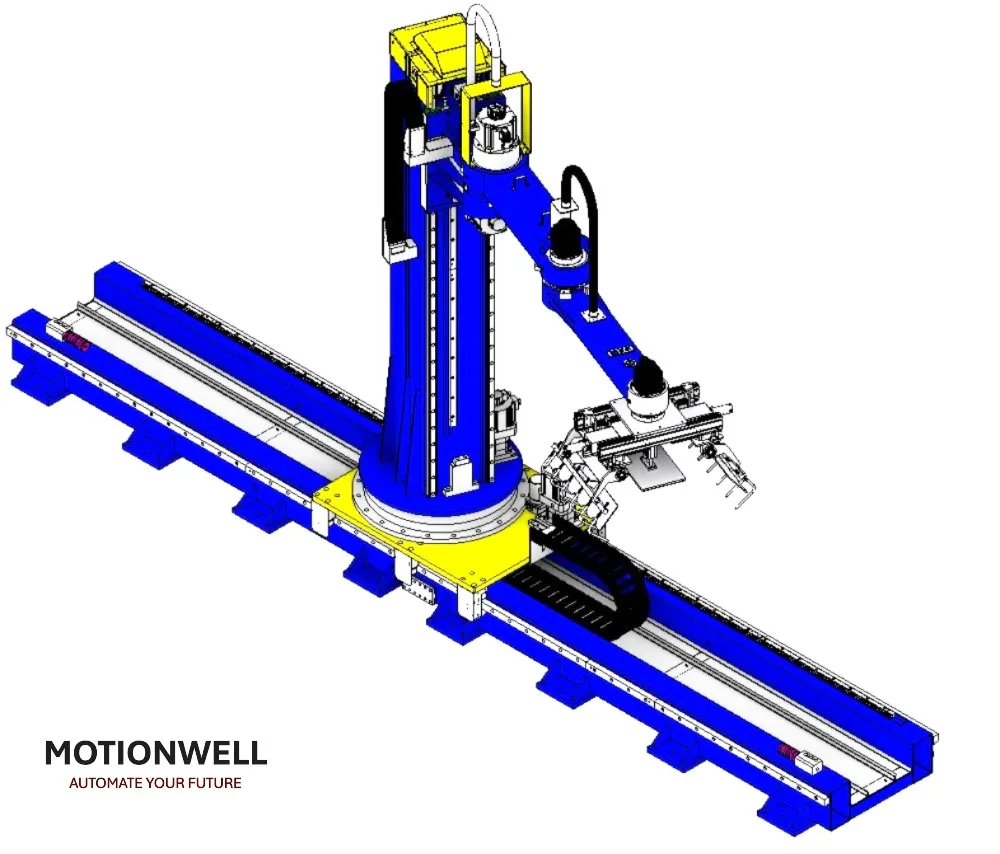
Alongside the articulated robot options described above, Motionwell also deploys 4-axis column-type palletizing robots for applications where the cost-performance ratio is the primary selection criterion. The 4-axis column palletizer uses a fundamentally different kinematic architecture from articulated robots:
| Axis | Motion | What the axis has to cover |
|---|---|---|
| J1 | Base rotation | The infeed pick point and the pallet positions either side of the column |
| J2 | Vertical lift (column) | Full stack height, plus the pallet, the gripper and the case |
| J3 | Horizontal extend (arm) | The pallet footprint and the distance from the column to the pick point |
| J4 | Wrist rotation | Case orientation within the layer pattern |
The column design provides purely vertical lifting motion on J2, which is mechanically more efficient than the shoulder-elbow kinematics of articulated robots when the primary task is lifting cartons vertically onto pallets. The vertical column uses a ball-screw or rack-and-pinion drive with a counterbalance mechanism, reducing the servo motor sizing required compared to an articulated arm that must support the full payload at horizontal extension.
What Sizes the Platform
| Parameter | What decides it |
|---|---|
| Payload capacity | Heaviest case in the SKU list plus the gripper |
| Working radius | Pallet footprint and the distance from the column to the infeed pick point |
| Lift stroke | Full stack height, measured with the pallet and the gripper included |
| Palletizing rate | Case weight, layer pattern, and how many cases the gripper takes per pick |
| Repeat accuracy | The dimensional tolerance the case itself holds |
Repeat accuracy is specified against the carton, because typical dimensional tolerances on the cartons themselves are +/-2-3mm and chasing tighter placement accuracy than the carton holds is wasted money. Rate is settled the same way. Single-case picks on the column platform handle most single-line end-of-line palletizing requirements; where the line needs more cases per minute than one column platform sustains, Motionwell specifies an articulated platform or a gripper that takes more than one case per pick, and the gripper is the first thing to price, because it lifts cases per pick without adding a second controller and a second safety zone.
Heavy-Duty Linear Track for Extended Reach
For installations where a single palletizing robot must serve multiple pallet positions (for example, palletizing two or three SKUs simultaneously onto separate pallets), Motionwell mounts the column palletizer on a heavy-duty linear track. The track uses a rack-and-pinion drive system with hardened steel rails, providing:
- Extended working envelope spanning multiple palletizing stations along the track axis
- Positioning accuracy of +/-0.5mm along the track using an absolute linear encoder
- Travel speed commissioned to the stroke, the moving mass and the stopping distance the guarding can absorb
- Payload capacity rated for the combined weight of the robot, gripper, and maximum carton load
The linear track extends the robot’s working area across several pallet positions. Travel and settling time are included in the pallet-pattern cycle, with buffer capacity and pallet exchange considered in the sustained-rate test.
Palletizing Robot Cost Versus a 6-Axis Solution
The 4-axis column palletizer with linear track costs less than an equivalent 6-axis articulated robot solution for standard carton palletizing applications, and the gap is structural, not negotiated. The cost savings come from three factors:
- Simpler mechanical design: Four axes with direct-drive column lift require fewer gearboxes, bearings, and structural castings than six-axis articulated arms.
- Smaller servo drives: The counterbalanced column design and purely vertical lifting motion reduce the motor torque requirements compared to articulated robots that must support payload at varying arm extensions.
- Simpler programming: 4-axis palletizing requires only position-rotation paths without the complex singularity avoidance and joint-limit management needed for 6-axis robots in confined palletizing cells.
Motionwell recommends the 4-axis column architecture for straightforward carton palletizing inside the rated payload of the platform, where the application does not require the dexterity of 6-axis motion (such as bag palletizing, multi-face label application, or palletizing into constrained spaces). That saving is a comparison between two architectures. The absolute number for a cell like this one comes from the case list: case rate and SKU count set the robot class and the pattern work, case condition sets the gripper, and stack height decides whether a lift column or a 7th axis has to be added. Those drivers are set out on our palletizing systems page.
Which Four Decisions Shaped This Cell, and What Did Each Cost?
Four axes for level placement. The column architecture uses vertical lift, horizontal reach and rotation to place cartons in the required layer pattern. A six-axis arm adds approach-angle flexibility for constrained placements or additional handling tasks. Bag handling is assessed from the bag support and gripper design as well as the motion path; it does not automatically require six axes.
Vacuum area gripping. Vacuum releases faster, marks nothing and adapts to different case footprints by zoning the pad. It fails on open-top cases, wet or dusty board, and unstable loads where the top face lifts away from the contents. Those applications get pneumatic side clamps added, which slows the cycle and adds a mechanism that has to be re-taught per case size.
One robot on a linear track. A track lets a single arm serve multiple pallet positions. The cycle study includes travel, picking, placement and pallet exchange to establish sustained output. Buffer capacity and the recovery sequence address the shared robot and track, while independent cells provide a separate option for lines that need lane-by-lane availability.
Placement accuracy matched to the carton. The placement figure was set from what corrugated cases hold on their own dimensions, +/-2-3 mm. Specifying a tighter arm would raise cost with no effect on stack quality.
Where Else Does This Engineering Show Up?
The same end-of-line handling work runs through our projects for the warehouse and intralogistics industry, and end-of-line cells like this one commonly sit downstream of consumer product and pharmaceutical packing lines. A related material-flow project is documented in the AGV fleet warehouse case study, and buyers weighing suppliers may want our checklist on choosing a system integrator.