
What Does an Automated QA Lab Actually Replace?
Motionwell Automation delivered a fully integrated QA laboratory automation system for a global medical device manufacturer in Singapore. The project combined an autonomous mobile robot with a collaborative robot arm to create an end-to-end automated testing workflow for quality assurance operations. It has since been re-ordered in four consecutive years, and the architecture is now being replicated for other customers.
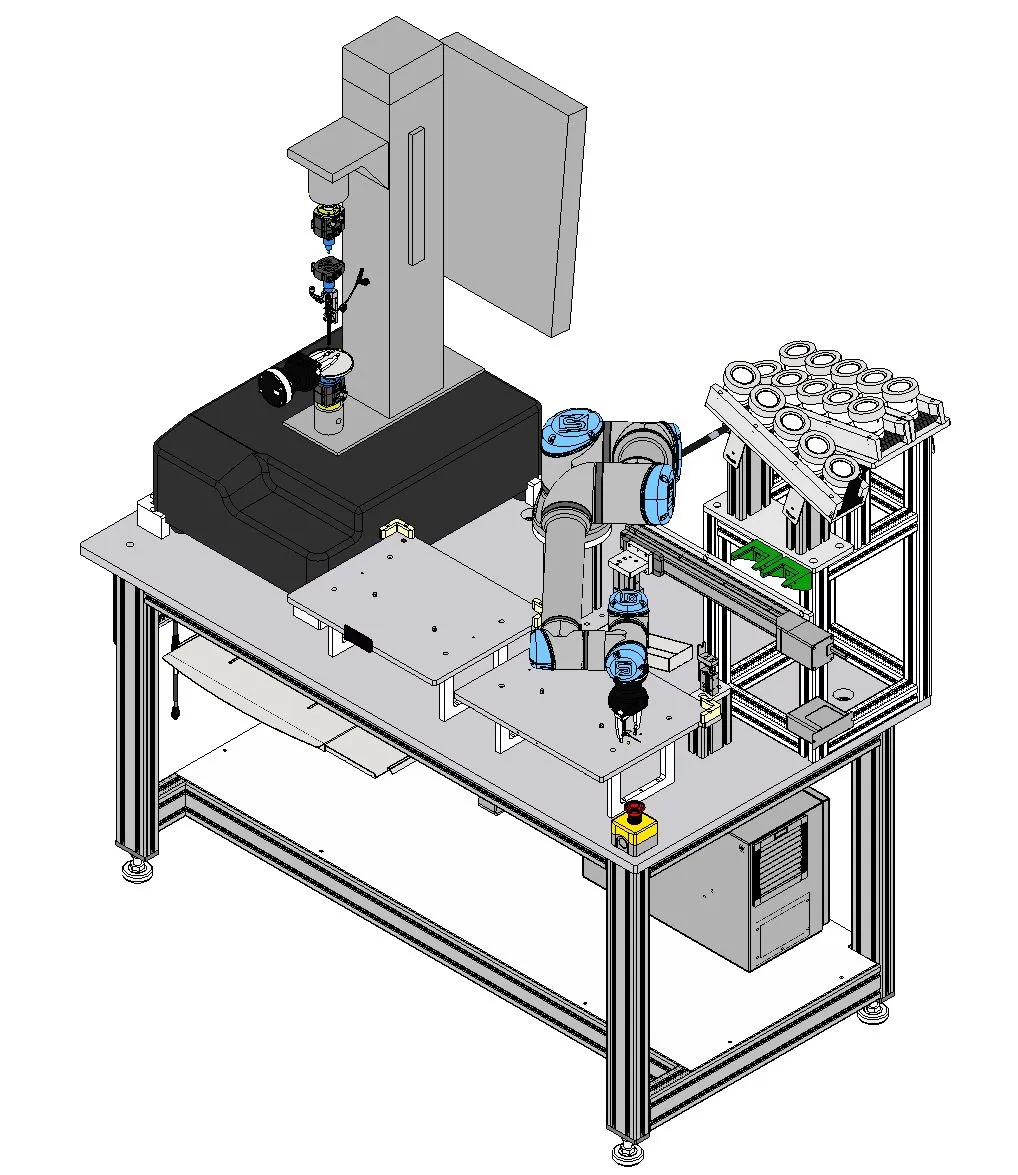
The system automates the complete QA testing cycle: sample retrieval from storage, transport to testing stations, automated tensile and puncture testing on the lab’s Instron machines, result recording, and sample return. PLC-based control and a custom lightweight WMS (Warehouse Management System) connect storage and handling with the test workflow. Automatically named result files are uploaded to network storage.
What the automation removes is not the testing. It is the walking, the transcription and the gaps between them. A technician fetching a sample, keying a test setup and filing a result by hand creates three places where the record and the physical sample can diverge, and in a regulated lab a divergence is a deviation whether or not the test itself was correct. This project sits within Motionwell’s laboratory automation capability.
How Is the System Put Together?
AMR + Cobot Compound Robot
The core of the system is a compound mobile robot that combines an AMR base with a collaborative robot arm mounted on top. This configuration enables:
- Autonomous navigation between storage racks and testing stations
- Precise sample pick-and-place at each station
- Flexible routing based on test schedules and station availability
The choice between a free-navigating AMR and a fixed-route AGV is the first fork in any transport project, and the reasoning is set out in our AMR versus AGV guide. A lab whose bench layout changes between studies rules out taped routes almost immediately.
PLC-Native Lightweight WMS
Motionwell implemented lightweight storage management in PLC logic as part of the automated lab workflow. The system combines:
- 70-position sample storage management across 7 racks
- Real-time inventory tracking with barcode verification
- Coordination of sample retrieval, delivery and return with the testing stations
- Automatic result naming and upload to network storage
Instron Integration
The system communicates bidirectionally with multiple Instron universal testing machines:
- Automated zero-reset and speed parameter configuration
- Test start trigger and completion acknowledgment
- Real-time test data monitoring
- Automatic result file naming and network upload
For a new instrument-tending project, our tensile testing machine selection guide explains how grips, strain measurement and specimen handling fit around these command and result interfaces.
When extending instrument tending to another method, preserve its specific specimen and fixture conditions. Our compression testing automation guide develops that planning question for compression; the delivered tests described here remain tensile and puncture.
What Are the Headline System Specifications?
| Component | Specification |
|---|---|
| Mobile Robot | AMR base with collaborative robot arm |
| Controller | PLC-based cell control and lightweight storage management |
| Storage | 70 positions across 7 racks |
| Testing | Multiple Instron stations (tensile/puncture) |
| Traceability | Sample and tray tracking with automatically named test results |
| Communication | Ethernet/IP, bidirectional Instron protocol |
How Does the Positioning Stack Work?
Three-Layer Closed-Loop Positioning Architecture
The compound robot system achieves reliable sample handling through a three-layer positioning architecture that progressively refines accuracy from macro navigation down to sub-millimetre placement:
-
SLAM Navigation Layer: The AMR uses simultaneous localization and mapping (SLAM) with LiDAR-based environmental scanning for autonomous navigation across the laboratory floor. The SLAM map is updated incrementally as the robot traverses between racks and stations, maintaining positional awareness even as lab furniture or equipment configurations change. Navigation accuracy at this layer is within +/-50mm, sufficient for approaching the target station but not for sample handoff.
-
Cobot Joint Positioning Layer: Once the AMR docks at a station, the collaborative robot arm takes over positioning using its six-axis joint encoders. The cobot operates in a calibrated coordinate frame relative to the AMR’s docking position. Joint-level positioning provides repeatability within +/-0.1mm at the tool centre point, enabling the gripper to reach the approximate pick or place location on the rack or Instron fixture.
-
Vision-Based Error Compensation Layer: A wrist-mounted camera on the cobot performs a final alignment step before each pick or place operation. The vision system identifies fiducial markers on the sample trays and test fixtures, calculates the X-Y-theta offset between the expected and actual position, and sends real-time compensation values to the cobot controller. This closed-loop correction compensates for AMR docking variance, rack position drift, and thermal expansion effects, bringing final placement accuracy to within +/-0.5mm.
The three layers operate sequentially on every pick-and-place cycle. If any layer fails its tolerance check, the system retries the current layer up to three times before escalating to an operator alert with the specific failure mode logged.
Work Orders and Test Execution
The workflow connects each sample’s test requirement with transport and instrument operation. Samples are retrieved from storage, moved to the appropriate testing station, tested and returned. The PLC exchanges commands and status with the Instron machines, including zero-reset, speed setting and test start.
Work order intake, instrument availability and completion signals are planning topics covered on our laboratory automation scheduling page.
Sample and Result Tracking
Storage management keeps rack positions and tray handling connected to the testing workflow. The Instron integration exchanges test commands and status with the control system, then automatically named results are uploaded to network storage.
The useful record is the connection between the physical sample, its test and the saved result. Automating the file naming and upload removes the manual filing step between the test station and the lab’s result archive.
For the wider production record, see our electronic device history record systems. The verification of automated records and interfaces is covered on our computer system validation page.
Which Four Engineering Choices Shaped This Cell?
A PLC-native WMS. Lightweight storage logic coordinates rack positions and tray handling with the lab’s test workflow. This gives the 70-position storage area a direct connection to machine control. Test results are automatically named and uploaded to network storage, joining the handling process to the lab’s result archive.
Three positioning layers. SLAM navigation alone lands the vehicle within about +/-50 mm, which is nowhere near a fixture handoff. Precision docking hardware would close that gap mechanically, at the cost of fitting and maintaining a docking station at every rack and instrument. The design instead stacks joint-level cobot positioning on top of navigation and adds a wrist camera that reads fiducials and corrects X-Y-theta before every pick and place, bringing final placement to +/-0.5 mm. What that buys is tolerance to drift: rack movement, thermal growth and docking variance are absorbed in software. What it costs is a vision step in every cycle and a dependency on fiducials staying clean and unobstructed.
Mixed human and robot operation. The lab still has manual stations, and technicians work in the same room while the AMR runs. Fencing the automated stations would have been simpler to justify in the risk assessment but would have cut the lab in two. Station safeguarding was used instead, which means the operating rules matter as much as the hardware, the same logic covered in our note on collaborative robot safety standards.
Bounded, logged recovery. A transient image or docking error follows a defined retry routine with a limit and a safe escalation state. Each attempt records its failure mode, so successful recovery remains visible in the maintenance history. The retry limit and conditions are tested against representative faults, including the point at which an operator must intervene.
Where Else Does This Engineering Show Up?
The same transport, handling and record work runs through our projects for the laboratory and QA testing industry and the medical device industry. A related regulated-environment build is documented in the cleanroom automated test equipment case study.
If you are planning a lab transformation and want to talk through rack count, instrument interfaces and the audit trail before committing to a layout, get in touch.
Other material tests need their own fixtures and measurement conditions. The bending-test automation requirements explains specimen placement, support geometry and deflection measurement.
A new spring instrument would need its own method and fixture validation. spring-test workflow planning describes the method, working positions and instrument records.
Paperboard testing is a separate possible laboratory workflow. Mullen instrument workflow defines its specimen preparation and instrument-record requirements.