
What Makes EV Battery Dismantlement Different from Ordinary Disassembly?
Motionwell Automation entered the EV battery industry in 2023 with the design and delivery of an automated battery dismantlement line. The project addresses the growing need for safe, efficient battery module disassembly as the electric vehicle market expands across Southeast Asia. The wider picture, who commissions teardown lines and what they need recorded, is on the EV battery automation page.
Battery packs can retain hazardous energy after external supplies are disconnected. The incoming condition, isolation procedure and permitted disassembly steps therefore shape the tooling, access controls and recovery sequence. Machine safety engineering is developed alongside the mechanical process from concept design.
Why Does the Safety Case Drive the Whole Design?
EV battery dismantlement presents unique challenges:
- High-voltage DC power (400V+) in battery modules
- Thermal runaway risk if cells are damaged during disassembly
- Exposure to toxic electrolyte materials
- Heavy module weights requiring mechanical handling
The design coordinates four areas of protection:
- Tooling and fixtures: Contact geometry and insulating materials are selected against terminal locations, voltage exposure, mechanical wear and cleaning conditions.
- Safety-related controls: Robot and external safety functions are allocated in a function register, with the required performance and fault response validated for each function.
- Interlocked access: Guard release depends on the defined safe state of both the machinery and the workpiece, with controlled entry and restart procedures.
- Environmental interfaces: The equipment layout accommodates the site’s extraction, detection and emergency-response requirements for the battery condition being processed.
Because operators still share the building with the cell and load incoming packs at the head of the line, the risk assessment separated the fenced robot stations from the manual loading area. Where a task genuinely needs a person and a robot in the same space, the rules are the ones set out in our guide to collaborative robot safety standards; those rules were deliberately not used to justify an open cell here. The general form of that decision is worked through in cobot vs industrial robot, and the wider equipment context on our battery and energy storage automation page.
How Is the Line Laid Out?
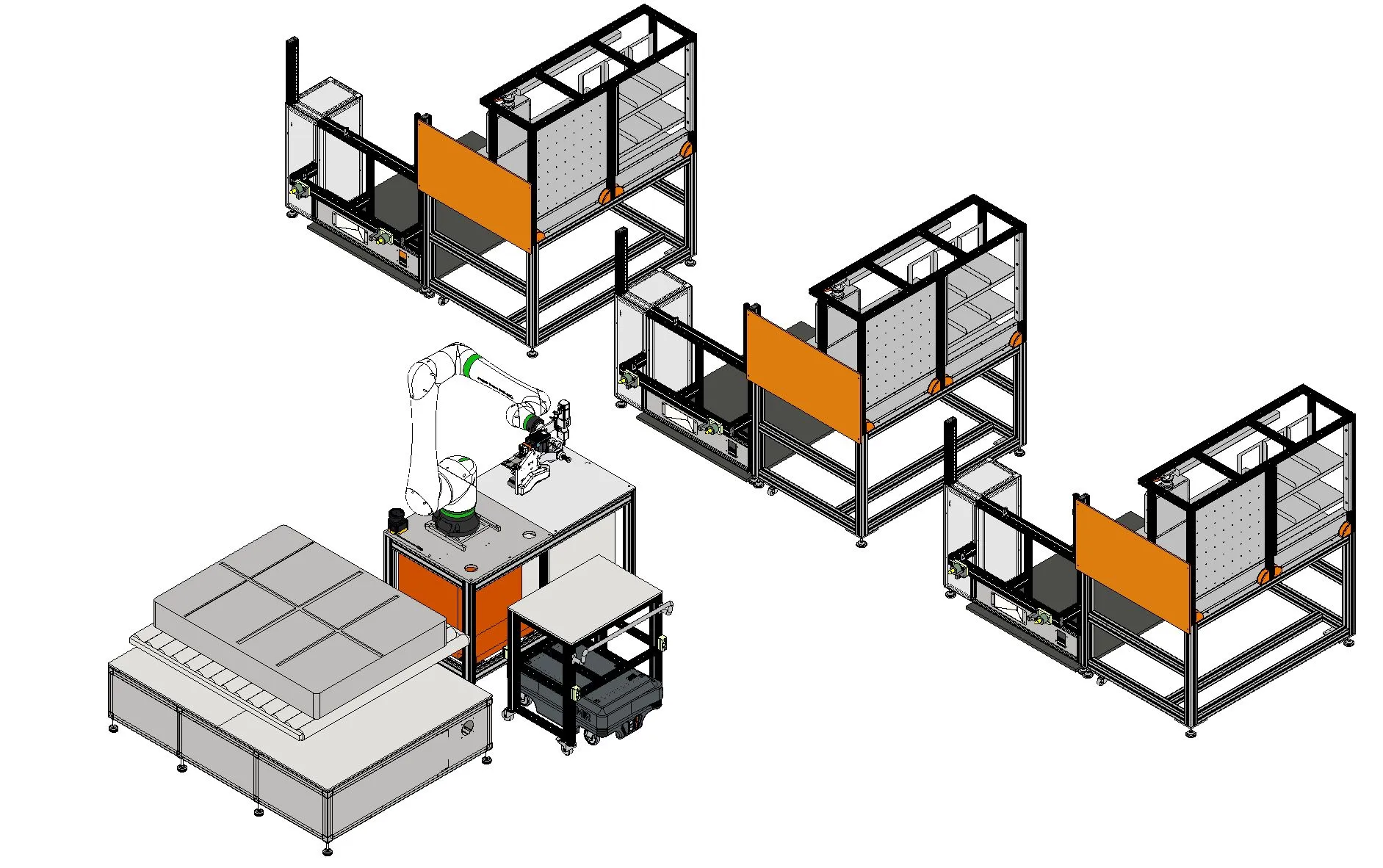
Robotic Disassembly Stations
The line uses two 6-axis articulated robots in the 200kg payload and 2.6m reach class. Modules weigh 30-80kg depending on format, and the arm class was set by what can be held at extension at the wrist, because a module leaves the pack near full reach and an arm sized on the wrist number derates exactly where the work happens. The six axes are there for fastener access in confined module geometries:
- Automated fastener removal with torque-controlled nutrunners on the robot flange, logging torque and angle for every fastener. Angle is logged alongside torque because torque alone cannot separate a bolt that came out cleanly from one that seized, sheared or was already loose, and on a pack that has spent years in a vehicle all three occur
- Busbar disconnection with insulated grippers, gated by an insulation resistance measurement read into the cell controller, so the verification sits inside the interlock chain and cannot be skipped when the line is behind schedule
- Module extraction using vacuum-assisted mechanical grippers with load cells confirming module weight against expected values before transfer
- Sorting of separated modules, busbars and enclosure parts into identified downstream handling streams
The battery module handling procedure follows a strict sequence: incoming pack identification via barcode scan, automated voltage and insulation resistance check, mechanical disassembly, electrical disconnection, module separation, and final sorting. Each step requires a green status from the preceding operation before the robot proceeds. The barcode read and the visual condition check at the head of the line use the same camera and lighting approach described on our machine vision inspection capability page, because a swollen or deformed casing has to be caught before a gripper touches it.
Conveyor and Fixturing
- Heavy-duty belt conveyor on a pallet transfer system rated for 500kg per pallet position, sized on the incoming pack and never on the modules it breaks into
- Adjustable fixturing with pneumatic clamps and 3D-printed nylon locating nests, reconfigurable for prismatic and pouch cell module formats. Printed nests were chosen over machined ones because a recycler takes whatever arrives, and the incoming format mix changes faster than a machined nest can be re-cut
- Zero-pressure accumulation between stations, so a waiting pallet is never pushed by the one behind it; on a battery line that is a contact force question
- 3-position accumulation buffer between disassembly and sorting to decouple station cycle times
How Do the Safety Functions Actually Work?
Safety-Rated Robot Controllers with Dual-Channel Monitoring
The safety-function register identifies the protected operation, required performance level, sensors, logic and actuators for each function. Robot-integrated functions can supervise speed, standstill or axis limits; external safety controls coordinate protective devices and equipment interfaces. Validation tests check normal operation, fault response and restart on the completed installation.
Insulated Tooling for High-Voltage Environments
Tooling insulation is designed as part of the mechanical assembly, including gripper contact surfaces, mounting interfaces and exposed conductive paths. Material selection considers dielectric properties, wear, contamination and the forces transmitted through the tool. The verification procedure defines inspection points, test conditions and replacement criteria, with results retained in the maintenance record.
Emergency Stop with Safe Torque Off (STO)
The stop sequence is selected for the moving axes, held load and workpiece hazards. Safe Torque Off prevents drive-generated torque; controlled stopping and load-retention measures are coordinated where the safe state requires them. Validation measures stopping time and distance under representative loads and tests the response to supply loss. Restart requires the protective conditions to be restored, a deliberate reset and confirmation of the machine and workpiece state.
Modular Fixture Design
The line’s fixturing system uses a modular design with adjustable mounting points to accommodate different battery module dimensions without fabricating new fixtures. The base fixture plate features a grid of M8 threaded inserts on 50 mm centres, allowing pneumatic clamps and locating pins to be repositioned for different module footprints.
Module-specific locating features mount on pneumatic swing clamps with adjustable stroke and clamping force. Swing clamps, because the arm comes down over the module face and any clamp left standing in that path is the part a recipe error hits first. Changeover between battery module formats requires repositioning the clamps and updating the clamp position recipe in the PLC, a procedure that takes approximately 30 minutes with two technicians. No welding, drilling, or permanent modification is required.
The fixture mounting plates are fabricated from anodised aluminium 6061-T6, selected for its strength-to-weight ratio (enabling manual repositioning) and non-magnetic properties (avoiding interference with battery management system electronics during disassembly).
Conveyor with Anti-Static Treatment
The belt conveyor surfaces receive anti-static treatment to prevent electrostatic charge buildup during battery module transport. The conveyor belts use carbon-fibre-loaded PVC with surface resistivity in the 10^6 to 10^9 ohm range (dissipative classification per IEC 61340-5-1). Grounding straps connect the conveyor frame to the facility ground bus at every 3-metre interval.
Anti-static treatment is critical in battery dismantlement because electrostatic discharge near exposed cell terminals could ignite flammable electrolyte vapours or damage battery management system PCBs. The dissipative belt material bleeds static charge to ground gradually, so no sudden discharge event builds up in the first place.
Which Four Decisions Shaped This Line, and What Did Each Cost?
A defined stop and recovery sequence. Stopping the robot, retaining a held module and restoring a known process state are designed together. The acceptance plan tests interruptions during representative operations so the recovery instructions correspond to the actual machine state.
A reconfigurable fixture grid instead of dedicated hard tooling. Dedicated nests for one module format would clamp faster, locate better and need no recipe management. The grid of threaded inserts with repositionable clamps was chosen because the incoming mix is not under the operator’s control, since a recycler takes what arrives. The trade-off is a 30-minute changeover with two technicians and a clamp-position recipe that has to be right, because a mislocated module is a mechanical interference on a live pack.
Robots sized for payload at reach. Modules run 30-80 kg and have to be lifted at extension, which sets the arm class. Cycle time was never the selection criterion, and it could not have been: the voltage and insulation-resistance verification step in front of every disconnection takes as long as it takes and cannot be compressed by a faster arm. Anyone benchmarking this line on parts per hour is measuring the wrong thing.
Defined output streams. The line delivers separated modules, busbars and enclosure parts to identified destinations. The output specification records each item’s state, handling method and downstream interface, following the responsibility mapping used in turnkey automation projects.
Where Else Does This Engineering Show Up?
The same robotics integration and custom special purpose machine design runs through our hazardous-process work, with machine vision supporting the barcode identification and defect detection steps. Buyers comparing integrators for a hazardous-process cell may find our checklist on choosing a system integrator useful before the first site visit.