
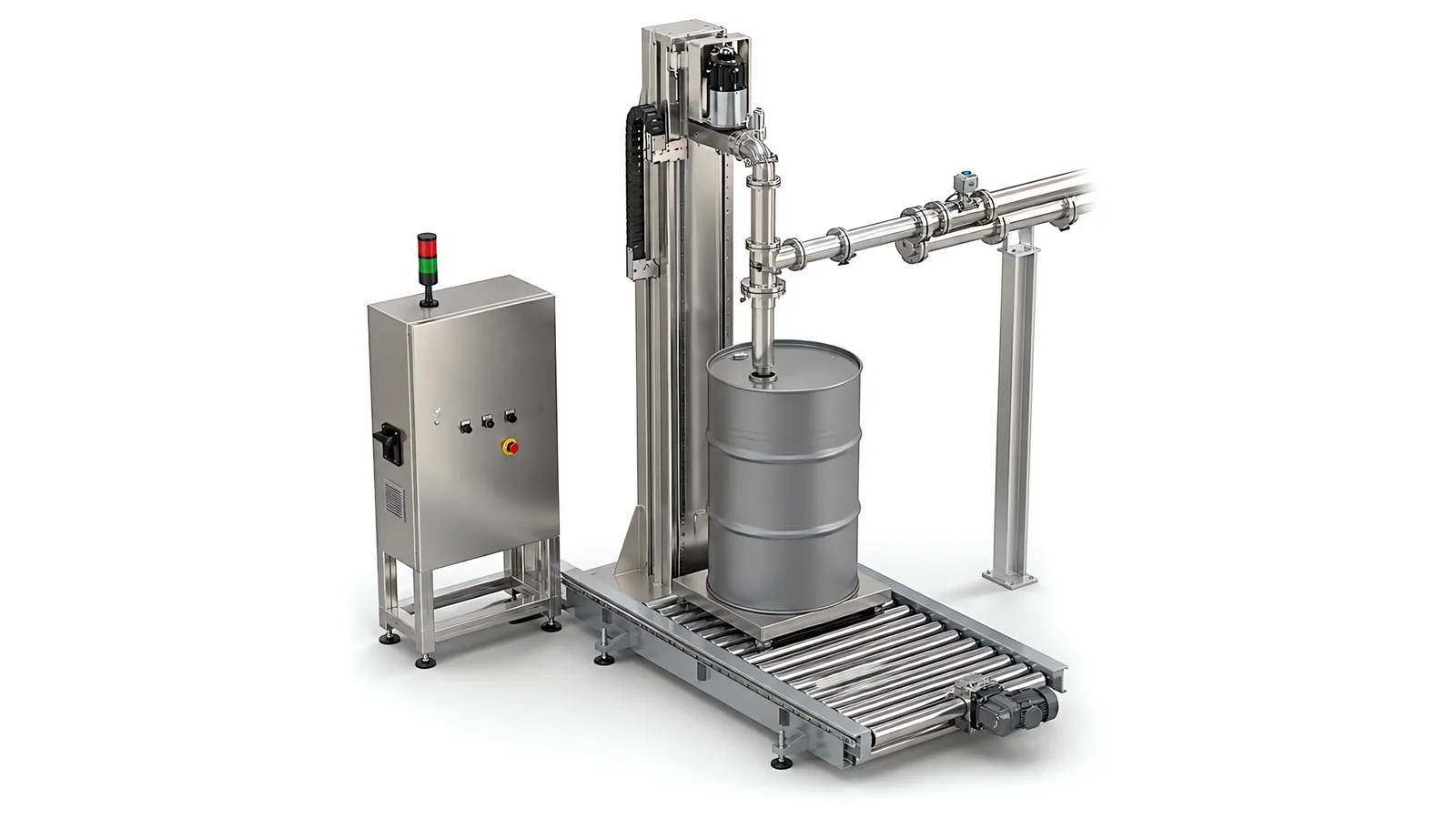
Motionwell Automation engineers bulk filling systems in Singapore for drums, pails, jerrycans and IBCs. Start with the product, required fill mass or volume, and how the container reaches the nozzle. Those inputs determine the dosing method, weighing platform, container handling and any hazardous-area provisions. A pallet filler also needs to locate each opening without moving individual filled containers by hand.
Our delivered filling work is at container scale, on a tray-fed filling and sealing machine and a vial capping and uncapping unit. The engineering that decides whether a bulk filler works is the same set of questions asked of a larger vessel and a heavier dose, and this page sets them out.
What Counts as Bulk Filling, and Where Does It Start?
The line is drawn by handling. Once a full container is too heavy to lift, the machine has to move it on rollers, chains or a pallet, and the design centre of gravity shifts from the nozzle to the conveyor.
| Container | Opening | What makes it awkward |
|---|---|---|
| Pail, 10 to 25 litres | Open head | Lid pressing and clinching, handle interference |
| Can or jerrycan | Small neck or spout | Narrow target, cap application, often multi-head |
| Tight-head drum, 200 litres | Bung on the top head | Machine must locate and index to the bung |
| Open-head drum | Full diameter, lever ring | Easy to fill, awkward to close automatically |
| IBC, around 1000 litres | Large top opening | One at a time, needs real floor and conveyor capacity |
Why Bottle Line Thinking Breaks Above Twenty Litres
Containers stop being interchangeable and start being tracked individually, because one bad drum is a large loss. Fill time goes long enough that the nozzle sets the cycle. And the container becomes a lifting and traffic problem, which drags in guarding, pallet truck routes and floor loading. If your containers are under a litre, the bottle, vial and tray work sits on our custom filling machines page instead.
What Filling Experience Does Motionwell Bring to Bulk Containers?
Four things transfer directly.
Dosing to a tolerance. The tray-fed filling and sealing machine doses through three heads in parallel with a camera checking fill level behind them, and the dispensing valves are a diaphragm type, which keeps the air side of the actuator out of the product path and makes the diaphragm a planned wear part with a replacement interval. The dose tolerance and the volume band are specification lines, because viscosity, container geometry and foaming behaviour set what a given head can hold. What carries over to a two-stage weigh-fill is the discipline: dose to a stated tolerance, check every container, and let the controller learn its correction from the first few fills. Why the control loop matters more than the pump is covered in our note on servo versus stepper motor selection.
Product-contact construction. The delivered machine runs stainless steel product-contact surfaces on a full stainless frame, designed for an ISO Class 7 or 8 room. Which alloy, which surface finish and which enclosure rating apply is decided by your cleaning chemistry and washdown method, and each belongs in the specification as a named value. Bulk pharmaceutical intermediates need the same discipline in a bigger pipe, and the delivered build is in our filling and sealing case study.
Verification, and no sampling. Container presence is sensed, with a fibre optic pair confirming a container is under the head before the valve opens, because a sequence that fires on elapsed time doses an empty station as willingly as a full one. A camera then checks fill level, so anything outside tolerance is flagged at the machine, by which point the rest of the batch has been filled the same way. The camera side is set out in our machine vision inspection capability.
Controls and retrofit. PLC, servo and VFD modernisation of existing machines is our largest line of work this year, and the control platform is whichever one your site already maintains, because a filler built on a platform nobody on the floor is trained on turns every fault into a service call. That matters more for bulk filling than people expect, and it returns below.
Net Weight or Volumetric: Which Dosing Method Fits Bulk Filling?
Most bulk filling is done by net weight. The container sits on a load cell platform, the controller zeroes the tare, and flow stops when measured mass hits target. It ignores density shifts from temperature, batch or grade, which is why it copes with five products on one line where a volumetric setup would need recalibrating for each. The dosing physics barely change with container size, so the full comparison of volumetric or gravimetric dosing applies to small containers on the same terms.
Volumetric dosing earns its place when one well-characterised product runs at rate, or when the container cannot be weighed cleanly. A Coriolis meter measures mass flow directly, giving a true net weight without a stable weighing platform, which is often the answer for filling an IBC on a forklift-fed stand.
| Method | Suits | Weak point |
|---|---|---|
| Weigh cell, net weight | Multi-product lines, variable density, trade weight | Vibration and pipe pull corrupt readings |
| Coriolis mass flow | Solvents, where a scale cannot be stabilised | Instrument cost, needs a full pipe |
| Piston or gear pump | Single product, high rate, viscous product | Density drift shows up as weight error |
| Magnetic flowmeter | Water-based and conductive products | Does not read non-conductive liquids |
How the Bulk, Dribble and Top-Up Stages Work
Accuracy comes from splitting the fill. The bulk stage runs at full flow to a cut point short of target. The dribble stage drops to a low flow rate so the final approach is slow. The valve closes, and whatever is still in flight between valve and product surface lands afterwards as in-flight error, which the controller learns and subtracts from the cut point over the first few containers.
Get the cut point wrong and you choose between overfilling every drum, which is money poured away at scale, or a crawl to target that halves throughput. On viscous products the top-up stage sometimes gets a second, smaller nozzle, because one valve cannot do a fast bulk flow and a fine trickle well.
What the Weighing Platform Has to Survive
A load cell reports whatever forces reach it: conveyor vibration from the next station, the pull of a rigid fill hose, a forklift striking the frame. A weigh station that reads well at commissioning and drifts in production nearly always has a mechanical path someone forgot to break. Flexible hose connections, a decoupled weigh deck and a settling delay before the reading is trusted do more for accuracy than upgrading the cells.
One local point to check early: if the net weight printed on the drum is the basis of sale, the weighing instrument becomes a trade instrument under Singapore’s weights and measures regime, with pattern approval and verification attached. Confirm that before you specify the scale.
Bulk powder delivery still needs material-flow and weight trials. powder filling verification checks startup, replenishment and the selected dosing/verification boundary.
How Do You Fill a Drum Without Foaming or Splashing?
You keep the outlet under the surface. A diving nozzle, or lance, enters through the bung, descends close to the base, and retracts as the level rises so the discharge stays submerged for most of the fill. That kills three problems at once: foam on surfactant and detergent products, splashing on the drum wall and threads, and the static charge that free-fall filling builds in low conductivity liquids.
The nozzle retracts to just above final level before the dribble stage. Drip control after that is a set of small mechanical decisions that decide whether operators spend the shift wiping drum tops:
- A positive shut-off nozzle that seals at the tip, not at a valve half a metre upstream
- Suck-back on retract, pulling the meniscus into the nozzle
- A drip tray that indexes under the nozzle whenever it is not over a container
- Slow dribble flow, so the valve closes against low pressure instead of full line flow
- Product-specific nozzle geometry, because a thin solvent and a thixotropic paint break off differently
Drips are not cosmetic. On a paint filling machine or a solvent line, product on the drum top means a slippery floor, a contaminated label surface, and vapour where you did not plan for it.
How Does the Machine Find the Bung and Index the Drum?
A tight-head drum can only be filled through its bung, and it arrives at whatever rotation the previous handling left it in. The machine has to find the opening before it can do anything useful.
The usual method drives the drum in rotation on powered rollers or a turntable while a sensor watches the top head. An inductive or laser point sensor detects the bung profile, or a camera makes the call when the top head has features that confuse a point sensor. The choice follows what else is on that head: an inductive sensor answers to metal and ignores paint and labels, a laser sees the step at the bung but is thrown by a bright repaint, and a camera costs more while being the only one of the three that can be taught a second drum type without new hardware. Rotation stops on detection, the drum indexes so the bung sits under the fill head, and a centring device clamps it there so the lance can descend without fouling the threads.
Two things ruin this in the field. Dented, repainted or reconditioned drums scatter the sensor return, so detection logic needs tolerance for scruffy containers. And a drum free to shuffle on the rollers loses its index between detection and fill, which is why the clamp matters as much as the sensor.
Pails and Open-Head Containers
Open-head containers skip all of it. There is no bung to find, so the fill head lowers into the open top and the machine runs at whatever rate the dose time allows. That is the main reason a pail filling line for coatings and cleaning products costs less per station than a drum line at the same output.
How Do Lids, Caps and Can Seams Get Closed on a Bulk Line?
Closing is where bulk filling stops being one machine and becomes a line. Where a clinching or seaming head can trap a hand, the guarding and the interlock that stops it are rated work, and the performance level comes out of ISO 13849-1.
Pails take a lid that is placed and then pressed home, with a clinching head that rolls the lid rim into the pail bead. Press force and head alignment are what stop leaking lids, and both are easier to hold on a dedicated station than on a combined fill-and-close head. Drums take a bung cap, applied and torqued, sometimes with a tamper-evident seal. Torque control matters for the same reason it does on a pharmaceutical closure: too little leaks in transit, too much distorts the gasket.
Round metal cans are a different animal. Seaming a can lid is a specialised machine made in quantity by the firms that own the process, so we buy a proven seamer and design the line around it, the same as we do with stretch wrappers and standard pallet conveyors.
Coding sits at the end, and the reader matters as much as the printer: print-and-verify. Where the drum holds a pharmaceutical intermediate, that is the technology on our pharmaceutical serialization page, scaled to a drum.
What Changes When the Product Is a Flammable Solvent?
The area classification changes the whole equipment list, and it comes before machine design.
Zone classification, under the ATEX or IECEx framework, belongs to your process safety team and fire safety consultant. A machine builder who offers to classify your area for you is telling you something about how they work. What we do is build to a classification you supply: certified motors, sensors and solenoids inside the zone, the control cabinet outside the zone or purged where it cannot be, and instruments restricted to what carries the right certification for the zone and gas group.
Static is the failure mode people underestimate. Filling a low conductivity liquid by free fall generates charge, and an ungrounded steel drum holds it. The countermeasures are a bonding clamp from container to machine earth, a continuity check that has to pass before the fill valve opens, and submerged filling to reduce charge generation in the first place.
Fume Extraction and Operator Exposure
Local exhaust is a design element. The capture hood belongs at the container opening, close enough to hold face velocity where the vapour actually leaves. The interlock chain is where automating the job pays: if extraction airflow drops or gas detection trips, the fill valve closes and the sequence holds. Guarding, safety laser scanners, LVD and CE testing and MOM lifting certification are in our normal delivery scope, and how that scope follows from a risk assessment is on our machine safety and compliance page.
How Do Heavy Containers Move Through the Line?
Container handling drives both the cost and the layout arguments on a bulk filling system.
There are three broad approaches. Individual conveying moves drums or pails one at a time through infeed, fill, close and discharge. Pallet-based conveying keeps containers on the pallet and moves the pallet between stations. An automatic pallet filler leaves the containers on the pallet permanently, positioning the fill head over each in turn with a gantry or robot, often weighing the whole pallet and dosing by weight difference. That suits producers who already palletise empties and want no container singulation at all, trading a simpler handling problem for a harder positioning one.
Everything downstream is standard intralogistics built from catalogue components, and the specification worth holding is the one that still matters in year three: roller conveyor rated for the loaded weight with real margin, pallet stops that can absorb a moving loaded pallet, clear forklift access, and every wearing item carrying a part number your storeman can order from a local distributor without calling the machine builder first. If full pallets then need stacking or wrapping, that connects to our automated palletizing systems, and the storage side is on the warehouse and intralogistics page.
When Is a Semi-Automatic Filling Station the Right Answer?
More often than buyers expect. A semi-automatic weigh-fill station gives you the same dosing controller, the same nozzle and the same accuracy as a full line, and leaves container handling to an operator with a pallet truck. It costs a fraction, because container handling is the expensive half.
| Condition | Semi-automatic station | Full automatic line |
|---|---|---|
| Rate | Below roughly one container per minute | Sustained higher rate, or multi-shift |
| Product count | Several products, frequent changes | Few products, long runs |
| Operator exposure | Acceptable with extraction and PPE | Hazardous product, remove the operator |
| Traceability | Manual record or printed ticket | Every fill logged against batch |
| Capital | Low, payback on giveaway alone | Justified by labour, safety and throughput |
There is a fourth option people forget. If you already run a drum or pail filler that is mechanically sound but electrically obsolete, a controls retrofit is usually the cheapest accuracy improvement available: replace the obsolete PLC, add servo control on the dosing axis, put a modern VFD on the pump, and keep the mechanics you already paid for. Control system modernisation is our largest line of work this year, and on a filler the accuracy comes from the dosing axis and from a valve that closes the same way every time, never from the controller in the cabinet.
What Drives the Cost of a Drum or Pail Filling System?
The number comes out of your layout and your container mix, and the eight drivers below are what move it. Each one is settled at concept review, before anything is drawn.
| Cost driver | Why it moves |
|---|---|
| Container mix | Drums plus pails plus IBCs on one line is three handling problems |
| Fill rate | Sets nozzle count, pump sizing, parallel stations |
| Dosing method | Isolated weigh platforms cost more, and usually earn it |
| Area classification | Certified equipment and extraction can dominate a solvent line |
| Product properties | Viscosity, foaming and temperature drive pump and nozzle choice |
| Closure scope | Manual capping versus lid placing, pressing, clinching, torque logging |
| Container handling | Pallet truck feed versus conveyors, palletising and wrapping |
| Site conditions | Floor loading, ceiling height, drainage, bunding, forklift routes |
How a project like this gets scoped, from concept to factory acceptance, is in our write-up on special purpose machine design, and what to ask before signing is in our guide to choosing a system integrator. Washdown requirements and pharmaceutical bulk both start from pharmaceutical packaging automation.
Frequently Asked Questions
Does Motionwell build drum and pail filling machines in Singapore?
Yes, as custom engineered systems. Our delivered filling work to date is at container scale: a tray-fed filling and sealing machine dosing through three heads on a continuous dual-tray feed, and a vial capping and uncapping unit. What decides whether a bulk filler works is the same engineering carried to a larger vessel: dosing that is calibrated and checked on every container, stainless product paths, and the control and safety design underneath. The parts that genuinely change with size are container handling, bung indexing and area classification, and those are the three the specification has to settle first.
Should a drum filling machine dose by net weight or by volume?
Net weight for most bulk work. A load cell under the container measures what actually went in, so density changes with temperature, batch or product grade do not shift your fill. Volumetric dosing is faster to change over and suits a single well-characterised product, and a Coriolis meter gives you mass without a scale when a stable weighing platform is impractical. Magnetic flowmeters are usually out for solvents and oils, because they need a conductive liquid. The deciding questions are how many products share the line, how much the density moves, and whether the filled weight is the basis of sale.
How do you stop drips and foaming when filling drums?
Foam is controlled by filling from the bottom up. A diving nozzle enters through the bung, reaches near the base, and retracts as the level rises so the outlet stays below the surface. That also cuts the static charge that splash filling generates in low conductivity liquids. Drips are a separate problem handled with a positive shut-off nozzle, suck-back on retract, a drip tray that indexes under the nozzle between containers, and a slow final dribble stage so the valve closes against a low flow rate.