
TL;DR: To choose a system integrator in Singapore, compare eight things against the same project scope: industry experience, design capability, robot selection, vision expertise, controls architecture, project management, after-sales support, and certifications and standards. Ask for evidence tied to your process: sample test results, a named engineering team, a delivery plan and the files your maintenance team receives at handover.
Why Does the Integrator Matter More Than the Components?
Motionwell has completed over 100 automation projects in Singapore since 2014, working across medical devices, electronics, pharmaceuticals, consumer products, and warehouse logistics. One observation holds consistently: the success of an automation project depends more on the system integrator than on the components selected.
A collaborative robot arm, a smart camera and a PLC are catalogue items with published specifications, and any competent supplier can quote you the same three. They do not become a working production system until someone designs the mechanical fixtures, writes the control logic, configures the vision recipes, integrates the safety system, tests the complete workflow, and commissions the machine on the factory floor. That someone is the system integrator, or the machine builder where the scope is one machine, and that work is the part of the price you cannot compare line by line, which is exactly why proposals get compared on the part that can be.
When the choice goes wrong, it shows up as change orders, a delivery date that keeps moving, and a machine the operators work around. When it goes right, the machine is running to specification while the argument about who owns which interface never has to happen.
What follows is an 8-point set of selection criteria for choosing a system integrator or automation partner in Singapore, drawn from what we have seen work, and fail, across projects in the region. If you have already decided on single-source delivery, read it alongside our explanation of what turnkey automation actually covers.
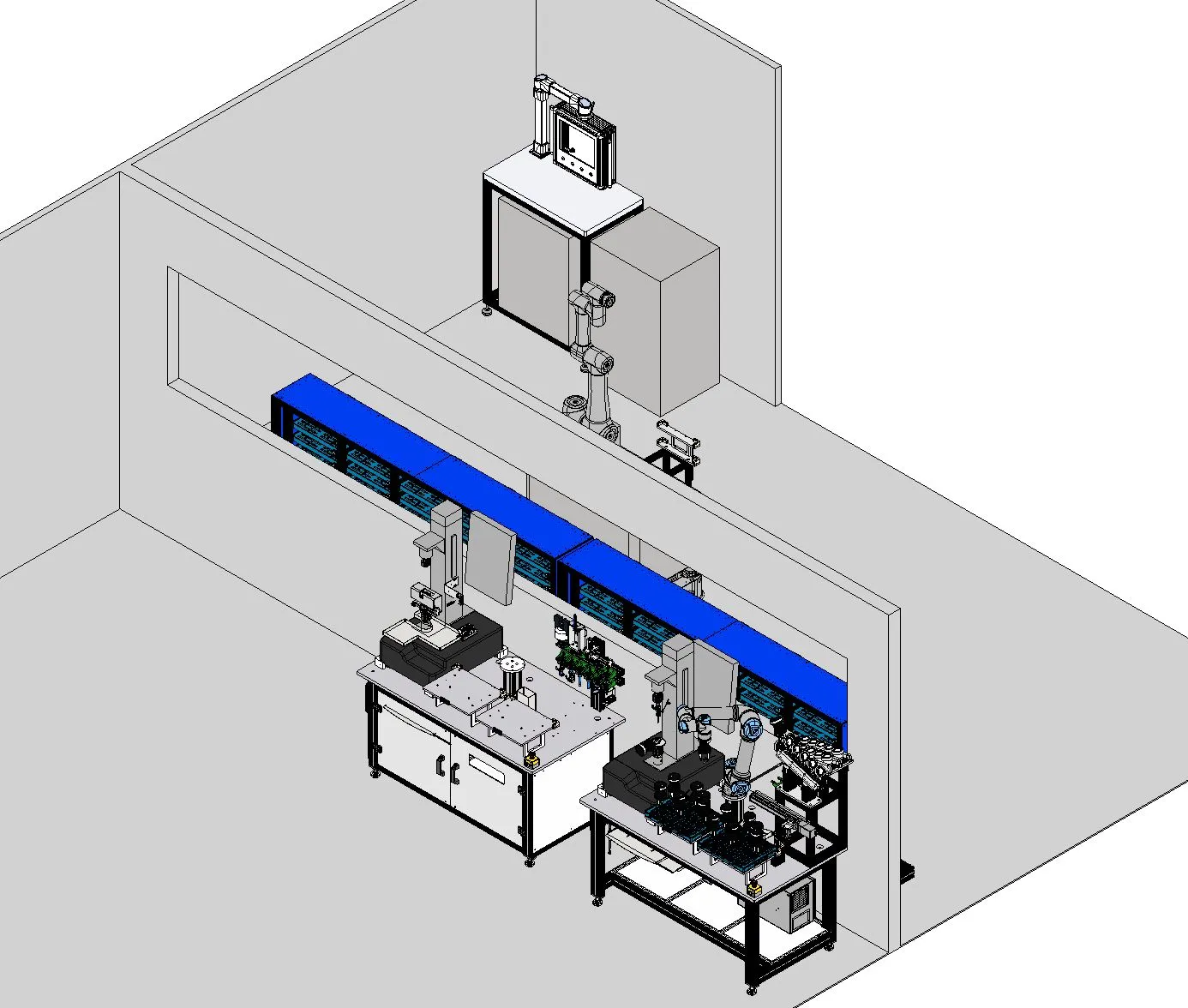
The cell in that image is a worked example of the difference. The QA lab automation case study describes the mobile robot, the cobot, the test instruments, and the PLC-native inventory logic as one system, because that is the only level at which it works.
What Should You Evaluate in a System Integrator?
The Eight Points at a Glance
| # | Evaluation Point | Why It Matters | Red Flag |
|---|---|---|---|
| 1 | Industry experience | Regulated industries require specific knowledge | “We can do anything” with no references |
| 2 | In-house design capability | Design quality determines system performance | Outsources all mechanical or software design |
| 3 | Robot brand portfolio | Multi-brand means application-driven selection | Locked to one brand regardless of application |
| 4 | Vision system expertise | Vision is the hardest subsystem to get right | Treats vision as “just a camera” |
| 5 | Control architecture standards | PLC platform and documentation quality affect long-term maintainability | No standard architecture, every project from scratch |
| 6 | Project management approach | Structured milestones reduce risk for both parties | Vague timeline, unclear payment terms |
| 7 | After-sales support | Machines break, response time matters | No local service team, depends on third parties |
| 8 | Certifications and standards | Quality systems indicate organisational maturity | No ISO 9001, no documented processes |
Point 1: Industry Experience
Automation experience does not transfer evenly between industries. A system integrator with strong experience in automotive stamping may struggle with pharmaceutical packaging because the regulatory framework, documentation requirements, and validation expectations are fundamentally different.
| Industry | Specific Knowledge Required |
|---|---|
| Medical devices | FDA 21 CFR Part 820, ISO 13485, IQ/OQ/PQ validation, cleanroom compatibility, biocompatible material selection |
| Pharmaceutical packaging | GAMP 5, 21 CFR Part 11, serialization, batch record integration |
| Electronics/semiconductor | ESD protection, cleanroom protocols, high-precision handling, micro-assembly |
| Aerospace and precision | AS9100, tight tolerances, traceability, non-destructive testing |
| Warehouse/intralogistics | WMS integration, fleet management, throughput optimization, safety zoning |
| Laboratory and QA | Instrument protocols, sample chain of custody, scheduling logic, per-sample traceability |
What to ask: “Show me three completed projects in our industry with references I can contact.” If the integrator cannot provide industry-specific references, they are learning on your project.
Point 2: In-House Design Capability
The quality of an automation system is determined during design, not during assembly. An integrator with strong in-house design capability can iterate quickly, resolve design conflicts internally, and maintain design intent through manufacturing and commissioning.
| Design Discipline | What to Verify |
|---|---|
| Mechanical design | 3D CAD (SolidWorks, Inventor, or equivalent), FEA for critical structures, tolerance analysis for precision assemblies |
| Electrical design | Schematic capture (EPLAN, AutoCAD Electrical), panel design, cable routing, safety circuit design |
| Software/controls | PLC programming (Siemens TIA Portal, Mitsubishi GX Works, Rockwell Studio 5000), HMI development, motion control |
| Vision systems | Camera selection, lighting design, algorithm development and tuning |
| Simulation | Offline robot programming, cycle time simulation, virtual commissioning (if applicable) |
What to ask: “What percentage of your design work is done in-house vs subcontracted?” and “Can I meet the engineers who will design my system?”
An integrator who subcontracts all mechanical design to a third-party drafting house, or all PLC programming to a freelance programmer, has limited control over design quality and limited ability to make changes quickly during commissioning.
Point 3: Robot Brand Portfolio
System integrators generally fall into two categories: single-brand specialists and multi-brand integrators. Both models produce good machines, and they fail in different places.
| Approach | Advantage | Risk |
|---|---|---|
| Single-brand (a shop that builds only on one robot vendor’s platform) | Deep expertise in one platform, strong vendor relationship | May recommend their brand even when another suits the application better |
| Multi-brand | Selects the right robot for each application | Needs to maintain competency across multiple platforms |
Motionwell selects across industrial arms, collaborative arms, SCARA units and mobile platforms, with no house supplier the choice defaults to, and builds cells around arms a customer already owns. Robot selection is then argued from payload, reach, speed, precision, safety mode and cost.
The reason to ask about this is not variety for its own sake. Every additional platform an integrator carries is another programming toolchain, another set of licences, and another engineer who has to stay current on it, so a genuinely multi-brand shop is paying a real overhead and will only pay it where the applications differ enough to justify it. A long list on a slide costs nothing to produce. Two questions test it: which platform would they put on your cell if price were removed from the discussion, and which one have they turned down recently and for what reason. An integrator who has never declined a platform has never made the choice.
What to ask: “For my application, which robot brand and model do you recommend, and why?” A good integrator provides a technical justification, not a default recommendation. If the answer is a collaborative robot, ask how the cell will satisfy ISO/TS 15066 and the surrounding safety standards before you accept the layout.
If your transport problem is mobile and not fixed, the same logic applies to platform choice, and our guide on AMR versus AGV selection works through it.
Point 4: Vision System Expertise
Machine vision needs a sample-based feasibility review. Surface finish, lighting, presentation and defect variation determine whether the proposed optics and processing can make the required decision. Ask the integrator to show results on representative good and defective parts, including the difficult cases near your acceptance limit.
| Vision Capability | What to Evaluate |
|---|---|
| Camera platforms | Does the integrator work with Keyence, Cognex, Basler, or other industrial vision brands? |
| Lighting design | Can the integrator design and test lighting setups for your specific product surfaces? |
| Algorithm development | Does the integrator write custom vision algorithms, or only use vendor tools? |
| Defect detection experience | Has the integrator solved defect detection problems similar to yours? |
| Performance validation | Can the integrator demonstrate detection rates, false positive rates, and cycle times on your actual samples? |
What to ask: “Can you run a feasibility study on our product samples before we commit to the project?” A capable integrator will offer a paid or free feasibility study where they test camera and lighting combinations on your actual parts and demonstrate detection performance.
For what that study should produce, and how smart-camera and PC-based architectures differ, see our page on machine vision inspection systems.
Point 5: Control Architecture Standards
The PLC platform, control architecture, and documentation standards used by your integrator determine how maintainable the system is after handover. A well-structured control system can be understood, modified, and troubleshot by your maintenance team. A poorly structured one creates permanent dependency on the integrator.
| Standard Element | What Good Looks Like |
|---|---|
| PLC platform | Consistent use of one or two major platforms (Siemens, Mitsubishi, Omron, Beckhoff) with modular program structure |
| Program structure | Function blocks, state machines, clear naming conventions, comments in English |
| HMI design | Consistent screen layouts, alarm management, diagnostic screens for troubleshooting |
| Documentation | I/O list, PLC variable list, program flow description, alarm code table |
| Software backup | Complete backup on project USB/drive, version-controlled source code |
| Remote access | VPN or secure remote access capability for diagnostics (if desired) |
What to ask: “Can I see the control architecture documentation from a previous project?” and “What PLC platform do you standardize on?”
Point 6: Project Management Approach
Automation projects fail as often from poor project management as from poor engineering. Look for structured milestone management, clear communication protocols, and transparent commercial terms.
| Project Management Element | What to Evaluate |
|---|---|
| Milestone schedule | Defined milestones with dates: concept review, design freeze, FAT, delivery, SAT |
| Payment terms | Milestone-based payments tied to deliverables (not just calendar dates) |
| Change control | Formal process for evaluating cost and schedule impact of requirement changes |
| Progress reporting | Regular updates (weekly or biweekly) with status, risks, and issues |
| FAT process | Defined acceptance criteria, test protocol, and customer witness opportunity |
| SAT process | On-site acceptance criteria separate from FAT |
| Warranty terms | Clear warranty period, coverage scope, and response time commitments |
What to ask: “Walk me through your project lifecycle from contract signing to handover.” and “What is your change order process?”
Point 7: After-Sales Support and Parts Availability
The automation system will operate for 10 to 15 years. The integrator’s support capability during that period matters as much as the initial project delivery.
| Support Element | What to Evaluate |
|---|---|
| Local service team | Engineers based in Singapore who can respond within 24-48 hours |
| Spare parts availability | Critical spare parts stocked locally or available within 3-5 business days |
| Remote diagnostics | Ability to connect remotely for initial troubleshooting and guidance |
| Preventive maintenance | Structured PM program with scheduled visits and documented checklists |
| Software support | PLC program modifications, HMI updates, vision recipe adjustments |
| Upgrade path | Ability to modify or expand the system as production requirements change |
What to ask: “What is your average response time for emergency support calls?” and “Do you keep spare parts inventory for the components you specify?”
An integrator located in Singapore with in-house service engineers and local spare parts inventory can respond faster than one who relies on overseas support. For critical production lines, this response time difference translates directly to downtime cost.
Point 8: Certifications and Standards
Certifications indicate that an integrator has implemented formalized quality management, safety, and engineering processes. They are not sufficient proof of quality, but their absence is a meaningful warning.
| Certification | What It Indicates |
|---|---|
| ISO 9001:2015 | Quality management system is in place and audited |
| CE marking capability | Understands Machinery Directive requirements for safety design and documentation |
| ISO 12100 competency | Can perform risk assessments for automated systems |
| ISO 13849 competency | Can design and validate safety-related control systems |
| Industry-specific (ISO 13485, GAMP 5) | Has worked in regulated environments and understands documentation requirements |
The rows read alike, but they call for evidence of three different kinds, and asking for the wrong kind is how an evaluation gets fooled. ISO 9001 arrives as a certificate with a scope printed on it, so the line worth reading is the scope printed on it and never the logo above it: a scope that covers design and manufacture is a different claim from one that covers assembly and trading. CE marking capability produces no certificate to photocopy for most machinery, so what exists to inspect is the technical file from a machine already delivered, and our machine safety and CE marking page sets out what belongs in one. ISO 12100 competency is issued by nobody, and the artefact standing in for it is a hazard register from a past machine with the reduction decisions still readable in it. A questionnaire that takes a tick in all three rows has collected three ticks and no evidence.
Security claims fail the same test in a sharper way, because there a certificate is granted per role: what a component supplier holds and what an integrator holds are separate documents, and neither of them describes the plant you are going to run. Which role an integrator is answering for is worked through on our IEC 62443 for machine builders page.
What to ask: “Are you ISO 9001 certified?” and “Who performs risk assessments on your machines?” The answer to the second question should be a named competency, not a subcontractor found after design freeze. Our machine safety and CE marking page sets out how that workflow runs, and computer system validation covers the IQ/OQ/PQ side for regulated equipment.
Which Red Flags Should Disqualify an Integrator?
Based on Motionwell’s experience observing the Singapore automation market, these are the warning signs that should trigger additional due diligence:
| Red Flag | What It Usually Means |
|---|---|
| “We can automate anything” | Lack of industry focus means learning on your project |
| No FAT facility | The machine is tested for the first time on your factory floor |
| Cannot name PLC platform preference | No standard architecture, inconsistent quality |
| Price significantly below competitors (>30% lower) | Missing scope items, underestimated effort, or low-quality components |
| No reference customers available for a call | Request alternative evidence, such as an anonymised acceptance record, a witnessed demonstration or a site visit permitted by the customer’s confidentiality terms |
| Single engineer handles design and PM | Organizational risk, no knowledge backup |
| Requires full payment before delivery | Financial risk, and nothing held back to enforce acceptance |
| Cannot provide documentation samples | Documentation is an afterthought, not part of the standard process |
What Questions Should You Ask During Evaluation?
Use these questions during integrator evaluation meetings. The answers reveal more than any brochure.
Technical Questions
- “What is your standard PLC platform, and why?”
- “How do you handle vision system feasibility before committing to a project?”
- “Can I see a 3D model and electrical schematic from a previous project?”
- “How do you structure your FAT protocol?”
- “What is your approach to safety design and risk assessment?”
Commercial Questions
- “What is your standard payment milestone structure?”
- “How do you handle change orders during the project?”
- “What is included in your warranty, and what is excluded?”
- “What are your after-sales support response time commitments?”
Reference Questions
- “Can I visit a completed installation at a customer site?”
- “Can I speak with a customer who experienced a problem during their project and how it was resolved?”
- “How many projects have you delivered in my industry in the last three years?”
Why Choose a Singapore-Based Integrator?
For manufacturers operating in Singapore, a locally based integrator provides specific advantages over international suppliers or regional alternatives:
| Advantage | Practical Benefit |
|---|---|
| Proximity | Face-to-face design reviews, site visits, and relationship building |
| Response time | Emergency support within hours, not days |
| Supply chain knowledge | Understands local component availability, customs, and logistics |
| Regulatory familiarity | Knows the WSH Act and its machinery provisions, MOM requirements, and local fire code |
| Labor market | Recruits from local polytechnics and universities, stable workforce |
| Time zone alignment | No coordination delays for design reviews and issue resolution |
| IP protection | Singapore’s strong legal framework for IP and contract enforcement |
How Does Motionwell Fit This Framework?
Evaluating Motionwell against the 8-point framework:
| Evaluation Point | Motionwell Position |
|---|---|
| Industry experience | 100+ projects across medical devices, electronics, pharma, consumer products, aerospace precision, and warehouse logistics. References include global medical device manufacturers and aerospace suppliers. |
| In-house design | Full mechanical (SolidWorks), electrical, PLC/HMI, and vision design in-house in Singapore, applied to the special purpose machines we design and build. |
| Robot brand portfolio | Industrial arms, collaborative arms, SCARA units and mobile platforms, including a regional distributorship on one mobile robot platform, plus cells built around arms the customer already owned. The platform is argued from payload, reach, cycle time, safety mode and what your maintenance team can already support. |
| Vision system expertise | Smart-camera and PC-based vision, with the application deciding which one is fitted, applied in the vision-guided SCARA panel assembly case study. Feasibility study on your own samples before commitment, because lighting and surface finish decide whether the inspection is possible at all, and no datasheet settles that. |
| Control architecture | A small number of mainstream platforms, held steady across projects and matched where possible to the platform your site already stocks spares for and can program. Documented program structure, I/O list and variable list, handed over unlocked. |
| Project management | Milestone-based delivery with defined FAT/SAT protocols, change control process, and regular progress reporting. |
| After-sales support | Singapore-based service team, local spare parts for specified components, remote diagnostics capability. |
| Certifications | ISO 9001:2015 certified. Implementation partner for manufacturing transformation projects with global consulting firms. |
Contact the Motionwell team to discuss your project requirements.
How Do You Run the Evaluation in Practice?
Step 1: Define Your Requirements First
Before evaluating integrators, document your requirements clearly:
- Process description (what the machine must do)
- Performance targets (cycle time, throughput, quality), ideally anchored to a baseline you already measure, such as OEE on the line being replaced
- Industry and regulatory context
- Budget range
- Timeline constraints
Step 2: Create a Shortlist of 3-5 Integrators
Use industry directories (Singapore Automation Association, EDB supplier database), trade show contacts, and peer recommendations to identify candidates.
Step 3: Score Each Integrator on the 8 Points
| Evaluation Point | Weight | Integrator A | Integrator B | Integrator C |
|---|---|---|---|---|
| Industry experience | 20% | |||
| In-house design | 15% | |||
| Robot brands | 10% | |||
| Vision expertise | 10% | |||
| Control standards | 10% | |||
| Project management | 15% | |||
| After-sales support | 10% | |||
| Certifications | 10% | |||
| Weighted total | 100% |
Step 4: Visit Facilities and Check References
Visit the shortlisted integrators’ facilities. See their workshop, meet the engineering team, and review completed machines if available. Contact reference customers and ask about project execution, not just the final result.
Step 5: Compare Proposals on Total Value
Do not choose the cheapest proposal. Compare proposals on total value: scope completeness, component quality, documentation standard, warranty terms, and support commitments. The lowest-price proposal often generates the highest total project cost when change orders, rework, and extended commissioning are included.
Next Steps
If you are evaluating system integrators for an automation project in Singapore, Motionwell welcomes the opportunity to be included in your evaluation. Contact the team with your project requirements for a technical discussion and proposal.
Before that conversation, it is worth reading how we approach special purpose machine design and what our Singapore facility and team actually cover.