
Turnkey automation is a delivery model in which one integrator coordinates the agreed system from concept through design, build, testing, commissioning and handover. The buyer receives a working machine or line with its operating documentation and training. This guide explains the scope, compares delivery models and shows how phased equipment purchases can create an integration project that needs its own owner and budget.
What Does Turnkey Automation Actually Mean?
Motionwell has delivered over 100 automation projects since 2014, spanning medical device assembly, semiconductor handling, pharmaceutical packaging and warehouse intralogistics. In a turnkey project, the scope defines the equipment, upstream and downstream interfaces, acceptance criteria and handover package under one lead integrator.
The term comes from construction: a buyer turns a key and the building is ready. In automation, it means the manufacturer receives a fully operational system, tested, documented, and ready for production, without having to coordinate multiple vendors, resolve interface gaps, or manage design changes across separate contracts.
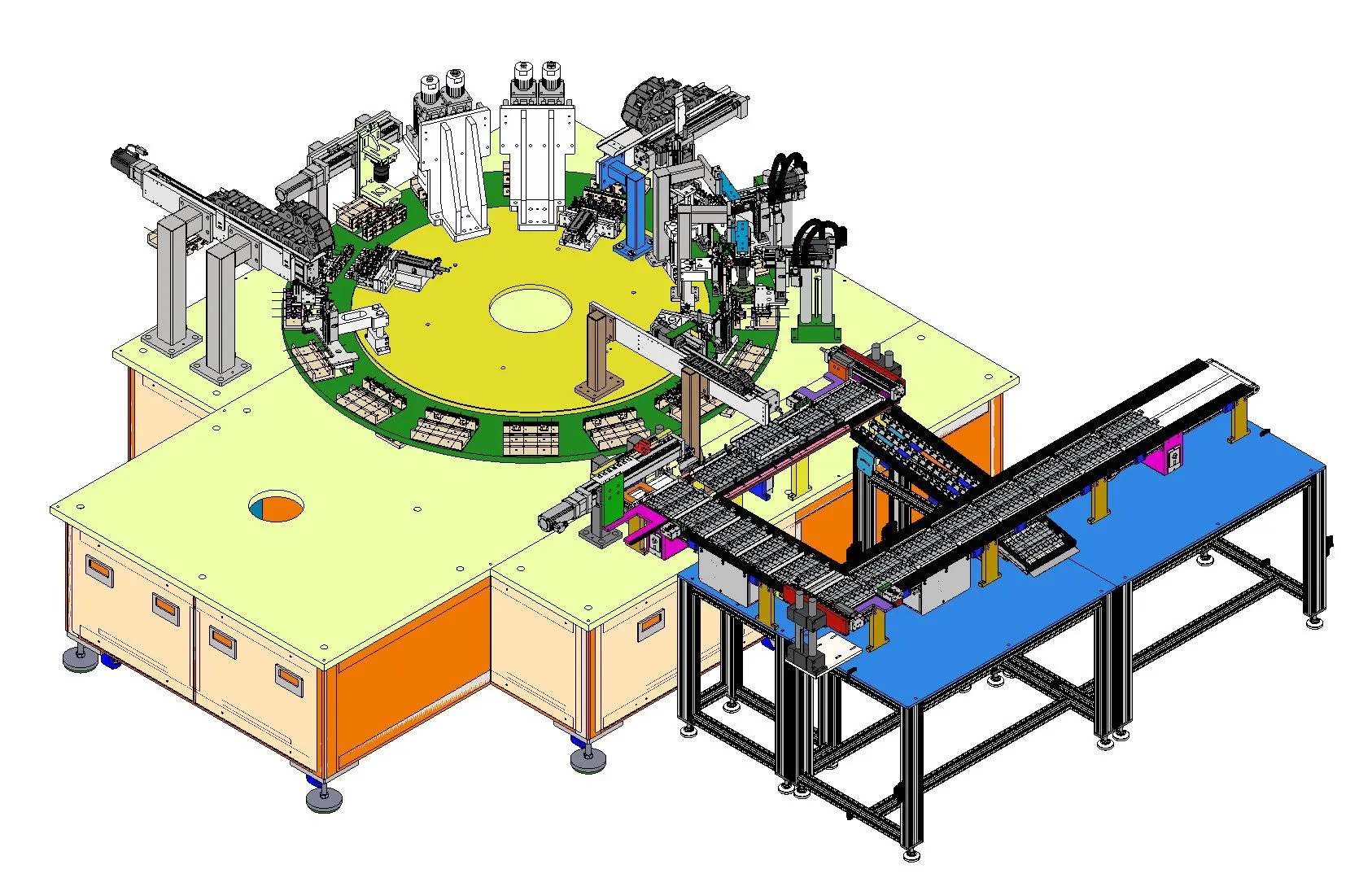
What Is Included in the Full Scope of a Turnkey Project?
A turnkey scope can cover one special purpose machine or a complete line. Define the same four phases in either case, with support arrangements and interfaces listed alongside the equipment.
Phase 1: Concept and Feasibility
| Deliverable | What It Covers |
|---|---|
| Process analysis | Study existing workflow, cycle time, quality data, and bottlenecks |
| Concept design | Functional layout, station sequence, technology selection |
| Feasibility study | Risk identification, throughput modelling, ROI estimation |
| 3D concept model | SolidWorks or equivalent visualization for layout review |
| Proposal and timeline | Milestone schedule, cost breakdown, acceptance criteria |
This phase determines whether automation is justified and defines the technical approach before any hardware commitment. At Motionwell, concept design uses SolidWorks 3D modelling to validate spatial constraints, operator access, and maintenance clearances before procurement begins.
Phase 2: Detailed Design
| Deliverable | What It Covers |
|---|---|
| Mechanical design | Full 3D models, assembly drawings, tolerance analysis |
| Electrical design | Schematic drawings, panel layout, cable routing |
| Control architecture | PLC program structure, I/O mapping, HMI design |
| Vision system design | Camera selection, lighting study, algorithm specification, as covered in machine vision inspection |
| Safety design | Risk assessment, safety circuit design, guard specification, and the evidence trail described in machine safety and CE compliance |
| BOM and procurement | Component selection, lead time management, supplier coordination |
Phase 3: Manufacturing, Assembly, and Testing
| Deliverable | What It Covers |
|---|---|
| Machining and fabrication | Precision parts manufactured to drawing specifications |
| Mechanical assembly | Frame, fixtures, motion systems, pneumatics |
| Electrical build | Panel wiring, field wiring, sensor installation |
| Software development | PLC code, HMI screens, vision recipes, motion profiles |
| Factory acceptance test (FAT) | Functional testing at integrator facility before shipping |
Phase 4: Installation, Commissioning, and Handover
| Deliverable | What It Covers |
|---|---|
| Site installation | Mechanical positioning, utility connection, safety integration |
| Commissioning | Parameter tuning, process validation, cycle time verification |
| Site acceptance test (SAT) | Testing under production conditions at customer facility |
| Operator training | Hands-on training for operation, changeover, basic troubleshooting |
| Documentation package | Operation manual, maintenance schedule, electrical drawings, software backup |
This four-phase structure is standard across Motionwell’s custom machine design projects. Each phase has defined deliverables, review gates, and acceptance criteria.
How Does Turnkey Compare With Multi-Vendor Integration and Component Supply?
Manufacturers have three basic options when automating a process. Each has different risk profiles, cost structures, and management overhead.
Comparison Table: Three Project Delivery Models
| Factor | Turnkey (Single Integrator) | Multi-Vendor Integration | Component Supply (DIY) |
|---|---|---|---|
| Design responsibility | Integrator owns full design | Split across vendors | Manufacturer’s engineering team |
| Interface management | Internal to integrator | Manufacturer coordinates | Manufacturer coordinates |
| Lead accountability | Named integrator for the agreed system | Named lead supplier or manufacturer’s project team | Manufacturer’s engineering team |
| Integration planning | Included in the integrator’s design and test plan | Shared interface specification and cross-vendor tests | Internal design and test plan |
| Buyer’s project role | Requirements, reviews and site readiness | Those tasks plus supplier coordination | Design, procurement, build and commissioning |
| Schedule drivers | Design maturity, procurement, build and site readiness | Those drivers plus cross-vendor test windows | Internal capacity and component availability |
| Cost comparison | Agreed system scope, often a fixed project price | Supplier scopes plus integration budget | Components plus internal engineering and build costs |
| Commissioning responsibility | Integrator for the agreed system | Allocated by subsystem, with a commissioning lead | Manufacturer |
| After-sales support | Single contact | Multiple vendors | Component suppliers only |
| Suitable for | New lines, complex systems, regulated industries | Large capex with specialized subsystems | Simple upgrades with strong in-house team |
What a Multi-Vendor Integration Plan Needs
A multi-vendor project works best when the following items have a named owner and a shared test plan:
A shared interface specification. Agree transfer positions, signal ownership, timing and fault behaviour between suppliers. Give each interface a design owner and a test so both machines are built against the same requirement.
Fault resolution during commissioning. Give the commissioning lead access to each supplier’s technical team. Shared logs, timings and acceptance tests help identify whether a stop comes from a subsystem or its interface.
Change control across suppliers. A change to transfer height, part orientation or handshake timing can affect several machines. Review those impacts together before approving the individual changes.
Coordinated test windows. Book the people, production material and utilities needed for cross-machine trials. Test representative interfaces before shipment where practical, then complete the site-specific tests during commissioning.
Why Do Multi-Vendor Projects Often Happen Without Anyone Choosing One?
Because the shape of the money settles the delivery model long before the comparison above gets drawn, and by the time anyone draws that table the choice has already been made.
The sequence is ordinary. A conveyor is approved in one round because a material handling problem was urgent. A vision station is approved months later against a quality budget with a different owner. A robot cell arrives on a third approval, justified by a labour saving that had nothing to do with either. Each purchase was reasonable on its own terms. Together they are a multi-vendor project nobody selected, running under three contracts written by three people who never met.
What falls out of that sequence is the integration work. It has no datasheet and no obvious owner, so it appears as a line item in none of the three approvals, and it lands on whichever internal engineer is still holding the file when the equipment arrives. That engineer inherits an obligation that was never scoped or priced, and the plant meets the cost of integration as an overrun.
There is a second effect, and it falls on the last approval. Equipment bought in rounds fixes its interfaces in rounds. By the time the third machine is specified, the two already standing on the floor have set the transfer height, the part orientation and the signal convention, so the newest purchase absorbs every accommodation and pays for the flexibility the earlier ones spent.
Two habits change this, and neither requires a preference for turnkey delivery. Decide the model while the budget is still being shaped, because that is the last point at which the choice is genuinely open. And give the integration work a named owner and a line of its own under whichever model you pick, since that work exists in all three columns of the table above. The only question is whether it gets bought deliberately or absorbed quietly.
When Does Turnkey Automation Make Sense?
Turnkey delivery is particularly useful when several disciplines and interfaces need one coordinated scope:
New Production Lines
For a new production line, a single integrator can design the mechanical, electrical and software interfaces together, then test the transfers, buffers and recovery sequences against the line acceptance criteria.
Process Changes Requiring New Equipment
When a process change requires new automation equipment, turnkey delivery ensures the new system integrates correctly with existing upstream and downstream processes. The integrator takes responsibility for the full interface, well past the new machine.
Facility Moves and Relocations
When moving production to a new facility, turnkey delivery covers layout adaptation, utility planning, installation, and recommissioning. This is particularly relevant in Singapore where manufacturers relocate between industrial estates or expand to regional facilities in Malaysia, Vietnam, or Thailand.
Regulated Industries
In medical device manufacturing, pharmaceutical packaging, documentation and validation requirements are substantial. A turnkey integrator delivers the complete documentation package, including IQ/OQ/PQ protocols, risk assessments, and traceability records, as part of the project scope. The stage-by-stage evidence expected from each protocol is set out in our page on computer system validation for production equipment.
Our turnkey automation systems page connects these delivery choices to machine scope, interfaces and the information needed for an enquiry.
How Does Motionwell Deliver a Turnkey Project In-House?
Motionwell operates as a turnkey system integrator with all design and build capabilities in Singapore. This means the full project lifecycle, from 3D modelling through procurement, assembly, testing, and commissioning, is owned by one team and never split across contracts.
In-House Capabilities
| Capability | What It Means for the Project |
|---|---|
| Mechanical design (SolidWorks) | 3D models, simulation, and drawings created by the same team that builds the machine |
| Electrical design | Schematics, panel layout, and wiring done internally |
| Precision machining | Parts made to Motionwell drawings through our manufacturing facilities and qualified partners, specified and inspected by the design team |
| Assembly and integration | Mechanical, electrical, and pneumatic assembly in Motionwell’s facility |
| Software development | PLC programming, HMI development, vision system configuration |
| Factory acceptance testing | Full functional testing before the machine leaves the facility |
How Components Get Chosen
Component selection balances the application’s performance requirements with your plant standards and the support chain. Record the reasons for any platform choice that adds a new toolchain or spare-parts family to the site.
What your site already runs comes first. A plant standing on one controller family and one drive spares shelf pays a real price for a machine that adds a second of each: another programming licence, and another support contact for whoever is on shift when it fails. That cost lands on maintenance years after the project closes, which is why it loses arguments at design review and should not.
What the supply chain can actually deliver comes second. A part with local distributor stock and a named replacement path is a different machine, five years in, from an equivalent part on a long lead time from one factory. Ask what the lead time is on the single most critical item in the bill of materials, and what the line does while it waits.
The application overrides both only when it has to. A force-controlled process, a sustained cycle rate, a cleanroom rating or a payload band can require something the site does not otherwise carry. When it does, the reason belongs in the handover documentation, because somebody in year six will ask why this one machine is different and the answer has to survive without the engineer who made the call.
The failure this order prevents is the machine specified around whatever the integrator was comfortable with. A cell can be sound on every axis of its own design and still be the wrong machine for the plant it lands in, and that verdict arrives years later as maintenance cost, long after acceptance testing signed it off.
Selecting this way is also what lets one line mix machine types without an argument: a collaborative arm on a flexible assembly cell and a four-axis industrial robot on a high-speed palletizing station, because the two stations are answering different questions about rate and human access.
Which Industries Benefit Most From Turnkey Delivery?
Medical Devices
Medical device projects align equipment records and process validation with the manufacturer’s quality system, including ISO 13485 requirements. Define the traceability, test evidence and qualification support in the machine specification. Motionwell has delivered automation systems for global medical device manufacturers.
Where the product calls for a multi-station rotary assembly machine with inline vision, the design decisions that carry the validation burden, from indexer selection and station balance to force-monitored presses and camera placement, are set out in how we design multi-station rotary assembly machines.
Pharmaceutical Packaging
Pharmaceutical packaging specifications identify the product’s destination markets, code requirements and GxP records. GAMP 5 guides risk-based assurance of the computerised system. Where serialization is required, integrate the serialization equipment, cameras and packaging sequence in one design, with tests for code quality, rejection and data transfer.
Read more about automation in pharma and packaging.
Electronics and Semiconductor
Electronics and semiconductor manufacturing demands tight tolerances, cleanroom compatibility, and high throughput. Turnkey delivery ensures mechanical precision, ESD protection and process control are designed together.
What Does a Turnkey Project Leave Behind for the Second Line?
It leaves a controlled design record with an owner who keeps the drawings, software and interface definitions aligned. That record becomes the starting point for a repeat build.
An aligned design record uses the same station names, tag numbering and definition of a finished part across drawings, schematics, software and acceptance criteria. One engineering owner can maintain that consistency throughout the build. A multi-vendor project achieves the same result through a shared naming standard and controlled document register.
For a repeat enquiry, use the controlled record to identify what changes: a product variant, a rate, a building or a destination site’s standard. The document register should point to the current files from every contributing supplier and record the interface decisions, making the original design intent available to the next project team.
The same reasoning decides how far a line can travel. Where a second plant is meant to run the same process, the question worth settling early is which parts of the design are deliberately identical across sites and which are allowed to differ, and somebody has to hold that answer for the whole line, because holding it for one subsystem settles nothing. Under a split scope there is no such person by default.
One decision belongs on your side of the table. Name the person who owns the design record after handover, the way you would name an owner for a machine. A record with no internal owner is complete on the day it arrives and out of date by the second modification, which is the version a repeat enquiry then has to be quoted against.
How Do You Evaluate a Turnkey Automation Partner?
Not every company that claims “turnkey” actually delivers full-scope project ownership. Here are the criteria that matter. Our longer framework for choosing a system integrator in Singapore scores each one.
| Evaluation Point | What to Look For |
|---|---|
| In-house design | Does the integrator do mechanical, electrical, and software design internally? |
| Manufacturing capability | Does the integrator machine parts and assemble systems, or subcontract everything? |
| FAT facility | Can you witness factory acceptance testing before the machine ships? |
| Documentation standard | Does the integrator deliver a complete documentation package as standard scope? |
| Project references | Can the integrator show completed projects in your industry? |
| After-sales support | Is the integrator local, with spare parts availability and service engineers? |
| Technology breadth | Does the integrator work with multiple robot, vision, and PLC brands? |
What Should the Contract Cover Before Work Starts?
What happens if requirements change during the project?
Every turnkey project should include a change control process. When requirements change, the integrator evaluates the impact on schedule, cost, and technical risk, then issues a change order for approval before proceeding. This is standard engineering practice and should be defined in the contract.
How are payments typically structured?
Most turnkey automation projects use milestone-based payments tied to deliverables: a percentage at contract signing, concept approval, detailed design completion, FAT, and SAT. This structure aligns payment with verified progress.
What about intellectual property?
Specify ownership and reuse rights for product information, machine drawings and software at quotation stage. List the editable source files, configuration backups and third-party licences included at handover, together with the access needed for maintenance and future repeat builds.
Next Steps
For a line purchase, use the turnkey assembly automation guide to define output and commissioning acceptance. For a programme spanning several lines, the turnkey factory automation guide covers phasing, shared resources and plant-owned standards.
If you are evaluating automation for a new production line, process change, or facility expansion, Motionwell provides turnkey project delivery with all design and manufacturing in Singapore.
Start with a process review. Contact the Motionwell engineering team with your process requirements, production volumes and quality targets, and say whether the scope is custom machine design, machine vision inspection or robotics integration. The team will assess feasibility and come back with a concept proposal carrying a timeline and a budget estimate.