
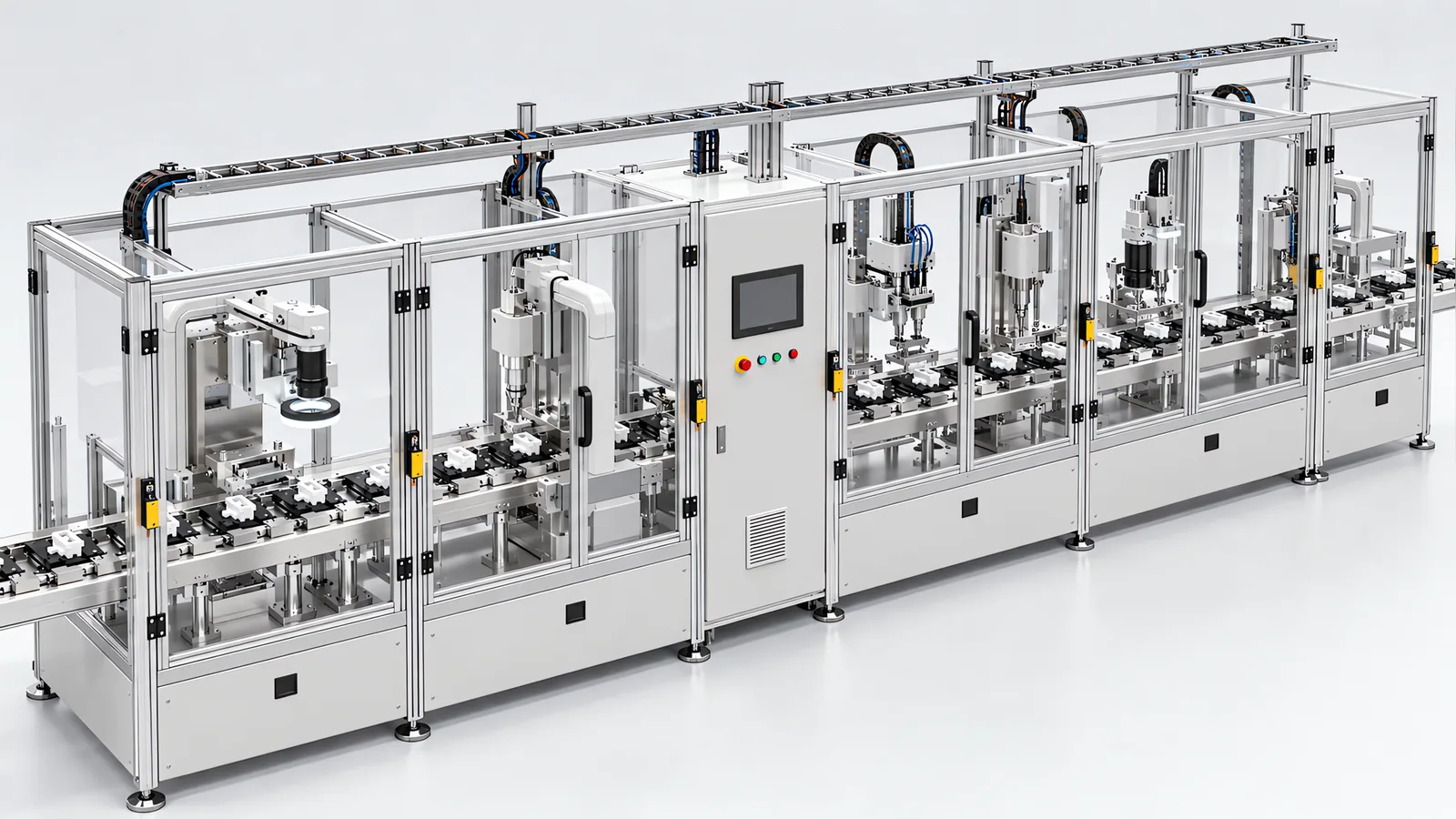
Turnkey assembly automation brings the assembly stations, transfers, controls and acceptance tests under one coordinated line scope. Buying the line means specifying its sustained output as well as each machine’s performance. The purchase needs a counting rule, a long-lead schedule, a commissioning plan and acceptance milestones for the linked system.
Motionwell has designed, built and commissioned automation in Singapore since 2014. This guide focuses on the buyer’s decisions when several machines must work together. Our turnkey automation systems page describes the equipment and engineering scope; turnkey automation explained covers the delivery model.
What Changes in the Purchase When a Line Replaces Four Machines?
The purchase adds coordination across machine boundaries: part transfers, shared safety functions, line states and recovery after a stop. A lead integrator plans that work alongside design, procurement, build and commissioning.
Ask which suppliers provide the critical equipment, custom parts and required records. Identify single-source items and the person coordinating each dependency. A supplier count gives context, but the sourcing plan shows how the line’s delivery will be managed.
Four machines bought separately do not multiply that count by four. Catalogue families repeat across builds, so the second, third and fourth machines draw on names the first one already used, and one contract over the whole line consolidates them further still. What does not consolidate is the part of the line drawn specifically for it.
Separate bought assemblies from drawing-controlled parts in the procurement plan. Custom brackets, plates, guarding and tooling need released drawings, materials and inspection criteria before manufacture. An approved second source can reproduce them from a complete manufacturing pack. Their design and fabrication dates belong on the line schedule alongside the robot, controls and specialist equipment.
| What you are buying | Four machines bought separately | One line under one contract |
|---|---|---|
| Supplier relationships you hold | Each machine supplier, with a named integration lead | One lead integrator coordinating the supporting suppliers |
| The drawing-controlled items | Four separate drawing sets in four conventions | One set, one station naming, one revision history |
| Catalogue items | Consolidation needs coordination between machine orders | Consolidated where the part repeats |
| The schedule | Four dates, each with float you cannot see | One critical path, with the float where it is needed |
| Who answers for the rate of the whole | Nobody, unless somebody was contracted for it | One party |
| Tracking a supplier delay | Compare each supplier’s progress with the shared commissioning date | Review its effect on the integrated critical path and recovery plan |
Coordination needs a budget, owner and schedule under either model. A split purchase can provide those through the manufacturer’s team or a separate integration scope. For the same decision across several production lines, see turnkey factory automation.
Which Supplier Actually Sets the Line’s Date?
Not the one that appears most often on the purchase orders, which is the part buyers find counter-intuitive.
Frequently used distributors and fabricators can still supply a critical item. Check actual stock, fabrication capacity and approved alternatives; past order volume does not establish current availability.
Model-specific equipment can also drive the schedule: a robot with the required reach and payload, an inspection head or a drive compatible with an existing motor. Changing one may affect drawings, software or tests. Review those dependencies alongside custom tooling and fabrication when identifying the critical path.
| Item class | Whose schedule it runs on | What the contract should name |
|---|---|---|
| Machining, sheet metal and tooling made to drawings | The builder’s, inside fabrication, gated by design freeze | The design freeze date the drawings are cut against |
| Standard parts, fasteners and cable | Distributor stock and any special material or certification requirements | Required specification, plant preferences and availability of critical items |
| Pneumatics and actuation | Stock or manufacturer lead time for the selected size and options | Plant standard and functionally reviewed alternatives |
| Electrical control and sensing | Mixed, and one item here can carry a long lead on its own | The controller and robot platform, plus every long-lead item by name |
| Robots and specialist heads | The manufacturer’s order book | The order date, and who escalates |
Start a preliminary long-lead list during concept engineering, then refine it as selections and drawings are released. Name each item, its order date, required-on-floor date and responsible buyer. Early orders need an agreed design basis so a later change does not invalidate the purchase. Our automation project process page shows how design release and procurement fit the build stages.
An integrated schedule makes dependencies and float visible across the machines. Some delays can be recovered by resequencing independent work; others require an alternative component or a revised milestone. Review the recovery plan against the linked line test date, under either purchasing model.
Who Owns the Line’s Rate, and How Should That Clause Read?
One party owns it, and the reason a coupled line produces less than the slowest machine’s datasheet figure is set out on our packaging line integration page. What that page does not cover is the wording, which is where a rate argument at acceptance gets decided.
A rate clause that can be tested has six parts. A clause carrying two or three of them is where acceptance turns into a negotiation.
| Element of the clause | What it has to state | What gets argued when it is missing |
|---|---|---|
| The unit counted | Which output the figure refers to, and the test that makes one of them acceptable | Each party arrives at acceptance with a different numerator and both can defend theirs |
| Where it is counted | A named physical point, after the last check | Each party counts at the point that flatters its own scope |
| The run length | A duration or a batch size, stated, and long enough that ordinary interruptions fall inside it | A short demonstration gets offered as proof of an hourly figure |
| The material | Named part numbers at real tolerance, plus consumables from your own supplier | The test runs on convenient samples and the line underperforms on yours |
| The operating conditions | How changeovers, utility interruptions and nonconforming material are recorded and handled in the test | The teams calculate sustained output on different bases |
| The remedy | What happens if the figure is short, and for how long it applies | The only available remedy is withholding payment, which suits neither party |
Name the pacing station and distinguish sustained output from maximum cycle capability. These definitions matter within a multi-station machine and across a line; on a line they also determine the required transfer rates and buffer behaviour between suppliers. The packaging line integration page explains that relationship.
Record the consumable specification, supplier and batch used for acceptance alongside the product parts. Film, labels and containers can affect feeding, sealing and line output, so production-representative material makes the trial useful. The packaging line integration page explains those effects. Selection questions are in our guide to choosing a liquid filling machine, and our automation URS page shows how to make each requirement testable.
What Do You Pay for Four Times Under a Split Purchase?
The functions each machine needs once and the line needs once in total, which is an ordinary consequence of four quotations written by four people who each priced a complete machine.
Compare the panels, operator interfaces, spares, document conventions and training in the individual quotations. A shared line specification can standardize these while preserving the local controls each machine needs. It should also define the line-level state and command structure described on the packaging line integration page.
| Function | How a machine quotation prices it | What the line actually needs |
|---|---|---|
| Control panel and enclosure | One per machine, to that maker’s convention | One per machine still, but built to one wiring standard and one drawing set |
| Operator interface | One per machine, with its own screen language | One place an operator stands for the line, with machine screens behind it |
| Safety circuit | One per machine, assessed to that machine’s edge | One assessment of the assembly, plus the functions that cross between machines |
| Spares holding | One kit per machine, overlapping parts bought twice | One reconciled kit against one bill of materials |
| Training | One session per supplier, scheduled by each | One session on the line as your operators will run it |
| Documentation | Four packs, four station naming conventions | One pack your technician can read at two in the morning |
Name the owner of the assembly-level risk assessment at quotation stage. Use the ISO 12100 method to review the coupled system, including transfer openings, shared access and cross-machine stop behaviour. Include the resulting design and validation records as deliverables with dates. Our machine safety and CE marking page explains the guarding and evidence scope.
Specify the controller and robot platforms your maintenance team supports, and record any application-driven exceptions. This makes software licences, spares and training visible before purchase. IEC 60204-1 informs the machine’s electrical equipment design alongside those platform decisions. Electrical system integrator scope explains the panel and field-wiring interfaces; our control panel design and build page covers the panel itself.
Who Staffs and Pays for the Commissioning Period?
Treat commissioning as a staffed activity with a duration, resource plan and completion milestone. A line needs time for both station tuning and cross-machine trials.
Four things get consumed while a line is being tuned. Our engineers’ days on your floor. Your material, at production quantity, because a rate cannot be tuned on a handful of parts. Your operators’ time, since the people who will run the line have to be in front of it. And your line hours, which is the expensive one and the one that belongs to a plant manager and never to a project engineer.
Both a machine and a line can need specialist support for a bought-in vision head, drive or safety controller. A line adds more interfaces and test dependencies, so name the commissioning lead and the route to each equipment supplier. The scope should identify the included support days, escalation arrangements and joint test windows. Turnkey automation explained describes how this coordination fits into the delivery model.
Use five questions to plan the commissioning stage.
- How many engineer-days are inside the price, and what does a day beyond cost? A figure.
- Does the plan count calendar days or available line days? Match the engineering allocation to the actual production access and test windows.
- What event closes the window? Name the site acceptance, production run or other completion milestone and the support arrangements that follow it.
- Whose material, and is the output sellable? Product made during tuning is real product. Somebody has to decide whether it can be released, and quality has to be in that conversation before the first run.
- What support is available for the first production week? Agree on-site days, remote support and an escalation contact around the planned production ramp-up.
Where that period sits among the project’s other stages, and what each stage can and cannot establish, is on the automation project process page linked earlier. A checklist for the test that precedes all of this, run on our floor before the line ships, is in our factory acceptance test checklist.
How Should Payment Follow Acceptance on a Line?
Against events that establish something about the coupled line, and the reason acceptance belongs in stages at all is argued on the turnkey automation systems page. What follows is the money mapped onto those stages, which is a separate decision and one made by a different person in your company.
The trap is specific. A line built in stations can be accepted station by station, and a station accepted alone is a genuine result worth paying for when it runs into a manual step and relieves something today. A station accepted against simulated inputs is not that. Pay out the retention against station tests and the only leverage left on the line rate is a commercial conversation after the line is on your floor.
The following is a milestone structure to adapt to the project. Agree the payment allocation against each event and name the buyer’s representative who can verify the corresponding evidence.
| Event | What it is reasonable to release | Who on your side should sign it |
|---|---|---|
| Contract and concept approval | The mobilisation and engineering portion | The sponsor who owns the budget |
| Bill of materials released, long-lead orders placed | The procurement portion, against evidence of the orders | Your buyer, reading order acknowledgements |
| Station test on your samples at our floor | A station portion, where that station has standalone value | The process engineer who supplied the samples |
| Linked line running at our floor | The agreed integrated factory acceptance milestone | The process engineer and the production manager together |
| Installed, energised and safeguarded on your floor | The agreed installation milestone | Facilities, plus whoever holds safety for the site |
| Site acceptance on production material | The agreed site acceptance milestone | The production manager responsible for the line |
| Commissioning window closed | Any payment portion linked to the agreed completion criteria | The plant manager or named project owner |
Use order acknowledgements and procurement progress records to verify the long-lead list, whether or not a payment milestone is tied to them. Keep a defined payment portion linked to the integrated line acceptance criteria. Assign each sign-off to the buyer’s representative who can review the corresponding engineering, production or site evidence.
What Flows Through to You From the Suppliers You Never Signed With?
Four things, and all four are decided by wording.
Service coordination. Name the first support contact and the route to specialist equipment suppliers. Include fault diagnosis, replacement-part sourcing and commissioning of the replacement in the service plan. Response and site-support considerations are covered on our local versus overseas machine builder page.
Spares, as a directory. A parts list drawn from dozens of suppliers leaves your store team a reordering problem. Ask for manufacturer part numbers in the spare parts list, because a list of our internal item codes makes you call us for a proximity sensor.
Substitution review. Identify components whose characteristics drive the process or a safety function. A dispensing valve affects wetted materials and dose behaviour; a cylinder or gripper can change force, stroke, timing, sensing and holding performance. Review every proposed substitute against the affected functions, then define the inspection and retesting needed. Record approval and the installed part number in the machine files.
The design record. One line, one set of drawings, one station naming convention and one program archive, with an owner named on your side after handover. The value of that record on the repeat build is argued on the explanation page, and the framework for scoring builders against each other, including us, is in our guide to choosing a special purpose machine builder.
What Does a Line Contract Need That a Machine Contract Did Not?
Review these nine attachments when buying an integrated line. Several also apply to a complex single machine; the line scope extends them across stations and suppliers.
- The rate definition, carrying all six elements from the table above, plus the pacing station named and the figure marked as sustained or as a ceiling.
- The material for acceptance, as part numbers at stated tolerance and consumables from your own supplier, with who supplies them and when.
- The long-lead list, started during concept engineering and updated at design release, with an order date, needed-on-floor date and escalation owner per item.
- The free-issue schedule, if any equipment of yours enters the scope, with a performance statement attached to each item.
- The commissioning window, as engineer-days, a day rate beyond them, the clock basis and the event that closes it.
- The payment and retention map, with the retention sized against the line rate and released after the window closes.
- The assembly-level safety file, with the party producing it named, the cross-machine functions listed, and a required performance level stated against each under ISO 13849-1.
- The platform standard, naming controller and robot brand for every station, set by whoever maintains them afterwards.
- The handover pack, itemised: mechanical drawings, electrical schematics, PLC program documentation, operator manuals, maintenance schedules and a spare parts list with manufacturer part numbers. Specify the software archives, editable project files, versions and licences needed to maintain the supplied system.
Defining these items at quotation stage lets the supplier price the work and plan its resources. It also gives the buyer a clear basis for comparing scopes before the line is built.