
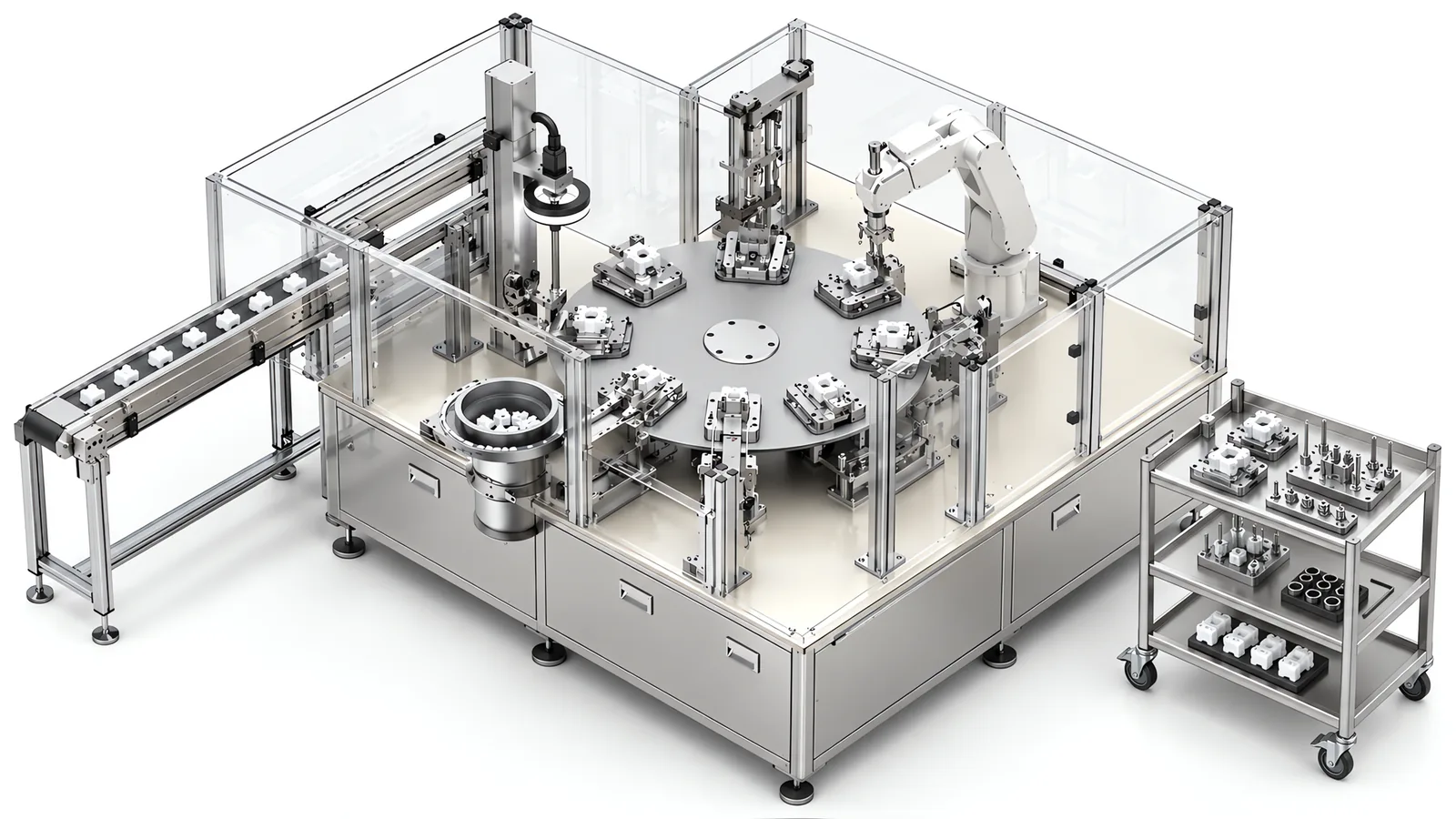
Special purpose machines for medical device assembly combine product-specific tooling with controlled processing, inspection and traceability. The bill of materials connects that design to the components installed, the instruments requiring control and the spares used after qualification.
Motionwell builds these machines in Singapore. This guide focuses on configuration and component control: which parts locate or process the device, how variants are managed and what evidence follows the installed equipment. The related electronics and cleanroom examples below illustrate specific mechanisms and handling methods.
The sections below connect the parts list to sourcing, variant handling, clean enclosures and qualification. Process stations, force control and nest materials are covered separately on our medical device assembly machine page, and dial architecture on the rotary indexing assembly machine page. For the equipment definition, see what a special purpose machine means in engineering.
Which Parts of a Medical Assembly Machine Need Custom Engineering?
Start by separating standard modules from product-specific tooling and process development. A standard assembly platform may suit the task with custom nests, feeders, inspection or joining stations. A more specialised process may need a new layout and mechanisms. Ask for that split by assembly so the engineering work and sourcing plan are visible.
Two other reasons compound it on a medical build. The parts that touch the device are the parts a catalogue is least able to supply, because their geometry is the inverse of a component that has not been designed anywhere else. And the deliverable is not only hardware: a medical assembly machine ships with evidence of its own installation, and that evidence is specific to the machine and the room it lands in.
What this does not mean is that everything inside the frame is bespoke. Standard modules inside a drawn frame is the normal shape of these machines, and where the line between them should fall is the subject of our custom machine versus standard equipment comparison. The useful question for a buyer is not custom or standard. It is how much of this specific machine is drawn, because that fraction is the engineering schedule and the part of the quotation with real uncertainty in it.
What Is Actually Inside the Parts List of a Medical Device Assembly Machine?
Four groups cover most of what is on the list. Read the table as an answer to how many different things have to be drawn, ordered and received, not as an answer to where the money goes. A single drive or vision controller is one line on the list and can outweigh a hundred machined brackets commercially.
| Group | What it consists of | What it decides for you |
|---|---|---|
| Local machining, sheet metal and tooling | Plates, brackets, frames, guards, nests and change parts cut to the product geometry | Drawing release, fabrication and inspection milestones for each assembly |
| Standard mechanical parts and cable | Bearings, shafts, dowels, fasteners, cable and connectors | Check availability, critical specifications and approved replacement routes |
| Pneumatics | Cylinders, valves, regulators, fittings, slides and grippers | Cleanroom-rated variants and piped exhaust have to be specified at design |
| Electrical control and sensing | PLC, drives, HMI, sensors, cameras, safety devices | Software versions, obsolescence planning and calibration or verification according to each instrument’s use |
Review the control and sensing items by model, software version and function. Distinguish instruments used for product acceptance from those used for setup, monitoring or protection, and define the evidence each needs. Include mechanical gauges and fixtures where their condition affects the measurement. Both custom and catalogue parts need an approved replacement route.
Review the custom-versus-bought split and proposed control components alongside the price. At concept stage some selections remain open; record when they will be confirmed and how they affect cost, delivery and qualification.
How Many Suppliers Sit Behind One Medical Equipment Assembly Build?
More than the buyer’s mental model, which is the part that catches people out. The raw number matters less than the shape behind it: two machines with the same item count can sit behind very different supplier lists, and the ratio between the two says what kind of machine you are buying.
| Shape of the parts list | What that shape usually is | What it does to your schedule and your quality system |
|---|---|---|
| Many items, few sources | A repetitive mechanism, such as a buffer conveying unit built from the same parts many times over | Fewer purchasing interfaces, but greater exposure if a critical source is delayed |
| Fewer items, many sources | Equipment combining several specialist functions | More component interfaces and lifecycle records to coordinate; check the actual critical path |
| A robot cell | An arm, trays, nest plates, a gripper, vision, guarding and a control panel, each from a different place | Concentrated in a few long-lead items, where the order date matters more than the quoted delivery date |
| A line | Several machines with transfer, loading and test between them | Name the interface and acceptance owners; risk depends on the connections and coordination, not supplier count alone |
Two consequences follow for a medical program specifically, and both outlive the project. Under a manufacturer’s quality system, built to ISO 13485, the installed machine becomes a controlled object, so the supplier list is not a commercial detail that disappears at handover. It is part of what your quality unit has to be able to reconstruct years later, which is what turns a like-for-like component substitution into a change control decision, and not a purchasing one. And the obsolescence exposure is distributed: every source runs its own product lifecycle, and the ones that go end of life first are clustered in the electrical row that carries the fewest items. Which side of a build carries more of that risk over a decade is worked through on the custom machine versus standard equipment page, and it is the argument for getting the spares list, with manufacturer part numbers, written into the purchase order before commissioning.
At tender stage, review critical sources, approved alternatives and the records each supplier provides. Put the document owner and required delivery date in the project plan alongside the physical component, especially where qualification needs that evidence.
When Does a Collaborative Robot Earn Its Place on a Medical Assembly Cell?
A collaborative robot gets scoped by buyers as buying an arm. On a cobot loading machine the arm is one line on the parts list, from one supplier. Everything that makes it useful is the rest of the list: the tray system, the nest plates the trays locate on, the gripper, the vision that tells the robot where the specimen actually is, the enclosure, the panel and the safety devices. A quotation built around the arm has priced a fraction of the cell, and the fraction it has priced is the one part with a published price.
A cobot is one option for repetitive loading and high-mix handling. Tray exchange can overlap manual preparation with an automated cycle, provided the access and safeguarding arrangement supports it. Our cleanroom automated test equipment provides related electronics-industry context; a medical application needs its own tooling, process and qualification specification.
Compare the complete application: cycle time, payload, tooling, operator access, programming and safeguards. A cobot can work inside a guarded cell; its built-in safety functions alone do not determine whether a fence is needed. The assessment under ISO 12100 defines the protective measures for the robot, tool, workpiece and process. Our machine safety and compliance page covers that work, and collaborative robot applications covers where this class of robot fits.
How Much Variant Range Should One Medical Devices Assembly System Carry?
The vision-guided SCARA panel line illustrates recipe selection and vision correction for a defined family of industrial sensor panels. For a medical assembly machine, review each proposed variant against tooling, feed presentation, process limits and inspection. Vision can correct location, while differences in grip geometry or process requirements may still call for hardware changes.
| Where the range lives | What a changeover costs | What breaks it | What it costs on a validated machine |
|---|---|---|---|
| In the parameter set: paths, grip profiles, vision windows, force limits | Minutes, one selection at the HMI | A difference the parameters cannot express | A re-test scope per variant, which is worth agreeing with your quality unit before the range is fixed |
| In the camera: the machine measures the part position and the motion corrects for it | Recipe and verification work; hardware can remain if the variant fits the designed range | Features outside the viewing or correction range, or differences that also affect handling | Qualification of adjustable inspection rules is covered on our medical device assembly machine page |
| In the steel: a nest or fixture set per variant | A tooling swap with a record | Storage, wear and re-verification for every set held | Each set is a change part with its own record and replacement interval |
| Not carried: one variant per machine | No format changeover | A second device family needing different equipment | A narrower qualification scope; utilisation depends on demand for that variant |
Compare the time saved by each changeover option with its tooling, maintenance and qualification work. A frequently changed product family has a different balance from a machine running long campaigns. Agree the variant range and re-test approach with the quality team before fixing the architecture; our medical device assembly machine page explains how adjustability affects the evidence needed.
What Changes When the Machine Carries Its Own Cleanroom Envelope?
There are two arrangements and buyers sometimes specify the wrong one. How a room holds a class with facility air handling, and how a machine enclosure does the same job over a much smaller volume, is set out on our medical device automation page. What matters here is what moves when the envelope belongs to the machine.
Define the enclosure’s required cleanliness, operating states and interfaces with the surrounding room. Allocate filter checks, particle counts, recovery tests and maintenance responsibilities in the qualification plan. The enclosure and room work together, so the room classification and transfer arrangements follow the product’s contamination-control requirements. Classification by particle concentration is defined in ISO 14644-1; the design considerations are in our cleanroom automation guide and medical device assembly machine page.
The cost side is access. A fully enclosed machine is harder to reach into for changeover, cleaning and fault recovery, so wipe-down geometry, door positions and reach distances have to be designed and not discovered at site. Where the particles on an assembly machine actually come from, and what that does to material selection, is on the medical device assembly machine page.
One commercial point follows. A clean envelope is an unglamorous thing to have built before, and it is the part of the machine you least want as a first of kind, because airflow that misbehaves is discovered at qualification. Ask a builder which parts of their classified-space design are already running somewhere and which are only rendered, and ask it about the enclosure and the airflow specifically instead of about the machine as a whole. Our own enclosed work of this kind is the test equipment series named above, built for electronics manufacturers, and that is the boundary of what it proves.
Where Do Traceability Requirements Land on the Machine’s Own Configuration?
Traceability on a medical build is usually discussed as the record the machine produces about each device. There is a second half that gets discovered late: the machine is itself an object under configuration control, and the parts list is the document that control rests on.
Installation qualification checks the installed configuration against the approved design and BOM. Build the calibration and verification register from the purpose of each measurement: product acceptance, process control, setup, equipment protection or monitoring. Include a pressure gauge when its reading supports a critical process setting; include the acceptance sensor with its required range, accuracy and traceability. Assign intervals and evidence according to use and risk. The computer system validation and equipment qualification route connects those records with software configuration and functional tests.
Agree the BOM release stages and receive the final as-built list with manufacturer part numbers and controlled drawing references. The quality team uses it with the approved design for installation checks, while maintenance uses it for spares and replacement control. Keep the procurement schedule linked to the same revisions.
What Should You Ask Before You Sign for a Special Purpose Machine?
Use these seven questions to review the proposal’s maturity and supporting evidence. Some details become available as design develops, so identify the owner and release milestone for each open item.
| Question | Why it decides something | What a weak answer sounds like |
|---|---|---|
| How many line items are drawn to our device geometry, and against which freeze date? | It sizes the engineering schedule and the uncertain half of the price | “We use standard components wherever possible” |
| Which measurements require calibration or verification, and for what use? | Connects acceptance and process-control measurements to the required evidence | “Everything is calibrated” |
| Which parts of the clean envelope have you built before? | First-of-kind enclosures and airflow are where schedules are lost | A render of an enclosure |
| Which variant differences live in the parameter set, and which need metal? | Defines changeover tasks, tooling storage and verification for each format | “Fully flexible” |
| What is the re-test scope when one station’s parameter changes? | It prices every future adjustment before you agree to the architecture | No answer |
| When do we get the parts list with manufacturer part numbers, and in what format? | Your qualification, your spares holding and your obsolescence exposure all read from it | “At handover” |
| Which procurement items are on the critical path? | Connects supplier deliveries with drawing release, assembly and qualification | A lead time with no supporting dependencies |
If the scope extends past one machine to a line with transfer, loading and test between the stations, how a turnkey assembly scope is drawn covers the boundaries, and how to choose a special purpose machine builder covers the supplier selection itself. For primary containers and fluid paths the governing questions are different ones, and special purpose machines for pharmaceutical production is the closer match. For the wider picture of how we work with device manufacturers, see our medical device automation page.