
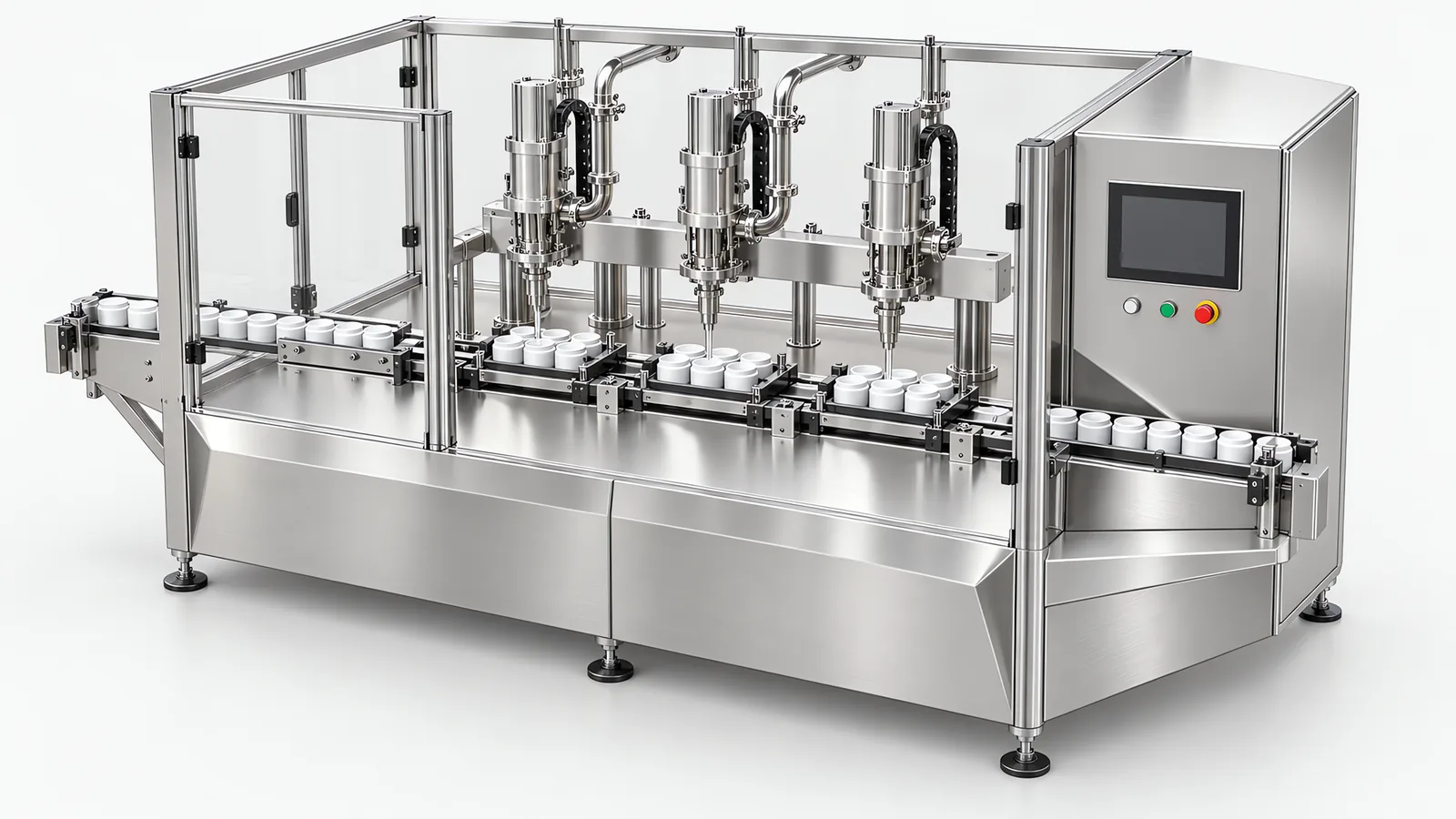
Special purpose machines for pharmaceutical production need a defined product path, cleaning method, operating environment and record set alongside the required rate and accuracy. Use those inputs to specify contact parts, container tooling, controls and qualification evidence.
Motionwell’s equipment projects include filling and sealing, and vial capping and uncapping. This guide follows a pharmaceutical machine’s components through product contact, cleaning, maintenance and records, so each part of a new quotation has an engineering purpose.
Is a Pharma Special Purpose Machine a Different Machine, or the Same Machine with Different Paperwork?
Both, and the proportions surprise people. The mechanics of indexing a container, opening a valve for a metered time and closing a seal are not pharmaceutical engineering. The sequence logic is not either. What changes is narrower and more expensive than a redesign: what the product is allowed to touch, what the room allows the machine to emit, and what the machine has to be able to prove afterwards.
That matters commercially because those three things are priced separately from the mechanism, and a quotation that does not separate them is hiding either a gap or a contingency.
| What the buyer asks about | On a general industrial machine | On a pharmaceutical machine | The question that settles it |
|---|---|---|---|
| Contact materials | Chosen for wear and cost | Chosen for the cleaning chemistry and certified on paper | Which cleaning agent, at what concentration, how often |
| Change parts | Convenience | The format strategy and a cleaning boundary | How many container formats, and who draws the next one |
| Control scope | Make the sequence run | Make the sequence reconstructable | Which records does a predicate rule already require |
| Environment | Guarding and ingress protection | The room’s particle budget | What class is the room, and who counts it |
| Acceptance | Factory test, then site test | Factory test written to carry into qualification | Does the factory test evidence get reused or repeated |
| Ownership after handover | Spares and schematics | Spares, schematics, drawings and certificates | Can your team replace a contact part without us |
Read the right-hand column. The arguments we have sat through on pharmaceutical projects trace back to one of those six questions being answered late.
What Does the Parts List Tell You Before the Quotation Does?
Ask each bidder for the bill of materials split by count, and split again into parts that can be ordered against a catalogue number and parts that exist only because this machine was drawn. Both halves are ordinary information for a builder who has designed the machine. A builder who has priced a concept cannot produce the second half yet, and that tells you where the design actually stands.
Two things about the shape of that answer are worth knowing before it arrives.
Drawing-controlled items can include container trays, sealing tools, brackets and guarding. Their lead time includes design release, fabrication and inspection. An alternative fabricator needs the controlled drawing and material requirements; a catalogue search alone will not define an interchangeable custom part.
The second is that the group carrying the regulated obligation is small enough to overlook. The controller, the operator interface, the sensors and the software are few line items against the rest, and every record the machine will ever write comes out of them. A small share of the count, a large share of the obligation.
| Part group | How you recognise it on a quotation | What it decides for you |
|---|---|---|
| Machined parts, sheet metal and tooling | Controlled by drawings and fabrication specifications | Tooling, structure and some contact parts; identify contact duty and the required material evidence separately |
| Standard mechanical items and cable | Ordered against a published part number | Confirm local availability, approved alternatives and the service stock for critical items |
| Pneumatics and actuation | Catalogue parts with service intervals | Wear and spares budget. Ask for the maintenance list by part number |
| Control, sensing and software | Few line items, long lead on documentation | The compliance load. This is where validation scope is decided |
Identify product-contact parts separately from the made-to-drawing split. The wetted path can include standard valves, seals and tubing as well as custom nozzles, while many custom brackets and guards never touch product. A BOM marked by both manufacturing route and contact duty supports sourcing, material evidence and maintenance without confusing those two categories.
Which Parts Actually Touch the Product, and What Do You Ask About Each One?
Group the parts list by contact, and the question set changes per group. Our filling and sealing machine is described mechanism by mechanism on its own page. What follows is the buyer’s cut of the same machine, which is a different document with different questions in it.
The wetted path. Everything between the product reservoir and the container: the valve that meters the shot, the seat it closes against, the nozzle, and the seals in between. Two questions settle this group. Which of these parts wear, and does each wear item carry a manufacturer part number in the handover pack. A wear item that touches the product and has no number becomes an enquiry to the builder every time it is replaced, and a replacement interval that lives only in the builder’s head belongs in your maintenance procedure instead. Which dosing method suits which product, and how the product side is kept away from the actuation that drives it, is a selection question worked through on the custom filling machines page.
The container location. On a tray-fed machine the container sits in a machined pocket, held by the pocket itself and by nothing that grips or guides it, and that pocket exists as a drawing before it exists as metal. So the question is not who cut the tray. It is who holds the drawing, whether the pocket tolerance is recorded on it, and whether your plant gets a copy at handover, because that answer decides whether your next container size is a purchase order or a redesign. A tray is cheap to make twice and expensive to be unable to make at all. How the rest of a format change is engineered is a subject of its own on our filling line changeover page.
The parts that move and never touch. Review cylinders, slides, grippers and guides for particle generation, lubricant suitability and cleaning compatibility. Their material evidence follows their location and contamination risk, even when they are outside the wetted path. Our cleanroom automation guide works through particle sources on moving parts in detail.
Sensing and process control. Classify each instrument by how it contacts the process and how its measurement is used. A wetted probe needs material and cleaning specifications; an optical sensor needs a defined viewing condition. For either, identify the calibration or verification, control action and required record. The quality and engineering teams agree which data is retained and how it supports process decisions.
| Part group | What defines the group | What to ask the builder |
|---|---|---|
| Wetted path and dosing | Everything the product touches between reservoir and container | Materials with certificates, wear items by part number, cleaning compatibility, who stocks them |
| Container location and change parts | Parts drawn for one container size | Drawings, material, tolerance on the locating feature, lead time for a new format |
| Handling and actuation | Moves the container, never touches the product | Particle behaviour, lubricant, whether it survives the cleaning regime |
| Sensing and process control | Produces signals, some of which become records | What is logged, at what resolution, where it is stored, who may change it |
| Frame and enclosure | The surfaces the room sees and the operator wipes | How the finish is measured and where, and which cleaning method the rating was chosen against |
Use the five rows to request the design basis and evidence for the proposed machine, including any items that still need a trial or detailed design.
Which Parts on the List Decide Your Delivery Date?
Either custom or purchased parts can set the delivery date. Check drawing release, fabrication and inspection alongside lead times for specialist valves, sensors and controls. The method is covered in our guide to choosing a special purpose machine builder. On regulated work, add the dates for required material and qualification evidence.
The first is that a supplier count is a documentation count. Ask a bidder how many separate suppliers sit behind the machine, and how many of those sit behind the parts that touch the product. Expect a larger number than the machine looks like it needs, because installation qualification asks for evidence about components and each supplier is a chain to follow when a certificate is missing. A builder who cannot state the number has not built the machine on paper yet.
The second is that a substitution behaves differently once the machine is qualified. Ask for the bill of materials marked up three ways: catalogue, made to order, and single source with no documented alternate. The third category is the one to have named before the order, not at spares time, because replacing one of those parts later is a change control exercise inside your quality system instead of a procurement decision inside the builder’s. Accept that for some dosing and sensing items the answer is that there is no alternate, since the form and the behaviour are part of the qualified configuration. That answer is fair. Meeting it for the first time years later, with the part obsolete and the machine running, is not.
Is Your Product a Drug, a Device, or Both?
Worth settling before the machine is specified, because it changes which quality system the equipment answers to and therefore what the builder has to produce.
A drug, device or combination product brings the manufacturing requirements applicable to its classification and destination market. The quality team translates those requirements into equipment controls and evidence. For US combination products, FDA explains the applicable framework in its combination-product CGMP guidance. Device quality systems can use ISO 13485, while electronic records are assessed against the scope of 21 CFR Part 11 and the underlying record requirements.
Specify the machine functions, tests and documentation that support the product’s quality system. For device assembly and testing, our page on special purpose machines for medical devices covers configuration and measurement control. Container formats and dosing decisions are explored in how to choose a liquid filling machine.
Which Records Does the Machine Owe You, and Who Decides That?
The production and quality teams define which records the process needs, and the integrator translates those requirements into machine functions. Identify the records required for this product and process, then specify audit trails, timestamps, recipe access, retention and retrieval. The control platform is selected to support that record set.
Plan software assurance from intended use and risk to product quality, patient safety and data integrity. GAMP 5 provides a risk-based framework; software category is one input alongside complexity, supplier evidence and the functions being controlled. Agree the responsibilities, tests and records during specification, then maintain them as the design develops.
The clause-level questions on electronic records are worked through on our page of 21 CFR Part 11 questions, and the V-model, the qualification stages and the traceability matrix are covered under computer system validation. Bring the records list to the first technical meeting and both of those pages become a checklist.
What Does Asking for a Cleanroom Machine Actually Commit You To?
ISO 14644-1 classifies air cleanliness in cleanrooms and clean zones by particle concentration. Define the classified space and its occupancy state: the room around the machine, a local enclosure or both. Then specify the machine’s materials, particle sources, airflow interfaces and testing within that arrangement.
The machine answers that request in four places: the materials and the finish of every surface an operator wipes, the enclosure rating chosen against the cleaning method instead of against a catalogue, where the moving parts put their particles and where the machine puts its own air, and the lubricants. None of the four has a house standard that survives contact with a real cleaning regime, which is why all four stay open until design review and none of them gets printed on a datasheet. Which of them your product and your room actually fix, and where the line falls between a wipe-down duty machine and a higher grade of fill, is set out on the pharmaceutical packaging page. The room-versus-machine decision, including when the clean zone should be carried by the machine, is the subject of our cleanroom automation equipment page.
Agree the room or local-zone class, cleaning procedure and chemistry, and responsibility for particle testing after installation. Put those interfaces into the design and acceptance plan with the facilities and quality teams.
Which Questions Separate a Builder Who Has Done Pharma from One Who Has Not?
Use the questions below to connect the proposed machine with your product and quality requirements. Request the design basis and evidence for each answer, then carry the agreed items into the specification.
| Ask this | A specific answer sounds like | A weak answer sounds like |
|---|---|---|
| What have you delivered into a regulated plant, and what was the scope boundary | A named machine type, the room class, and what the customer’s quality unit owned | A list of industries served |
| Which parts on your last build touched the product | A group of parts with materials and certificates, and the wear items by number | Stainless steel throughout |
| What is the wear part on your dosing station | A manufacturer part number and an interval | We replace it when it fails |
| Who cuts the change parts | A named shop, in house or subcontracted, with a lead time and who inspects them on return | Our supplier handles it |
| Which procurement items and supplier records are critical | A sourcing plan showing custom parts, single-source items and the owner of required records | No defined sourcing responsibilities |
| What happens if a sensor goes obsolete after qualification | A change control conversation with your quality unit | We will find an equivalent |
| Which records will the machine write | A question back to you about your predicate rule | Full 21 CFR Part 11 compliance |
| Who counts particles after installation | A name and a point in the acceptance plan | The machine is cleanroom compatible |
| Who owns each machine, room and validation deliverable | Named responsibilities and acceptance evidence | Unassigned responsibilities |
Carry those responsibilities into the project plan. Identify the owner, required inputs and acceptance evidence for the machine, its room interfaces and each validation deliverable.
Define closure handling as a complete function whether it is integrated into the filler or supplied as a separate machine. Specify closure feeding, application, verification and reject handling, plus the transfer between filling and closing. Our capping and sealing systems page covers the closure methods, while the special purpose machine design guide sets out the overall design and delivery sequence.
Next Steps
Contact the engineering team about the process you want to automate. We can develop the machine concept and quality requirements with your team. Motionwell has operated in Singapore since 2014, with design, assembly and testing at Woodlands Link, ISO 9001:2015 certification and bizSAFE Level 3.