
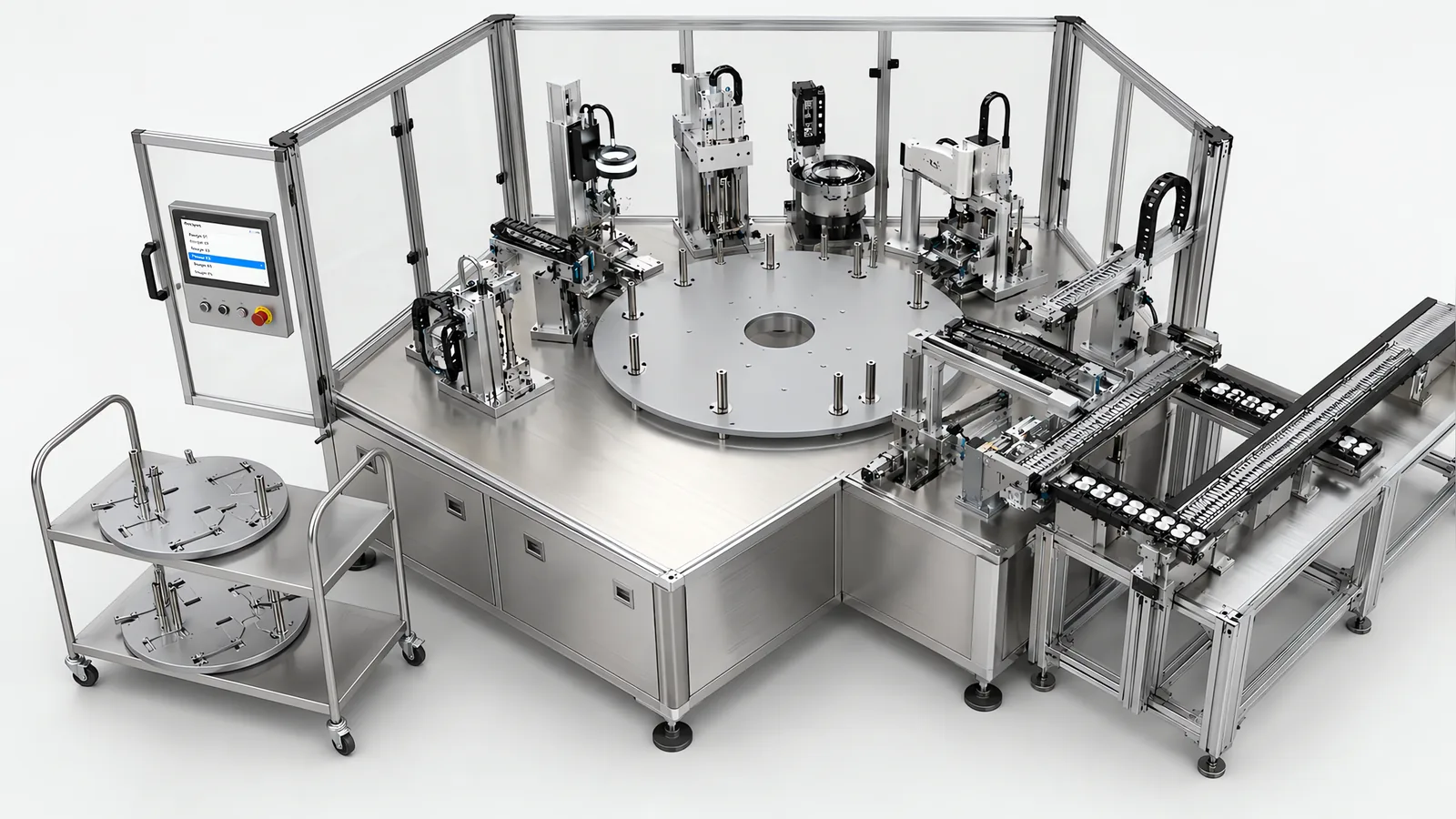
Filling line changeover combines mechanical format changes, recipe selection, cleaning and verification. Motionwell designs those activities alongside the dosing process so the required format range is reflected in trays, tooling and access. Our delivered tray-fed filling machine carries container geometry in machined tray sets. Replenishing the same container format is a separate availability task, handled through feed capacity and the reload sequence.
This page sets out what changeover time is actually made of on a filling line, which parts of a format change belong in a recipe and which stay in the toolbox, how much of a GMP changeover is cleaning, and why the changeover concept has to be settled before the layout is frozen. The machines themselves are described on the custom filling machines page, and the qualification work that a format change drags behind it on a regulated line sits on the equipment qualification and validation page. If you already have an SKU list and a changeover time you are trying to hit, send it to an engineer.
What Actually Consumes the Changeover Clock on a Filling Line?
Measure it from the last good unit of the old job to the first good unit of the new one. Any other definition flatters the number, usually by parking the slow parts outside the measurement. Under that definition a filling line changeover is five separate pieces of work with different owners, different failure modes and different fixes.
| Block | What happens | Who owns it | What machine design can remove |
|---|---|---|---|
| Strip and remove | Product-contact parts come off, the wet path drains, old format parts and remaining product are cleared | Production | Tool-free fasteners, captive hardware, drain points sloped so the path empties without being tipped |
| Clean | Wash, rinse, dry, then swab or visual check to whatever standard your product demands | Quality and production | A wet path that drains fully with no dead legs, and a surface finish that releases residue |
| Refit and adjust | New nest plates, guides, chucks and nozzles go on; heights, pitches, volumes and torques get set | Production, sometimes engineering | Keyed and dowelled mounting so a part fits one way only, motorised axes so settings arrive from a recipe |
| First-article confirmation | Fill volume, torque, seal, code and label checked and accepted before the batch runs | QA | Inline verification that gives the answer in the first few units |
| Documentation and release | Line clearance, recipe approval, batch record start | QA | Signature points in the machine record |
Most changeover projects spend their budget on block three. Refit is the visible part, the part with hardware in it, so it gets the attention. On a validated line blocks two and five are usually larger, and neither one is a mechanical problem. The way to find out which block is costing you the week is to log all five separately for a month; availability losses filed into a single bucket called setup hide exactly the thing you are trying to fix, an argument set out in more detail in our note on measuring OEE properly.
Which Format Changes Are Tool-Free on a Motionwell Filling Machine?
Tool-free is a specific claim, so it is worth stating what it covers. It means the operator removes and refits the part by hand. It means the part locates on dowels or a keyed interface, so nothing needs re-teaching afterwards because position is mechanical. It does not mean the part is light, and it does not mean the wet path behind it is clean.
| Delivered system | What changes | Mechanism | Figure |
|---|---|---|---|
| Filling and sealing machine, tray-fed | Container format parts | Machined tray set carried as the change part | Measured at factory acceptance |
| Filling and sealing machine, tray-fed | Incoming tray of containers | Continuous dual-tray feed | No stop at all |
| SCARA panel assembly line | Panel variant, more than 15 on one line | HMI recipe, no mechanical adjustment | Under 3 minutes |
| Cleanroom test cell | Test fixture per connector type | Quick-change mount with dowel-pin alignment | Under 2 minutes |
| Carton palletizing cell | Layer pattern, up to 50 stored | Recipe called by barcode scan or MES command | No mechanical adjustment |
| EV battery module dismantling cell | Module fixture for a different pack format | Repositionable clamps plus a clamp-position recipe | About 30 minutes, two technicians |
The last row is in the table on purpose. A reconfigurable clamp grid was the right answer for a recycler who cannot control what arrives at the door, and the price of that flexibility was a 30 minute changeover with two technicians and a clamp-position recipe that has to be right, because a mislocated module is a mechanical interference on a live pack. Flexibility is not free. A machine built to accept anything usually changes over more slowly than one built around a defined envelope, and pretending otherwise is how a specification goes wrong at the start.
How Does Recipe Management Turn Machine Setting Into Recipe Selection?
An axis enters the recipe only if a motor or a software parameter controls it. That is the whole rule, and it is decided in the mechanical design. A hand-wheel with a scale on it is not a recipe entry regardless of what the HMI displays next to it.
Recipe handling ships as part of the machine control system, built on whichever platform your site already runs, whether that is Allen-Bradley, Siemens, Mitsubishi, Omron or Beckhoff.
On the filling lines we build, four things can be parameters, and each one depends on a hardware decision:
- Fill volume. Where the dose is metered by a motorised or timed axis, volume is a number in a recipe. Our tray-fed filling and sealing machine doses through three heads, each sized for a declared volume band and a declared tolerance; inside that band a new volume is a setting, outside it is a different dosing head.
- Closure torque. On a servo-driven capping head the torque setpoint is a recipe value and the torque curve can be logged for every closure, so the closure specification becomes a parameter and its evidence becomes automatic. On a clutch-driven head the torque is set by hand and checked with a meter, which makes it an adjustment however the HMI presents it.
- Code and artwork. The print file and the matching verification routine for the variant are held together as one recipe entry, so the reader checks the code this job is supposed to carry. Making the artwork variant part of the recipe is what catches the classic changeover failure of running yesterday’s label on today’s product, described further on our inline vision inspection page.
- Pattern and pitch. On collation and end-of-line stations, pick pitch runs on motorised axes and layer patterns are stored as recipes, so an SKU change is a selection.
What this buys is not only speed. It removes the operator’s memory from the setup. Startup scrap after a changeover is a quality loss with an availability cause, and stored parameters plus a first-article check built into the sequence are what shorten it.
On a regulated line the recipe is a controlled object. Who may edit it, who may only select it, and what the audit trail records when it changes are design decisions with a rule behind them, 21 CFR Part 11 for electronic records and signatures, and how we build that split into the machine is covered on our electronic batch record page. A machine that lets any operator type in a new fill volume at three in the morning has a faster changeover and a deviation waiting.
Where Does the Recipe Stop and the Toolbox Start?
This is the question that decides whether a quoted changeover time will survive contact with your SKU list.
| What changes between jobs | Where it lives | Why |
|---|---|---|
| Fill volume inside the dosing head’s range | Recipe | A motorised or timed dose is a number, and the calibration for that head already exists |
| Fill volume outside the dosing head’s range | Change part | A different dosing head or pump size, followed by recalibration |
| Container height | Recipe, if a motorised height axis was specified | A hand-set column is an adjustment |
| Container diameter or shape outside the machine envelope | Change part set | Star wheel, container guides and capping chuck geometry are all cut around one container envelope |
| Closure type, ROPP to screw | Change part | Chuck and head geometry differ |
| Capping torque on a servo capping head | Recipe | Programmable, and the curve can be logged per closure |
| Label and printed code artwork | Recipe | Print file plus the matching verification routine for that variant |
| Tray or nest layout | Change part, tool-free | Quick-change nest plate on a keyed mount |
| Product with different viscosity or foaming behaviour | Recipe plus a trial | Nozzle and speed profile may move with it, and that has to be proven |
| A new product sharing the line | Cleaning and qualification | Not a machine setting at all |
Separate recipe settings from physical change parts when timing each format transition. On the SCARA panel assembly line, more than 15 variants change in under 3 minutes where robot paths, grip profiles and vision parameters cover the difference. A variant needing new gripper or tray geometry adds a hardware change and its verification. Quick-change hardware can also take minutes; measure the complete last-good-to-first-good sequence.
A tube change may alter holders, orientation and closing equipment. tube filling format change identifies those physical changes alongside the dose recipe.
A new bottle shape can change sorting tooling and outfeed orientation. bottle unscrambler changeover ties the physical setup to downstream filling requirements.
How Much of a GMP Changeover Is Cleaning and Verification?
More than the mechanics, usually. It is also the part a machine builder can influence but cannot decide.
Use the validated residue limits, hold times, swab locations and acceptance criteria to time the cleaning sequence. Machine design contributes accessible product paths, removable contact parts and a repeatable cleaning setup. Those features can shorten preparation and refitting while preserving the required cleaning steps.
On the filling and sealing machine we delivered, that contribution is specific. Product-contact surfaces are stainless steel with a specified finish, and the machine was designed for an ISO Class 7 or Class 8 environment. The alloy and the finish follow from your cleaning agent and your residue limit, which is why we ask for the named compound before either is fixed. The container format lives in the tray set, so a format change is a tray swap. The cleaning cycle itself stays your procedure, run on surfaces specified so that residue releases and drains, which is the half of the problem a machine builder can actually engineer.
The largest single reduction available on a GMP changeover is usually not mechanical at all. It is a second set of product-contact parts, cleaned and staged before the line stops, which takes the entire cleaning block off the critical path. What it costs is a duplicate part set, storage space, and the same identification and cleaning-status control as the first set, which is a quality system commitment.
Where we deliver performance qualification, it includes cleaning and changeover performed by the customer’s own staff following their own written procedure. That is the moment an optimistic changeover figure either survives or does not, and how the evidence gets structured is described on our computer system validation page.
Can a Filling Line Change Material Without Stopping?
Not every stop is a format change. A line that halts to load the next tray of containers, the next reel of labels or the next box of caps is losing availability to material changeover, which is a different problem with a cheaper fix: buffer it, or feed from two sources so one can be reloaded while the other runs.
On a tray-fed machine, compare the reload time with the number of containers remaining in the active feed and any buffer. A dual-feed arrangement can keep supplying containers while one position is reloaded; an infeed and an outfeed station perform different jobs. Specify the tray roles and switching sequence on the layout, then demonstrate replenishment at the required rate. Tray capacity and fill rate determine how often the operator returns.
The same reasoning applies to every consumable on the line. Whether a second reel position or a splice is worth its mechanism depends on how many times per shift you actually run out, and that is a measurement. Accumulation upstream and downstream does the softer version of the same job: a buffer does not remove a stop, it converts a stop into a slow-down, which is often enough.
How Does SMED Land on a Filling Line in Practice?
SMED is one idea wearing a lot of packaging. Work done while the machine is stopped is internal, work that could be done while it runs is external, and most of the gain comes from moving work between those two categories before anyone tries to make any of it faster.
| Work that is usually internal | How it becomes external | What it costs |
|---|---|---|
| Fetching format parts from a store room | Kit the set on a station cart before the current run ends | A cart, storage at the station, part identification |
| Cleaning the parts that just came off | Stage a second cleaned set before the stop | Duplicate part set, storage, cleaning-status control |
| Setting fill volume by trial and error | Stored recipe with a calibrated dose per head | Motorised axes specified at concept |
| Waiting for QA to attend a first article | Inline verification answering in the first few units | Checkweigh, fill-level vision, torque log, cap inspection |
| Preparing new labels and printed codes | Staged with the job order, verified by the reader on unit one | Artwork variant held in the vision recipe |
| Line clearance paperwork walking to an office | Signature points inside the machine record | Access control and audit trail designed in |
| One operator working through every step in sequence | Two operators with defined roles working in parallel | Access designed for two people, and a written sequence |
Two cautions worth stating plainly. The single-digit-minute target that gives SMED its name was set on press dies, and a line with a mandatory clean and a documented clearance will not reach it. Aim at your own previous number. And parallel work only pays if the machine was laid out so two people can reach it at once without one waiting on the other, which is a layout decision taken at concept and effectively impossible to add later.
Why Must Changeover Design Be Fixed at Concept Stage, Not Added Later?
Most of what decides changeover time is geometry, and geometry is settled early.
The clearest example is head count and layout. A multi-head rotary filler buys its rate with a star wheel, container guides and capping chuck geometry all cut around one container envelope, so a container outside that envelope is a change part set. Our tray-fed filling and sealing machine sits at the flexibility end of that trade: three dosing heads, and the container format carried in a machined tray set. That is a concept-stage trade between rate and flexibility, and no amount of later effort converts one into the other.
Retrofitting quick change onto a machine that was designed for one format means re-machining mounting interfaces to accept a datum, re-cutting access panels so a part can come out by hand, and adding motorised axes where a hand-set stop was considered good enough. On a validated line it means more. After PQ, adding a change part set is a change control with an impact assessment and re-qualification of everything it touches, and the hardware is rarely the expensive half of that.
The place to fix all of this is the user requirement specification, and the test is whether a line in it could fail. A requirement stating that the machine shall be easy to change over cannot be qualified. A requirement stating that product-contact parts shall be removable without tools, and that a format change from last good unit to first good unit shall be completed within a defined window by two trained operators, is a test with a pass and a fail.
Motionwell runs 16 to 24 weeks from concept approval to factory acceptance testing on a standard build, and 24 to 32 weeks where cleanroom compatibility or full GMP validation applies. The changeover requirement has to be in the room during week one of that schedule, because by the time the frame is welded the envelope is decided. Machines are designed, built and tested at our Woodlands Link facility, which is also the reason the factory acceptance test is a chance to run an actual changeover with your own people. The company has delivered more than 150 special purpose machines since 2014 and holds ISO 9001:2015 and bizSAFE Level 3.
Is a Faster Changeover Worth What It Costs?
Often it is not, and the arithmetic that settles it is shorter than most specifications assume.
Calculate the weekly time benefit as changeovers per week × minutes saved per changeover ÷ 60 × the value of a recovered bottleneck hour. Add avoided startup scrap and recoverable labour only where those benefits are not already included in the hourly value. Compare that benefit with the installed cost and ongoing work of a duplicate part set, motorised height axis or second feed position.
We frame the same trade on the palletizing side as one combination tool versus a quick-change tool rack, and frequency decides it: four format changes a shift argues for one tool that compromises on every format, while weekly changes argue for the rack. The hardware differs on a filling line but the argument does not, and the end-of-line palletizing page works through that version of it.
If your line runs one product for three weeks at a stretch, spend the money on rate and verification instead. Changeover engineering pays back on high-mix lines, and on those it pays back quickly, because a high-mix line loses more of its week to switching jobs than to cycle time. That is the whole argument behind how we scope co-packing and high-mix consumer lines.
Which Parts of a Changeover Are a Machine Design Problem?
Three of the five blocks in the first table respond to hardware, and two do not. Sorting yours before you start spending is the difference between a project that returns the hours and one that buys a very well engineered part cart.
Refit responds to hardware, and it is where tool-free fasteners, keyed and dowelled mounts, motorised axes and stored recipes do their work. Material changeover responds to hardware as well, through dual feed positions and accumulation. First-article confirmation responds to instrumentation: a checkweigher, a fill-level camera, a torque log or a cap inspection turns a wait for QA into an answer inside the first few units.
Cleaning and documentation belong to your plant. Residue limits, hold times, swab locations and line clearance are set by your quality unit and your validated procedures, and a machine builder influences how quickly the surfaces release and drain without touching the acceptance criteria themselves. The same is true of working practice: kaizen events, time studies and SOP writing sit with your production team, and the machine’s job is to give a time study something worth finding.
Our delivered changeover experience sits on small-container, tray and fixture platforms, where the format is carried in a machined tray set or a keyed nest plate. Bulk containers change the problem, because on a drum or pail line the container itself becomes the handling constraint and the change part set follows the pallet, not the nest. That version is covered on the drum and pail filling page.
Record the last-good-to-first-good time during acceptance with the intended trays, product and cleaning procedure. That measurement gives the production team a usable baseline for each format transition.
Standards Used in Machine Design and Validation
These references inform the design, testing and documentation described on this page. Each row links to its primary source and records the edition checked.
| Standard | Current edition | What it means for your machine |
|---|---|---|
| 21 CFR Part 11: FDA rule on electronic records and electronic signatures | Current eCFR text; most recent amendment to the part dated 2 March 2023 | Applies to electronic records maintained under FDA predicate rules and to the electronic signatures within its scope. Identify those records during machine specification, then design access control, audit trails, retention, accurate copies and signature binding around their intended use.Checked 7 Sep 2026 against eCFR versioner API (ecfr.gov/api/versioner/v1/versions/title-21.json, part 11), latest section amendment_date 2023-03-02 |
Frequently Asked Questions
How long does a format changeover take on a Motionwell filling machine?
Measure from the last good unit of one format to the first good unit of the next. The time includes tray and tooling changes, recipe selection, cleaning, line clearance and first-article checks. Our tray-fed filling machine uses machined tray sets for container formats. We set the changeover target against your SKU list and cleaning procedure, then measure it during acceptance with the operators and parts that will run the line.
What is the difference between a recipe change and a change part?
A recipe change is any setting the machine moves under software control: fill volume within the dosing head's range, capping torque on a servo-driven capping head, pick pitch on a motorised axis, vision and code parameters. A change part is geometry: star wheels, container guides, capping chucks, nest plates. Recipes take seconds and leave nothing to lose or misfit. Change parts take minutes and need storage, identification and a check that the right one went on. Ask any supplier which axis of variation sits where.
Can changeover time be reduced on a filling machine we already own?
Sometimes, and less than people hope. The available wins are converting hand-set stops to keyed or dowelled positions, kitting format parts on a cart at the station, moving cleaning and first-article checks off the critical path, and putting settings into HMI recipes where the axes are already motorised. What cannot be retrofitted cheaply is a container envelope. If a new format falls outside the star wheel and capping chuck geometry the machine was built around, that is a new change part set, and on a validated line it is also a change control.