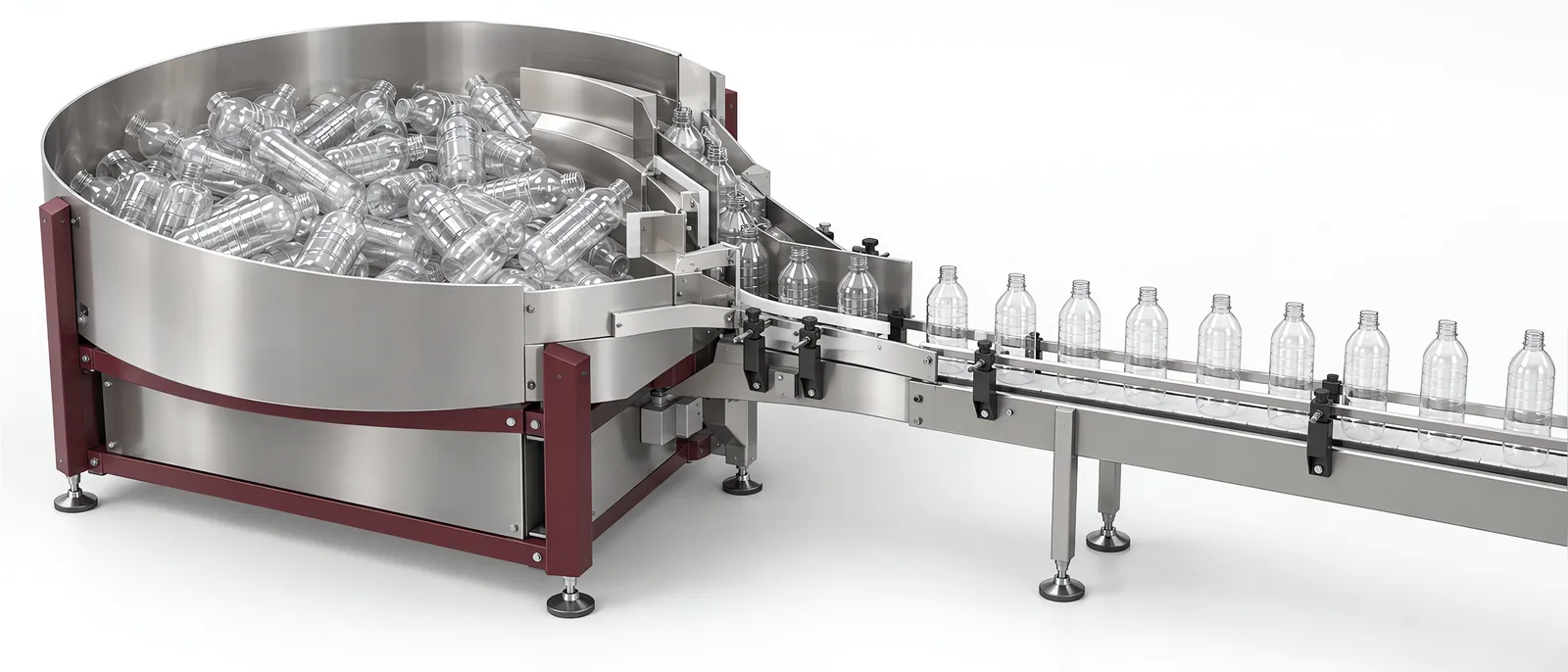
Conceptual equipment illustration.
A bottle unscrambler machine converts a bulk supply of empty bottles into an orderly outfeed. Define what “oriented” means for the next operation: a bottle standing upright may still face the wrong direction for a handle, shaped label panel or filling arrangement.
For filling-machine integration, the useful output is a consistently presented bottle at the receiving station.
Establish the Required Outfeed
Pace’s Omni-Line description explains one disc-and-tooling route that transfers bulk bottles into upright discharge. That particular mechanism does not establish the handling method of every unscrambler.
Specify bottle material, geometry and the empty-container condition. Include the permitted dimensional variation, static/friction behaviour and deformation relevant to that family.
The part-feeding and presentation scope provides the broader feeding distinction. Bottle handling must preserve a stable container through the transfer into filling.
Separate Upright and Feature Orientation
An upright cylindrical bottle may be ready for the next conveyor. An asymmetric bottle can need an additional orientation step. Define the feature used to establish direction and where the downstream machine confirms it.
Do not accept the same “orientation complete” signal for two different tasks without checking its meaning. An unscrambler can supply the standing bottle while a separate orientor establishes its rotational position.
For labelling and coding, the available label panel and the presentation at the labeller matter. Trial the actual bottle at the receiving labeller and retain its presentation there.
Trial Continuous Supply and Accumulation
Run with representative bulk levels and the full intended bottle family. Measure the supply of correctly presented bottles at the defined outfeed. Keep jams, recirculation and operator interventions visible in the result.
Test a downstream stop and restart. Accumulated lightweight bottles can behave differently from isolated samples; the transfer should remain controlled when the receiving conveyor is full.
A high nominal sorting rate does not establish the filling line’s sustained supply if the outfeed repeatedly starves or the downstream equipment cannot accept bottles.
Change the Bottle, Then Reverify the Route
List guides and handling parts that change with the format. Coordinate them with the filling-line changeover, including recipes and orientation checks. Test an incorrect format setting so that a stored name cannot hide a mismatched mechanical setup.
Include missing, tipped and unacceptable bottles in the receiving-station trial. The filler should act on confirmed presentation, not merely the unscrambler’s running status.
Contact Motionwell about the bottle flow to discuss bulk supply, outfeed orientation and the handover into filling or labelling.