
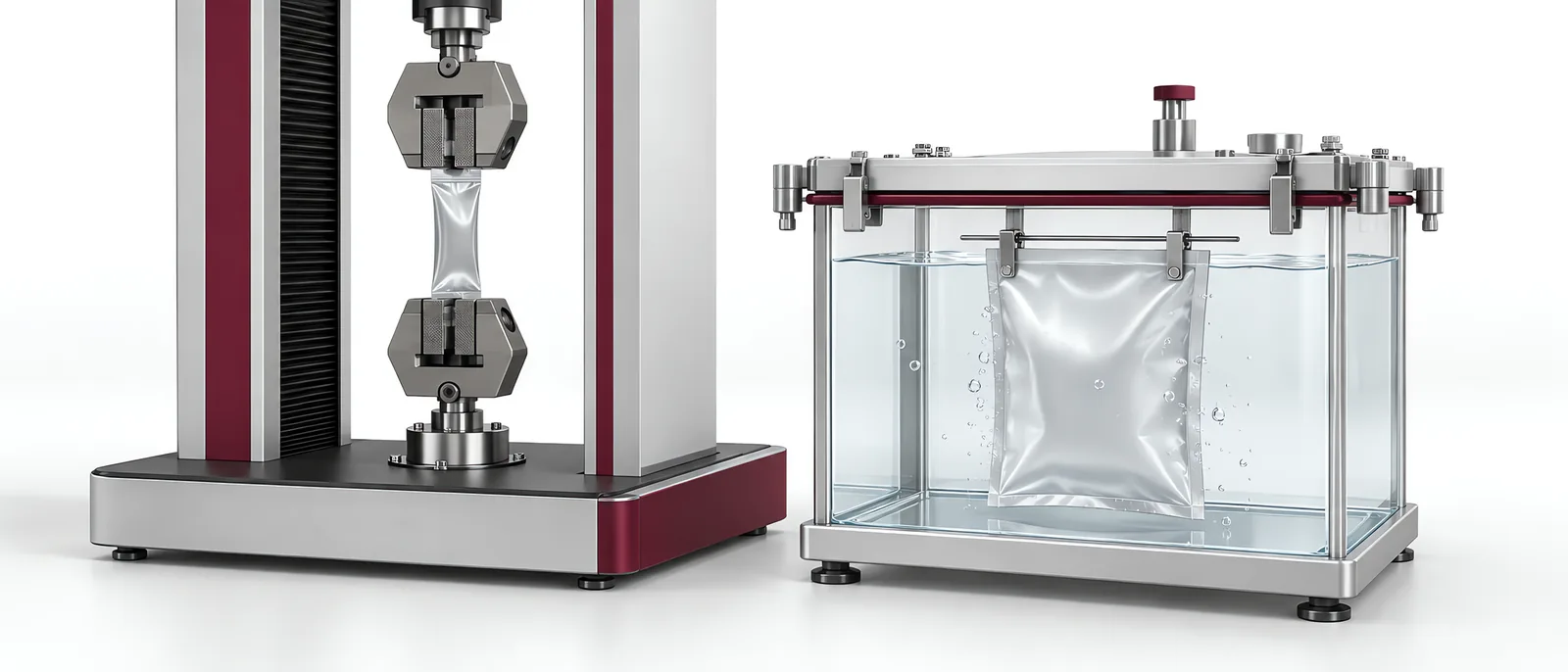
Conceptual equipment illustration.
Pouch seal integrity testing needs to distinguish a weak seal from a leakage path. A peel-strength result describes separation force under its defined test conditions; it does not prove the complete package is leak-free. Choose the method from the failure that the package requirement needs to detect.
Within automated test equipment, keep sample preparation and interpretation attached to the test result.
Map the Question to the Method
ASTM’s packaging standards overview identifies separate methods for flexible-seal strength, visual seal inspection and leakage. Their scopes matter: a method for one material or package condition is not automatically interchangeable with another.
| Question | Evidence needed |
|---|---|
| How much force separates the seal? | A seal-strength method with specified specimen and loading arrangement |
| Is there a visible incomplete seal or channel? | An appropriate visual inspection and defined defect criteria |
| Does the closed package leak under the test conditions? | A method suited to the package and required leakage sensitivity |
| Where is a detected failure? | The method’s localization capability, if required |
Avoid a single generic “seal passed” field. Record which question was answered and how.
Prepare the Sample for That Question
A strip cut for a peel test represents a defined part of the seal. Its width, orientation and gripping arrangement affect the reported force. A whole-pouch leakage test uses a different specimen and may require a different conditioning or preparation route.
If pressure or vacuum is applied, verify that the method and fixture suit the pouch’s flexibility and volume. Package movement or the test connection can create an apparent failure unrelated to the original seal.
The leak-testing systems scope covers instrument and fixture selection. Flexible packaging should be evaluated with its actual behaviour, not a test configuration copied from a rigid metal component.
Qualify the Detection with Known Conditions
Include acceptable packages and suitable method-specific challenge samples. Establish what the selected method detects and how invalid tests are handled. A visible bubble or no observed bubble only has meaning within that verified setup.
Helium leak testing is another method family with its own tracer, preparation and sensitivity requirements. It is not automatically the right choice because it can support sensitive testing in other applications.
Connect Results Back to the Sealing Process
Keep film, product, sealing recipe and sample location with the result. If a failure clusters after a line pause, compare it with the actual sealing-system sequence, including contaminated seal areas and interrupted closures.
For destructive testing, identify how samples are selected and associated with production. A sampled result should not be silently labelled as an individual test of every pack.
Discuss the pouch-testing objective with Motionwell to align the failure mechanism, instrument and result record.