
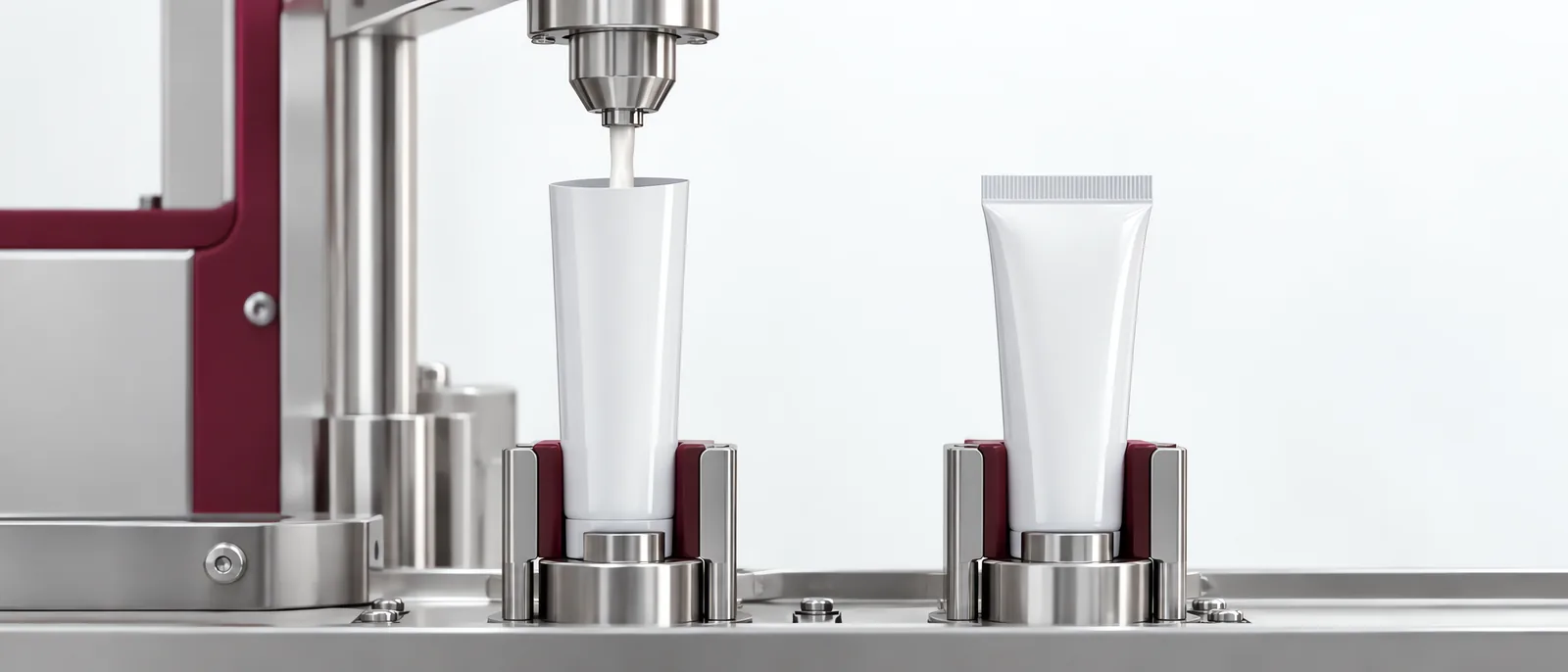
Conceptual equipment illustration.
A tube filling machine fills packaging tubes through their open tails and closes those tails using the process appropriate to the tube construction. Select the tube material and required finish before choosing the sealing unit. A plastic, laminate and aluminium tube should not be treated as the same closure task.
This guide concerns packaging tubes within a filling-machine line, not filling rigid laboratory test tubes.
Match the Sequence to the Tube
Norden’s Tube Filling 101 describes tube holders, orientation, filling and sealing stations. Orientation aligns the print with the required finished presentation; dose and closure are subsequent separate operations.
Specify the incoming tube, diameter/length range and position mark used by the selected equipment. Confirm the cap and shoulder condition that the incoming tube already supplies. The filler should not be assumed to manufacture or assemble that tube.
For the product, establish viscosity behaviour, dosing requirement and how the nozzle avoids contaminating the tail area. Compare the metering choices in the liquid-filling guide.
Seal According to the Material
A selected plastic/laminate process can use hot-air preparation and closing jaws. Aluminium tubes can use a mechanical folding/crimping route. Match the closing equipment to the specified tube construction and verify the resulting tail seal.
The capping and sealing scope helps separate closure processes across container types. Here, define tail appearance, final dimensions and the required integrity/function checks.
Inspect the dose and the closed tube separately. A correct quantity does not establish an acceptable tail, and a neat tail does not establish a correct quantity.
Include Format Changes in the Trial
A different tube can require holder, nozzle, orientation or closing adjustments. List those physical changes alongside the recipe. The filling-line changeover guide explains why a software selection alone is not the complete changeover.
Trial the smallest and largest supported formats with the intended product. Record the orientation result after discharge so that the print and finished tail relationship can be checked on the actual pack.
Establish the Interrupted-Cycle Route
Test missing tubes, unavailable product and interrupted sealing. The machine should distinguish an empty holder, a filled open tube and a completed pack. Define which stage requires removal or additional verification after a stop.
Keep the product, tube identity and recipe with the acceptance record. A sample produced under an undocumented setup cannot serve as a repeatable reference for production.
Contact Motionwell about the tube-packaging task to discuss the dosing, handling and checks around the equipment.