
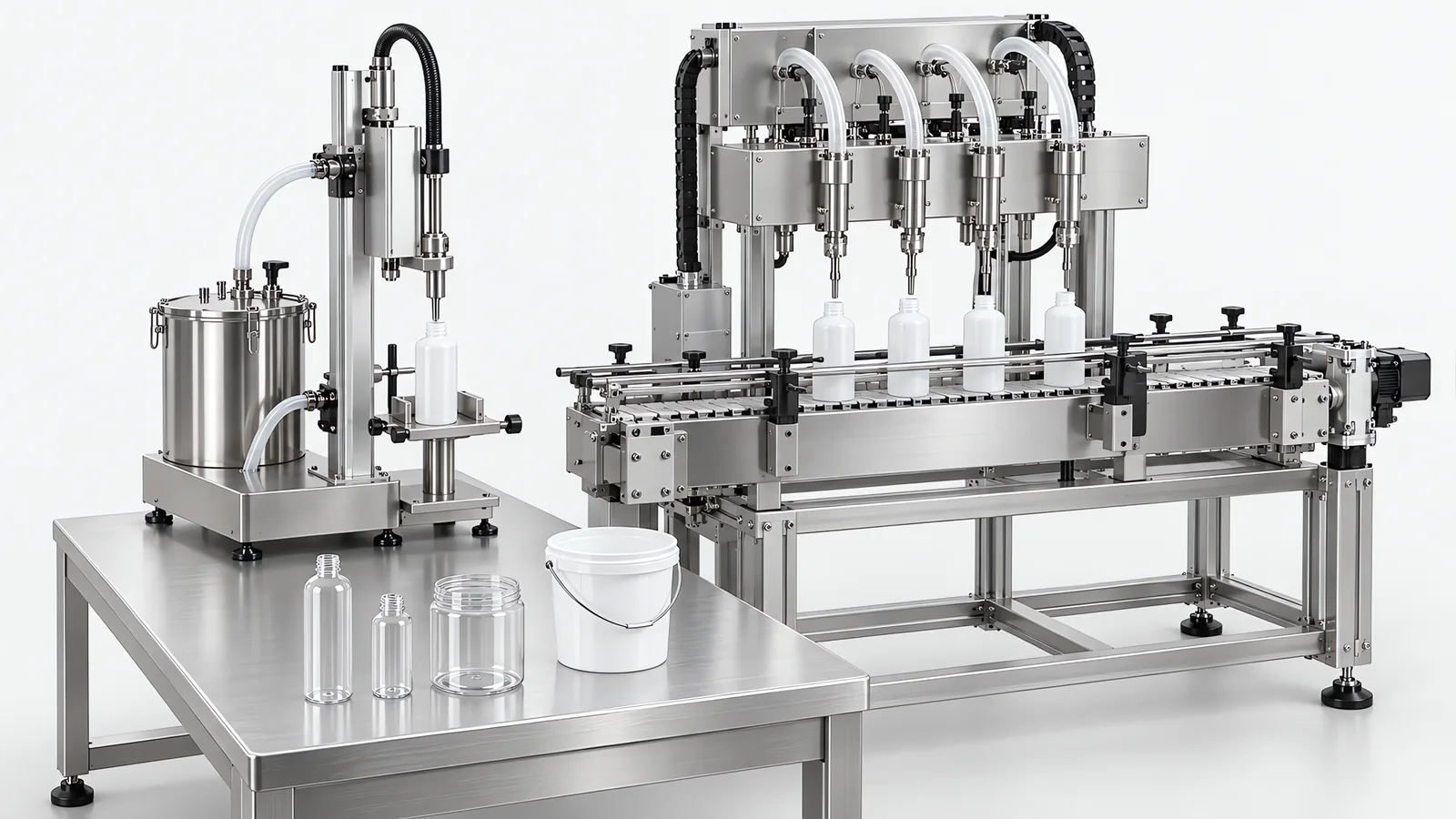
Choose a liquid filling machine from the product’s flow behaviour, the required dose and accuracy, the container format and sustained production rate. Then decide how much loading, inspection and closure handling to automate. The selection works best with production samples and a defined acceptance test for each format.
Motionwell builds liquid filling and sealing equipment in Singapore. This guide explains how product trials, container handling and cleaning requirements shape a new machine, from dosing method to production acceptance.
The following sections explain the product trials, handling choices and quotation details that turn an initial filling requirement into an equipment specification.
Where Should Liquid Filling Machine Selection Start?
Start with the product, container and intended formats. Review those alongside output, operator tasks, cleaning and the operating environment. Together they define the dosing and handling options worth testing.
The part that gets this wrong is rarely laziness. It is that buyers send typical values. A supplier reading a typical viscosity and a typical density sizes the flow path and the dose for that case, and then one of two things happens. Either the machine meets the number and fails on the batch that sat at the awkward end of your own specification, or an experienced supplier recognises the gap and prices the unknown into the quote. Both outcomes cost you money that a range would have saved.
| Product property | How to state it in the enquiry | What a typical value costs you |
|---|---|---|
| Viscosity | Measured at the temperature it will be filled at, as a batch range, with the measurement method named | The machine gets sized for the middle of your range, and the thick end arrives later as a change request |
| Density | Nominal plus the spread you actually see batch to batch and grade to grade | The metering argument gets settled on an average that no real batch is |
| Foaming | Whether air is entrained while it is moved, and how long a head takes to fall | Settling never enters the quoted cycle, so the rate is right on paper and short on the line |
| Stringing and drip | Whether it tails at cut off, and onto what | Nobody prices the wipe or the contaminated closure, and both get counted first on your line |
| Particulates | Largest dimension present, whether fibres are in there, and whether every batch carries them | The shortlist you are given was drawn on viscosity alone, and the heads that pass solids were never on it |
| Chemistry | Solvent content, pH, chlorides, the cleaning agent as well as the product | Each bidder answers from a different house standard, and the quotations stop being comparable |
| Fill temperature | The window it must be in at the nozzle, and whether it degrades while held | Heating stays on your side of the boundary and appears as a site cost after delivery |
| Batch and campaign pattern | Batch size, and how often you change product | Cleaning falls outside the rate calculation, so the output quoted is a machine number, never a shift number |
Representative samples help verify the properties listed above. Include the demanding ends of the approved product range, such as the highest viscosity or strongest foaming behaviour, when planning trials. A multi-product line may need several samples to cover different dosing and cleaning challenges. Our filling machines page explains the equipment choices those trials inform.
Which Product Behaviours Decide the Metering Method, and Which Only Decide the Speed?
Two decisions routinely get collapsed into one, and separating them is the first useful thing you can do.
The declared quantity and density variation help determine whether the dose should be controlled by volume or mass. Product behaviour then guides the pump, valve and nozzle selection, with trials confirming performance. The measurement-basis comparison is on our page covering volumetric and gravimetric filling.
Foam, stringing and particulates affect both the dosing method and the achievable cycle. Match the pump or metering device, valve passages and nozzle to the product, then test flow, cut-off, settling and cleaning. Our filling machines page explains the flow-path and nozzle choices behind those behaviours.
Compare rates at the same fill volume, closure, product and operating conditions. Ask whether the figure comes from a product trial, a comparable application or a calculated cycle, then confirm it on representative material during acceptance.
Parallel heads can add capacity when dosing is the limiting step, provided container handling and closure operations keep pace. More heads also add setup and verification work. Report accuracy by head as well as for the machine overall; the volumetric and gravimetric page covers that acceptance check.
Where Is the Real Line Between a Semi-automatic and an Automatic Liquid Filling Machine?
The difference is how container handling and the filling sequence are shared between the operator and the equipment.
A semi-automatic liquid filling machine typically leaves loading and cycle initiation to the operator while controlling the dose itself. Container location, presence checks and completion interlocks help make that cycle repeatable. Automatic equipment coordinates those steps with feeding and discharge. In both cases, assess the complete process, including operator actions, fill verification and reject handling.
| Operator action | On a semi-automatic station | On an automatic machine | Which number it moves |
|---|---|---|---|
| Presenting the container | By hand, each one | Tray, puck or conveyor locates it | Dose accuracy through seating, and throughput |
| Starting the dose | Foot pedal or button starts a controlled dosing cycle | Triggered by the validated handling sequence and presence checks | Cycle timing and prevention of an incomplete or misplaced fill |
| Judging the fill | Manual or instrumented check, as specified | Inline measurement or sampling, as specified | Detection performance and the record of accepted and rejected fills |
| Applying the closure | By hand, or a separate bench unit | Station on the same machine, with torque or temperature held | Seal quality consistency |
| Removing and collating | By hand | Outfeed | Throughput only |
| Handling a reject | Operator decides and sets it aside | Diverted and counted | Traceability of what left the room |
Use the table to assign operator tasks and quality checks, then compare the sustained rate and labour required for each option. Include changeovers and replenishment in the trial so the quoted output represents the way the station will be used.
Automatic filling can still include manual tray loading or magazine replenishment. A tray-fed arrangement may transfer containers from dosing to sealing without individual handling between those steps, while the operator prepares the next batch. List the operator’s tasks station by station to compare labour and sustained output across proposals.
On upgrading later. Review the upgrade route before choosing the semi-automatic station. The dosing head may be reusable, while automatic loading can require different locating features, guarding, controls and frame access. A modular station designed for those interfaces offers a different upgrade path from a standalone bench unit. Trials on the initial station can supply useful product and dosing data for either route.
Which Container Properties Have to Be Measured Before the Frame Is Drawn?
The container is a mechanical part in a machine, and a photograph describes none of the properties that matter.
| Container property | Why it is measured | What changes if it is wrong |
|---|---|---|
| Base diameter against filled height | Decides whether it stands up while being moved at all | A tall narrow container tips, and the handling concept changes late |
| Wall rigidity | Sets gripper force, and whether a squeeze changes the level | A thin wall deforms in the gripper and the level check reads a fault that is not there |
| Neck and closure form, with tolerances | Sets sealing tooling and closure presentation | Closures that present at the bench and jam in a feeder |
| Dimensional spread within a lot | Sets the locating pocket and the nozzle entry clearance | Nozzle strikes the neck on the containers at one end of the tolerance |
| Optical property, clear to opaque | Decides how presence and level are detected | A sensing arrangement proven on white and blind on clear glass |
| Behaviour under seal heat or press | Decides tooling and dwell | Distortion at the sealing station discovered at acceptance |
The optical row is the one that surprises people. A detection method proven on white plastic can be blind on clear glass, and the arrangement that recovers it, reading through the container or across it, changes what has to be mounted at the station and how precisely the container has to be located for it. Put your actual container in front of the supplier, at both ends of its tolerance and in every colour you run, and ask two things. Which detection method is assumed for it, and what the machine does when the reading is ambiguous or clearly absent. The second question is the one that separates a specification from a demonstration.
Container measurements guide the tooling, sensing and handling design. For a custom tray or nest, agree when drawings and representative samples will be available for design release and trials. Link those dates to the fabrication and assembly schedule. The broader sourcing review is in how to choose a special purpose machine builder.
Does Your Product Need to Be Filled Warm, and Who Owns That Loop?
For some products, controlled warming reduces viscosity and improves dosing. Check product stability, permissible temperature and the heating and cleaning requirements before choosing that approach. Include the product-temperature loop explicitly in the equipment scope.
Distinguish product-temperature control from sealing-tool temperature control. A heated sealing tool controls the closure process; it does not establish the temperature of the liquid arriving at the nozzle. Name the required control loops and measurement points separately in the specification.
If the product has to arrive at the nozzle inside a window, four things enter the scope. A heated or jacketed vessel. A heated path from vessel to nozzle, since a short unheated run loses the benefit on the first dose after a pause. A measurement at the nozzle, because the tank reading is the one that looks good. And an interlock decision: does an out of window temperature stop the shot, or raise a warning the operator acknowledges. Ask which of the four is in the quotation.
Two consequences follow for the product path itself. Heat changes what bakes onto a surface, so cleaning effort goes up. And the elastomer list narrows, since seals and diaphragms carry temperature ratings that are easy to miss while matching chemistry. That is a contact parts conversation, and the questions to ask about each wetted part are set out in our page on special purpose machines for pharmaceutical production.
How Many Container Formats Should You Declare in the Enquiry?
All of them, sorted into two groups, and no more than that.
Committed formats are the ones you fill now or have an order for. Each one buys a change part set, and each one adds to validation if your quality system says so. Speculative formats are the ones under discussion in a marketing meeting. Those do not buy change parts. What they buy is envelope in the frame: stroke length, station pitch, adjustment range, a nozzle height that can travel further than today’s container needs. Whether that envelope can be widened once the frame exists is a concept-stage geometry question, and it is argued in full, with the change part and recipe side included, on our page on filling line changeover design. For the enquiry it reduces to one line: declare the speculative format and ask for it priced twice, once as envelope now and once as a format added after design freeze. A bidder who will not separate those two numbers has quoted you only the first.
Then group them by what a machine cares about, because a product family grouping is not what shapes the tooling. Containers sharing a base diameter and a height band often share a tray and need only a different nest. A container with a different closure type pulls in different sealing tooling regardless of how similar the body looks. Ask each bidder to itemise the change parts per format, because that list is checkable and a changeover time is only a claim.
Keep committed formats separate from future possibilities. Specify the change parts and qualification work for the formats being purchased, and record any reserved mechanical envelope for later additions.
Which Numbers on a Filling Machine Quotation Are Conditional, and on What?
Almost all of them are conditional. The skill is knowing which condition each one hides, and asking for it in writing before the order.
| Number quoted | The condition it hides | Ask for this instead |
|---|---|---|
| Units per minute | Fill volume, closure dwell, and which fluid it was measured on | The rate at your volume, your closure, your product |
| Fill accuracy | Metering principle, and whether it is per head or pooled | Head by head distribution at acceptance |
| Range per head | It belongs to the head fitted | What happens outside the range, and whether that is a part or a setting |
| Changeover time | Which items are recipe and which are tooling, and whether cleaning is counted | The itemised change part list per format |
| Accuracy over time | The wear part interval behind it | Whether the figure is as commissioned or held across a stated service interval |
| Uptime | What was counted as downtime, and over how long a window | The definition in writing, including whether cleaning, changeover and starved time sit inside it |
| Lead time | Design release, fabrication, procurement and testing dependencies | The current critical path and recovery options |
Valve diaphragms, seals and other metering components can affect dosing as they wear. Record the parts requiring inspection or replacement, the recommended service interval and the checks used to confirm fill performance. This connects the acceptance result to the maintenance plan for the same product and duty.
A filler combines dosing, pneumatics, sensing, temperature control and tooling. Review the critical component deliveries alongside drawing release, product trials and assembly. Identify the owner of required material and supplier records so documentation is ready for the planned acceptance tests.
What Does a Filling Machine Quotation Have to Say About Cleaning Access and Safety?
A filler is opened more than most machines, for product change, wipe down and nozzle strip down, and that changes what the safety scope has to cover.
Risk assessment comes first. The hazards present while a guard is open are not the production hazards: sealing tooling still hot after a stop, stored energy in pneumatic slides and grippers, product under pressure in the line. A risk assessment done to ISO 12100 covers the whole life of the machine including setting and cleaning, so ask whether the cleaning and changeover modes were assessed, and who did it. The method we follow is described in our note on machine safety risk assessment.
The electrical build comes second. Sanitation drives the enclosure rating before anything else does, and it has to be set from the procedure your room actually runs. A rating carried over from the last machine a supplier built tells you nothing, because a wipe with disinfectant, a hose and a steam clean are three different requirements. Ask which of them the quoted rating was chosen against, then ask the same question separately of every item an operator sprays: the pendant, the stack light, the interlock switch on the guard door, the cable entries. The general requirements for the electrical equipment of machines, including isolation and what has to happen on restoration of supply, sit in IEC 60204-1. The question to put to a supplier is narrow and revealing: where is the isolator, and what does it not isolate. Air supply and stored pneumatic energy are the usual answer, and they are what hurts somebody during a nozzle change.
Third comes the wetted parts list. Ask for it as a list, with the tool needed for each part and whether it can be removed without breaking a calibration. A machine an operator can strip with hand tools and a machine that needs a technician look the same on a drawing.
How Do You Prove a Filling Machine on Your Own Product Before You Accept It?
Use representative product, containers and closures from production stock. If a trial uses a substitute fluid, establish which behaviours it represents and which still need confirmation on the production product.
Agree the test in writing before the machine is finished, and cover six things. Name the product and the batch, then the container and the closure, both drawn from production stock. Say how many containers will be run and how the dose on each is measured, and require the dose to be reported head by head. Foam and stringing have to be judged once the machine has been running a while, since both behave differently after the nozzle and the product path are wet. The reject path has to be exercised deliberately, by feeding a unit that should fail, and never by waiting to see whether one turns up.
Include the intended operator tasks and a representative changeover in the trial. Our filling line changeover design page covers tooling and recipe changes, while the factory acceptance test checklist helps separate factory tests from checks requiring the production site.
For larger containers, see the handling and dosing options on our drum and pail filling page. The filling and sealing machine case study provides related equipment context.