
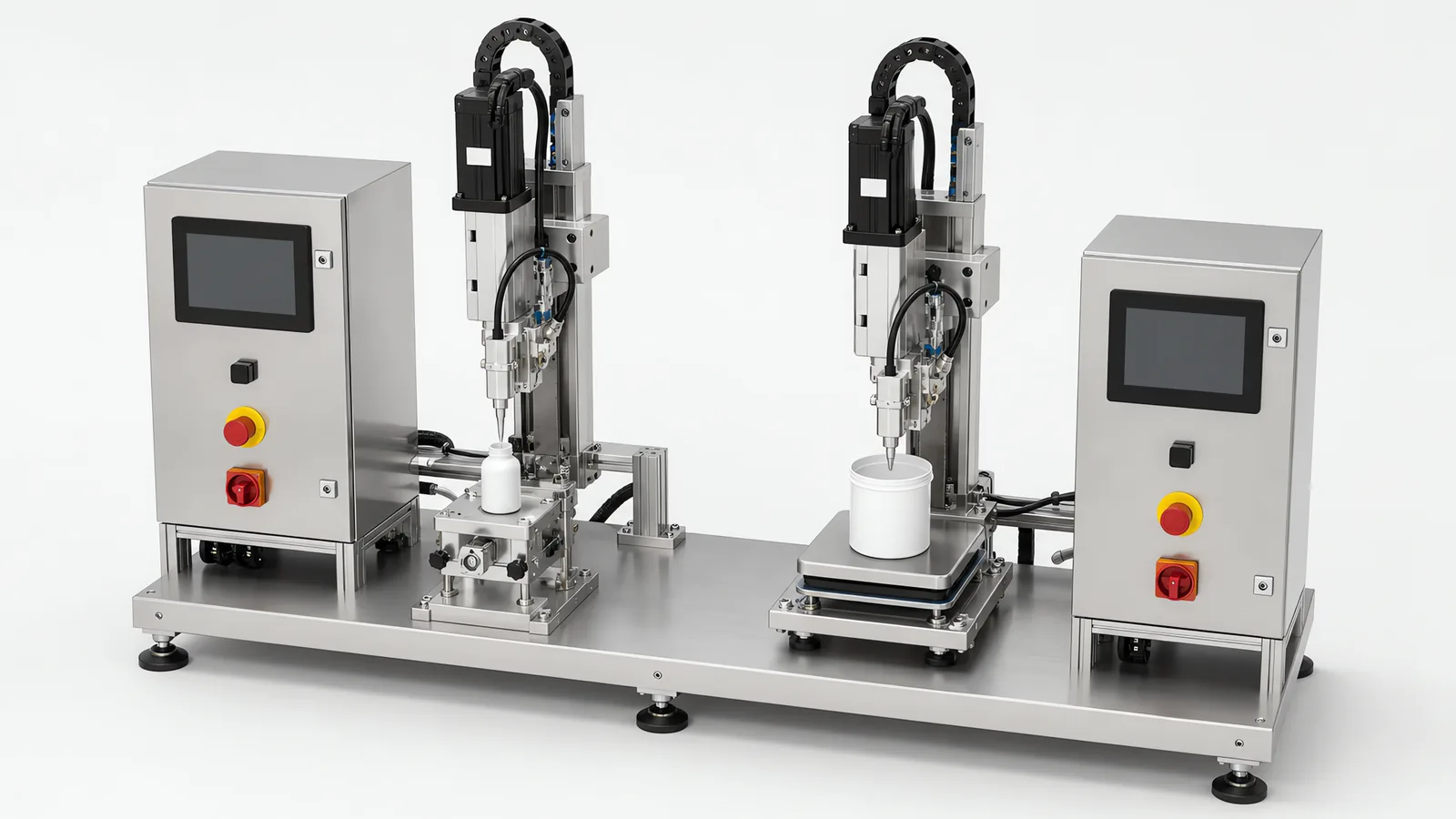
Motionwell Automation builds custom filling machines in Singapore and specifies either dosing method to suit the product, and the short answer is this: dose by volume when the container is the unit of sale and your product density is stable, and dose by weight when the declared quantity is a mass or the density moves with temperature, batch or grade. The filling and sealing machine we have delivered meters volumetrically: three diaphragm dispense valves in parallel on a tray-fed platform, each dose a valve open time against a regulated supply. Fill range, tolerance band and rate are specified per project against your product, container and closure, and no volume tolerance transfers to your product until someone has measured how far your density actually moves.
That is the conclusion. The rest of this page is the reasoning, because the volumetric vs gravimetric filling choice gets made badly more often than it gets made wrong: buyers compare two accuracy percentages that are not measuring the same thing, then discover in production that the number they care about is the other one. The equipment context sits on our custom filling machine capability page, and the container sizes where net weight becomes the default are covered under drum, pail and IBC filling systems.
What Is the Real Difference Between Volumetric and Gravimetric Filling?
A volumetric filler measures space. A piston draws a defined volume into a chamber and pushes it out, or a pump turns a counted number of revolutions, or a valve stays open for a metered number of counts. The machine never learns how much product left the nozzle. It knows how much space it displaced, and it trusts that the space was full of product at the expected density.
A gravimetric filler measures the product itself. The container sits on a load cell platform, the controller zeroes the tare, product flows in, and the valve closes when measured mass reaches target. The machine has no opinion about density, viscosity, entrained air or temperature, because it is watching the one quantity that all of those affect.
Everything else follows from that one difference.
| Dimension | Volumetric (piston, pump, flow-time) | Gravimetric (net weight, weigh cell) |
|---|---|---|
| What is controlled | Delivered volume | Delivered mass |
| What is allowed to drift | Mass, with density | Volume, with density |
| Density change response | Fill mass shifts by the same percentage | No effect on the result |
| Entrained air or foam | Meters the air as product | Air weighs almost nothing, so it is ignored |
| Cycle time | Fast, a fixed mechanical stroke | Slower, needs settle and dribble stages |
| Multi-product on one line | Recalibrate per product | Same station, change the recipe |
| Product path | Pump chamber, check valves, seals | Valve and hose, no pump chamber needed |
| Container tolerance | Irrelevant, product is metered before it lands | Irrelevant, tare is zeroed per container |
| Weak point | Density assumption, air entrainment, wear on seals | Vibration, pipe pull, resolution over range |
| Typical scale | 1 mL to 5 L | Pails, drums, IBCs, anything sold by weight |
Two things in that table get missed in quotations. First, a piston filler is usually more repeatable than a weigh filler at small doses, and less true, because repeatability is a mechanical property and trueness depends on a calibration that ages. Second, the tare column is why gravimetric filling copes with container weight variation that would defeat a gross-weight check: a glass bottle whose weight varies bottle to bottle is a problem for a checkweigher reading total weight, and no problem at all for a net weight filler that zeroes each container before it fills.
Why Is a Volumetric Accuracy Figure Not the Same Number as a Weight Accuracy Figure?
This is a specification error that costs money at both ends.
An accuracy figure is only meaningful with the quantity attached. The tolerance we quote on our filling and sealing machine is a tolerance on target volume. That is a statement about millilitres. If the label declares grams, converting that specification into a weight tolerance means adding the uncertainty of the density: how well you know it, and how far it moves across your filling temperature range and between raw material batches. Mass equals volume times density, so a one percent density shift is a one percent mass shift at constant volume, arithmetic that no amount of valve tuning changes.
The reverse trap is just as real. A weigh filler quoted at a tight weight tolerance says nothing about fill level, and fill level is what a customer sees through the bottle wall. Two containers at identical net weight can show visibly different levels if density or trapped air varies, and the complaint arrives as an underfill complaint regardless of what the scale recorded.
| What you must guarantee | Meter this | Verify this | The number that will embarrass you |
|---|---|---|---|
| Declared volume on the label | Volume | Fill level, and mass for records | Weight variation across a batch |
| Declared net weight on the label | Mass | Weight, every container | Visible fill level variation |
| Dose uniformity for a regulator | Volume, calibrated per nozzle | Both, logged per container | Between-head spread |
| Cosmetic fill level in clear glass | Volume | Level by vision | Net weight drifting off target |
The third row deserves a note, because it is where per-head calibration earns its cost. On a multi-head machine the mean fill across the batch can sit perfectly on target while individual heads sit either side of it. That is why, on a multi-head machine, including our own three-head filling and sealing machine, the acceptance test should look at head-by-head distribution, with each head set up and checked on its own. The delivered build is described in our filling and sealing machine case study.
What Happens to Each Method When the Product Density Moves?
Density moves for three ordinary reasons, and all three are common enough that they should be checked before the dosing method is chosen.
Temperature. Product warmed for pumping, product filled straight from a jacketed vessel, or product that sits in a hot day-tank in a Singapore factory with air conditioning only in the cleanroom. A volumetric filler delivers the same millilitres and progressively less mass as the product warms. The fix on a volumetric machine is either temperature control on the product loop or a temperature-compensated dose table, both of which are real engineering.
Batch and grade. Solvent blends, syrups, oils and coatings arrive within a specification band. If your incoming specification allows a density range, a volumetric filler will deliver a mass range across that band whether you planned for it or not.
Entrained air. This is the case where gravimetric wins outright. A product that foams, or one aerated by a pump or a splash-filling nozzle, occupies more volume than the product alone. A piston filler meters the bubbles as if they were product and under-delivers mass on every stroke. A weigh filler simply does not see them, because air has negligible mass. If your product foams, do not solve it in the dosing method alone; fill from the bottom up so the outlet stays under the surface, which is the same technique described on the bulk container filling page.
Where a volumetric machine must run several products with different densities, the practical answer is a per-product recipe holding its own dose calibration, plus a verification step that catches the case where someone runs the wrong recipe. It is still worth designing the wrong-recipe interlock.
A fixed powder volume can have different mass as bulk density changes. powder volume and mass gives an illustrative calculation and the corresponding filling tests.
Which Method Fills Faster?
Volumetric, at small container sizes, by a wide margin. A piston stroke is a fixed mechanical motion that can be run at whatever speed the product viscosity and nozzle allow, and heads can be multiplied on a rotary carousel. Even a three-head machine like our tray-fed filling and sealing machine takes its rate from the dosing method, because each dose is a timed valve cycle with no settling stage, and multiplying heads on a carousel takes the rate past anything a single weigh station approaches.
Gravimetric costs time in three specific places. The weigh deck needs a settling period before the reading can be trusted. The fill must be split into a fast bulk stage and a slow dribble stage, because a valve closing against full flow throws too much product in flight to be predictable. And the controller has to learn the in-flight quantity, the product still travelling between the closed valve and the surface, then subtract it from the cut point.
That is why bulk filling stations dose in stages and why their rated throughput is quoted in containers per hour. Speed can be bought back with parallel weigh stations, each with its own platform and valve, which is a cost decision. A useful way to frame it: volumetric buys speed with an assumption, gravimetric buys certainty with time.
Which Is Harder to Clean and Change Over?
Cleaning effort follows the wetted-path design. A piston system includes a chamber, piston, seals and check valves; a weight-controlled system may use a relatively simple valve and hose, depending on how product is supplied. Our tray-fed filler uses diaphragm dispensing valves with removable wetted components. Material grade, contact finish, drainability and access are selected against the product and cleaning procedure for either dosing method.
Changeover splits differently, in a way people rarely expect.
- Changing volume on a volumetric machine can mean change parts. A piston sized for a 5 mL dose is not the part that fills 500 mL well, because resolution and stroke length both matter, so a wide fill range often means a second pump size in the spares cabinet.
- Changing volume on a gravimetric machine is a recipe entry. Nothing mechanical moves, which is the main reason multi-product bulk lines default to net weight.
- Changing product on a volumetric machine means recalibrating against the new density, or trusting a stored recipe that somebody validated once.
- Changing product on a gravimetric machine keeps the target in mass units. Flow rate, fast-to-slow transition, valve cut-off and settling time are checked for the new product, along with the cleaning procedure.
- Changing container affects both equally, and on our filling and sealing machine is handled by swapping the machined tray set.
The wet argument against gravimetric is the weighing platform in a washdown zone. Load cells and their cabling have to be sealed to the environment, and the mechanical decoupling that protects the reading is one more thing to keep clean around. That is a design problem with known answers, and it belongs on the specification before the frame is drawn.
Does the Law Care Which Method You Use?
Sometimes it removes the choice completely.
If the declared quantity is a net weight and that weight is the basis of sale, then mass is what you are legally accountable for, and reaching it through a density assumption puts the assumption inside your compliance case. In Singapore the weighing instrument used for that purpose may fall under the weights and measures regime, with pattern approval and verification attached, which restricts which instrument you may install and how it must be checked in service. This has to be settled before the scale is specified, because retrofitting an approved instrument into a machine designed around an unapproved one is expensive.
Some destination markets also regulate pre-packaged quantities on an average and minimum basis instead of as a single limit per container, and the rules differ market to market, so this is a question for your regulatory contact and not for a machine builder. It matters commercially: the tighter your fill distribution, the closer you can set the target to nominal without breaching a minimum, and the less product you give away on every container.
On the pharmaceutical side the question changes shape. There the regulator’s question is whether you can demonstrate, with data, that the delivered dose stays inside the registered limits. Where a filling machine goes into a validated process we supply IQ/OQ/PQ documentation, factory acceptance testing in Singapore before shipment, site acceptance testing at your cleanroom, and validation protocols following ISPE Baseline Guide Vol. 5, with batch records supporting 21 CFR Part 11.
Trade approval for a weighing instrument is granted by your regulator, and the machine is built around the approval route the two of you confirm, with instruments specified to carry the certification that route requires. Where the control system itself falls into validation scope, that work is scoped separately as computer system validation.
Is a Coriolis or Magnetic Flow Meter Volumetric or Gravimetric?
It depends entirely on the meter, and separating them matters because meter-based filling is often presented as a third option when it is really two different options wearing one name.
| Meter | What it actually measures | Behaves like | Where it fails |
|---|---|---|---|
| Coriolis | Mass flow, directly | Gravimetric, without a scale | Instrument cost, needs a full pipe with no gas slugs |
| Magnetic | Volume flow | Volumetric | Needs a conductive liquid, so solvents and oils are out |
| Positive displacement | Volume per revolution | Volumetric | Wear changes the calibration slowly and invisibly |
| Piston pump | Volume per stroke | Volumetric | Density drift shows up as weight error |
| Weigh cell | Mass in the container | Gravimetric | Vibration, pipe pull, resolution over full scale |
A Coriolis meter is the useful special case: it gives you a true mass dose without a stable weighing platform, which is why it turns up on IBC filling and on solvent lines where a decoupled weigh deck is impractical. It is the expensive answer, and it earns its cost specifically when you need mass but cannot weigh.
One sizing point that costs projects money. A weighing instrument resolves a fraction of its full scale, so a platform sized to carry a full drum resolves coarsely against a small dose. If one station must fill both a 20 litre pail and a 200 litre drum, check the resolution at the small end before assuming one platform covers both. The same discipline applies to reading a specification sheet: ask for accuracy class and resolution across your actual fill range.
What Does Each Method Cost to Buy and to Own?
Compare capital cost and operating cost using the same fill range, sustained rate, cleaning procedure and acceptance band. Dosing hardware, parallel stations and weighing resolution account for much of the difference.
| Cost driver | Volumetric | Gravimetric |
|---|---|---|
| Base dosing hardware | Pump or dispense valve and its drive, per head | Load cell platform, decoupling, valve, per station |
| Adding throughput | More heads on a rotary, near linear | More parallel weigh stations, each with a platform |
| Wide fill range | Second pump size, more change parts | Recipe change, sometimes a second platform for resolution |
| Multi-product | Calibration per product, plus recipe management | Little to none on the dosing |
| Cleaning and spares | Pump seals, check valves, piston wear | Valve and hose, fewer wear parts in the product path |
| Installation sensitivity | Low | High, vibration and pipe pull decide the result |
| Giveaway | Set by density assumption plus process spread | Set by process spread alone |
Giveaway is the line that decides ownership cost at volume. Whatever your fill distribution looks like, the target has to sit far enough above nominal that the low tail still clears your minimum. Narrow that distribution and you can lower the target, and the saving lands on every container you fill for the life of the machine. On an expensive product it can dominate the capital difference between the two methods. That arithmetic is worth doing with your own numbers before choosing on machine price.
Lead time is the same either way: 16 to 24 weeks from concept approval to factory acceptance for a standard build, and 24 to 32 weeks where cleanroom compatibility or full GMP validation applies. Design, fabrication, assembly and testing happen at our Woodlands Link facility, so a Singapore buyer attends the acceptance test without flying to it.
Which Method Do Motionwell’s Delivered Machines Use, and Why?
Volumetric on the machine we have actually shipped for small containers, and net weight recommended where the containers get large.
Medical and pharmaceutical, volumetric. The filling and sealing machine we delivered for a medical and pharmaceutical customer doses through three heads in parallel on diaphragm dispense valves. That is flow-time metering: each valve is held open for a set count against a regulated supply, so it behaves as a volumetric filler and carries the same density caveat as a piston. Fill range, tolerance band and rate on that platform follow the container and the product, which is why a sample and a container drawing come before any of the three appears in a quotation. Containers arrive from a tray magazine and pneumatic slides and grippers place them at the stations, which was chosen over servo handling because every move is a fixed stroke between two hard stops: the repeatability comes from the mechanics, and there are fewer drives to qualify and to keep serviced inside a cleanroom. Container presence is confirmed by fibre-optic sensing, because a timer cannot separate a missing container from a slow one, and a valve opening over an empty nest puts product on the tray. A camera then checks the fill level after the dose, which catches what the dosing control cannot see for itself: a partly blocked nozzle that delivered less than the open time implies. Volumetric fits that work for three reasons: the doses are small, the containers arrive at a fixed pitch in trays, so a timed valve cycle at each of three positions is faster than three weigh decks would be, and a diaphragm valve is a defined, cleanable product path that is simpler to qualify than a weigh deck built into the container handling. Sealing is a separate station on the same machine, and we have also delivered a standalone vial capping and uncapping unit. The cleanroom side of that work is covered on the pharmaceutical packaging automation page.
Bulk containers, net weight. For drums, pails and IBCs, net weight filling is the default recommendation, for the reasons above plus the trade measurement point. Our delivered filling work is at container scale, and what carries across to a bulk line is the dosing control, the stainless product path, the per-container verification and the safety design, which the bulk filling systems page works through in full.
Can You Run Volumetric Dosing and Gravimetric Checking on the Same Machine?
Yes, and for most production this is the answer. Meter fast by volume, check by weight, and close the loop between them.
The arrangement runs like this. The filler doses volumetrically at rate. A checkweigher immediately downstream measures every container. The measured weight feeds back to the dosing controller, which trims the piston stroke or dose counts to hold the weight mean on target as density drifts through the shift. Containers outside limits are diverted by pneumatic pusher to a quarantine bin, and each rejection is logged with its reason for SPC review.
You get volumetric speed, gravimetric evidence, and automatic correction for the density drift that would otherwise go unnoticed until QC sampled the batch. On our delivered filling and sealing machine the verification is by sight: fibre-optic sensing confirms a container is at the station before a valve opens, and a camera checks the fill level after the dose. That pair catches a missing container and a short fill, and it does not catch a density shift, which is the limit you accept when the check is a level. How those camera systems get specified, lit and calibrated is covered on our machine vision inspection capability page.
The one thing feedback control cannot fix is a wrong assumption held constant. If the density drifts and the checkweigher trims for it, you are protected. If the density is simply not what the recipe says, and the declared quantity is a volume, the weight loop will happily hold you at the wrong volume. Decide which quantity is the one that must be right, then make that the one you measure.
Which Method Should You Specify for Your Product?
Run these seven questions in order. The first one that gives a hard answer usually settles it.
- What does the label declare, weight or volume? If weight, and weight is the basis of sale, start from gravimetric and treat volumetric as something you have to justify.
- How far does your density move, across your filling temperature range and across your incoming material specification? If nobody can tell you, that is the first measurement to take.
- Does the product entrain air or foam? If it does, volumetric dosing is metering bubbles, and the design has to address both the dosing method and the nozzle technique.
- How many products share the line, and how often do they change? Many products with frequent changes push hard towards weight, because the dosing recalibration disappears.
- What rate do you need, sustained? High rate at small container sizes points to volumetric with weight verification behind it.
- How large is the container? Above roughly twenty litres the handling problem dominates and net weight becomes the normal answer.
- What has to be proven, and to whom? A regulator, a customer specification and a trade measurement authority each want a different record, and the record is easier to produce when you measure the quantity you have to defend.
| Your situation | Start from | Why |
|---|---|---|
| Pharmaceutical liquid, registered dose in mL, high rate | Volumetric, piston or valve, weight verified | Dose is a volume, density stable, speed matters |
| Viscous gel or paste sold by net weight in small tubs | Gravimetric, or volumetric with checkweigh feedback | Weight is the declared quantity, viscosity varies |
| Coating or solvent in pails and drums | Gravimetric, net weight | Density varies by grade, and it is sold by weight |
| Single well-characterised product, high speed, clear bottle | Volumetric | Fill level is what the customer sees |
| Five products on one line, moderate rate | Gravimetric | No recalibration between products |
| Foaming detergent | Gravimetric, plus bottom-up filling | Air is metered as product by any volumetric method |
| Expensive active ingredient, tight minimum content | Whichever narrows the distribution, then verify every container | Giveaway compounds over the life of the machine |
| IBC on a forklift-fed stand | Coriolis mass flow | Mass without a stable weighing platform |
Where the answer comes out mixed, that is not a failure of the checklist. It usually means the right configuration is volumetric dosing with gravimetric verification, and the real design question moves to how tightly the two are coupled.
Frequently Asked Questions
Is gravimetric filling more accurate than volumetric filling?
Not automatically. The two methods control different quantities, so the accuracy figures are not comparable until you convert one into the other. A volumetric filler controls delivered volume and lets mass drift with density. A gravimetric filler controls delivered mass and lets volume drift. Our tray-fed filling and sealing machine controls delivered volume, so the tolerance on it is a tolerance in millilitres, and it only becomes a weight figure once you know how far your product density moves between batches and across your filling temperature range.
Which method should I use if my product is sold by net weight?
Fill gravimetrically, or verify gravimetrically on every container. When the declared net weight is the basis of sale, the quantity you are legally responsible for is mass, and a volumetric filler only reaches it through a density assumption. In Singapore the weighing instrument may then fall under the weights and measures regime, with pattern approval and verification attached. Confirm that with your regulatory contact before the scale is specified, because it changes which instrument you may buy.
Which method does Motionwell's delivered filling machine use?
Volumetric. The filling and sealing machine we delivered for a medical and pharmaceutical customer doses through three diaphragm dispense valves in parallel. A diaphragm valve was chosen over a piston pump because the wetted path is a diaphragm and a seat, not a chamber with sliding seals, so there is less to strip, swab and revalidate between products. A valve held open for a set count against a regulated supply is still flow-time metering, so it behaves as a volumetric filler and carries the same density caveat as a piston. Fill range, tolerance band and rate are a specification line on that platform, set by your product, container and closure. For drums, pails and IBCs the recommendation reverses to net weight, for the trade measurement reasons set out on the bulk filling page.