
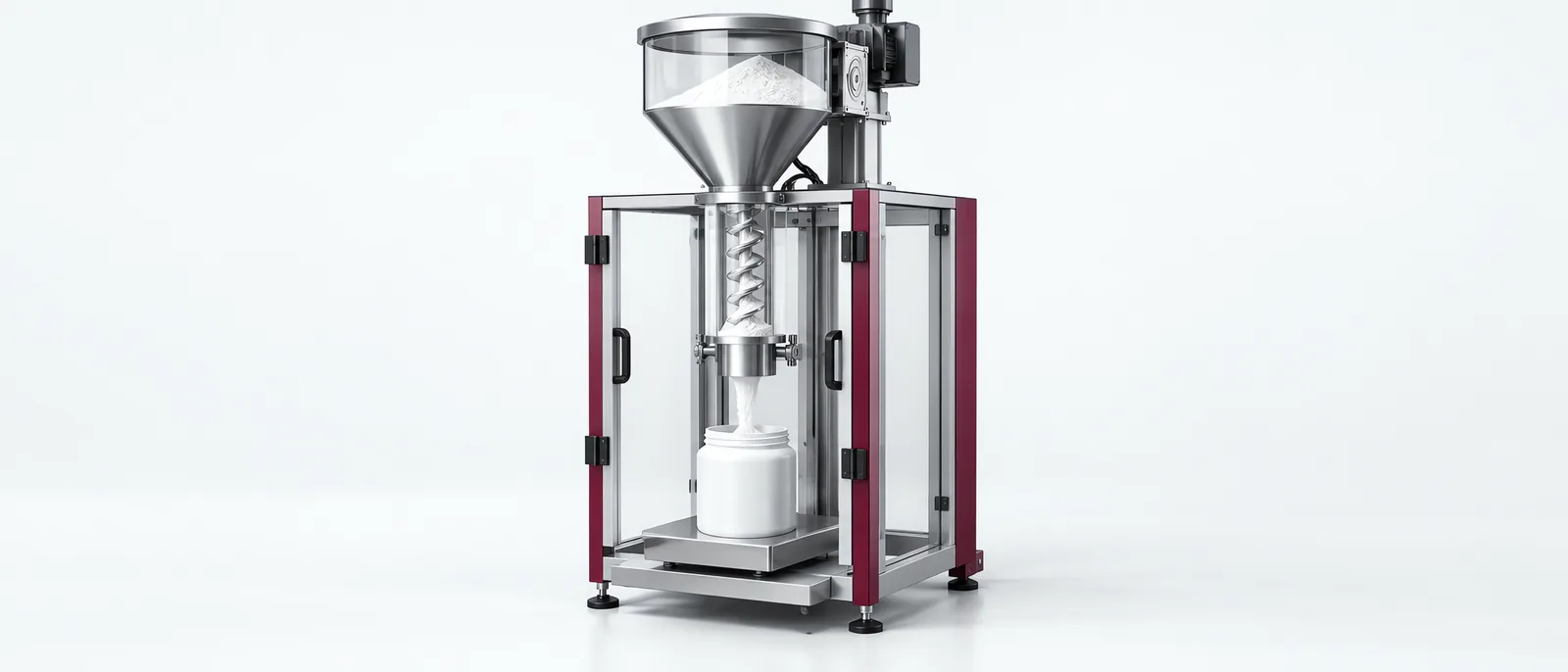
Conceptual equipment illustration.
A powder filling machine needs to deliver the required quantity with the powder in its actual production condition. Choose the dosing principle from flow behaviour, bulk-density variation and the required result. A repeatable number of auger turns does not necessarily produce a repeatable mass when the powder condition changes.
The decision sits within filling-machine integration, with container handling and inspection around the dosing operation.
State Whether the Requirement Is Volume or Mass
All-Fill’s powder-filling FAQ distinguishes volumetric filling for sufficiently consistent bulk density from gravimetric approaches where density variation or weight verification matters. That distinction is the starting point, not a universal accuracy figure for every powder.
For an illustrative calculation, suppose a volumetric dose is 100 mL. At an assumed bulk density of 0.5 g/mL it contains 50 g; at 0.6 g/mL it contains 60 g. Those are hypothetical inputs showing why a constant volume can produce a different mass.
Use the volumetric versus gravimetric filling comparison to define which variable the equipment controls and which variable the product specification accepts.
Trial the Powder through the Operating Range
Include the powder batches and conditions the station will encounter. Observe bridging, aeration, settling and flow after a pause. The auger, funnel, agitation and cutoff arrangement need to suit the material; one powder’s successful setup should not be copied unchanged to another.
Run trials across the permitted hopper levels. Record fill results after replenishment, on startup and during sustained production. Those states can expose variation hidden in a short uninterrupted demonstration.
Confirm the Container and Cutoff
Check where the nozzle sits relative to the container opening and how the container is supported. Powder remaining in the discharge path can affect the final quantity or spill during indexing.
Keep dust handling and product-contact cleaning in the specified scope for the actual material. A generic enclosure does not automatically resolve the powder’s contamination or handling requirements.
For large quantities, compare the bulk-filling scope against the smaller-dose configuration. Container support and weighing arrangements can change substantially.
Verify the Final Quantity
If a downstream checkweigher is used, define tare handling, reject criteria and whether feedback changes the filler setting. Distinguish an individual rejected fill from a process adjustment based on a group of results.
Retain the powder identity, recipe, dosing settings and verification method with the trial. A purchase comparison should use the same material and quantity definition across quotations.
Contact Motionwell about powder filling to discuss dosing, container handling and verification together.