
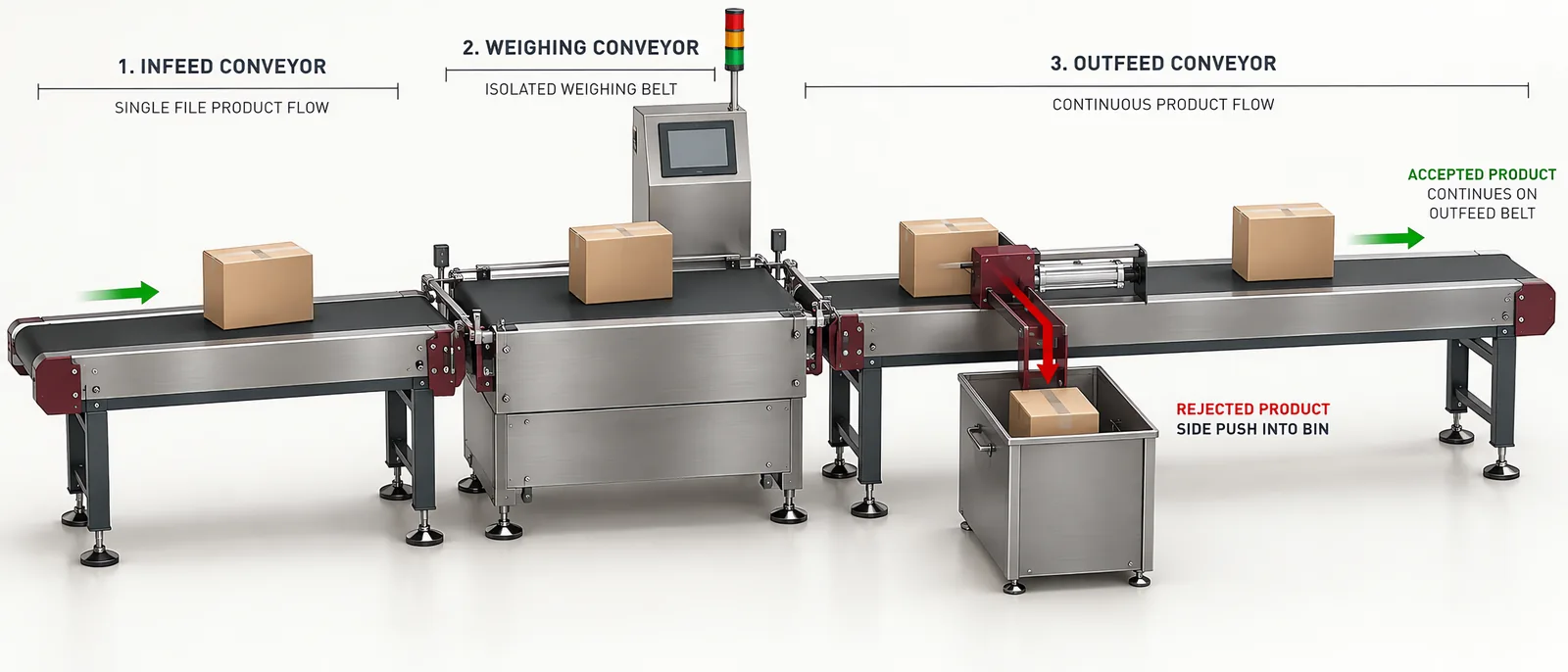
Conceptual equipment illustration.
A checkweigher measures individual products and classifies them against defined weight limits. On a conveyor-based dynamic system, the product must pass through a usable weighing window while the machine associates the result with the correct item.
Choose the required discrimination first: what weight difference must the system detect, on which package, at which production rate? A display resolution is not the same as demonstrated measurement performance under those conditions.
Make Room for the Measurement
The package should be fully supported by the weighing section during the measurement interval, without another package sharing that section or external contact adding force. Product length, belt length, speed and spacing therefore work together.
METTLER TOLEDO’s checkweighing guidance explains package pitch and the use of timing and spacing conveyors. For a proposed line, verify the arrangement using the longest pack and the least consistent incoming gaps.
Also examine transfers, guide contact, vibration and product movement. A loose product inside a carton or liquid moving inside a bottle can behave differently from a rigid test weight.
Separate Gross Weight From Product Quantity
The measured package weight includes its packaging. If the decision concerns net contents, determine how packaging variation is accounted for. A gross-weight check can detect a missing component only when the expected difference is distinguishable from normal product and packaging variation.
This distinction matters on filling-machine lines. Checkweigher feedback may help a filling process when properly designed, but it does not make the weighing and filling mechanisms the same measurement system.
Likewise, a weight result cannot identify every dimensional or assembly defect. Use a separate in-line dimensional measurement operation where geometry is the actual acceptance characteristic.
Specify the Decision and the Physical Reject
| Stage | Evidence the system should provide |
|---|---|
| Detect product | A unique item position or sequence association |
| Measure | A valid weight, or an explicit invalid-measurement result |
| Classify | Applied recipe and classification outcome |
| Track | The same item followed to the reject point |
| Remove | Confirmation appropriate to the rejection arrangement |
| Handle faults | Defined response to a failed reject, full bin or lost tracking |
A reject output turning on proves only that the controller issued a command. Acceptance should show that the intended product left the normal flow and that a neighbouring good product remained in the correct route.
For pharmaceutical and packaging applications, retain the required result and batch context. The level of identification should follow the production process, not be assumed from the presence of a network connection.
Build a Challenge Set
Use reference products with known weights and representative package behaviour. Include examples around the decision limits, clearly out-of-range products and normal acceptable products. Run them at the agreed production conditions.
Test consecutive rejects, a reject between two acceptable items and a stop before the item reaches the reject point. Record false acceptance, false rejection and invalid measurements separately. This reveals whether a problem comes from measurement, classification or item tracking.
Keep the Measurement Stable After Handover
Define cleaning, zero checks, reference checks and the response to a failed verification. Ensure production can retrieve the active recipe and recent fault information without changing the measurement setup.
The packaging-line integration scope should include upstream spacing and downstream rejection as part of the checkweighing station. Talk to Motionwell about your product inspection requirement.