
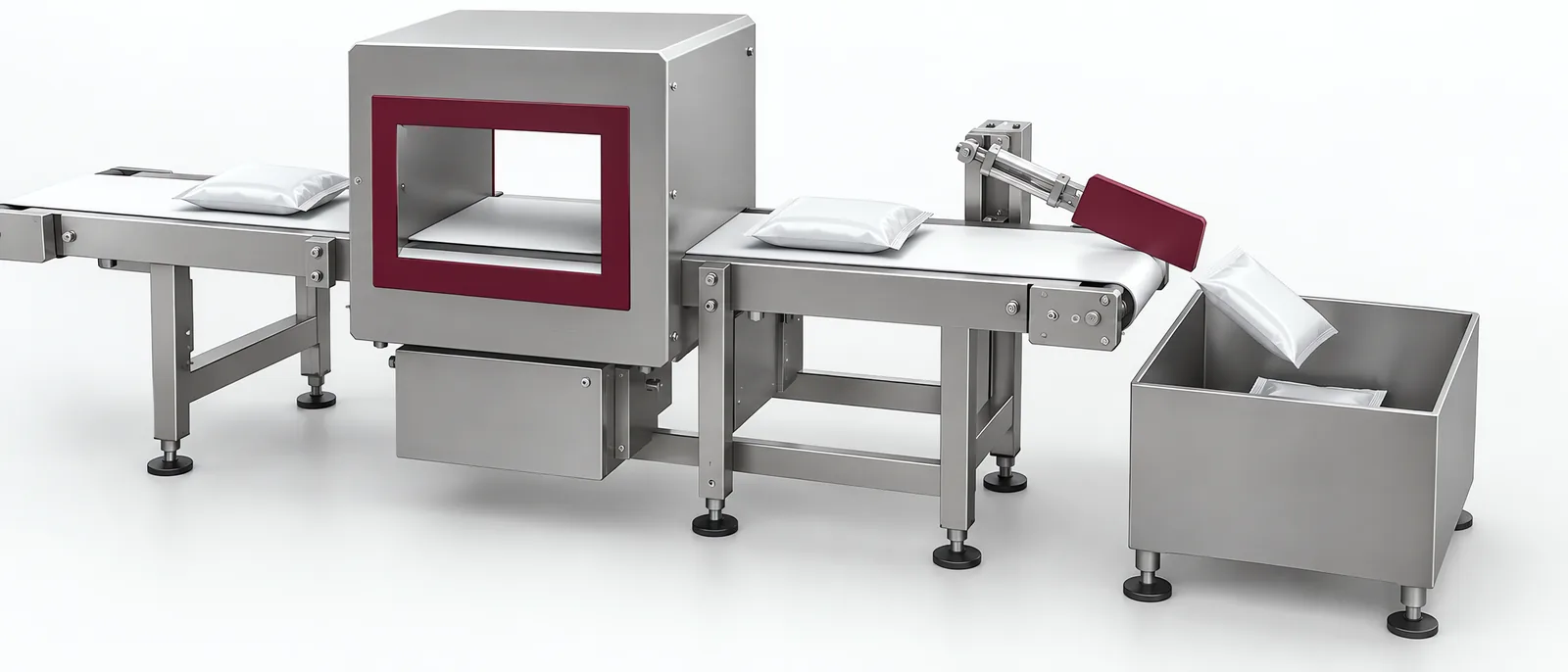
Conceptual equipment illustration.
A metal detector conveyor system needs to detect the agreed metal test pieces in the actual product and remove the correct pack from accepted flow. Selecting the detector head is only half that task. The conveyor, product spacing and rejection mechanism determine whether the detection result becomes an effective physical reject.
For packaging automation, define the product and challenge test before comparing sensitivity figures.
Trial the Real Product and Packaging
Product composition and condition can create a signal that interacts with the detection. Mettler Toledo’s metal-detection guide discusses product effect, detection configuration and reject confirmation as parts of a complete programme.
Different metals and test-piece positions can produce different results. Specify the test-piece type, size and placement agreed for the application, then challenge the system with the actual product, belt speed and package orientation.
A result from a dry empty aperture is not a demonstrated result for a wet product or a metalized package. Packaging can change which detection method is suitable. Confirm that choice during sample trials.
Trace the Pack to the Reject Point
Measure the relationship between detection and rejection. A timer-based delay assumes the pack travels as expected; an encoder-based arrangement has a different tracking path. Test starts, stops and closely spaced packs under the actual design.
Verify that the reject device removes the identified pack without taking an unrelated acceptable pack with it. The conveyor material-handling scope needs to preserve the spacing and position on which that tracking depends.
A combined station may also use a checkweigher, but weighing and metal detection have separate failure criteria. A pack passing the weight check must not override a metal-detection failure.
Verify the Unavailable States
Challenge the controls with unavailable detection, lost rejection utilities, a blocked/full reject collection point and failure of the reject confirmation. The required response should be specified and tested, not assumed from the presence of a fault lamp.
Keep test challenges identifiable in the result record. Repeatedly proving that a detector lights up is not the same as proving that each challenged pack leaves the accepted line.
Through the packaging-line integration, coordinate the station with upstream supply and downstream release. Record the detector recipe and challenge conditions associated with each product.
Contact Motionwell about the inspection station to discuss how detection, tracking and physical rejection need to work together.