
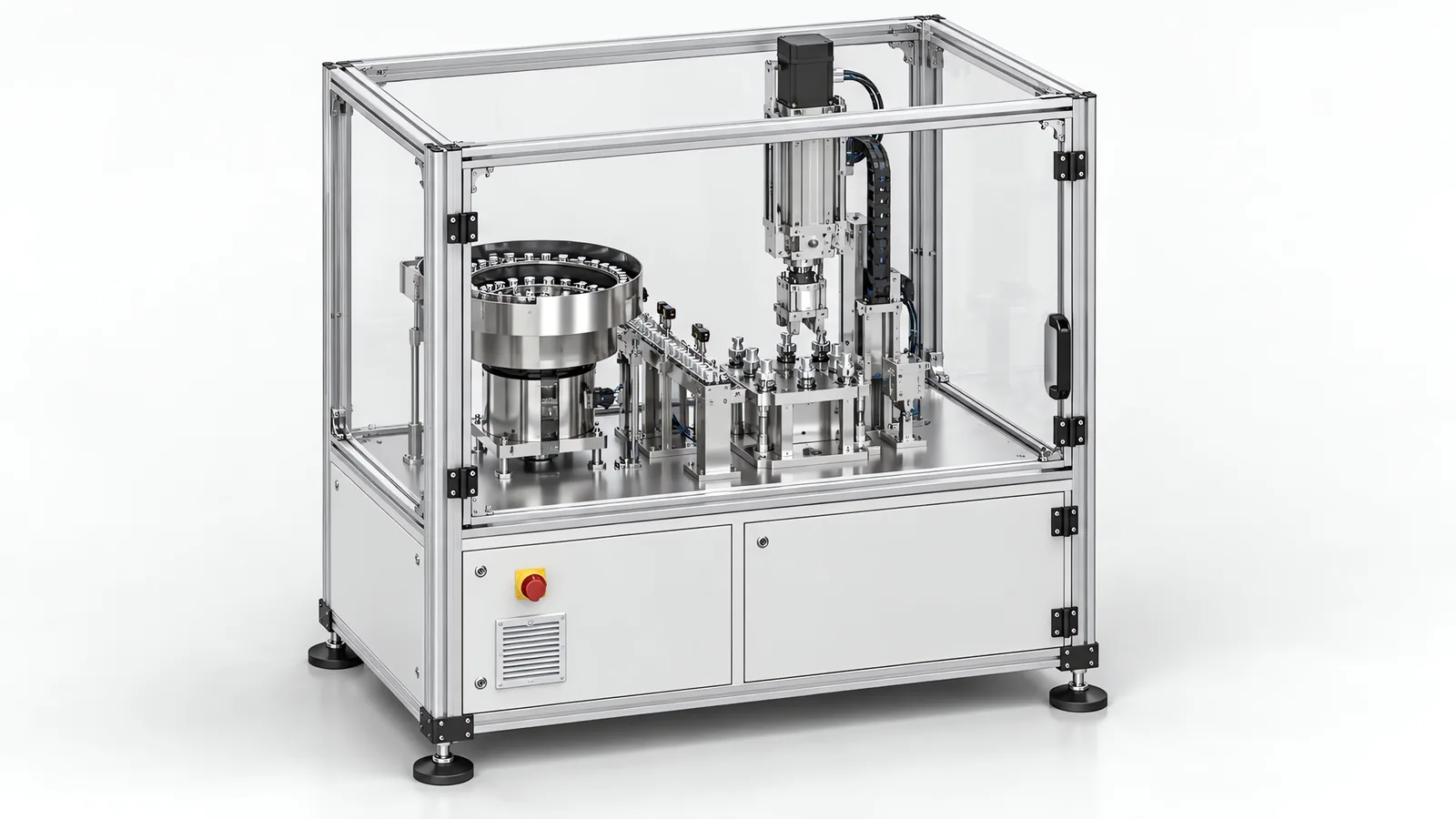
In production engineering, SPM means special purpose machine: equipment designed around a particular task or manufacturing process. SPM design covers the tooling, mechanisms, controls and verification needed to perform that task. Examples include a dedicated assembly station, a tray-fed filling and sealing machine and a CNC shot peening machine.
The term describes the machine’s purpose, not a fixed size, price or automation level. Motionwell builds SPMs in Singapore; this guide explains the different scopes that can sit behind those three letters on an enquiry or tender.
Cost and lead time are on the special purpose machine design guide, and the decision to build or buy is on custom machine vs standard equipment.
What Does SPM Stand For in Engineering?
Special purpose machine. Its design is matched to a defined task, product family or process. The same design can be repeated, and standard modules can be reused within it.
The letters arrive in several shapes in searches and tenders: SPM design, SPM machine, SPM machine design, special purpose machinery. SPM machine is redundant, since the M already stands for machine, and it survives because the three letters get read as a category label, not as an abbreviation. The referent is the same in every case. Our design and lead time guide covers what else these three letters are used for outside production equipment, and why a specification should spell the phrase out at first mention.
The engineering difference lies in how closely the equipment is matched to the process. A custom nest may locate your component while a standard actuator performs the motion. The BOM identifies both, and the drawings define the custom parts and their interfaces.
The letters say nothing about size, speed or how much of the process runs without an operator. A single-station bench fixture built around one process can be a special purpose machine. A purpose-built design can also become a repeat catalogue product. Its defined process is what matters, not whether the supplier has sold it before.
What Does SPM Design Mean on a Tender Document?
It names a scope of work and not a product category, and the same two words cover several different asks. In enquiries that reach us the phrase appears in at least four shapes, and the argument late in a project usually traces back to which one was meant.
| What the enquiry says | What is being asked for | What to settle before anyone quotes |
|---|---|---|
| SPM design, with a process description and no drawings | Concept engineering: whether the machine is possible, in what footprint, at what rate | Who owns the concept output, and whether a proving trial on real parts comes first |
| SPM design and build | Design, manufacture, assembly, testing and handover of one machine | Where factory acceptance happens, against which criteria, and who witnesses it |
| SPM design to our URS | Engineering against a requirement document somebody else wrote | Whether the URS is testable line by line, and what happens to requirements that contradict each other |
| SPM design package for another party to build | Drawings and schematics as the deliverable, with fabrication elsewhere | Who holds the risk assessment, and who signs the machine off as built |
The third row is the one that produces trouble late. A requirement document written by a consultancy can be internally inconsistent, and answering design to this without a line-by-line review transfers the inconsistency into the machine, where it surfaces at acceptance testing. We read a URS for testability before quoting against it, and our page on writing an automation URS sets out what makes a line testable.
For a design package built by another party, assign the manufacturer and integrator responsibilities explicitly. Name who completes the risk assessment, verifies the as-built machine and issues the required conformity documentation for the destination market. Link those duties to the actual design and build scope.
What Is Actually Designed When Somebody Writes SPM Design?
An SPM combines process-specific engineering with selected components and reusable modules. A quotation review should identify both, including their interfaces.
| Layer of the machine | Drawn or selected | What it costs you when it is wrong |
|---|---|---|
| Part contact: nests, trays, jaws, locating features | Designed or adapted to the part’s dimensions and handling needs | Location or contact errors affect product quality; acceptance needs to check both |
| Frame, layout and guarding | Designed around station geometry, access and protective measures | Poor access makes setup, cleaning and maintenance difficult |
| Motion: actuators, axes, arms | Selected against the duty, with mountings and transmission designed around them | Insufficient force, acceleration or thermal capacity limits the production cycle |
| Control hardware and program | Hardware selected, logic developed for this process | Poorly structured or undocumented sequences make fault recovery and maintenance difficult |
The process-specific work sits across the tooling, layout, motion integration and control sequence. A robot or valve model alone does not explain how the machine handles your part. Look for the proposed locating method, station sequence and quality checks alongside the hardware list.
The practical reading, before drawings exist, is to ask which items on the offered list will be made to drawing and which will be bought, and to expect the drawn side to be larger than the machine looks from a photograph. The supplier structure underneath that split, and the questions it lets you put to a bidder, are in how to choose a special purpose machine builder.
Do Two Machines Called SPM Have Anything in Common?
They can share design methods and components while solving very different process problems. These four machine types show why the label alone tells you little about the engineering scope.
| Kind of machine | What the process asks for | Where the special part sits |
|---|---|---|
| Tray-fed filling and sealing machine, pharmaceutical packaging | Dosing, container handling, position sensing, heat sealing and tray tooling, which are unrelated engineering problems | In tooling cut around one container envelope, and in the interaction between dosing and sealing |
| Five-axis CNC shot peening machine, aerospace | Coordinated motion under G-code, a media delivery and recovery circuit, extraction, and a fixture that presents the aerofoil to the nozzle | In the fixturing, coordinated nozzle path and integration of the peening process |
| Collaborative robot loading cell | An arm that is bought, and everything the arm reaches into | In part presentation, fixturing and the frame, none of which is what gets photographed |
| Buffer conveyor unit | Accumulation between two stations running at different rates | In the release logic between zones, which are one design used over and over |
Read down the last column and the pattern is that the special part is rarely the part a photograph shows. That is the standing failure mode of the word. SPM gets attached to the visible component, the buyer then evaluates bidders on the arm each one proposes, and the arm is the part of the cell that was going to be much the same whoever built it. What was designed is everything the arm reaches into, which is also where the cycle time comes from, and that argument at station level is on the machine tending automation page.
The first two rows are worth separating for a different reason. One is pharmaceutical packaging and the other is aerospace surface treatment, and evidence from either does not carry to the other: a builder who has delivered one has not thereby demonstrated the other. The word covers both, which is the limit of what the word is able to tell you about a bidder. How the filling machine doses and seals is on the filling machines page, which dosing principle suits which product is in how to choose a liquid filling machine, and the peening process and its records are in the five-axis shot peening case study.
Does a Longer Parts List Mean a Harder Machine?
Not necessarily. An accumulating conveyor can carry a long parts list because its zones repeat. A filling and sealing machine can carry a shorter list with more distinct process functions. Either can be demanding when transfer conditions, tolerances or recovery requirements are difficult.
The BOM helps estimate materials, assembly work and procurement effort. It does not explain the whole engineering challenge. Review the process tolerances, interaction between functions, software and testing effort as well. A bought component can have a demanding integration task behind a single line on the list.
So the place to look for difficulty in a quotation package is the process description. Count the unlike functions in it. Dosing, feeding, sensing, sealing, driving a fastener to a torque, measuring inline, buffering between stations running at different rates. Each one is a discipline somebody has to have debugged before, and a machine carrying five of them is a harder proposition than a machine with a much longer list and one of them. What accumulation actually has to get right, none of which is part count, is on the conveyor and material handling page.
Where Does a Special Purpose Machine Stop Being a Machine?
The useful distinction is between equipment performing a defined function and the integration of several machines into a production flow. A single machine can have several frames or controllers. A line adds transfers, shared states, recovery sequences and acceptance tests across machine boundaries. Neither part count nor controller count defines that boundary on its own.
That integration needs a named owner. It can sit inside a turnkey purchase, a separate integration package or the plant’s own project scope. Identify who specifies and tests the handshakes wherever machines transfer product between them. Our turnkey automation systems page sets out the scope boundaries, turnkey assembly automation covers the assembly case, and turnkey factory automation covers the plant-level one.
What Changes Once the Word SPM Is on Your Enquiry?
Three things, each with something you can act on.
Two quotations may propose different architectures for the same task. Compare them against a shared process requirement and acceptance criteria. Review the station sequence, quality checks, sustained output and changeover method, then examine the custom tooling and selected modules that each proposal uses to achieve them.
The delivery schedule includes external dependencies. Drawing release, fabrication, bought-component delivery, assembly and testing all contribute to the critical path. Identify long-lead and single-source items early, with an order date, required-on-floor date and recovery option for each.
The safety assessment covers the actual application. Proven designs and modules can supply useful evidence, but the assessment still needs to address this machine’s use, layout and interfaces. Apply ISO 12100 during design: identify hazards, estimate and evaluate risk, then reduce it through inherently safe design, safeguarding and information for use. Our machine safety risk assessment guide explains the process.
A fourth thing changes in regulated sectors, and it changes the records. The same machine built for a validated line has to be provable afterwards, and that provability is an architecture set at concept. It cannot be added as a setting later. What that adds is set out in special purpose machines for pharmaceutical production and special purpose machines for medical devices.
When Is SPM the Wrong Word for What You Need?
An enquiry about an SPM does not always need a new machine. Naming the work more precisely helps direct it to the right scope.
| What the enquiry describes | The scope it actually names | Where it goes |
|---|---|---|
| Mechanics still sound, controller or drives no longer supported | Electrical and control retrofit on an existing machine | machine retrofit and modernisation |
| Machines already bought that have to run as one line | Integration, where the interfaces are the project | electrical system integrator scope |
| A standard machine that cannot get the part presented to it | Part presentation and tooling around a bought machine | part feeding and presentation |
| A catalogue machine that does your part at your rate | A purchase | custom machine vs standard equipment |
The first row matters commercially as well as semantically. A new machine is priced from a process sheet and an empty parts list. A retrofit is priced from what is already bolted to the machine and from how much of its documentation survives, and those two estimates are built from different evidence. Calling a retrofit an SPM invites a quotation for a machine you do not need.
The last row comes up often enough to have its own page, and the test it sets out is worth running before an enquiry is written at all.
What Should an SPM Enquiry Describe?
Turn the term into a short process brief. This lets a builder distinguish concept work, a complete machine and integration around equipment you already own.
| Include | What it defines |
|---|---|
| Product drawings, samples and variants | The parts the machine must handle |
| Current process steps and quality checks | The functions being automated and how success is judged |
| Required output, shifts and changeovers | The operating duty and capacity target |
| Existing machines and interfaces | What is retained and what must connect |
| Layout, utilities and operating environment | The physical design conditions |
| Requested deliverable | Concept study, design package, design-and-build or integrated system |
Once that scope is clear, use the special purpose machine builder evaluation to compare design ownership, sourcing, acceptance and support. Those are supplier-selection questions; this brief establishes what you are asking each supplier to deliver.