
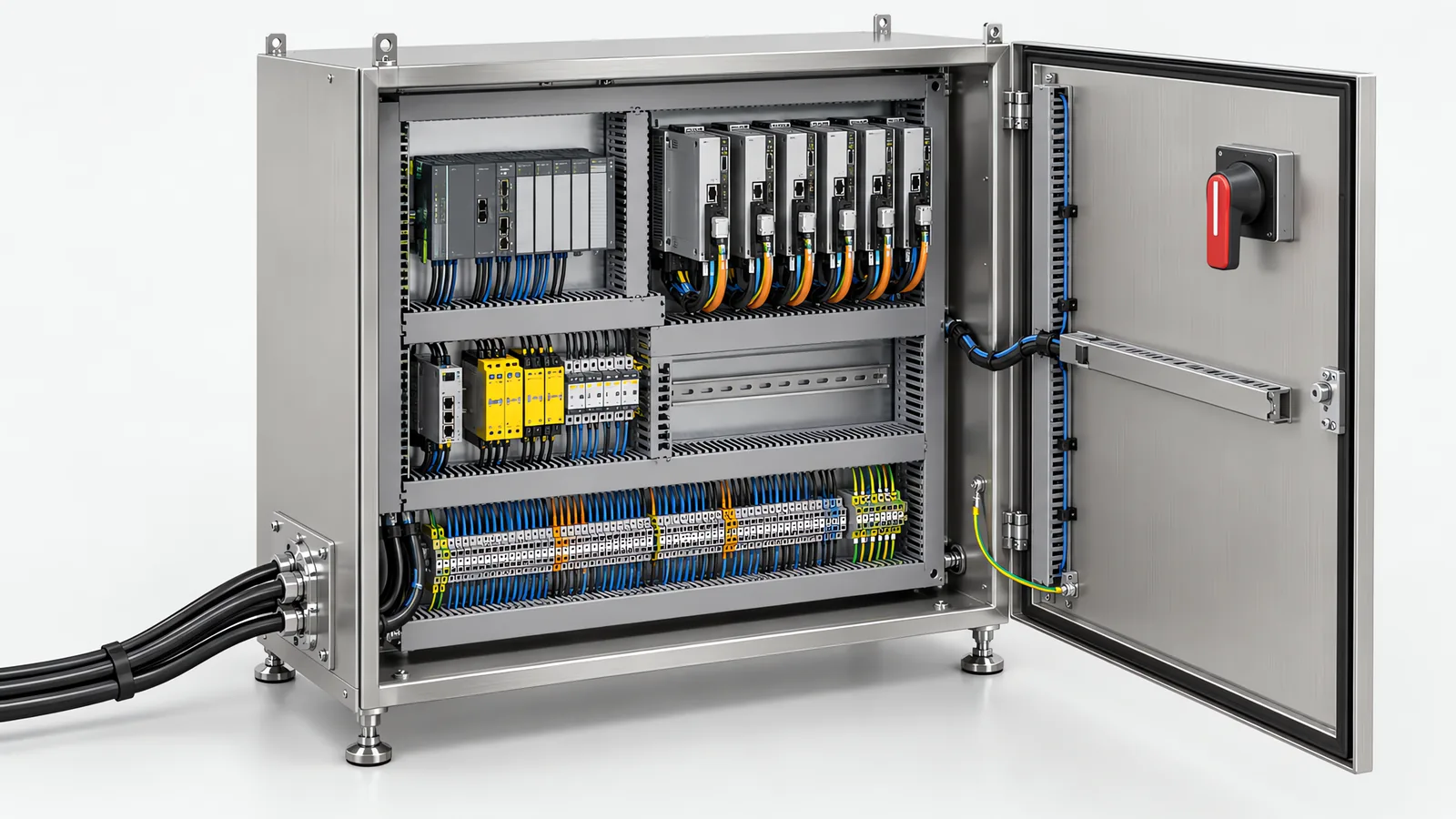
An electrical system integrator connects the control cabinet, on-machine wiring, drives, sensors, safety functions and machine network into a tested system. The scope should also name the site-supply connection and the drawings, software and test records delivered at handover.
Motionwell provides that electrical and controls scope for new machines and modernisation projects in Singapore. This guide maps the work between the machine designer, panel builder and site electrical contractor, including the interfaces that need a shared test.
The short answer. For a machine project, the electrical integration scope normally covers the control cabinet, on-machine wiring, drives, sensors, safety functions, machine network and as-built documentation. Define the connection to site power and services with the installation team. The isolator is a common supply boundary, while mechanical mounting, cable routing and cross-machine safety functions need joint design and testing.
The device list inside a panel we design is normally your plant standard, because a cabinet filled with devices your technicians already stock is one they can keep running without us. What the word integrator covers in general, and what the role hands over on a project, is set out on our page about what a system integrator is. The cabinet as a physical object, its thermal sizing, its ingress rating and its internal layout, is on the control panel design and build page. This page is the scope map between them.
What Does an Electrical System Integrator Actually Deliver on a Machine?
Four blocks, and the one that gets left out of quotations is never the first.
| Block | What is in it | Who usually owns it | What gets left out of the quotation |
|---|---|---|---|
| Control cabinet | Enclosure, protection devices, controller, I/O, drives, power supplies, terminal rails, internal wiring, labelling | Machine builder or a panel builder working to the builder’s drawings | Spare capacity: free terminals, free I/O points, free breaker ways for the change nobody has asked for yet |
| On-machine wiring | Cable from the cabinet to every motor, sensor, valve island and operator device, with containment, glands, drag chain routing and identification | Machine builder, because the routing follows the mechanism | Cable for axes that move, which is a different specification and a different quantity from static wiring |
| Safety circuit | Guard switches, interlocks, light curtains, scanners, safety logic, and the final element that achieves the specified safe state | Machine builder, as one function | The validation of the function as built, and the stopping performance measurement it rests on |
| Network and data | Switches, cabling, topology, addressing, and the uplink the plant plugs into | Shared, and therefore unowned unless named | The address plan and the port on the plant switch, which belong to two different departments |
The internal machine network is a scope item even without a site uplink. Identify its devices, addresses, connections and owner during design, then include the final topology in the handover records.
Where Does the Electrical Scope Stop and Your Electrical Contractor Begin?
At the machine isolator, in the ordinary case, and the useful part of that sentence is not the isolator but the word ordinary. Projects go wrong at this edge because each party assumes the standard split is the one they are used to.
| Item at the boundary | Normally the machine builder | Normally your electrical contractor | How to settle it in one line |
|---|---|---|---|
| Supply to the machine | Terminates the incoming cable at the isolator and states the required supply, protection and prospective fault level | Distribution board, protection upstream, feeder cable, containment to the machine position | Name the terminal the cable lands on and who pulls the cable to it |
| Earthing and bonding | Protective bonding of the machine’s own parts, including moving frames and the cabinet door | The installation earth the machine connects to | Name the connection point and who proves continuity at it |
| Compressed air and utilities | Machine-side distribution from a single connection point | Ring main to that point | One connection point, one size, one position on the layout |
| Operator devices away from the machine | Any device the machine’s own logic reads | Anything fed from the building, such as local lighting or sockets | Ask whether the machine’s controller reads it; if yes, it is machine scope |
| Network uplink | The machine’s internal network and one labelled port presented for connection | The run from that port to the plant switch, and the switch port itself | Name the port, the address, and the person who owns the address |
| Permits and isolation procedures | Lockout provisions on the machine | Site permit to work, and isolation of the supply | Agree the isolation point before the install week |
Mark the electrical connection point and cable route on the layout, and agree who supplies, terminates and tests each side. The machine’s supply requirements then give the site installation team a defined basis for its work.
In Singapore, electrical installation work must be carried out or supervised by a suitably licensed electrical worker, as described by EMA. Name the installation contractor and LEW responsibilities in the project scope, including testing before energisation. This makes a bid including site work comparable with one covering the machine only.
Why Does the Electrical Share Look Small in the Bill of Materials and Large at Commissioning?
Because the two views count different things. A bill of materials counts line items. A commissioning week counts interfaces, and the electrical content is where the interfaces are. One drive is one line item, and it is also one wiring set, one entry in the safety calculation, one node on the network and one set of parameters somebody has to be able to reproduce after a failure. One fabricated bracket is one line item and one bracket.
Sort the parts list you are handed by item count and the machined and fabricated parts, the sheet metal and the tooling take the top of it, with catalogue mechanical items and cable behind them and the control and sensing parts a long way down. Read that ranking as a share of engineering hours, or as a share of risk, and you have drawn the wrong conclusion from a correct list. It is a purchasing view, and a purchasing view is organised by what gets bought.
Two questions turn it into something usable in a bid comparison.
Ask what part of the electrical work carries no line item at all. The point-to-point check against the drawing before power goes on, the validation of the safety function on the built machine and the stopping performance measurement behind it, the address plan, and the correction of the schematics to as-built condition are all electrical scope, and none of them has a part number. A bid comparison run by scanning parts lists therefore weighs the half of the electrical scope that can be bought against the half that has to be done, and sees only the first. Ask each bidder to price those items as named lines. Where one bid carries them and another does not, the gap between the totals is not a discount.
Ask which cable on the machine moves. Cable sits in a parts list beside the standard components, which is where it belongs commercially and the wrong place for it technically, because cable type is a design decision on any axis that travels. A static run and a run inside a drag chain are not the same product, and substituting one for the other produces a fault that appears after long service, as an intermittent signal or a drive trip, and never as a broken wire anybody can see. The wider version of that argument, about where a machine’s cost and risk sit, and not where its line items sit, is in our note on how to choose a special purpose machine builder.
How Do Industrial System Integrators Divide Electrical Work From Mechanical Work?
Industrial system integrators draw this line in different places, and the place matters less than whether it is drawn at all. The division that survives contact with a build is not by component type. It is by what each discipline can still change on its own.
| Interface | Mechanical scope decides | Electrical scope decides | Where the two collide |
|---|---|---|---|
| A moving axis | Travel, load, guides, ratio, stops and the space available | Motor frame and feedback, drive rating, cable type and bend radius, brake control | Cable management on the moving member, which needs a mechanical route before an electrical specification can be written |
| A sensor | What has to be detected, from where, and the bracket holding it | Device type, wiring, filtering and how the signal is read | Adjustability after first run, because a sensor that cannot be nudged after the first run becomes a programming problem |
| A guard opening | Aperture, standoff, hinge and how a person gets in | Interlock type, defeat resistance, logic and the stop it commands | The position of the switch, which is a mechanical decision with a safety consequence |
| An operator station | Height, reach and where a person stands during a fault | Device layout, wiring and what each device is allowed to command | Sightline to the mechanism, which no schematic records |
| A pneumatic circuit | Actuator sizing, speed control, mounting | Valve island, its network card, and the dump valve arrangement | Exhaust and residual energy, where the safety argument is mechanical and the control is electrical |
Read the right-hand column. Those five collisions are where a split scope actually fails, and none of them is resolved by a clearer parts list. They are resolved by one party holding both halves of the interface, or by a design review where both parties sign the same drawing before anything is built.
Electrical integration can be purchased separately from mechanical design. On a controls modernisation, much of the existing mechanism may stay, while motors, sensors, brackets or cable routes still need interface checks. Assign each shared decision so that the drawings and tests cover the complete machine.
What Do a Drive’s Option Modules Tell You About Scope Lines?
A purchasing line that reads a quantity of drives is not one scope item. A modern drive is a chassis that takes option modules, and the modules are where the scope boundaries actually run, because each one belongs to a different conversation with a different owner.
A safety option module puts the drive inside the safety function, so fitting one changes the performance level calculation as well as the wiring. A feedback option ties the drive to the mechanical axis it serves, which makes feedback type a decision shared with whoever owns the gearbox and the travel. A network option card puts the drive on the machine network as a node with an address, which is the network owner’s problem. Put several such drives in one cabinet next to the controller and its I/O rack, and that single enclosure now carries the safety scope, the motion scope and the network scope at the same time, which is why splitting the cabinet away from the rest of the electrical work splits three arguments.
The practical consequence is a rule for reading quotations. Where one bid lists drives by quantity and another lists them by configuration, those are not the same machine even when the product line matches. Ask which option modules are fitted, why each one is there, and what happens to the price if one has to be added later, because a module that arrives after the panel is wired is not only a part but a retest. A drive with no safety option and a drive with one are different answers to the question of how the machine stops, and the second is not an upsell when the safety function needs it. The motion half of that argument sits on our servo and drive retrofit page.
Who Owns the Safety Circuit When the Scope Is Split Between Two Suppliers?
A safety function has a defined trigger, response and safe state. It includes the relevant sensing, logic and output elements, which may command a stop, limit motion or hold a load. Evaluate the complete function under ISO 13849-1, using the selected devices, architecture and operating conditions. The component list alone does not establish the achieved Performance Level.
Suppliers can deliver different parts of the chain if one named party coordinates the complete safety function. That party needs the component data, interface specification, calculations and validation evidence from both scopes. Assign the responsibility for the whole function even when the hardware supply is divided.
Three items travel with that ownership and are cheap to name early. The devices and their arrangement, because substituting an equivalent device changes the calculation. The stopping performance measured on the built machine, because scanner and light curtain distances are derived from it. And the validation record, because a function that was never proven as built is a drawing. The risk assessment and conformity workflow behind all of it is on our machine safety and CE marking page, and the physical side, meaning apertures, standoffs and interlock selection, is on the machine guarding design page.
Which Electrical Standard Governs the Machine, and What Does It Cover Beyond the Cabinet?
IEC 60204-1 governs the electrical equipment of machines, and the phrase that matters for a scope discussion is electrical equipment. The document reaches supply disconnection, protection against electric shock, stop categories, conductor identification, enclosures and documentation, across the machine. The current edition is the 2016 sixth edition with Amendment 1:2021, and the European edition is EN 60204-1:2018 with A1:2025. The counterpart for a machine going to the United States market is NFPA 79, which is why the destination market has to be settled before design starts.
For scope, two consequences follow and neither is about choosing a standard.
The first is that splitting the panel from the wiring splits a document written as one. Conductor identification, shock protection and stop category behaviour are properties of the installed machine. Where a plant builds the cabinet to our drawings and wires the machine itself, the compliance argument still has to be assembled across both halves, and the point-to-point check and the functional test are what assemble it. Name who runs them.
The second is that documentation is part of the requirement. A machine whose as-built schematics do not match it has an electrical scope that was delivered and then lost. On modernisation work this is frequently the starting condition: the drawings describe a machine that has been modified more than once by people who have left. Producing an accurate set is itself a deliverable, and it is the one that decides what the next project on that machine costs. The survey that produces it is on our machine retrofit and modernisation page.
Who Owns the Address Plan When IT and OT Both Touch the Machine?
The machine arrives with an internal network whose nodes are drives, I/O adapters, cameras and operator panels, and every one of them needs an address. Where those addresses come from is a departmental question before it is a technical one, and it is the part of the network scope with no natural owner. Production owns the machine. IT owns the address space of the site. OT, on a plant that has a separate OT function, owns the rule about what may cross between the two. None of the three writes a machine’s device addresses by default, so unless the purchase order names one of them, the addresses are invented by whoever powers the machine up first and then inherited by everybody who comes after.
That inheritance is expensive in two specific ways. Addresses set by a commissioning engineer on the day are rarely inside the range the site would have chosen, so the machine is either readdressed later, which means touching every node and every reference to it in the program, or hidden behind a router, which adds a device nobody budgeted for and a translation table nobody documents. And a range chosen without IT collides with something the year after, at which point the machine is the newcomer and the machine is what moves.
Agree the machine address range and uplink policy with the site network owner. Record the allocated device addresses and any routing or translation in the network drawing before installation.
Ownership of the physical port, of the switch and the run to it, and the decision about what the machine does while the uplink is unavailable, belong to the same argument as the interface between a machine and a plant control system, which is worked through in our note on DCS and PLC control architecture. What matters for an electrical scope is the consequence of settling it there: it is what keeps the network scope from quietly absorbing the safety scope.
ISA/IEC 62443 is the series behind the departmental division, and the feature of it worth knowing during a scope discussion is that it splits requirements by role. An asset owner, a system integrator and a component supplier are each answerable for a different part, so the question is not whether the machine is secure but which party is answerable for which layer, and the answer decides what belongs in whose price. How zones and conduits get drawn once those roles are settled is in our guide to IEC 62443 for industrial control systems.
How Should the Electrical Scope Be Written Into the Purchase Order?
Use the following list to compare electrical scopes. Put the connection points and responsible parties on the drawings as well as in the purchase order.
- The supply statement: voltage, phases, frequency, full load current, required upstream protection, and the terminal the incoming cable lands on.
- The boundary: one sentence naming what the machine builder terminates and what the electrical contractor pulls, with the connection point marked on the layout.
- Safety function ownership: one party named for the whole chain, with the validation and the stopping performance measurement inside the quoted figure.
- The device list source: your plant standard if you have one, sent as a document at enquiry, because working inside it costs less than correcting to it afterwards.
- Spare capacity: free terminals, free I/O points per type, and free breaker ways, stated as numbers. This is the cheapest line on the list and the one that decides what the first modification costs.
- Network ownership: the uplink port, the address range, and the behaviour when the link is down.
- Documentation: as-built schematics, device list, I/O list and cable schedule, named as deliverables with a revision.
- The destination market: settled before design, because the electrical build itself differs, and not only the paperwork that accompanies it.
Two of those lines are worth defending against the usual pressure to trim. Spare capacity looks like padding in a bid comparison and pays for itself the first time a sensor is added. Documentation looks like a formality and is the only part of the electrical scope that is still working for you in year eight. What else belongs in a comparable bid package, across the whole machine, is set out in our note on turnkey factory automation and in the integrator selection framework.
How Can the Electrical Scope Be Sized to the Work?
Five situations call for something narrower, and naming them early saves a quotation round.
You have an in-house controls team. Agree which design, panel-build and wiring tasks the team will carry, then define the released drawings and shared functional tests. Motionwell can scope the remaining integration work around that arrangement.
The work includes building services. Coordinate the distribution board, feeder, containment and earthing with the site electrical contractor. The machine team supplies the connection requirements and participates in interface testing.
The boundary is one signal. Establish what the signal does before sizing the job. A production-ready contact needs defined logic, fault response and a functional test. If the signal performs a safety function, assess and validate the complete chain from detection to the final switching device, including both machines where the function crosses the boundary.
The complaint is the program. That case is already made on the control panel design and build page, and nothing about an electrical scope changes it. The only thing worth adding here is what it means for a purchase order: where the answer is software, an electrical scope is not the purchase to be comparing, and the controller side of it is on our PLC programming services page.
The existing drawings are incomplete. Start with a machine survey and update the drawings needed to define the modification. This gives the retrofit a usable scope and leaves the maintenance team an as-built record.
Where Do the Two Edges and the Seam Fall?
A clear electrical scope identifies the site connection, the mechanical interfaces and the owner of each complete safety function. Different suppliers can contribute, provided their drawings, data and tests connect into one verified machine. Use that scope to compare quotations and plan the installation.