
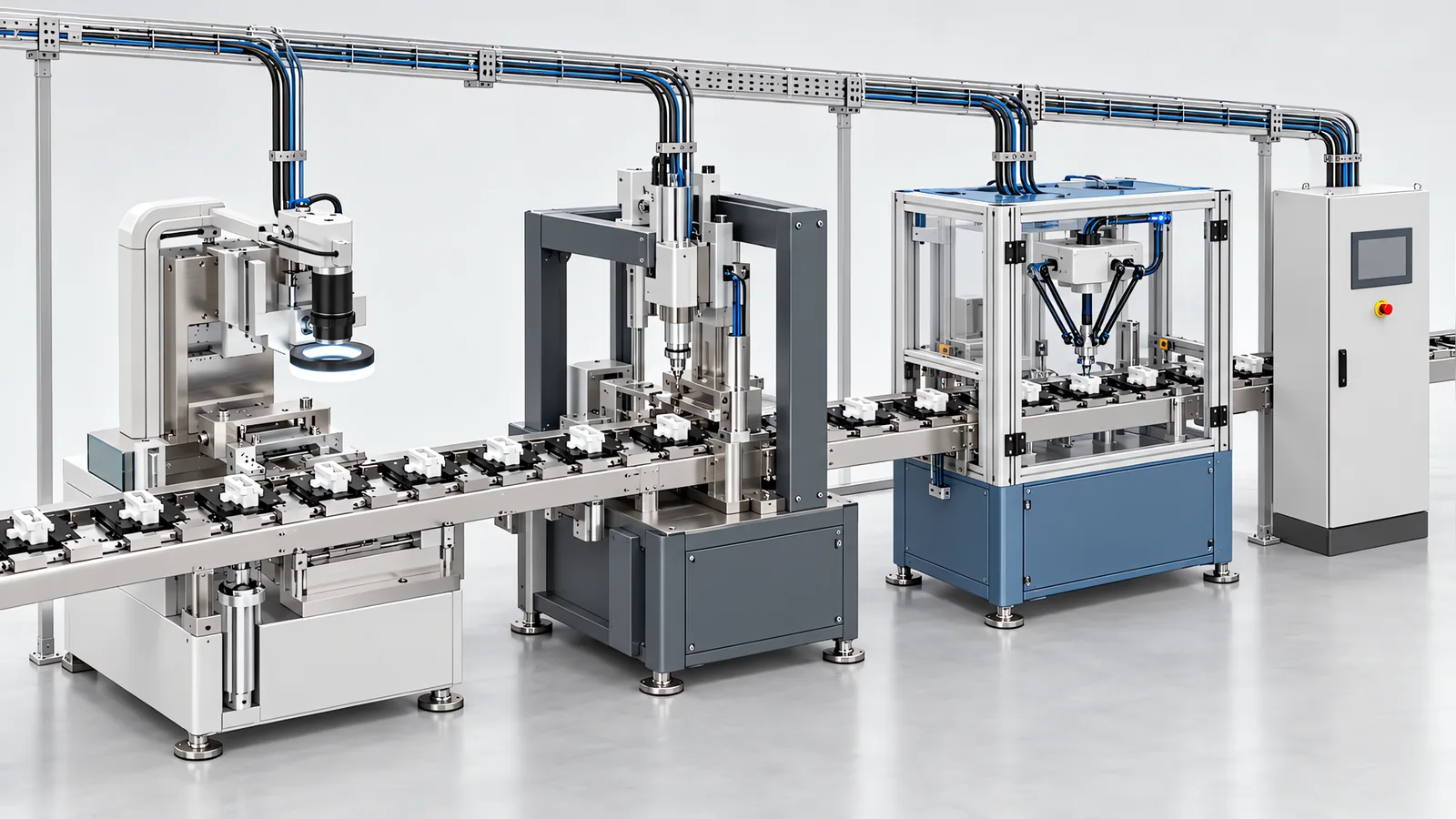
A system integrator connects equipment, controls and software into a working production system. In industrial automation, that includes the tooling, machine interfaces, control sequence, safety functions and tests needed to run your parts at the specified rate. The integrator coordinates those elements through design, commissioning and handover.
Motionwell works as both a machine builder and a system integrator in Singapore. Our QA laboratory automation project, for example, joins mobile sample transport, robotic instrument loading and test-result records into one workflow. We have delivered more than 150 special purpose machines since 2014.
This guide explains the role, deliverables and supplier responsibilities. For shortlisting and comparing proposals, use the separate guide to choosing a system integrator in Singapore.
What Is a System Integrator, and What Exactly Is the System?
The useful part of the term is the noun. A system is a set of parts that only has value in combination, and the combination is what has no natural supplier. Every component in an automated cell arrives with a datasheet that is true in isolation. A robot repeats to a stated tolerance. A camera resolves a stated number of pixels. A drive holds a stated position. None of those documents says anything about what happens when a person opens a door mid-cycle, when the conveyor upstream stops for four seconds, or when the part arrives rotated 15 degrees from where the gripper expects it.
That gap is the integrator’s subject. The role exists because production equipment is assembled from levels, and the levels have different owners.
| Level | What sits at this level | Who normally supplies it | What has no owner until someone integrates |
|---|---|---|---|
| Component | Motors, grippers, cameras, sensors, valves, PLCs | Component makers such as ABB, Schunk, Keyence, Cognex, SICK, Festo, SMC and ifm, through their distributors | Whether the stated performance survives contact with your part |
| Subsystem | Robot plus controller, vision system, conveyor section, safety relay group | The vendor or its distributor | How the subsystem behaves when its neighbour faults or stops |
| Machine or cell | A station that performs a process on your product | Machine builder or integrator | Cycle time on your parts, tooling, part presentation, recovery behaviour |
| Line | Several machines with buffers, transfers and handshakes between them | A lead integrator coordinating the machine suppliers | Which controller declares part ready, cell ready, buffer full, fault |
| Plant interface | Data out of the machine into your systems | Shared between the integrator and your IT | Recipe management, SPC logging, and the protocol the data arrives on |
Read down that table and the definition falls out. A system integrator is whoever owns the right-hand column. On a project where nobody does, the column does not disappear; it turns up during commissioning as a dispute about whose equipment is at fault, on your floor and not on anyone’s factory floor.
The word carries a second, older meaning in enterprise IT, where a system integrator connects software systems. Industrial usage borrowed the term and kept the logic, which is why the phrase is ambiguous in search results and why an enquiry sometimes arrives asking whether we do network integration. In manufacturing, the object being integrated is physical: parts, motion, forces, tolerances and the control system that coordinates them.
What Does a System Integrator Actually Hand Over?
This is the most concrete answer to what the role is, because a role is defined by what it is contractually obliged to produce. The list below is what leaves our building at the end of a project, grouped by what each item is for.
| Group | Deliverable | What it is for |
|---|---|---|
| Physical | The machine or cell, assembled and tested at our Woodlands Link facility before it ships | The thing you bought, in a state where a factory acceptance test can be run against it |
| Physical | End-of-arm tooling, fixtures, nests, feeders and part presentation designed for your part | Locating, holding and presenting the product consistently through the process |
| Physical | Guarding, interlocked access doors, light curtains, scanners and the safety-rated stop circuit | The access strategy the risk assessment concluded with |
| Engineering | Mechanical drawings and electrical schematics | Making a change in year four without redrawing the machine |
| Engineering | PLC program documentation, I/O list, variable list, program flow description and alarm code table | Letting your maintenance team diagnose a stop without calling the builder |
| Engineering | A complete software backup with version-controlled source and drive parameter files | Recovering the machine after a failed controller |
| Evidence | Factory acceptance test against agreed cycle time, accuracy and repeatability, witnessed by you | Proving the numbers while the machine is still on our floor and still ours to fix |
| Evidence | Site acceptance test with real production material | Proving the same numbers with your material, your operators and your utilities |
| Evidence | Risk assessment, safety-function validation and electrical test records, with conformity and lifting-equipment documentation specified for the destination market and equipment | Evidence linking the machine’s hazards, protective measures and verification results |
| Evidence | IQ and OQ protocols prepared, PQ supported with your quality team, in regulated production | The qualification trail a regulated line is audited against |
| People | Operator manuals, maintenance schedules, spare parts lists and hands-on operator training | Whether the machine is still running the way it was handed over, twelve months later |
Two rows deserve attention at quotation stage. The feeders, trays and escapements must handle the actual part geometry and tolerance range, so include representative samples in testing. The software archive needs a named owner, version identifiers and a recovery procedure so maintenance can restore the installed system.
What to test each of those deliverables against, and which of them a weak supplier will quietly omit, is the evaluation question, not the definition question, and it is covered point by point in the integrator selection framework.
How Do Integrators, OEMs, Distributors and Consultants Work Together?
The supplier’s role tells you where its main expertise and deliverables sit. A company may cover several roles; map them to the project scope when comparing proposals.
| Supplier role | Typical deliverables | Interface to coordinate |
|---|---|---|
| Component OEM or robot vendor | Arm, controller, camera or drive, with specifications and support | Mounting, tooling, signals and application performance |
| Equipment distributor | Standard equipment, configuration, installation and spares | Product trials and connection to surrounding equipment |
| Engineering consultancy | Requirements, layouts and tender documents | Design decisions and test criteria passed to the builder |
| System integrator and machine builder | Working machines, interfaces, tooling, controls and acceptance evidence | Performance across the complete agreed system |
| Facility or main contractor | Power, air, drainage and civil works | Utility capacity, connection points and site readiness |
Compare a configured standard cell with a custom design against the same part, rate and layout. A proven standard machine can shorten design work; a custom build accommodates a process or interface that needs dedicated engineering. Our guide to choosing the right type of automation company develops that comparison.
If you have several suppliers to compare, writing an automation URS gives them a shared requirement and makes differences in their proposals easier to evaluate.
Why Do Two Companies Called System Integrators Do Different Work?
The label covers different combinations of engineering work. Some projects chiefly arrange and program bought equipment; others also need custom mechanisms, fixtures and feeding systems. Establish whether the quoted scope includes mechanical design and who is responsible for building and verifying it.
Ask whether custom mechanisms and fixtures are designed in house or through a specialist partner, and who tests them against your parts. Motionwell combines integration with machine building; our capabilities directory covers equipment designed and built to order, from individual stations to complete lines.
The supply position is a second axis, and it is separate from the first. Some integrators build on one robot platform and know it deeply; others carry several and select per application. Neither is the better answer in the abstract, and the trade is legible enough to ask about directly. A single-platform builder has deeper programming habits, one set of spares, one support relationship and one toolchain to keep current, and pays for that by bending the application toward the platform on the jobs where the two do not quite agree. A multi-brand builder can put whatever arm your plant has standardised on into the cell, and pays for it in breadth: more licences, more toolchains, and a real risk of being shallow on the one platform you happen to need. We work multi-brand, across industrial, SCARA and collaborative arms and across both fixed-route and free-navigating mobile robots, and we have built cells around arms the customer already owned and supplied.
Ask what would change if the robot platform changed. A modular design can preserve useful tooling concepts and station interfaces, but the replacement still needs checks for reach, payload, mounting, controller interfaces and safety functions. The motion program and affected hardware are then adapted and tested together.
A third shape exists and is worth naming so it is not mistaken for a contradiction: a company can hold a distributorship for one product line while building machines around everything else, which is our own position. The test that separates the shapes is not the brand list. It is what happens when the catalogue does not contain the answer.
The consequence for brand selection is smaller than the brochures suggest. Payload, reach, speed, precision, safety mode and cost usually leave two or three platforms standing, after which the platform your maintenance team already stocks spares for and has been trained on tends to win on cost of ownership. The engineering detail behind that selection sits on our robot integration services page.
What Disciplines Sit Inside a System Integrator?
An integrator is an unusual kind of engineering company because it has to be several at once. A cell that fails at commissioning rarely fails in one discipline; it fails at a seam between two of them.
| Discipline | What it produces | Platforms and tools in our work |
|---|---|---|
| Mechanical design | Machine frames, jigs, fixtures, gauges, pallets, vacuum and pneumatic tooling, robotic end effectors | SolidWorks 3D design, FEA on critical structures, tolerance analysis on precision assemblies |
| Electrical design | Schematics, panel layout, cable routing, safety circuit design and panel commissioning | Control panel design and build, LVD and CE testing |
| Controls and software | Machine sequence code, HMI screens, motion control, recipe management, SPC data logging | Whichever controller platform the plant already runs and already trains on, with OPC-UA, EtherNet/IP and PROFINET networking |
| Machine vision | Camera and lens selection, lighting design, algorithm integration, calibration against real samples | Smart cameras by default for the maintenance story, sized against your own samples; dome lighting on the SCARA sensor panel line |
| Fabrication | Precision components manufactured and inspected against controlled drawings | Our manufacturing facilities and qualified fabrication partners, coordinated by the design team |
| Project management | Milestone gates, change control, factory and site acceptance protocols | Design Centre for engineering, Assembly and Integration Centre for build and factory acceptance |
Keeping fixture design with the integration team gives a clear route for revisions during part trials. The team can update the drawing, coordinate manufacture and retest the fit in the same project workflow. Our engineering, build and test facilities occupy five units at 20 Woodlands Link, described on the about page.
Vision trials need representative surface finishes, defect samples and lighting conditions alongside mechanical and electrical testing. A change in part reflectivity or ambient light can affect the result. Our machine vision inspection page explains sample selection, lighting and verification.
Who Owns the Cycle Time, the Safety File and the Handshakes?
Naming the owner of each item is the practical form of the definition, and the table below is the version we work to. The point of writing it down before a contract is that every unowned row surfaces later at a worse moment.
| Item | Who owns it | How it is evidenced |
|---|---|---|
| Product geometry and its revision freeze | You | Drawings and samples issued before detail engineering begins |
| The rate the machine is bought to hold | You, stated; us, proven | Agreed at concept, tested at factory acceptance on your parts |
| Part presentation into the station | The integrator | Feeder, tray or nest proven against the full tolerance range |
| Cycle time on your actual parts | The integrator | Timed with vision acquisition, settling, gripper actuation and PLC handshake counted in |
| Risk assessment under ISO 12100 | Integrator-led, decided jointly | A documented assessment that drives the design |
| Performance level of each safety function | The integrator | Rated and validated under ISO 13849-1; both delivered robot cells described on our robot page landed on Performance Level d |
| Guard and scanner positions | The integrator | Calculated under ISO 13855 from approach speed and the stopping performance measured on the built cell |
| Line handshakes: part ready, cell ready, buffer full, fault, reject asserted | Agreed in writing between both sides | Signal ownership settled before either side is built |
| Conformity of the finished machine | Assign the manufacturer, assessment and site responsibilities during scope definition | Required declarations, technical documentation and site acceptance records |
For industrial robot applications, ISO 10218-1:2025 covers the robot and ISO 10218-2:2025 covers integration of applications and cells. ISO 13849-1:2023 provides a method for designing safety-related control functions. Record the required Performance Level, design evidence and validation results for each function in the safety file.
The boundary that catches people is not new equipment but modified equipment. The European Commission states that the Machinery Directive applies to products placed on the market for the first time and also when existing machinery is modified to such an extent that it becomes de facto new machinery. Adding a robot to a machine signed off years ago can cross that line and put whoever did it in the position of placing new machinery on the market. Where the line falls is a judgement made per project, and it has to be settled before scope is fixed. The Directive applies to the EU market until 19 January 2027, after which Regulation (EU) 2023/1230 applies with no transitional period.
For Singapore installations, plan safeguarding, safe access and commissioning around the machinery’s hazards and the site’s Workplace Safety and Health requirements. Multinational plants may also specify CE documentation as part of their equipment standard. Our machine safety and CE marking page explains the engineering workflow and handover evidence.
What Helps an Integration Project Start Well?
Bring the product drawings and samples, production rate, format variants and site layout into concept review. The integrator can then compare standard equipment with custom mechanisms, identify the interfaces and plan the trials needed before detail design.
Set dates for product revision freeze, long-lead orders, utilities and test material. Link each to the design, workshop and commissioning milestones it affects. This gives both teams a practical way to manage changes while keeping the machine’s acceptance criteria clear. The stages are explained in how an automation project runs.
Contact the Motionwell team with your part, rate and layout to discuss the system scope and engineering approach.