
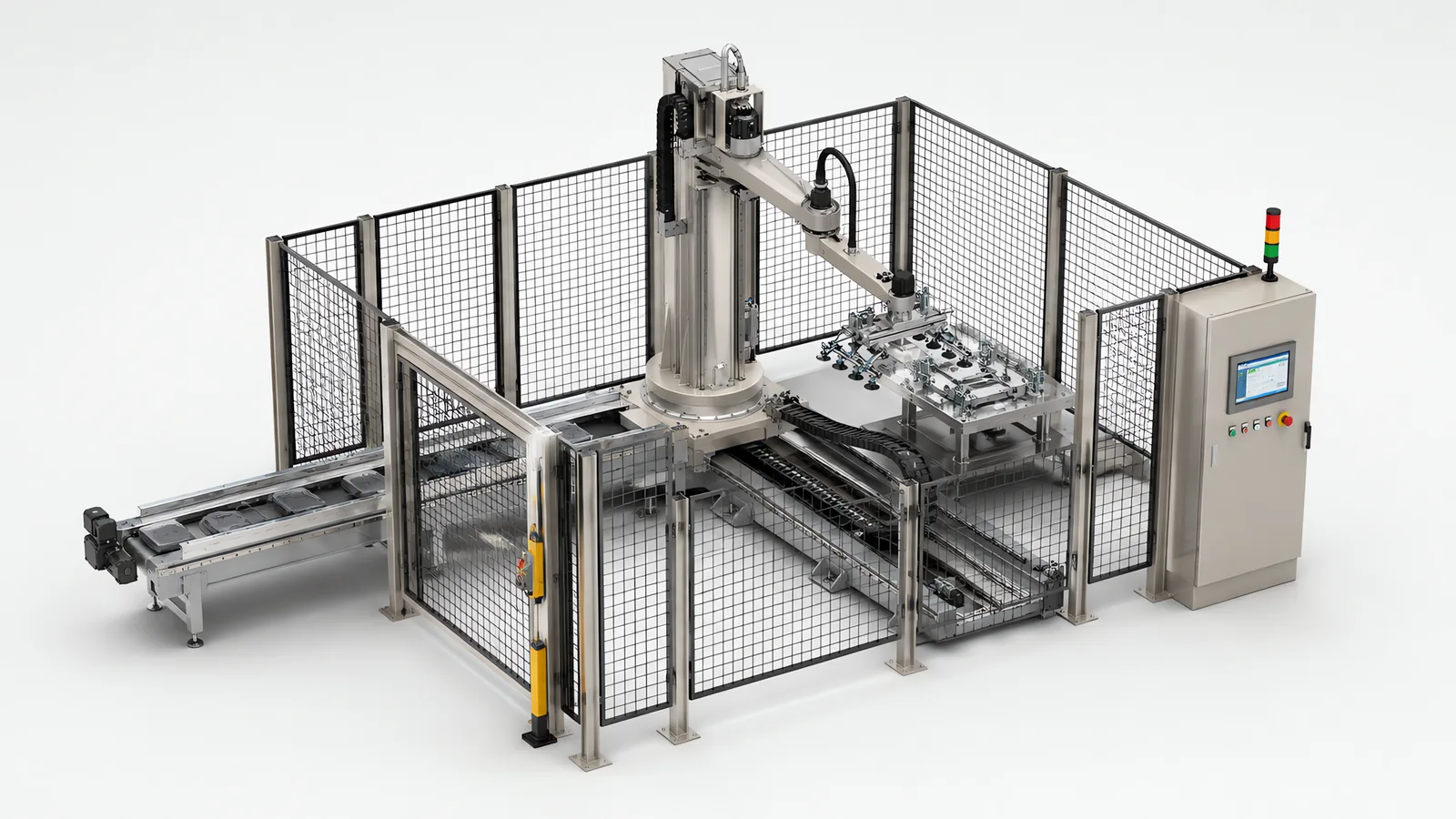
Motionwell Automation provides robot integration in Singapore as a design-and-build service: the cell layout, the end-of-arm tooling, the part presentation, the guarding, the control system and the commissioning that turn a bought arm into a station that makes rate. Delivered work runs from a four-axis column palletizing platform that stacks cartons from a purely vertical lift column on a heavy-duty linear track, through six-axis cells removing fasteners and extracting modules on a battery dismantling line, to collaborative arms tending laboratory instruments and unloading cartons. The arm was bought in every one of those. What decided whether the cell made rate was the part presentation, the tool and the handshake with the line above it. Grippers are bought in where a catalogue jaw closes on the part properly and designed here where it does not, which is a cost decision: a catalogue jaw arrives with a rated force and a spares path, and a designed tool arrives with neither until we write them. The cells are designed, assembled and tested at our Woodlands Link facility, and the company has delivered more than 150 special purpose machines since 2014 under ISO 9001:2015 and bizSAFE Level 3.
End-of-line stacking has its own selection logic on the automated palletizing systems page, robots tending instruments in a shared laboratory are covered under laboratory automation, and the safety workflow behind any guarded cell is on our machine safety and CE marking page.
What Does a Robot Integrator Actually Deliver Beyond the Arm?
Robotics integration is the engineering that turns a bought robot into a production station: it begins at the robot flange and at the signal boundary with your line, and it is finished when the cell has been proven on your own parts. The term names a scope of responsibility, which is why it covers fenced industrial cells, collaborative applications and mobile robots under one heading. It is often read as robot programming. Programming is one task inside it, and it sits alongside the mechanical, electrical, safety and control work set out below.
If you are still deciding what kind of supplier you need, start with what kind of automation company we are.
An arm out of a crate does nothing useful. It does not know where the part is, what holds it, what happens when it is not there, or what to do when a person opens a door. Every one of those answers is engineering, and it sits outside the robot vendor’s scope.
| Scope element | Who supplies it | What it decides |
|---|---|---|
| Robot arm and controller | Bought in on the platform your plant already maintains, or supplied by you | Payload, reach, speed envelope, safety modes available |
| End-of-arm tooling | Designed here, with catalogue grippers and vacuum components bought in wherever one covers the part | Whether the robot holds every part |
| Part presentation | Designed and built: feeders, trays, nests, escapements, conveyor squaring | Whether a pick is repeatable at all, and usually the largest single risk |
| Seventh axis or lift column | Designed and built: low-profile tracks, 100 mm profile height, plus or minus 0.5 mm repeat positioning | Whether one robot serves several stations |
| Guarding and safety circuit | Designed, built, validated and tested, including LVD and CE testing | Access strategy, stopping performance, residual risk |
| Cell controller and handshakes | Programmed on whichever PLC platform your plant already stocks and trains on | How the cell behaves when the line above or below stops |
| Vision and sensing | Specified and integrated, then proven on your parts under the lighting the cell will really have | Whether the robot knows what it picked and where it put it |
The arm is one line on the bill of materials. The engineering is in the other rows, which is why two quotations naming the same robot can differ by a wide margin without either being wrong.
One row deserves a note. Buying a bigger robot to cover a long part usually costs more than putting a normal robot on a track, and it does nothing for the multi-station case. Our low-profile track exists because a conventional seventh axis eats 200 to 400 mm of vertical working height straight out of the arm’s usable envelope; the delivered configuration runs 1.5 m or more of stroke on a 3 m track with 1.5 tonnes of platform load, and it runs as a coordinated external axis under the robot controller. That distinction is most of the value: an indexed track adds its travel time to every cycle, while a coordinated axis moves inside the arm’s own move and costs the cycle almost nothing. Reach and cycle time are then verified in offline simulation before anything is built, because a pose that cannot be reached is a mechanical problem.
How Does a Robot Brand Get Chosen, and Who Really Decides?
Application requirements narrow the field. Payload, reach, speed, precision, safety mode and cost usually leave two or three platforms standing. After that the decision belongs to your plant, and the deciding factor is normally the standard you already run: a platform your factory stocks spares for, trains on and has service cover for costs less to own than a cheaper unfamiliar brand, because the expensive parts of ownership are not on the purchase order. We ask which platform you run before we start selecting.
| Decision input | What it settles | Who owns it |
|---|---|---|
| Existing plant standard | Spares, training, programming environment, service response | Your maintenance and engineering teams |
| Payload at real centre of gravity | Whether the arm holds the part plus the tool at full extension | The integrator, from your part and tool data |
| Reach across the real layout | Furthest pick to furthest place, with fixtures and feeders in the way | The integrator, measured |
| Cycle time on the real part | Whether the station makes rate once vision, settling and handshakes are counted | The integrator, timed on your parts |
| Safety mode required | Fenced cell, or a collaborative application with a risk assessment behind it | Shared, decided by the ISO 12100 assessment |
| Customer-supplied arm | Whether the arm is bought at all | You, and it is a legitimate answer |
Motionwell integrates industrial six-axis, SCARA and collaborative robot arms from multiple manufacturers. Your plant standard, payload, reach, duty and support arrangements guide the platform choice. We design the end-of-arm tooling, fixtures and cell sequence, then implement the motion and safety configuration for the selected controller. On mobile robots, we have held an authorized AGV distributorship for Southeast Asia since 2017 and also integrate AMRs for flexible-routing applications. The material-flow options are set out on the warehouse and intralogistics automation page.
One boundary is worth being exact about: we have built cells onto customer-supplied arms, where the plant had already standardised on a platform and bought the arm itself. That is a different thing from stocking arms, and it moves one risk onto you, so we ask for the arm’s payload and reach data before accepting the split: if the arm turns out undersized once the tool is on the flange, the arm is already paid for.
Which Types of Industrial Robot Suit the Work You Are Automating?
Brand is the second question. Architecture is the first, and it is decided by the shape of the motion.
| Architecture | Where it earns its place | Where it stops making sense |
|---|---|---|
| SCARA, four axes | Planar pick, place, insertion and dispensing at speed; stiff in Z where screwdriving loads it | Changing approach angles, or payload and reach outside roughly 1 to 20 kg and 200 to 1,000 mm |
| Six-axis articulated | Changing approach angles, confined access, force-controlled process work, heavy payloads | Simple vertical stacking, where the extra axes are cost you do not use |
| Four-axis column palletizer | Fixed stacking patterns at continuous duty; a purely vertical lift is mechanically efficient | Bag palletizing, multi-face labelling, or placing into constrained spaces |
| Collaborative arm | Shared space, occasional intervention, tight footprint, redeployment between lines | Cycle time under pressure, or when the hazard is the payload or the tool |
| AGV or AMR | Moving material between cells | Anything needing a tool at the end of an arm |
Three structural arguments make that trade concrete, and none of them comes from a stopwatch on your parts. On the same standard test move a small SCARA completes its cycle in roughly half the time a comparable six-axis arm takes, which is why SCARA suits planar pick, place and insertion at speed. A four-axis column palletizer with a linear track costs less than an equivalent six-axis solution for standard carton stacking, and the saving is structural: fewer gearboxes, smaller servos because a counterbalanced column lifts straight up, and fewer controlled axes to buy, program and maintain. That is the reason we build our own column platform for fixed carton patterns. And above a certain sustained case rate the single vertical lift that makes a column platform cheap becomes the limit, at which point a dedicated articulated palletising arm buys the rate back with the gearboxes and the larger servos a counterbalanced column did without. Where that crossover falls on your line is arithmetic on your case list, done before either machine is quoted. The stacking comparison sits in the robotic carton palletizing case study, and the planar case in our SCARA robot guide for electronics.
Treat any datasheet cycle time as a floor. It is measured on a fixed gate-to-gate move with a dummy load and nothing else happening. Your real cycle adds vision acquisition and processing, settling before the vacuum releases, gripper actuation, the PLC handshake, and any wait on a conveyor or fixture. Those additions usually decide whether the station makes rate, which is why we time them on your parts before quoting a throughput figure.
Collaborative arms carry one constraint no purchase decision removes. An arm running as a power-and-force-limited application has its speed capped so any contact stays inside the ISO/TS 15066 limits, and that cap is the rate ceiling. You do not get around it by buying a faster arm. You get around it by adding guarding and speed, at which point you have built a small industrial cell with an expensive arm inside it.
A delta robot adds another architecture for suitable light-product picking, with a defined tracking window beneath the frame. Process-led cells have different requirements: robotic welding depends on joint access and torch condition, while robotic polishing depends on controlled contact and the required finish.
Tooling and sensing can decide the result before arm speed does. Vacuum gripper selection tests the product surface and leakage; vision guided robotics requires a calibrated path from image coordinates to robot targets. The machine vision vs computer vision guide separates the image algorithm from the acquisition, handling and control interfaces around it.
What Can a Robot Not Fix?
A robot repeats a motion. It does not create order that is not already there, and it does not absorb variation arriving from upstream, which puts six common complaints outside its reach entirely.
| What you see on the floor | What usually gets quoted | What is actually wrong | What fixes it |
|---|---|---|---|
| Parts arrive loose in a bin or a heap | A robot with a camera | Nothing presents the part in a repeatable pose | A feeder, tray or nest, or a flexible vision feeder that spreads parts flat before the pick |
| Runs well in commissioning, drops parts in month three | Retraining the robot | Floor markings wore, a rack leg was nudged, the tolerance stack moved | A docking feature, hand-eye vision measuring the real offset, and a compliant gripper for what is left |
| Robot waits, then rushes, then waits | A faster arm | Gaps in the upstream stream from rejects and stops | Accumulation and buffering sized as a design decision |
| Vision rejects climb across a shift | A higher resolution camera | Ambient light changed, or the fixture let the part sit differently | Controlled lighting, and a fixture that presents the part identically every cycle |
| Cycle time will not come down | A faster arm | The station waits on a cure, a test or a process dwell | Fix the process bottleneck; the arm is idle either way |
| The tool holds most parts | Tuning the vacuum | The tool was designed against the nominal part | Tooling designed against the full tolerance range, proven on samples |
Two engineering facts sit behind that table and both cost real money. First, feeding is chronically under-scoped: an arm is bought and taught while a feeder is drawn, cut and adjusted against real parts, and a feeder that presents a wrong-way part every fiftieth cycle costs far more than it looks like it should, because every one of those is either a jam or a reject. Second, inspection stations that fail in production usually fail because the ambient light changed or the fixture let the part sit differently. How cameras get specified, lit and calibrated against that is on our machine vision inspection page.
The tolerance stack is the version that catches mobile robots, where an AMR parks to within about plus or minus 50 mm and an arm has to reach into a rack slot to a fraction of a millimetre. Skipping the vision correction is how a cell passes commissioning and starts dropping samples in month three, and the QA lab automation programme is built around exactly that layering.
What Does the End-of-Arm Tool Decide?
It decides more of the outcome than the arm does, and on a mixed line it is rarely something you can buy off a shelf unchanged.
Start with the payload budget, because this is where projects go wrong before anyone opens CAD. Rated payload is measured at the tool flange and your gripper hangs off that flange, so whatever the tool weighs comes out of the budget left for the part. Rated payload also assumes the load sits close to the flange, so a wide part pushes the centre of mass out and the resulting moment is what limits the arm. Do the arithmetic with your heaviest part and your real reach. If the heaviest item only just fits, it does not fit.
Tool families follow the part. Vacuum is the default on sealed cartons and flat rigid surfaces, with pneumatic side clamping where the top face is unreliable: a scuffed, printed or partly open top face leaks, and a cup that leaks releases the carton somewhere above the pallet. Mechanical gripping covers trays, totes and bare product where vacuum has nothing to seal against, and a catalogue gripper is the right answer whenever one fits, because it arrives with a rated force, a published cycle life and spares your storeman can order against a part number. Where the arm has to tighten something the tool becomes an instrument: on the SCARA sensor panel line torque-controlled electric screwdrivers work to a target set per fastener in the recipe, with the result recorded against the panel serial number, and on the battery dismantling line torque-controlled nutrunners on the robot flange log torque and angle per fastener against the pack barcode.
Mixed-format lines get two workable options: one combination tool that compromises on every format, or a quick-change interface with a small tool rack, and changeover frequency decides which wins. We have delivered a cobot unloading station for a consumer goods distribution centre using a quick-change tool with a five-magnet electromagnet that switches between gripper and vacuum modes on its own, reconfiguring from a tool rack per carton on a barcode read.
One safety consequence belongs here, because it changes the mechanical design. End-effector geometry, workpiece edges and clamping forces all drive contact severity in a collaborative application, and long, thin or pointed tools concentrate force to the point where some geometries cannot pass a transient contact assessment at all.
Automatic tool exchange needs verified locking, utilities and identity before motion. robot tool changer checks distinguishes retention after supply loss from readiness to operate.
Magnetic holding depends on ferromagnetic material and real contact conditions. magnetic gripper qualification tests thickness, gaps, double picks and release.
A robot repeats motion around a separately qualified soldering process. soldering cell coordination covers tip access, consumables and interrupted-board handling.
How Does a Robot Integration Project Actually Run?
The sequence below is how we scope and run this work, and each phase has a review gate.
Concept design, 2 to 4 weeks. Process flow with cycle time per station, a preliminary 3D layout showing footprint and operator access, robot and major component selection, a risk register and a rough order of magnitude budget. This is the cheapest place in the project to change your mind, and reach gets checked here while layout is still free to move on a screen.
Detail engineering, 4 to 6 weeks. Full mechanical design in SolidWorks, electrical schematics, pneumatic layouts, control architecture, safety circuit design and the bill of materials. The largest schedule risk in the project appears at this gate: late finalisation of product design. If the part geometry changes after detail engineering begins, the tooling and usually the fixture change with it, so freeze the product first.
Fabrication and assembly, 6 to 8 weeks. Precision components machined to our own drawings by qualified machining partners, standard components sourced from approved suppliers, and the cell assembled and integrated in our own Singapore facility, following a documented build procedure with quality checkpoints.
Testing and commissioning, 2 to 4 weeks. Factory acceptance testing at Woodlands Link, witnessed by you, against the agreed cycle time, accuracy and repeatability. Then installation, site acceptance testing with real production material, operator training and the documentation pack. In regulated production, IQ and OQ protocols are prepared and PQ is supported with your quality team.
End to end, a simple one to three station cell runs 12 to 16 weeks from concept to factory acceptance, a medium multi-axis cell 16 to 24 weeks, and a complex integrated cell with vision and multiple robots 24 to 32 weeks, with 4 to 8 weeks added where GMP or cleanroom validation applies. The wider version of this process is in our guide to special purpose machine design.
What Safety Obligations Arrive With a Guarded Robot Cell?
They arrive with the robot, and they are the part of the scope most often discovered late.
Start from an ISO 12100 risk assessment and let the assessment drive the design. ISO 10218-1 then covers the robot itself and ISO 10218-2 covers the robot system and its integration, which is the part a machine builder owns. Each safety function is rated for performance level under ISO 13849-1, and on both of the delivered robot cells described below that assessment landed on Performance Level d.
Two edition facts matter this year if you are writing a specification. ISO 10218-1:2025 was published in February 2025, the third edition and the first substantive revision since 2011; it adds robot classifications with matching functional safety requirements, safety-related cybersecurity requirements and end-effector guidance, and most of what ISO/TS 15066:2016 said about collaborative operation moved into Part 2. It references the 2023 edition of ISO 13849-1 for control system safety functions, so a design still documented against the 2015 edition will need its performance level calculations restated when the machine is reassessed.
The physical scope includes guards, interlocked access doors, light curtains or scanners, and safety-related control functions. We define each function from the cell risk assessment, allocate it to suitable hardware and verify the completed circuit. Robot-integrated safe speed, standstill and axis-range functions can support the design alongside external protective devices. On applications such as battery module dismantling, access control, workpiece hazards and stored energy are assessed together. Stopping time is measured on the built cell, with the stop sequence and load-holding behaviour recorded in the validation tests.
Scanner and light curtain positions are calculated. ISO 13855 sets the minimum distance from the approach speed constant, taken as 2,000 mm/s up to 500 mm and 1,600 mm/s beyond, plus the stopping performance measured on the built cell. Guess it and you build a guard that looks right and stops too late.
For collaborative applications the distinction that matters is that there is no safe robot, only a safe application. A force-limited arm says nothing about the gripper, the workpiece or the fixture, and four collaboration modes are recognised, most cells using more than one in sequence. That assessment is worked through in our guide to collaborative robot safety standards.
Singapore does not require CE marking, but the Workplace Safety and Health Act requires dangerous parts of machinery to be securely fenced and places duties on the occupier and on anyone supplying machinery for use at work; most multinationals here specify CE conformity as an internal standard anyway. The machine builder’s share of that work is ours: the risk assessment, the architecture, the validation and the technical file.
How Does a Robot Cell Tie Into Controls You Already Run?
Much of the robot integration work we take on is a retrofit into a running plant, so the interface is the project. The pattern we build to keeps motion and logic separate: on the delivered palletizing cell the cell PLC sequences the stations while the robot controller owns the arm’s motion, the two talking over industrial Ethernet, so the PLC never interpolates robot moves itself. That split costs one network interface and buys two things: a pallet pattern can be changed without re-testing the line logic, and your maintenance team can retrain the arm without opening the code that owns the interlocks. The cell PLC owns the handshakes with your line: part ready, cell ready, buffer full, fault, reject asserted. Agree who owns each of those signals in writing before either side is built, because an unowned handshake surfaces on your floor.
Control system modernisation of existing machines, replacing ageing PLCs, servo drives and VFDs on the platform the plant maintains, is our largest line of work this year. For a robot-cell tie-in, we survey the existing controller’s support status, spare I/O, program access and safety interfaces. That survey determines whether to extend the current controls or include a controller migration in the integration scope.
One regulatory point belongs in the kickoff meeting. The European Commission states that the Machinery Directive applies to products placed on the market for the first time or when existing machinery is modified to such an extent that it becomes de facto new machinery. Adding a robot to a machine signed off years ago can cross that line, which puts the party doing it in the position of placing new machinery on the market with the conformity work that follows. Where the line sits is a judgement made per project, and it has to be settled before the scope is fixed. The Directive applies to the EU market until 19 January 2027, after which Regulation (EU) 2023/1230 applies with no transitional period.
What Drives the Cost and Lead Time of a Robot Integration Project?
Robot integration cost follows the handling, tooling, safeguarding and interface work around the arm. The table below identifies the decisions to settle before comparing quotations.
| Cost driver | Why it moves the number |
|---|---|
| Part presentation | A part arriving in a nest is cheap; a part arriving loose brings a feeder, a tray system or a vision feeder |
| Part and format count | Each format may need its own tool, fixture and vision recipe, and format count costs more than it looks |
| Cycle time target | Sets the robot class, and decides whether guarding is optional or mandatory |
| Safety strategy | A fenced cell with scanners and locking doors versus a collaborative application with a clean risk assessment |
| Reach and multi-station duty | A seventh axis or lift column where one arm serves positions outside a single envelope |
| Vision scope | Presence checking alone versus guided picking, identifier reading and post-place verification |
| Retrofit archaeology | On legacy machines, working out what the existing circuits do before replacing them is frequently the largest single item in a retrofit safety scope |
| Validation and documentation | IQ/OQ/PQ evidence is a documentation project running alongside the build |
Lead time follows the phase table above: 12 to 16 weeks for a simple cell, 16 to 24 for a medium one, 24 to 32 for a complex integrated cell, plus 4 to 8 weeks where validation applies.
Where Does a Packaged Cell Beat a Designed One?
Wherever a distributor’s packaged cobot cell or a standard machine serves the application better and cheaper than a custom build, and that is the recommendation you get at concept review. The condition is a settled duty: one part family, one presentation, a rate inside the packaged cell’s published envelope and an environment it was built for. Move any of those and the packaged cell starts needing the engineering it was bought to avoid. The same split runs at the end of the line, where case packing and wrapping is a mix of what we build and what we integrate.
What stays inside our scope either way is the control and recipe software, and the vision specification: the camera, the lens and the light chosen for your part, with the result proven on it before handover.
Standards Used in Machine Design and Validation
These references inform the design, testing and documentation described on this page. Each row links to its primary source and records the edition checked.
| Standard | Current edition | What it means for your machine |
|---|---|---|
| ISO 10218-1: Robotics, safety requirements, Part 1: industrial robots | ISO 10218-1:2025 | Published February 2025, the third edition and the first substantive revision since 2011. It adds robot classifications with matching functional safety requirements and safety-related cybersecurity requirements. Most of ISO/TS 15066:2016 on collaborative operation moved into Part 2.Checked 12 Sep 2026 against ISO 10218-1:2025 (iso.org/standard/73933.html) |
| ISO 13849-1: Safety of machinery, safety-related parts of control systems | ISO 13849-1:2023 | Provides the design method for safety-related control functions, including architecture, component reliability, diagnostic coverage and common-cause failure measures. The machine risk assessment establishes the required Performance Level; design calculations and validation provide the evidence for each function.Checked 1 Sep 2026 against ISO 10218-1:2025 normative references |
Frequently Asked Questions
What does a robot integrator deliver that the robot supplier does not?
Everything around the arm: the end-of-arm tool, the mechanism that presents the part the same way every cycle, the cell frame and layout, the guarding and safety circuit, the cell PLC and its handshakes with your line, the vision that confirms what the robot is holding, and the commissioning that proves cycle time on your parts. A robot vendor sells the arm, the controller and the programming environment. Motionwell buys those and designs the rest, taking a catalogue gripper wherever one closes on the part properly and designing tooling only where the part defeats a standard jaw. The useful test when comparing quotations: ask who owns the cycle time number on your actual parts.
Which robot brand should we specify for our cell?
Usually the one your maintenance team already stocks spares for and has been trained on. Selection is driven by payload, reach, speed, precision, safety mode and cost, but when two platforms both clear those requirements, the existing plant standard wins on cost of ownership because spares, training and support already exist. Motionwell manufactures no arms and is tied to no single platform, so adopting your standard costs us nothing in the concept, and we have built cells around arms the customer had already bought. Tell us your site standard at enquiry stage so it lands in the concept.
Will a robot fix a throughput problem?
Only if the constraint is the motion, and it usually is not. A robot repeats a motion accurately; it does not create order that is not already there. If parts arrive in a heap, the cost lands on the feeder or the tray. If upstream stops leave gaps in the stream, the robot waits through every gap. If the station waits four seconds on a cure, a test or a dwell, a faster arm buys nothing at all. Count how many parts per minute reach the pick point in a usable presentation before you compare arm cycle times.