
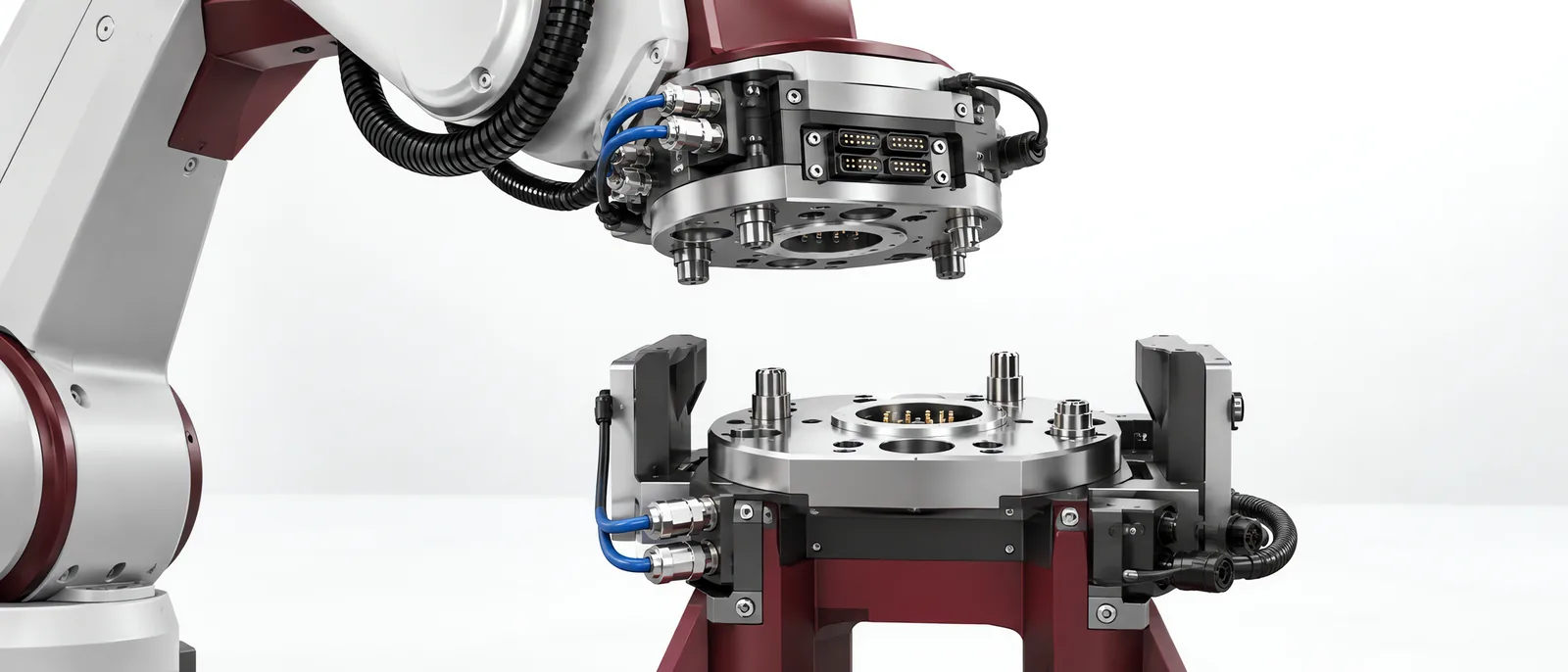
Conceptual equipment illustration.
A robot tool changer needs to connect the tool mechanically, transfer its utilities and confirm the correct locked state before the robot moves. Select it from the complete tool load and operating sequence, not only the quoted payload. The tool’s mass, centre of gravity and dynamic moments all matter to the configured connection.
The changer belongs within robot integration and the wider end-of-arm tooling design.
Map the Connections for Each Tool
List air, vacuum, electrical power and signals required by every tool. Confirm the connector capacity and the connection/disconnection sequence. A mechanical plate that locks correctly does not prove that an electrical contact or pneumatic path has engaged.
Give every tool an identity and associate it with the correct robot programme and payload setting. A station should distinguish an empty docking position, the wrong tool and a tool present but not securely connected.
Retained Is Not the Same as Ready to Operate
ATI’s QC-76 manual describes a fail-safe feature that retains the tool plate after loss of locking air. It also states that positional accuracy is not maintained in that condition and operation should stop until pressure and secure locking are restored.
That retention behaviour belongs to the specified model and mechanism. For the selected equipment, identify what happens when locking power or pressure is lost and which signals establish readiness afterwards.
Do not reduce several states to one “tool present” bit. The control sequence needs the connection states relevant to the mechanism.
Trial Docking and Interrupted Changes
Test the docking station across the allowed robot approach and tool-placement variation. Look for cable loads or hoses pulling a parked tool out of position. The stand should support the tool in the intended orientation before unlocking.
Include these interruptions in the acceptance sequence:
- A tool missing from its stand.
- Lock or unlock confirmation unavailable.
- A utility connection that fails to establish.
- Loss of supply during a change or subsequent operation.
Record the recovery state and how the system confirms the tool before restarting. An interrupted programme should not resume a motion that assumes a successfully completed change.
For machine tending, verify the tool identity against the machine operation, such as gripping a raw or completed part. The payload and approach can differ between tools.
The robot-safety standards guide gives the broader cell context. A changer’s retention mechanism is only one part of the robot and machine sequence.
Contact Motionwell about the tool-change task to discuss the tools, stand and required utilities together.