
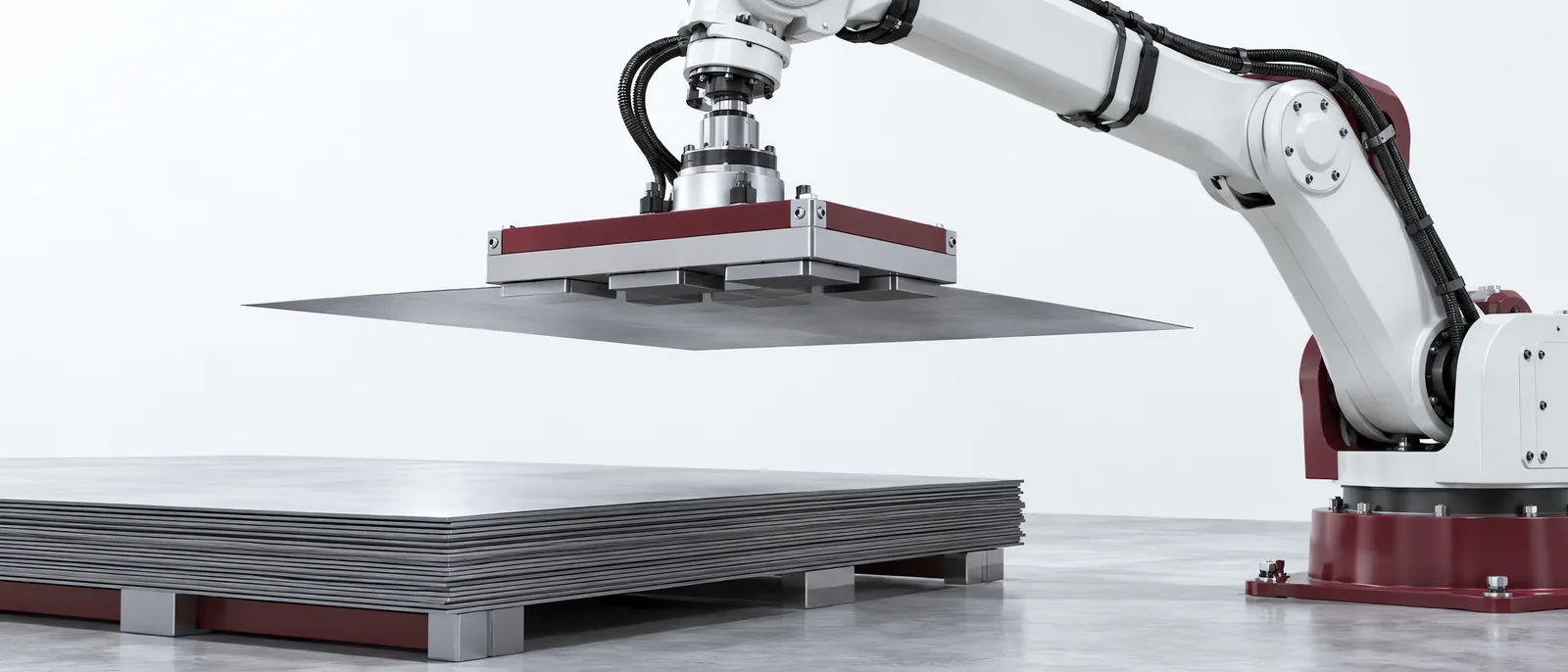
Conceptual equipment illustration.
A magnetic robot gripper is an option for ferromagnetic workpieces when their material and contact geometry support the required holding force. It is not a general solution for all metal parts. Check the actual alloy, thickness and surface before comparing catalogue holding figures.
In robot integration, the gripper must keep the part controlled through pickup, movement and release.
Identify the Magnetic Mechanism
Electromagnetic, electro-permanent and pneumatically switched permanent-magnet grippers have different switching and supply requirements. Schmalz’s magnetic-gripper overview describes a permanent magnet moved by compressed air. That mechanism should not be generalized to every magnetic gripper.
Confirm the selected unit’s state after a loss of power or air, how its state is sensed and how it releases the workpiece. Retaining a magnetic state is not proof that every downstream cell action remains controlled.
Use the Real Contact Condition
A holding-force figure depends on the manufacturer’s stated test material and geometry. A thinner part, coating, rough surface or gap can change the magnetic circuit. Test the permitted workpiece extremes in the direction and acceleration of the intended motion.
Include the moment created by an off-centre part. A pull force normal to a flat test plate does not establish resistance to peeling or sliding in your installation.
The EOAT design scope covers the full load path from robot flange to workpiece. Check the mounting as well as the gripping face.
Make Double Picks Visible
For stacked sheet handling, test whether the magnet lifts one sheet or several. Establish a suitable separation and single-part check before allowing the next operation. An active gripper signal does not count the sheets attached to it.
Observe release under the actual fixture and placement conditions. The part must reach its support before the gripper disengages, and residual attraction must not pull it back as the robot withdraws.
A vacuum gripper provides a different comparison where the material or contact surface makes magnetic handling unsuitable. It has its own sealing and supply requirements, so the alternative also needs a part trial.
Record the Handling Window
Keep the gripper model, pole arrangement, part specification and validated robot motion with the recipe. Changing the part’s material or thickness changes that qualified configuration.
For machine tending, include unavailable pickup, double pickup and failed release in the interface test. A machine should receive a confirmed correctly presented part, not just a robot cycle-complete signal.
Discuss the handling task with Motionwell to evaluate the gripping principle and the checks around it.