
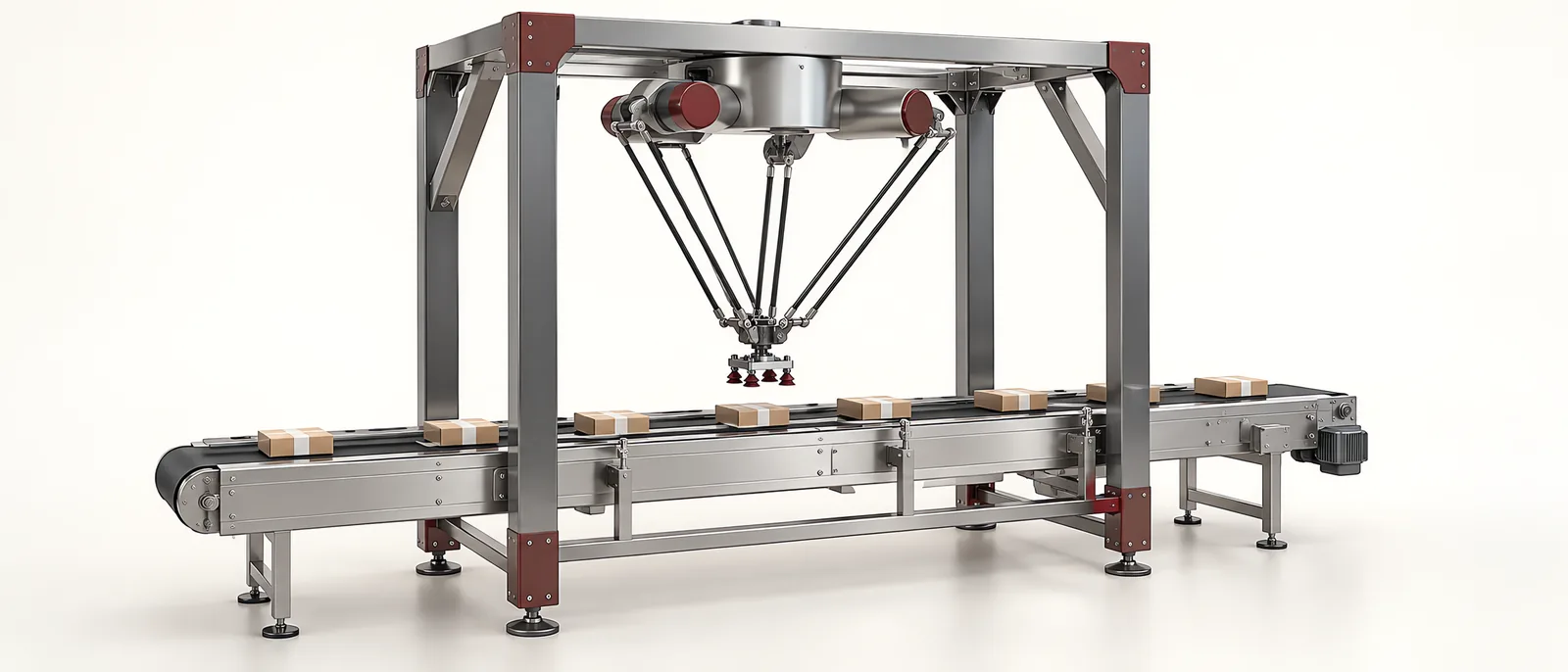
Conceptual equipment illustration.
A delta robot is a parallel-arm robot commonly used for repeated picking and placing of relatively light products. Its suitability depends on the complete motion: where the product becomes visible, where the tool can reach it, and how the robot must orient it at placement. A fast catalogue cycle cannot answer those questions on its own.
For a packaging application, start with a drawing of the product flow and a list of permitted product orientations. That establishes whether the task fits a delta arrangement or needs another of the industrial robot types.
Draw the Picking Window Before Selecting Reach
Mark the camera position, conveyor direction, usable robot workspace and destination on the same layout. On a moving belt, a detected product remains available only while it is within the reachable picking region. The controller needs enough time for image processing, target selection, approach and gripping before that opportunity passes.
A wider nominal workspace can help, but mounting height, tool length and surrounding equipment change the usable region. Check the edges as well as the centre. Include the tallest product and any fixture that the tool must clear during placement.
The ABB IRB 360 family illustrates why the exact variant matters: payload, workspace and available axes differ within a delta product range. Rotation capability should therefore be checked on the proposed model, not assumed from the robot category.
Account for the Tool at Full Speed
The robot carries the gripper, adapters and attached services as well as the product. An array gripper that picks several packs at once changes both load and clearance. A tall or offset tool also changes the moments applied at the flange.
Test the intended acceleration with the actual gripping method. A soft pouch may remain attached during a slow demonstration but move within the cups during a production-speed turn. Record missed picks, product movement and release reliability separately; all three can reduce usable output without a robot fault.
Tracking Starts With Reliable Product Presentation
Conveyor tracking needs a consistent relationship between the measured belt movement and the product location. Product sliding, touching packs and variable separation can make that relationship difficult to maintain. Feeding changes may solve more than an additional robot would.
The part feeding and presentation scope addresses orientation and spacing before the picking station. For each product family, identify whether the cell receives an ordered stream, separated random positions or overlapping items. Those are different vision and handling tasks.
Delta or SCARA?
| Production task | What to examine first |
|---|---|
| Repeated transfers across a moving stream | Delta workspace, tracking and grip reliability |
| Placement into a close-fitting assembly nest | Insertion direction, fixture alignment and allowable contact forces |
| Substantial product reorientation | Required axes and collision-free tool orientation |
| Mixed products with different heights | Reach throughout the height range and changeover method |
A SCARA electronics assembly cell may be a better starting point for a constrained assembly task. The choice should follow the path and process forces, not a blanket claim that one robot type is faster.
Test the Cell When the Flow Is Uneven
Run a trial containing gaps, dense groups and products at the outer edges of the permitted belt region. Check what happens to a product that cannot be picked, how the system prevents duplicate picking, and how tracking restarts after a conveyor stop.
Measure accepted placements over the full trial, including missed products and recovery time. A short sequence of successful centre-of-belt picks does not reveal the capacity of the complete cell.
For the machine layout, controls and downstream handover, see our robot integration services. Talk to Motionwell about your picking process.