
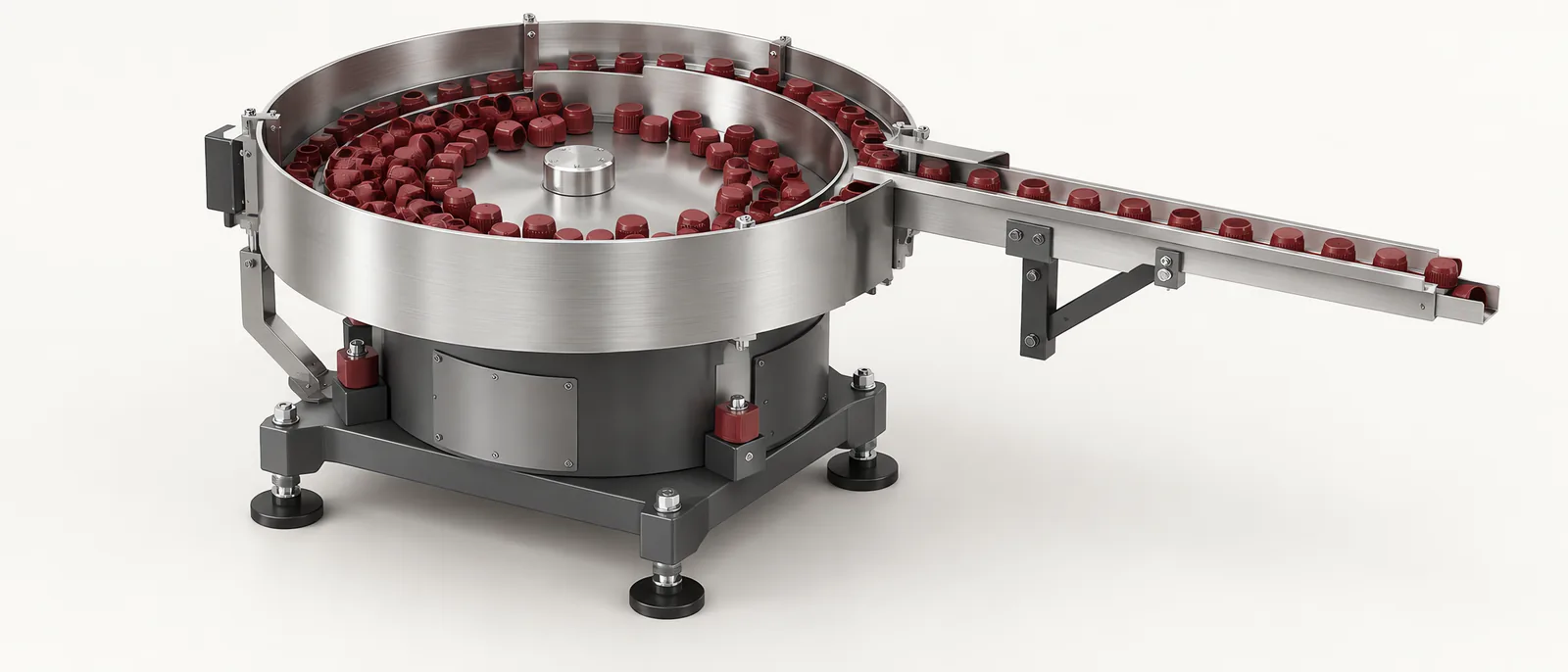
Conceptual equipment illustration.
A centrifugal feeder uses rotary motion to move bulk parts towards a peripheral track, where tooling separates and orients them for discharge. It can suit a sustained flow of suitable components, but useful output means correctly oriented parts at the receiving machine, not simply parts moving around the bowl.
Begin with the required orientation and the features that make it distinguishable. A cap with an obvious open face presents a different sorting problem from a nearly symmetrical component with a small hidden feature.
Establish Whether the Part Can Be Sorted Reliably
Examine size variation, centre of gravity, friction, flexibility and the tendency to nest or interlock. Include the condition in which parts arrive from storage. Static, residue or damaged edges can change how they move through the tooling.
The rotating-disc and peripheral-bowl arrangement is illustrated in the Hoppmann FS-60 feeder manual. Its particular setup details belong to that feeder; the general selection task is to prove the route from bulk loading to the required outlet orientation.
Trial enough parts to observe recirculation. If many parts repeatedly fail the orientation tooling, increasing the disc speed may increase circulation without providing the required discharge rate. Check handling marks as well as output.
Define the Feeder’s Output Boundary
A useful feeder specification names the point where the part is available to the next operation. State the required orientation, spacing and queue capacity at that point. The downstream machine may need a single part isolated in a nest, not a continuous touching stream.
The part feeding and presentation page covers the wider choice between feeding methods. A centrifugal feeder should be selected for the part and demand pattern; it is not a universal upgrade over a vibratory bowl or a flexible feeding surface.
For rotary indexing assembly, the escapement or handover must supply the correct part at each required index. Test the feeder with the assembly machine’s actual stop-start demand.
Check These Four Operating Conditions
Normal drawdown: Confirm sustained correctly oriented output with the hopper and bowl operating in their intended ranges. Record starvation at the receiving point separately from feeder faults.
Downstream stopped: Verify that the outlet queue does not force parts into an unstable arrangement. Determine when the feeder slows or stops and how it restarts as space becomes available.
Low bulk level: Observe whether output and orientation change as the supply reduces. Refill sensing should give the system enough time to recover without a sudden loss of parts.
Interrupted feed: Introduce the permitted difficult samples and test the agreed recovery procedure. Check that the operator can identify and clear the affected area without disturbing unrelated settings.
These behaviours should also be included in a packaging-line integration specification, especially where the feeder supplies closures or other format-dependent components.
Treat Changeover as a Physical Task
List the guides, pockets, tracks and settings that change between part families. Give removable tooling a defined location and identity. Verify the first correctly oriented parts after a change, including the least favourable size variation.
Cleaning access matters where debris or residue changes friction. Inspect areas that retain small parts so that an old format does not reappear after the next batch starts. Record the removal and refitting procedure during acceptance.
For custom automation, the feeder, buffer and receiving station form one supply system. Talk to Motionwell about your component and feed rate.