
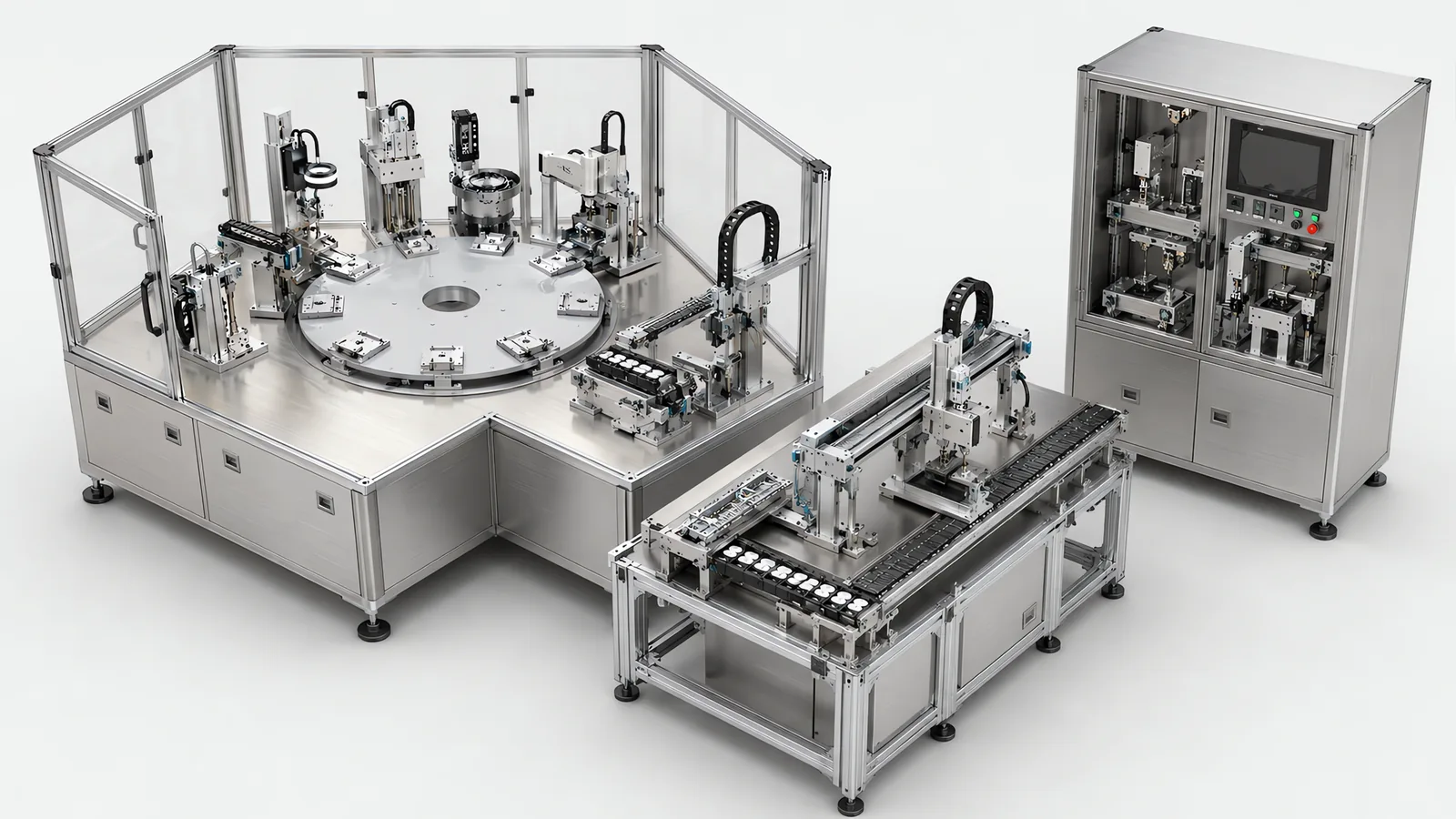
Motionwell Automation develops custom automation solutions in Singapore for production tasks that need purpose-built tooling, handling or controls. The starting point is the result you need to change: output, quality, changeover time, unattended running or material loss. We use that requirement to compare a fixture, an existing-machine retrofit, standard equipment and a custom build.
Delivered work ranges from five-axis shot peening and a gantry serving more than ten CNC machines to three-head filling and sealing, jigs and gauges. Design, assembly and testing take place at Woodlands Link. The sections below help turn an initial production problem into a scope that can be discussed and priced.
The fastest self-diagnosis is one sentence. Name the thing that has to change, in a unit somebody already measures: units per hour, escapes per million, minutes per changeover, hours of unattended running, or dollars of giveaway. If that sentence exists, the rest of this page will point you at the right family of work in one click. If it does not exist yet, the first section is the one to read, because a machine is not always the answer and a fixture sometimes is. The full index of what we build is the capabilities hub; this page is the narrative route into it.
Is This Actually an Automation Problem?
Sometimes it is not, and the cheaper answers deserve a hearing before a machine does.
Start by separating the symptom from the constraint. A station that people complain about is not necessarily the station that limits the plant, and lifting a station that is not the bottleneck converts capital into inventory. The arithmetic for that, along with the benefit terms that usually matter more than the labour line, is on our automation ROI page.
What is worth setting out here is the set of answers that are not machines.
A fixture or a jig, where the problem is variation. If parts are being scrapped because an operator holds them differently on a Friday afternoon than on a Tuesday morning, the defect is in how the part is located, and locating it properly is a workholding job. The discipline is real engineering: on a multi-station rotary assembly machine, for example, the nest contact surfaces carry the tightest tolerances on the dial, because every micron of slop in a nest is spent before any sensor gets a chance to read the part, and the reasoning behind that is set out in how we design multi-station rotary assembly machines. We machine custom jigs, fixtures, gauges, pallets and alignment tools alongside the machines we build, and the first medical work this company took in 2015 was exactly that, customised fixtures and inspection tooling.
A change to the product or the process, where the machine would be paid to absorb a decision nobody made. Two versions of it are worth naming. A pack whose printed code position ends up under a shrink band, a tamper seal or a cap skirt is not a coding machine problem; walking the pack through every downstream station with a marker pen on the intended code position settles it before anyone orders equipment. And a product design that is still moving is a reason to wait, never a reason to specify, because a geometry change after detail engineering has begun changes the machine.
A control system retrofit, where the mechanics are sound and only the controls are obsolete. This is our largest line of work this year. What decides it is rarely the controller: it is whether the mechanics have life left in them, because a retrofit buys new control onto old wear, and a machine whose ways and ballscrews are worn will hold a new position no better than it held the old one. The decision between that and a new build is worked through on the retrofit versus replace page and the scope itself on the machine retrofit and modernisation page.
A catalogue machine, or a semi-automatic station that leaves handling to an operator. On drum and pail filling, a semi-automatic weigh-fill station gives you the same dosing controller, the same nozzle and the same accuracy as a full line and leaves container handling to an operator with a pallet truck, because container handling is the expensive half. The thresholds that close the catalogue option, and the ones that do not, are set out on our custom machine versus standard equipment page.
None of those four is a consolation prize. Each is a smaller commitment that solves the stated problem.
Which of the Four Shapes Does Your Enquiry Take?
Where the answer is a machine, four problem shapes are worth telling apart, because each one routes to a different family of work and each one is scoped against a different number.
The first is a manual station that cannot keep up. The stated problem is rate, and the number is sustained units per hour. Cases stacked by hand onto pallets, machine tools loaded and unloaded between cuts and samples walked between instruments in a laboratory all sit here. What gets built is a handling cell sized from your case list or machine list, and the sizing is arithmetic. The delivered column palletizing platform stacks cartons onto pallets at a rate set by your case weight and layer pattern; the linear gantry series serves a row of machine tools from one beam; a compound autonomous mobile robot and collaborative arm move samples between racks and instruments in a QA laboratory while technicians work in the same room.
The second is a quality escape that inspection cannot catch. The stated problem is a defect that reaches a customer, and the number is escapes. The defining feature of this shape is that the defect is invisible at the point it is created. An under-torqued closure looks identical to a correct one and leaks three weeks later in somebody else’s warehouse; an under-tightened fastener looks fine and loosens in service. Adding an inspection step downstream rarely addresses it, because by then the defect is already inside the product. What does address it is instrumenting the process that creates the defect, so that the machine records what actually happened, and never only what the part looks like afterwards: a full force-displacement curve captured at every press-fit station is the pattern, and a capping head or a screwdriver should record its torque the same way. Vision then judges what is visible, and the boundary between the two is the design question.
The third is a process nobody sells a machine for. The stated problem is that the sequence exists in your process sheet and in nobody’s brochure. There is no installed base to buy from, so the enquiry starts at feasibility. Our own work at the awkward end of that runs from one delivered line to two development programmes: a battery module dismantling line where the workpiece cannot be switched off, with modules of 30 to 80 kg and a pack carrying 400 V and above; force-controlled robotic grinding of CFRP composite panels holding 100 N constant contact force through the tool path, developed with A*STAR SIMTech on the Aerospace Open Innovation Challenge 2024; a nacelle paint-removal robot working from colour-vision feedback. This shape needs a proving trial in the schedule and not only a design phase, and the trial is what turns an opinion about feasibility into a number.
The fourth is a line that has to change faster than it can. The stated problem is mix, and the number is minutes per changeover multiplied by changeovers per week. A machine optimised for one part number is the wrong machine here, and buying a faster one makes the problem worse. On the cleanroom automated test equipment build, a dedicated gantry would have been faster per cycle and was still the wrong answer, because mixed connector types with modest volume per variant meant the loading device had to be reprogrammable, so a collaborative arm holding plus or minus 0.05 mm at the fixture interface was specified instead. What gets given up is peak throughput on any single high-volume part number, which is the trade this shape makes.
| The shape | What it sounds like | What usually gets built | Where it is described in full |
|---|---|---|---|
| A manual station that cannot keep up | “We cannot hire enough people to stack these” | A handling cell, a palletizer, a tending gantry or a robot on a track | Palletizing systems, machine tending automation, robot integration services |
| A quality escape inspection cannot catch | “It passes here and fails at the customer” | An instrumented process station that records what it did, with vision judging what is visible | Machine vision inspection, inline dimensional measurement, surface defect inspection |
| A process nobody sells a machine for | “We asked four suppliers and none of them do this” | A special purpose machine, usually preceded by a proving trial | Custom machine versus standard equipment, special purpose machine design |
| A line that has to change faster than it can | “We lose two days a week to format changes” | Format parts, recipe-driven changeover, or a reprogrammable cell | Filling line changeover, collaborative robot applications |
These are not exclusive, and the pairing worth testing for is a rate problem that is really a changeover problem. The two lead to different machines, so establish which one you have before a cell is sized.
Within a new assembly machine, press-fit equipment controls the joining load path, while the heat staking vs ultrasonic welding comparison starts with the required joint function. Once ultrasonic plastic joining is selected, the ultrasonic welding machine guide covers tooling, process control and recovery.
Component supply and product mix need their own decisions. A centrifugal feeder must demonstrate usable outlet flow, and flexible vs fixed automation compares the physical and software work involved in a named product change.
What Do We Need Before a Number Can Exist?
Six items, and none of them is a budget. A quotation is an engineering answer to a stated requirement, so the requirement has to exist first.
| What to send | What it decides | What happens without it |
|---|---|---|
| A drawing or a physical sample, with the feature that has to be held | The gripper, the nest, the fixture and the tolerance stack | The mechanism cannot be chosen, so any number is a guess |
| Sustained units per hour, and shifts per day | Station count, cycle time budget, and whether one unit covers the job | A peak figure sizes a machine you will pay for without using |
| The space, with floor area, clear height and what is already overhead | Whether the layout is possible at all, and which kinematics survive | Cranes, ducting and sprinklers become a redesign after the concept is approved |
| The interface to your existing line: conveyor height, controller make and vintage, and the signals to be exchanged | The control architecture and the boundary of the scope | The interface becomes the project, discovered during commissioning |
| Whether every unit has to be provable afterwards, and to which rule | Record architecture, access control and validation scope | Logging depth cannot be added cheaply to a machine that was not built for it |
| The variants you actually run, plus the one genuinely on the roadmap | Change parts, recipe structure and how much flexibility to build | You either pay for flexibility you never use, or rebuild for the variant nobody mentioned |
One item sits outside that list and outside the schedule. Where an inspection station is involved, a signed-off limit sample set shortens the project, and sample collection sits outside the build schedule, which is why it should start at the enquiry and never wait for the purchase order. How to turn all of this into a document a builder can quote against line by line, and what makes competing quotations comparable, is on our guide to writing an automation URS.
At concept stage, the motion itself helps define the machine cost. Our pneumatic cylinder and electric actuator comparison separates simple end-to-end movements from duties that need programmable positions or force feedback.
How Is the Work Staged From Concept to Commissioning?
Four phases, each ending in something you approve.
| Phase | Duration | What it produces | What you are approving |
|---|---|---|---|
| Concept design | 2 to 4 weeks | Process flow, station layout, cycle time analysis with the bottleneck identified, preliminary component list, risk register and a budget range | That the machine described is the machine you want |
| Detail engineering | 4 to 6 weeks | Full 3D mechanical design, electrical schematics, pneumatic layouts, control architecture and the bill of materials | The specification every component is then bought against |
| Fabrication and assembly | 6 to 8 weeks | Machined parts to our drawings, standard components procured, machine assembled, wired and programmed | Progress against a documented build procedure with quality checkpoints |
| Testing and commissioning | 2 to 4 weeks | Factory acceptance testing at Woodlands Link, then installation, site acceptance testing on real production material, training and the documentation pack | That the machine holds the agreed cycle time, accuracy and repeatability on your parts |
Lead time runs 16 to 24 weeks from concept approval to factory acceptance testing on a standard build, and 24 to 32 weeks where cleanroom compatibility or full validation documentation applies. Design, fabrication, assembly and testing happen at Woodlands Link with an in-house design team of eight, which is why a Singapore buyer attends the factory acceptance test in an afternoon instead of flying to it, and why an adjustment found on your own parts happens in hours instead of a shipping cycle. What that is worth against an imported machine, in landed cost and in response time, is worked through on our local versus overseas machine builder page; the phase-by-phase detail is in the special purpose machine design guide.
Who Owns What Between Us and You?
Nothing in the split below is unusual. What causes trouble is leaving a row unassigned, so this is the version we agree in writing before design starts.
| Item | Ours | Yours |
|---|---|---|
| The requirement | Challenging every line for testability before design starts | Writing it and approving it; you own the process, the product, the site and the rate |
| The mechanism | Choosing it, designing it and standing behind it | Saying what it has to achieve, not how it should be built |
| The cycle time on your parts | Measuring it and owning the number | Supplying parts representative of what actually runs |
| Part presentation upstream of the machine | Designing the feeding, nests and fixtures inside our scope | Confirming how parts arrive today, including the bad days |
| Consumables and their specification | Building the station to hold the window | The closure, liner, media or adhesive specification, from your supplier |
| Signals across the boundary | The cell control system and its handshakes | Naming the owner of each signal before either side builds |
| Safety design | Risk assessment input, safety functions, guarding, and the performance level calculated and validated under ISO 13849-1, never asserted | Accepting residual risk as the occupier, and the duties that come with operating the machine |
| Regulated qualification | IQ and OQ protocols prepared, PQ supported | PQ executed with your quality unit, which approves the protocols |
| Year seven | Documentation, schematics, program archive and spares support | The maintenance team and the platform they already stock spares for |
The last row decides more than it looks. A custom machine assumes somebody on site reads schematics and holds spares. It is also why the control platform can be your decision: the right PLC is frequently the one your technicians already know.
Where Is Each Family of Work Described in Detail?
They are organised by what the machine has to do, because that is the axis the decision actually turns on.
Move it. Handling, palletizing, machine tending and the structures that carry a robot further than its own reach. Start at robot integration services for the cell around a bought arm, palletizing systems for end of line, machine tending automation for loading production machines, and linear gantry and truss robots for the beam itself. The tooling that touches your product, and the usual reason a cell makes rate or does not, is on the end of arm tooling page.
Fill it and close it. Liquid filling splits by container size, so filling machines covers bottles, vials and trays while drum and pail filling covers the bulk end. Downstream of dosing sit capping and sealing, labelling and coding and case packing and wrapping.
Join it. Assembly work, where the first architectural decision is the transport, set out on rotary indexing versus inline assembly.
Prove it. Measurement and inspection as stations inside the lines: inline dimensional measurement for a number on every part, surface defect inspection for appearance, machine vision inspection for the reject decision, automated test equipment for the machine around a measurement, and laboratory automation where the instruments are the process.
Modernise it. Where the frame stays and the controls change: machine retrofit and modernisation, PLC migration and upgrade, servo drive retrofit, and legacy machine connectivity when a machine that ran isolated for fifteen years acquires a network port.
Make it provable. Regulated production adds a documentation project alongside the build: machine safety and CE marking, computer system validation, 21 CFR Part 11 and electronic batch records, and pharmaceutical serialization.
The same engineering behaves differently depending on what a defect costs and which regulator is watching, which is what the industries section is for, from medical devices and pharmaceutical packaging through electronics and semiconductor to warehouse and intralogistics. Delivered builds with their constraints and their compromises are in the case studies, and the questions worth putting to any builder, including us, are in our guide to choosing a system integrator.
Potting requires the correct mixture and cured result, not only a repeatable shot. epoxy potting process trials covers ratio basis, idle time and finished-assembly checks.
Non-contact deposition still needs qualification with the actual fluid. jet dispensing valve trials specifies the nozzle/controller and motion conditions behind a usable deposit.
Permanent forming needs joint-function evidence as well as a head profile. orbital riveting joint checks distinguishes orbital/radial motion and tests the completed joint.
Wire termination needs matched tooling and complementary mechanical/electrical evidence. wire crimping station checks links preparation, crimp geometry and production monitoring.
Pin insertion needs receiving-part support and alignment before force limits. pin insertion fixture checks connects those conditions with seating and electrical verification.
Lifting bulk parts and presenting one oriented part are separate functions. step feeder presentation traces the step feeder through orientation, buffering and release.
Selected separation equipment still needs controlled panel support and individual-board transfer. PCB depaneling handling includes those functions in the overall cell scope.
Which Page Should You Open Next?
Pick the row matching the sentence you would use to describe the problem today.
| If this is your situation | Open this next | Why |
|---|---|---|
| You are not yet sure a machine is the right purchase | Automation ROI calculation | It contains the cases where the numbers say do not automate |
| A catalogue machine might already cover it | Custom machine versus standard equipment | It names the conditions that close the catalogue option, and the ones that do not |
| The mechanics are sound and the controls are obsolete | Retrofit versus replace | Age settles none of it; four specific questions settle most of it |
| You need to write a specification suppliers can quote against | Writing an automation URS | It turns differently shaped proposals into one comparable table |
| You are comparing a Singapore builder against an import | Local versus overseas machine builder | Landed cost, acceptance testing, spares and response time |
| You want the full index | Capabilities hub | Delivered specifications by equipment class |
| You want to know how a custom build is actually run | Special purpose machine design | Phase by phase, with what each one produces |
| You want one supplier accountable for the whole scope | Turnkey automation explained | What single-source delivery includes and where it costs more |
Several rows may apply to the same project as it moves from investment justification to requirements and supplier selection. Follow the pages that answer your current decisions; equipment and commercial boundaries determine whether the work is quoted as one project or several packages.
Frequently Asked Questions
What is the smallest project you will take on?
Smaller than a machine. The work here runs from custom jigs, fixtures, gauges, pallets and alignment tools through single stations to complete lines, and the first medical projects this company took in 2015 were customised fixtures and inspection tooling. A single station that fills one gap in a line you already run is usually the cheapest place to start. Where a jig or a single station closes the gap, that is what gets quoted.
Can we give you part of the scope and keep the rest?
Yes, and much of the work we take on is a retrofit into a running plant. The condition is that every boundary has a named owner before either side builds anything. On the delivered palletizing cell the cell PLC owns the handshakes with the line, meaning part ready, cell ready, buffer full, fault and reject asserted, and each of those signals is agreed in writing. Tell us at enquiry which parts are already bought or already committed elsewhere, because that changes the design as well as the price.
How firm is the budget figure we get at concept stage?
It is a rough order of magnitude range, and the detailed quotation follows concept design review. Two things move it afterwards: what the concept review itself changes, and what the requirement list turns out to contain once every line on it has to be testable. Concept approval is also the cheapest place to change your mind, because a change made there is still a change to a drawing, while the same change made once detail engineering has started reaches the parts already designed around it. That asymmetry is the reason we would rather spend an extra fortnight on a concept than build the wrong machine on schedule.